
























 As pilots we all “know” that oxygen is important to aviation safety and comfort.Our FAA written exams contain questions on the subject: the physiologic effects ofinadequate oxygen; the regulations pertaining to oxygen use. But how does oxygen really”work?” How does the oxygen we breathe get to where it’s going, what does it doon arrival, and what happens when we don’t get enough? This article will attempt to answersome of these questions in terms that won’t leave your heads spinning (a symptom ofhypoxia or of confusion!)
Let me state up front that I am not an AME, nor do I play one on television. I am aprivate pilot who is also an anesthesiologist and an internist, so oxygen is near and dearto my heart in my job. While reviewing the subject for my recent oral board exam inanesthesiology I decided that I had never read a really adequate, concise, and pertinenttreatment of the subject in aviation publications for the nonmedical pilot. This articleis the result; the reader may judge whether I have succeeded.
What Does Oxygen “Do?”
In a nutshell, oxygen enables the cells of the body to release the energy stored ashigh-energy chemical bonds in our food, and enables them to use that energy to do whatcells do: namely, to keep us alive, heart beating, brain thinking, and kidneys turning ourDiet Cokes into unplanned pit stops. Virtually every cell in the body needs oxygen inorder to perform its part in the complex symphony of skills and judgement that enables usto fly an airplane.
Many cells in the body can function for a short time using anaerobic metabolism,or metabolism without oxygen. Alas, the brain and heart, while skilled at many things, arenotoriously poor anaerobic performers. Four or five minutes with no oxygen and the brainand heart throw in the towel. This is what happens when, for instance, a person suffers acardiac arrest and is not resuscitated quickly. There is no flow of oxygen-carrying bloodto the brain and other vital organs when the heart is not beating, so they are damagedirreversibly in a very short time.
In aviation, however, rarely do we function in a completely oxygen-free environment. Wecommonly function in a hypoxic, or low-oxygen, environment, however, since thepartial pressure (more later) of oxygen we breathe decreases as our altitude increases.When we function in a hypoxic environment, the end result may be hypoxemia, or astate of inadequate oxygen content in the bloodstream. Hypoxemia in turn leads toinadequate delivery of oxygen to our vital organs. Though our cells and organs don’t dieoutright because of the decrease in oxygen, they don’t work at maximum efficiency either.This oxygen-deprived state has significant effects on our perfomance of complex tasks,like flying.
Aviators are most concerned with hypoxia’s effects on the brain. Hypoxic symptoms canbe present even at modest altitudes, lower than those at which we’re required to put onthe cannula. The symptoms become progressively worse along a continuum as we continue toascend or as our time at a given altitude increases. We might notice fatigue ordegradation of night vision beginning at pressure altitudes as low as 5000 or 6000 feet.Headache, drowsiness, hyperventilation (breathing fast), unconsciousness, coma, andultimately death can occur as oxygen partial pressure declines with increasing altitude –first in the environment, thence the bloodstream, and finally in our cells. As anapproximation, the ceiling for an aviator in a nonpressurized cockpit not breathing oxygenis about 23,000 feet. At this altitude, his blood contains only half the oxygen present atsea level. Any higher, or any longer than a brief exposure, and he is unconscious. This isa state more conducive to absorbing arcane aviation articles than to flying an aircraft.
How Does Oxygen Get Where It’s Going?
We all remember from high-school biology that when we take in a breath the air entersour lungs and the oxygen in it goes through our bloodstream to our body. We also know thatthe bloodstream picks up carbon dioxide from the body and brings it back to the lungswhere it is exhaled, and the process starts all over again. But what actually”pushes” or “pulls” the oxygen “in” and the carbon dioxide”out”? We will discuss some of these concepts now, since a basic understandingof respiratory physiology will make our reading here easier and more meaningful.
A word about units of pressure before we begin. I will state pressures here inmillimeters of mercury (or mm Hg, or just “mm”) unless otherwise noted. Eventhough pilots are used to thinking of pressures in terms of inches of mercury ormillibars, most of the physiologic equations dealing with oxygen use either mm Hg,pascals, atmospheres, so I have chosen to go with mm and forget about constant unitconversions. The concepts still make sense regardless of which unit is used.
The air we breathe consists of about 78% nitrogen and 21% oxygen (O2) with trace gasesmaking up the rest. These percentages remain constant throughout the atmosphere, from theDead Sea to the stratosphere, regardless of altitude. In any mixture of gases, such as theair, each gas exerts a partial pressure (PP) which is the product of its concentration andthe total pressure of the mixture. For the air, that total pressure is the barometricpressure (Pbaro). In a roomful of air at sea level the PP of nitrogen is 78% of 760 mm Hg,or about 593 mm, while the corresponding O2 PP is 21% of 760, or 160 mm. In Denver, wherePbaro is about 624 mm, that same 21% oxygen gives us a partial pressure of 131 mm; and atFL180, with Pbaro at about 404 mm, only about 85 mm O2 PP. These may not seem like hugedifferences, but they are physiologically significant as we will see in a moment.
The important concepts to take away are that 1) partial pressure, not concentration, ofoxygen decreases with increasing altitude; and 2) The partial pressure of oxygen, not itsconcentration, is the most important determinant of how much oxygen gets from theatmosphere into our cells. Within certain limits, your body does not care whether you arebreathing 50% oxygen at 320 mm Hg pressure or 21% oxygen at 760 mm, because in each caseyou are breathing an oxygen PP of 160 mm.
Where Does Oxygen Go?
With each breath the gases you inspire , or breathe in, are transported into the alveoli,which are the millions of tiny air sacs within the lung. Picture them as bunches ofgrapes, with branching hollow stalks (the air tubes that bring the air into the lungs)terminating in the fruit (the air sacs themselves.) Each alveolus (one air sac) has atleast one blood vessel, a capillary, lying in close contact with it; the alveolus and thecapillary share a common, gas-permeable membrane which separates the inside of thecapillary, where the blood is, and the inside of the alveolus, where the air is. Theoxygen you breathe in moves across the membrane from alveolus into the bloodstream. At thesame time the carbon dioxide in the bloodstream moves in the opposite direction, into thealveolus, from which it is exhaled to the atmosphere the next time you breathe out.
The driving force for the movement of these gas molecules is the difference in partialpressures of each gas on either side of this gas-permeable membrane. Gases separated by apermeable barrier want to equilibrate their partial pressures across that membrane. Theywant to move from an area of high PP, where they are more crowded, to an area of lower PP,where they are less crowded.
Consider only oxygen for the moment. When you inhaled you filled the alveolus withoxygen-rich air. But across that alveolar membrane is the capillary blood, which has justreturned from the oxygen-hungry cells of the body and is thus depleted of its oxygen. Theoxygen molecules want to try to equalize their partial pressures across the alveolarmembrane. Therefore , the oxygen molecules move from the oxygen-rich alveolus into theoxygen-poor capillary blood until the partial pressure of oxygen is roughly equilibratedacross that membrane.
The same thing is happening simultaneously with CO2, but in the opposite direction. Thealveolar capillary blood has just returned from body tissues, where it picked up a load of'”refuse”, the CO2 expelled by cells and tissues, and has brought it back to thealveolar capillary. Since that breath of air you took in has a very low CO2 PP, themolecules of CO2 move out of the capillary blood and cross the membrane into the alveolusto be exhaled to the atmosphere.
The key concept, therefore, is that all other things being equal, the alveolar partialpressure of oxygen largely determines how much oxygen winds up in the bloodstream. Thealveolar PP is determined by the inspired O2 PP, and in turn this inspired O2 PP is theproduct of the inspired O2 concentration (which remains a constant 21% throughout theatmosphere) and of the barometric pressure (which varies with altitude). The bottom lineis that the higher we fly, the lower the partial pressure of oxygen in the bloodstream,and ultimately the less oxygen we have available for our brain and other organs to use.
What Happens to Oxygen in the Bloodstream?
Once an oxygen molecule makes it into the bloodstream it is immediately attached to ahemoglobin (Hb) molecule, the special protein within your red blood cells that is nature’soxygen delivery truck. Depending on the blood O2 PP, which in turn depends on the alveolarO2 PP, the Hb molecules may or may not be fully “saturated”, or filled tocapacity, with oxygen. At sea level, the Hb molecules in the arteries just downstream fromthe alveolar capillaries, after the oxygen has made it into the bloodstream, are about 97%saturated in the normal person. Those fully-saturated Hb molecules are then pumped by theheart out to the body’s cells where they deliver their oxygen cargo, pick up the CO2 fromthose same cells, and return via the veins back to the heart. The heart next pumps thisdeoxygenated, CO2-rich blood into the alveolar capillaries where our gas exchange takesplace and the whole process begins again. The blood in those veins just prior to itsarrival in the alveolar capillaries is only about 75% saturated with oxygen. Thedifference in saturation (“sat”) between venous and arterial blood is due to theconsumption of oxygen by the tissues.
How Do We Adapt to Altitude?
In order to survive the low oxygen partial pressures that exist at high altitudes wemust either acclimatize (adapt) to that altitude by staying there for long periods oftime, or we must increase the oxygen PP we breathe. Since the aviator’s stay at altitudeis measured in hours, and acclimatization requires days or weeks, raising our oxygen PP isthe only practical strategy available to the pilot.
Consider people who have lived all their lives at altitude, like the Sherpas in Nepalor the residents of the Andes. Barometric pressures, and thus oxygen partial pressures,are low up there, so alveolar and ultimately blood O2 PP’s will be low as well. They mustmake the most of the limited oxygen PP in their alveoli. They want their hemoglobin topick up the scarce alveolar oxygen greedily as the blood passes through the alveolarcapillaries, and to release it readily to the oxygen-starved tissues of the body after itpicks up its oxygen load in the lungs. And furthermore, the more hemoglobin molecules thatcan be packed into a given volume of blood, the more oxygen can be carried per volume ofblood. High-altitude dwellers involuntarily make these adaptations through certainchemical changes within their red blood cells that alter hemoglobin’s grip on oxygen, andwhich cause an increase in the hemoglobin content of the blood. More trucks, more cargo.
When inspired oxygen partial pressures decrease, the speed and depth of our respirationincreases as a compensatory mechanism. This accounts for the hyperventilation which is asymptom of hypoxia. This increase in ventilation (the product of speed and depth ofbreathing) causes CO2 to be exhaled faster and thus decreases CO2 PP in the bloodstream.Since CO2 is acidic when dissolved in the blood, getting rid of it causes the blood tobecome less acidic than normal, and this change in acidity changes how eagerly hemoglobingrabs onto oxygen. In addition, other chemicals are produced within the red blood cellthat aid in this adaptation. The net effect is that hemoglobin releases its oxygen to thetissues more efficiently.
Furthermore, the amount of hemoglobin in the Sherpa’s blood is significantly higherthan that of the average sea level dweller; chronic exposure to low oxygen partialpressures stimulates the production of more red blood cells, eached packed withhemoglobin. Again, more trucks, more cargo. Oxygen is picked up more efficiently fromalveolus to blood; and more of the available oxygen can be carried in the blood becausethere is more hemoglobin to carry it. However, these adaptations occur only with long-termexposure to hypoxia, and go away shortly after returning to sea level. Within the brieftime frames with which we are concerned in aviation, these adaptations to altitude do notcome into play.
How Can We Increase the Oxygen in the Bloodstream?
This is the crux of the matter for the general aviation pilot. How can the pilotincrease the PP of O2 in her bloodstream, in order to attenuate or eliminate the effectsof hypoxia on safety and performance? She can either pressurize the cabin, which increasesher Pbaro, or she can breathe supplemental oxygen, which increases her inspired oxygenconcentration. In either case, she increases her inspired, alveolar, and blood O2 PP’s.
Pressurization systems cause air to enter the aircraft cabin slightly more rapidly thanit can leave, raising the pressure of the air in the cabin by a certain amount. You arebreathing air with the same old 21% O2. However, its pressure is considerably higher thanthat of the surrounding flight-level atmosphere, though not as high as that at sea level.Most airliner cabins are pressurized to a pressure altitude of about 5000-6000 feet whichproduces an inspired oxygen PP adequate for a healthy person for the duration of mostcommercial flights.
How Much Oxygen is Enough?
Good question, since this tells us how high we can safely go with and without oxygen.There is no absolute safe level of blood O2 PP or O2 sat. However, some rough guidelinesexist regarding hypoxemic tolerance. Judgement and fine motor control begin to deteriorateappreciably at a blood O2 sat less than about 85% in the healthy but unacclimatizedpilot.. This corresponds to a blood oxygen PP of about 55-60 mm Hg. Unconsciousness ensuesafter all but the shortest exposure to a blood O2 saturation of about 50% or less; youwill encounter this level of hypoxemia at an altitude of about 23,000 feet as I mentionedearlier. Of course, one’s tolerance for hypoxemia is significantly diminished by smokingor by certain heart or lung diseases such as emphysema or congestive heart failure. Youare unlikely to qualify for a medical with these problems, but you may well be allowed toboard a commercial flight.
FAR’s require the pilot in a nonpressurized aircraft to don oxygen above 12,500 feetMSL for that part of the flight exceeding 30 minutes. Further, the pilot is required touse oxygen for the entire flight above 14,000 feet. At the latter altitude the pilot’sblood O2 sat would be expected to be around 80% without oxygen, clearly below the”safe” minimum level . So physiologically, the altitude regulation makes somesense.
For many GA pilots, flying nonpressurized aircraft (the planes I rent usually aren’twatertight, much less airtight!), the alternative is to wear a cannula or mask and breathesupplemental oxygen. The conserving cannula systems generally consist of a cylinder ofoxygen with a regulator valve and a reservoir which release the oxygen in a controlledmanner to decrease waste of the gas. The valve mechanism senses the start of an inhalationand releases oxygen only during the inhalation. The reservoir accumulates a reserve ofoxygen so that the air inhaled at the very start of inspiration has a high oxygenconcentration. A nonconserving system, by contrast, simply administers the oxygen at asteady, constant flow rate regardless of whether the user is inhaling or exhaling, and hasno reservoir to enrich the early-inspiration flow of oxygen. By how much are we able toenrich the oxygen concentration we breathe using such equipment?
The average person breathes about 5-6 liters of air per minute. In addition, the rateat which a person inhales is not uniform; it is highest at the start of inspiration anddeclines to zero as the lungs approach their “full” point. At the start ofinspiration airflow rates may be 40-60 liters per minute or more. At this airflow, most ofwhat the pilot inhales when wearing a nonconserving cannula is normal cockpit airentrained, or sucked in around the cannula. If we increase the oxygen flow rate in orderto increase the concentration of oxygen inhaled, the resulting gas jet may beuncomfortable; and oxygen is wasted as it pours out uselessly during exhalation (whichmakes up 2/3 of each breathing cycle), emptying the cylinder far short of the destination.At an oxygen flow rate of 5 liters per minute, a 22 cubic-foot aviation oxygen cylinderwill be expend its 700 liters of oxygen in a little over 2 hours. And that’s with just thepilot alone breathing from the system. Add a few passengers on oxygen and you arerefilling your cylinder much more often than your fuel tanks.
With the conserving cannula, on the other hand, the oxygen flow rates can be set quitelow and still get the job done. Oxygen accumulates in the reservoir so that with eachinspiration one gets a “blast” of high-concentration oxygen; during exhalationno oxygen leaves the system, dramatically decreasing waste. Using that same 22-cubic-footcylinder a pilot wearing a conserving cannula might get 20 hours of flow at 18,000 feet.,for an average oxygen flow of about a half a liter per minute.
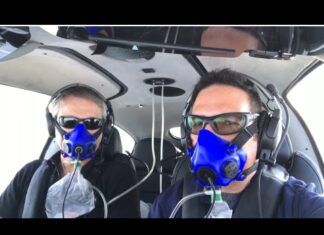
The tradeoff we accept in using a cannula is that at best we can increase only slightlythe oxygen concentration we breathe. For this reason, cannula systems are approved onlyfor altitudes up to 18,000 feet. Above this altitude, the small increase in oxygenconcentration from the cannula is inadequate to offset the drop in barometric pressure andproduce an inspired O2 PP sufficient to keep the blood adequately saturated with oxygen.For altitudes above 18,000 feet, masks which allow higher concentrations of oxygen must beused. These masks,of course, require higher oxygen flow from the cylinder and consequentlyuse up the available supply much faster.
In preparing this article I spoke with Tom Armao of Aerox Systems, a manufacturer ofaviation oxygen equipment. He told me that his company’s conserving cannulas are designedto increase the inspired oxygen concentration to about 24 percent, compared with thenormal 21 percent. This means that at FL180, where Pbaro is about 404 mm , this cannulacan increase our inspired oxygen PP from about 84 mm (400 times 0.21) to about 96 mm (400times 0.24) This increase in inspired O2 PP translates into a jump in blood oxygen PP froma non-supplemented value of around 45 mm to about 55 mm with the cannula on. As mentionedearlier, this puts you just about at the 55-60 mm point (about 85% sat) below which yourjudgement and motor skills begin to go seriously to pot. You can see that above FL180 thecannula will not be able to provide a sufficient increase in blood oxygen content for youto be able to function adequately for long. A regulation with an actual reason!
To illustrate this point, let’s consider the hot shot aviator who decides to take herTurbo-Brand-X up to FL250, where Pbaro is only about 282 mm Hg. Up there her blood O2 PPwill be only about 20 mm Hg with a saturation in the mid-20’s or so without oxygen,assuming she survives long enough to climb to that altitude. Using her 24% cannula shewould improve her blood O2 PP or saturation only marginally, not even enough to enable herto regain consciousness. But using an oxygen mask supplying 50% oxygen, she could improvethings quite a bit. With an inspired O2 PP of 141 mm (50% of 282 mm) her blood oxygen PPwould be expected in the low-60 mm range, giving her a sat of 90% or better. This is wellabove our 55mm/85% sat silliness threshold. However, she would have to turn up her oxygenflow rates fairly high, resulting in rapid exhaustion of her oxygen cylinder, to maintainher oxygenation. One can see why a pressurized cockpit makes practical sense for the pilotwho regularly flies her aircraft at the flight levels: no nose-hose to wear, no cylindersto refill, and no limit on endurance at altitude other than those imposed by theaircraft’s fuel reserves and the pilot’s bladder capacity!
I have tried here to give an overview of the physiology of oxygen metabolism, thedangers of hypoxia, and the rationale for the use of supplemental oxygen at altitude. Nowwhen you head for the flight levels you should better understand just what you are doing,and why, when you put on that cannula or glance at your cabin-pressure gauge.
Just remember, OXYGEN, like altitude, IS GOOD!