















Decompression sickness (DCS) describes a condition characterizedby a variety of symptoms resulting from exposure to low barometricpressures that cause inert gases (mainly nitrogen), normally dissolvedin body fluids and tissues, to come out of physical solution andform bubbles. DCS can occur during exposure to altitude (altitudeDCS) or during ascent from depth (mining or diving). The firstdocumented cases of DCS (Caisson Disease) were reported in 1841by a mining engineer who observed the occurrences of pain andmuscle cramps among coal miners exposed to air-pressurized mineshafts designed to keep water out. The first description of acase resulting from diving activities while wearing a pressurizedhard hat was reported in 1869.
Altitude-induced decompression sickness
Altitude DCS became a commonly observed problem associated withhigh-altitude balloon and aircraft flight in the 1930s. IN present-day aviation, technology allows civilian aircraft (commercialand private) to fly higher and faster than ever before. Thoughmodern aircraft are safer and more reliable, occupants are stillsubject to the stresses of high altitude flight–and the uniqueproblems that go wit these lofty heights. A century and one-halfafter the first DCS case was described, our understanding of
DCS has improved, and a body of knowledge has accumulated; however,this problem is far from being solved. Altitude DCS still representsa risk to the occupants of modern aircraft.
Tiny bubbles
According to Henry’s Law, when the pressure of a gas over a liquidis decreased, the amount of gas dissolved in that liquid willalso decrease. One of the best practical demonstrations of thislaw is offered by opening a soft drink. When the cap is removedfrom the bottle, gas is heard escaping, and bubbles can be seenforming in the soda. This is carbon dioxide gas coming out ofsolution as a result of sudden exposure to lower barometric pressure. Similarly, nitrogen Is an inert gas normally stored throughoutthe human body (tissues and fluids) in a physical solution. Whenthe body is expose to decrease barometric pressures (as in flyingan unpressurized aircraft to altitude or during a rapid decompression),the nitrogen dissolved in the body comes out solution. If thenitrogen is forced to leave the solution too rapidly, bubblesform in different areas of the body, causing a variety of signsand symptoms. The commonly symptom is joint pain, which is knownas “the bends.”
Trouble sites
Although bubbles can form anywhere in the body, the most frequentlytargeted anatomic locations are the shoulders, elbows, knees,and ankles. Table 1 list the different DCS types with their correspondingbubble formation sites and their most common symptoms. “TheBends” (joint pain) account for about 60 to 70% of all altitudeDCS cases with the shoulder being the most common site. Neurologicmanifestations are present in about 10 to 15% of all DCS caseswith headache and visual disturbance being the mot common symptoms. “The chokes” are very infrequent and occur in lessthan 2% of all DCS cases. Skin manifestation are present in about10 to 15 % of all DCS cases.
Medical treatment
Mild cases of “the bends” and skin bends (excludingmottled or marbled skin appearance) may disappear during descentfrom high altitude, but still require medical evaluation. Ifthe sign and symptoms persist during descent or reappear at groundlevel, it is necessary to provide hyperbaric oxygen treatmentimmediately (100% oxygen delivered in a high pressure chamber).Neurological DCS, “the chokes,” and skin bends withmottled or marbled skin lesion (see table 1) should always betreated with hyperbaric oxygenation. These conditions are veryserious and potentially fatal if untreated.
Facts about breathing 100% oxygen
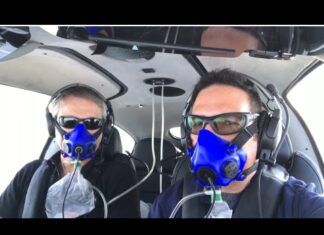
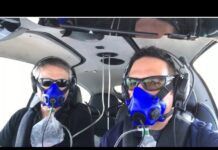
One of the most significant breakthroughs in altitude DCS researchwas the discovery that breathing 100% oxygen before exposure tolow barometric pressure (oxygen pre-breathing), decreases therisk of developing altitude DCS. Oxygen pre-breathing promotesthe elimination (washout) of nitrogen from body tissue. Pre-breathing100% oxygen for 30 minute prior to initiating ascent to altitudereduces the risk of altitude DCS for short exposures (10-30 minutesonly) to altitudes between 18,000 and 43,000 feet. However, oxygenpre-breathing has to be continued, without interruption, within-flight 100% oxygen breathing to provide effective protectingagainst altitude DCS.
Furthermore, it is very important to understand that breathing100% oxygen only during flight (ascent, en route, descent) doesnot decrease the risk of altitude DCS, and should not be usedin lieu of oxygen pre-breathing. Although 100% oxygen pre-breathingis an affective method to provide individual protection againstaltitude DCS, it is not a logistically simple nor an inexpensiveapproach for the protection of civil aviation flyers (commercialor private). Therefore, at the present time it is only used bymilitary flight crews and astronauts for their protection duringhigh altitude and space operations.
Table 1 — Types of Decompression Sickness
- Bends
- Bubble Location: mostly large joints of the body (elbows,shoulders, hip, wrist, knees, ankles)
- Signs & Symptoms: localized deep pain, ranging from mild(a “niggle”) to excruciating. Sometimes a dull ache,but rarely a sharp pain; active and passive motion of the joinaggravates the pain; pain can occur at altitude, during the descent,or many hours later.
- Bubble Location: mostly large joints of the body (elbows,shoulders, hip, wrist, knees, ankles)
- Neurologic
- Bubble Location: brain
- Signs & Symptoms: confusion or memory loss; headache;spots in visual field (scotoma), tunnel vision, double vision(diplopia), or blurry vision; Unexplained extreme fatigue or behaviorchanges; seizures dizziness, vertigo, nausea, vomiting, and unconsciousmay occur.
- Bubble Location: spinal cord
- Signs & Symptoms: abnormal sensations such as burning,stinging, and tingling around the lower chest and back; symptomsmay spread from the feet up and may be accompanied by ascendingweakness or paralysis; girdling abdominal or chest pain.
- Bubble Location: peripheral nerves
- Signs & Symptoms: urinary and rectal incontinence, abnormalsensations, such as numbness, burning , stinging, and tingling(paraesthesia); muscle weakness or twitching.
- Bubble Location: brain
- Chokes
- Bubble Location: lungs
- Signs & Symptoms: burning deep chest pain (under the sternum);pain is aggravated by breathing; shortness of breath (dyspnea);dry constant cough
- Bubble Location: lungs
- Skin bends
- Bubble Location: skin
- Signs & Symptoms: itching usually around the ears, face,neck , arms, and upper torso; sensation of tiny insects crawlingover the skin (formication); mottled or marbles skin usually aroundthe shoulders, upper chest and abdomen, accompanied by itching;swelling of the skin, accompanied by tiny scar-like skin depressions(pitting edema).
- Bubble Location: skin
Predisposing factors
- Altitude
There is no specific altitude that can be considered an absolutealtitude exposure threshold below which it can be assured thatno one will develop attitude DCS. However, there is very littleevidence of altitude DCS occurring among healthy individuals ataltitudes below 18,000 feet who have not been SCUBA (Self ContainedUnderwater Breathing Apparatus) diving. individual exposuresto altitude between 18,000 and 25,000 have show a low occurrenceof altitude DCS. Most cases of altitude DCS occur among individualsexposed to altitudes of 25,000 feet or higher. A U.S. Air Forcestudy of altitude DCS cases reported that only 13% occurred below25,000 feet.The higher the altitude of exposure, the greater the risk of developingaltitude DCS. It is important to clarify that although exposureto incremental altitude about 18,00 feet show an incremental riskof altitude DCS, they do not show a direct relationship with theseverity of the various types of DCS (see table 1).
- Repetitive Exposures
Repetitive exposure to altitudes above 18000 feet within ashort period of time (a few hours) also increase the risk of developingaltitude DCS. - Rate of Ascent
The faster the rate of ascent to altitude, the greater therisk of developing altitude DCS. An individual exposed to a rapiddecompression (high rate of ascent) about 18,000 feet has a graterrisk of altitude DCS than being exposed to the same altitude butas a lower rate of ascent. - Time at Altitude
The longer the duration of the expose to altitudes of 18,000feet and above, the greater the risk of altitude DCS. - Age
There are some reports indicating a higher risk of altitudeDCS with increase age. - Previous Injury
There is some indication that recent join of limb injuriesmay predispose individuals to developing “the bends”. - Ambient Temperature
There is some evidence suggesting that individual exposureto very cold ambient temperatures any increase the risk of altitudeDCS. - Body Type
Typically, a person who has a high body fat contest is atgreater risk of altitude DCS. Due to poor blood supply, nitrogenis stored in greater amounts in fat tissues. Although fat representsonly 15% of an adult normal body, it stores over half of the totalamount of nitrogen (about 1 liter) normally dissolved in the body. - Exercise
When a person is physically active while flying at altitudeabove 18,000 feet, there is grater risk of altitude DCS. - Alcohol Consumption
The after-effects of alcohol consumption increases the susceptibilityto DCS. - SCUBA Diving Before Flying
SCUBA diving requires breathing air under high pressure. Underthese conditions,there is a significant increase in the amount of nitrogen dissolvedin the body (body nitrogen saturation). The deeper the SCUBAdive, the greater the rate of body nitrogen saturation. Furthermore,SCUBA diving in high elevations (mountain lakes), at any givendepth, results in greater body nitrogen saturation when comparedto SCUBA diving at sea level at the same depth. Following SCUBAdiving, if not enough time is allowed to eliminate the excessnitrogen stored in the body, altitude DCS can occur during exposureto altitudes as low as 5,000 feet or less.
What to do when altitude DCS occurs
- Put on your oxygen mask immediately and switch the regulatorto 100% oxygen.
- Begin an emergency descent and land as soon as possible. Even if the symptoms disappear during descent, you should stillland and seek medical evaluation while continuing to breath oxygen.
- If one of your symptoms is join pain, keep the affected areastill; don not try to work pain out by moving the joint around.
- Upon landing, seek medical assistance from an FAA medicalofficer, aviation medical examiner (AME), military flight surgeon,or a hyperbaric medicine specialist. be aware that a physiciannot specialized in aviation or hyperbaric medicine may not befamily with this type of medical problem. Therefore, be yourown advocate.
- Definitive medical treatment may involve the use of a hyperbaricchamber operated by specially trained personnel.
- Delayed signs and symptoms of altitude DCS can occur afterreturn to ground level whether or not they were present duringflight.
Things to Remember
- Altitude DCS is a potential risk every time you fly in anunpressurized aircraft above 18,000 feet (or at lower altitudesif you SCUBA dive prior to flight).
- Be familiar with the signs and symptoms of altitude DCS (SeeTable 1) and monitor all aircraft occupant, including yourself,any time you fly an unpressurized aircraft above 18,000 feet.
- Avoid unnecessary strenuous physical activity prior to flyingan unpressurized aircraft above 18,000 feet and for 24 hours afterthe fight.
- Even if you are flying a pressurized aircraft, altitude DCScan occur as a result of sudden loss of cabin pressure (in-flightraid decompression).
- Following exposure to an in-flight rapid decompression, donot fly for at least 24 hours. In the meantime, remain vigilantfor the possible onset of delayed symptoms or signs of altitudeDCS. If you present delayed symptoms or signs of altitude DCS,seek medical attention immediately.
- Keep in mind that breathing 100% oxygen during flight withoutoxygen pre-breathing prior to take off, does not prevent the occurrenceof altitude DCS.
- Do not ignore any symptom of sign that go away during thedescent. In fact, this could confirm that you are actually sufferingaltitude DCS. You should be medically evaluated as soon as possible.
- If there is any indication that you may have experience altitudeDCS, do not fly again until you are cleared to do so by an FAAmedical officer, AME, military flight surgeon, or a hyperbaricmedicine specialist.
- Allow at least 24 hours to elapse between SCUBA diving andflying.
- Be prepared for a future emergency by familiarizing yourselfwith the availability of hyperbaric chamber in your area of operations. However, keep in mind that not all of the available hyperbarictreatment facility have personnel qualified to handle altitudeDCS emergencies. To obtain information on locations of hyperbarictreatment facilities capable of handling altitude DCS emergencies,call the Diver’s Alert Network at 919-684-8111.
If you are interested in learning more about altitude DCS, aswell as the other stressors that may affect your performance and/oryou health during flight, we encourage you to enroll in the physiologictraining course offered by the Aeromedical Education Division(Airman Education Programs) at the FAA Civil Aeromedical Institutein Oklahoma City. A similar course is also available to you atthe U.S. military physiologic training facilities around the countrythrough an FAA/DOD training agreement. For more information aboutany of these courses, call us at 405-954-4837.