





























Timeafter time, you put the landing gear switch in the "down" position, wait a fewseconds, and are rewarded with those three reassuring green down-and-locked indicatorlights. Then it happens…no green light! You stare at the lights in a few moments ofdisbelief and denial. You feel a knot growing in your stomach. And then you realize youhave to deal with it.
Welcome to the club. Any pilot who has flown retractable-gear aircraft for more than afew years has had this happen at least once. It’s happened to me at least three times thatI can recall. Once, it was simply a burned-out indicator light. Another time, it was agear motor circuit breaker that popped with the gear only partially extended and I crankedthe gear down the rest of the way by hand.
The third time was more serious: a hydraulic leak that resulted in not enough hydraulicfluid to lock the nose gear fully overcenter. I advised the tower (Phoenix, Sky Harbor),asked them to "roll the equipment" just in case, held the nosewheel off untilthe last minute, lowered it very gently to the runway, and shut down the moment I clearedthe runway. The nosegear did not collapse, and the mechanic who inspected it said I waslucky.
As common an occurrence as this is, our pilot training is often woefully deficient inpreparing us to handle it. As a result, it’s not uncommon for pilots to turn a ho-hum-yawnsituation into a much more serious one, as we’ll see.
Hey, don’t sweat it!
|
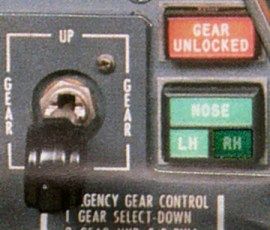
To deal appropriately with a possible gear-up landing, it’s extremely important to putthings in proper perspective. Specifically, a gear-up landing is no big deal (unless youmake it into one). Most gear-up landings result in surprisingly little damage to theaircraft, and no damage whatsoever to its occupants. (One friend of mine landed his CessnaR182 gear-up and discovered that airframe damage was confined almost exclusively to theADF antenna!)
Sure, the props will be toast and the engines will have to undergo a teardowninspection. But that’s not your problem – it’s your insurance company’s – and believe me,they’ll pay for the work without giving you any hassle. Insurance companies inventedthe phrase "shit happens." Anyway, you’ve paid those hull insurance premiums foryears just so you don’t have to sweat stuff like this.
If you know in advance that you’re about to make a gear-up landing, there are a fewthings you can do to help minimize damage…and some other things that you shouldn’tdo. (We’ll get to these later.) But basically, if you totally ignore the gear problem andjust make a normal landing, the chances are excellent that the aircraft will sustainminimal damage and you and your passengers will walk away without a scratch.
No green = brain caged?
When that green light doesn’t appear, many pilots get so preoccupied that they forgetto think things through. A perfect example happened on November 22, 1992, at my homeairport of Santa Maria, California, and resulted in serious injuries and the total loss ofa beautiful Cessna 421C. It’s perhaps the best example of an "error chain"accident I’ve ever seen.
Author’s note: Most of the examples cited in this article involve twin Cessnas, but the almost all the information and recommendations are applicable to any retractable-gear airplane.
The Golden Eagle was returning to Santa Maria from northern California when, 12 minutesafter takeoff, the left engine began to run very rough. Investigators later determinedthat the left magneto had failed as a result of inadequate maintenance, but the pilotapparently did not troubleshoot the engine problem sufficiently to isolate the defectivemagneto and shut it off. Instead, the pilot decided to shut down the left engine andcontinue to his destination on one engine, even through it was 210 NM and 1.5 hours away,and that the route involved crossing a mountain range and overflying at least five majorairports.
|
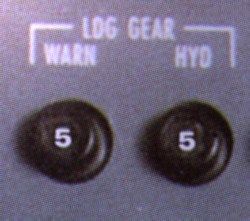
Having secured the left engine, the pilot next sought to shut off the blaring gearwarning horn. During his recent recurrent simulator training session at FlightSafetyInternational, he’d been taught to silence the horn by advancing the throttle of the deadengine after securing it. But inexplicably, the pilot chose to disable the gear horn bypulling the GEAR WARN circuit breaker. In doing so, he probably failed to consider thathe’d also disabled the landing gear lights.
More than an hour later, as the pilot executed the VOR Runway 12 approach to SantaMaria, the pulled circuit breaker must have been long forgotten. The weather beneath theovercast was VFR, the pilot reported the airport in sight and announced his intention tocircle to land on Runway 30 which was favored by the wind. (With an engine out and a6,300-foot runway, I’d have landed straight-in, wouldn’t you?)
The pilot flew an extended traffic pattern and held the gear until on final approachwith landing assured. He then selected gear down, heard the gear extend, but saw no greenlights. (Three guesses why.) The pilot then pulled the emergency gear extension T-handlewhich discharged the nitrogen-filled blow-down bottle. Of course, the gear lights remaineddark.
Now on short final to Runway 30, the pilot decided to execute a single-enginego-around…again contrary to his FlightSafety training. He might have gotten away withit, too, except for the fact that the 421C landing gear can no longer be retracted oncethe emergency blow-down procedure has been performed. The pilot soon realized that hisengine-out, gear-down-and-welded airplane was incapable of climbing. He made a valiantattempt to turn back to the airport and land downwind on Runway 12, and nearly made it.But the aircraft hit the ground 300 feet short of the runway, crossed a ditch whichsheared off the landing gear, and finally came to rest when it collided with the airportfence. The pilot’s boss was seriously injured and hospitalized, but the pilot and oneother passenger walked away. [NTSB LAX93LA051]
Think before you act
 Don’t panic…it’s probably just a light bulb. |
What did this full-time, professional, FlightSafety-trained pilot do wrong? Damn neareverything! He shut down an engine instead of just turning off the bad mag. (That’s onevery student pilot’s rough-engine checklist.) He pulled the GEAR WARN circuit breakerwithout considering that it would disable the gear lights, not just the horn. When heheard the gear go down but didn’t see the red gear-in-transit light, he should haverealized that he had an indication problem, and checked the lights and breaker…but hedidn’t. His decision to blow-down the gear was superfluous yet excusable…but heshould have realized that doing so with an engine out absolutely committed him to alanding. Attempting an impossible single-engine gear-down-and-welded go-around was hisfinal mistake. Time after time, he acted without thinking.
Anytime you put the gear down and fail to get a green down-and-locked light, the firstthing you should consider is that this might be nothing more than an indication problem.In most cases, a burned-out bulb, popped breaker, broken wire or defective microswitch aresignificantly more likely than an actual failure of the gear mechanism. It takes only afew seconds to check the lights (most systems have a press-to-test feature) and thecircuit breaker panel. A convex mirror mounted on an engine nacelle or tip tank canprovide additional information about whether or not the gear is actually down (althoughnot whether it’s locked).
If the lights and breakers are okay, the next impulse of most pilots is to recycle thelanding gear. But doing so almost never makes things better, and often makes them worse.
Electric gear emergencies
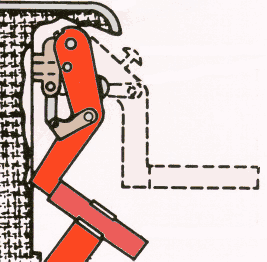 When’s the last time you hand-cranked down your gear in-flight? |
If your airplane has an electromechanical landing gear, cranking the gear down by handis a much more sensible course of action than recycling. Always keep cranking until youreach the mechanical stop at the end of the gearbox sector gear. By doing so, you can becertain that you’ve extended the gear actuating pushrods as far as possible and doneeverything that can be done to put the gear into a down-and-locked state. If you’vecranked all the way to the stop and the gear is still not down and locked, there’s nothingmore you can do but land as gently as possible and accept whatever happens.
August 9, 1990…Concord, California…Shortly after the Cessna 421 departed Concord airport, the pilot experienced an intermittent electrical failure followed by a total electrical failure. During the intermittent phase, the pilot electrically extended the landing gear. During the extension, the airplane sustained a total electrical failure. The pilot returned to Concord airport and landed. Upon touchdown, the main landing gear collapsed. After the airplane came to rest, the pilot shut off all electrical switches, including the battery master switch. The pilot stated that he thought the landing gear extended to the locked position before sustaining the total electrical failure and was unable to check the landing gear warning lights to determine that the landing gears were down and locked. The pilot did not follow the appropriate checklist and use the handcrank to determine that the landing gear was in fact extended and locked. [NTSB LAX90LA288]
It’s amazing how many pilots of electric-gear airplanes have never tried cranking downthe gear in-flight. I recommend that you do this at least once a year, both to refreshyour memory of the procedure and to learn what it actually feels like. If you wait untilyou have an actual gear emergency, you might blow it:
January 26, 1988…Urbana, Illinois…After the Cessna T310R experienced a complete electrical failure, the gear was extended manually and a precautionary landing was made. On rollout, the landing gear collapsed. Subsequent investigation revealed that 10 turns remained on the manual gear extension crank to place the gear in the down and locked position. No mechanical problem could be found to attribute to the loss of electrical power, other than a low battery condition as the entire electrical system functioned normally. Position of the battery switch and the left and right alternator switches at the time of the accident could not be verified. [NTSB CHI88LA053]
Hydraulic gear emergencies
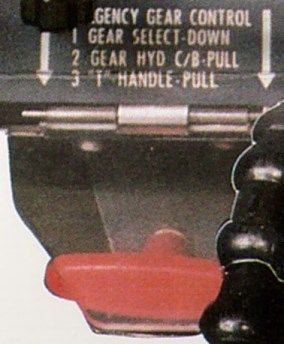 When in doubt, blow down the gear. But remember, once it’s down, it’s down! |
With hydraulic gear airplanes like the Cessna 402C, 414A and 421C, things are a bitless clear-cut. There are certain gear problems (like a sticky flow valve) that cansometimes be corrected by recycling the gear, but there are other problems (like hydraulicleaks, low fluid level, or an overheated hydraulic pump) where recycling can only makematters worse. If you absolutely must recycle, don’t do it more than once.
Most of the time, blowing down the gear is the best course of action. The blow-downbottle bypasses a lot of potentially troublesome landing gear system components, andextends the gear a lot faster and more aggressively than does normal hydraulic extension.If this doesn’t get the gear down and locked, nothing will.
But don’t forget that the blow-down procedure is an irrevocable act. The gear cannot beretracted again, and the plane is no longer flyable until an A&P resets the blow-downvalve, refills the blow-down bottle, purges the gas from the hydraulic system, jacks theairplane and swings the gear. Here’s what happened to one hapless pilot who forgot:
July 2, 1993…Seattle, Washington…Upon arrival at his original destination, the Cessna 414A pilot cycled the gear six times but the green gear-down light for the right main gear did not illuminate. After using the emergency extension system to blow the gear down, the right main gear-down light illuminated. After landing, the pilot made an inspection of the gear, but did not contact his company maintenance personnel or use an external lock to hold the gear in a down-and-locked position. He then departed for his final destination, leaving the gear in the down position. During the subsequent landing roll, the right main gear collapsed. Corrosion and scoring of the metal was found inside the down-lock tube where the teeth of the down-lock mechanism slide into the engaged position. Probable cause: the pilot’s intentional operation of the aircraft with known deficiencies in equipment. [NTSB SEA93LA148]
Tower fly-bys…and worse
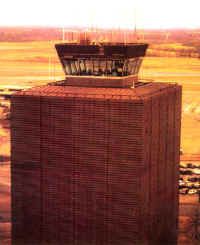 Before doing a tower fly-by, ask yourself what — if anything — you’ll do with the information they give you. |
Besides mindless recycling, another common but misguided pilot impulse in the absenceof three greens is to ask the tower or some other observer to take a look at the gear.This seldom makes any sense at all. For one thing, the tower can’t tell very much from a100-knot fly-by 1,000 feet away, even through powerful binoculars. They certainly can’ttell what you want to know: whether all three downlocks are engaged.
Before doing a tower fly-by, consider precisely what you’d do with the information youreceive from the tower. If the tower tells you "from here, it looks as if your wheelsare down," you still need to be prepared for the possibility that the no-green gearis not locked and will collapse on landing. If you think about it, your actions probablyshould be no different regardless of what the tower tells you. So why even bother with thefly-by?
If you don’t have three greens and you’ve eliminated obvious problems like bad bulbsand popped breakers, use the emergency extension procedure, make a gentle landing, andprepare your passengers to evacuate the airplane immediately if the gear doesn’t hold.It’s that simple.
There have been a couple of high-profile accidents in which fly-bys have resulted intruly tragic consequences:
November 29, 1987…Long Beach, California…The two pilots of a Piper Malibu were returning from San Diego to San Jose at night when they experienced an in-flight failure of the turbocharger system, followed by loss of an alternator, loss of engine oil pressure, an unsafe landing gear indication, and an in-flight fire. They declared an emergency and executed an approach to Long Beach in VMC, whereupon the PIC elected to make a fly-by of the control tower to confirm the landing gear position. While circling to land, the pilots experienced a loss of engine power crashed onto the southbound lanes of the San Diego Freeway a half-mile short of the runway threshold. The PIC/CFI was killed, and the copilot sustained crippling third-degree burns over most of his body. Investigation revealed an improperly installed turbocharger, a cracked exhaust manifold, a burned main electrical power lead, a separated cylinder, and low fluid level in the hydraulic reservoir. [NTSB LAX88FA060]
A tower fly-by at night while the airplane was on fire? What on earthcould the PIC/CFI have been thinking? Well, it turns out that this pilot made anunintentional gear-up landing in another aircraft two years prior to the fatal accident.Investigators concluded that this may have influenced his faulty decision not to land theaircraft at the earliest possible moment.
Another well-publicized tragedy along the same lines took the life of U.S. Senator JohnHeinz, heir to the ketchup fortune, and six others:
April 4, 1991…Merion, Pennsylvania…Piper Aerostar N3645D was arriving as Bell 412 helicopter N78S was departing. The Aerostar pilot reported that the aircraft’s nose gear indicator light did not illuminate to verify that the nose gear was down and locked. The helicopter crew heard the transmission and saw the Aerostar as they crossed beneath its approach path. They reported that the Aerostar’s nose gear appeared to be extended. As Aerostar was cleared to turn downwind, the helicopter offered to join for a closer look. The Aerostar captain accepted the offer. During joinup, the helicopter converged from the left rear, then reported that they would pass around the right side and look at everything as they went by. They reported that everything looked okay. Moments later, the two aircraft collided and crashed to the ground, resulting in 7 fatalities, 1 serious injury, and 4 minor injuries. No mechanical reason was found that would have resulted in the accident. None of the pilots had training for flight in close proximity to another aircraft. There were indications the captain of the Aerostar lacked training in aircraft systems. The Aerostar flight manual lacked info on emergency gear extension.
What possible difference would it have made to the Aerostar pilot whether or not thenose gear looked okay to the tower or the helicopter crew? In the absence of a greendown-and-locked light, the pilot would have made a normal landing, lowered the nose wheelas late and gently as possible, and hoped for the best. Nobody ever got hurt from a nosegear collapse, anyway. Whether or not the gear was locked should have mattered only to theinsurance company.
Don’t be a hero
Faced with the possibility of a wheels-up landing, pilots are often tempted to tryfoolish stunts in a misguided attempt to minimize aircraft damage. There have beenhundreds of cases where pilots have tried to shut down engines and feather props on shortfinal, and even attempt to "bump" two-bladed props to a horizontal position withthe starter switches. Occasionally this has the desired effect, but more frequently itresults in a hard or otherwise botched landing the causes far more damage than a normallanding would have.
Even worse are cases of unintended wheels-up landings or unexpected gear collapseswhere the pilot hears the propeller tips tick-tick-ticking against the asphalt, jams thethrottles forward, and attempts a heroic go-around. Sometimes they succeed, but it’s astupid move nonetheless because the pilot has no way of knowing how much prop orcrankshaft damage has been sustained and whether or not the aircraft is capable of poweredflight. It’s a bad enough stunt in a single-engine airplane, but in a twin there’s theadditional possibility that one engine will work and the other won’t:
August 8, 1990…El Paso, Texas…The Cessna 421B pilot said the airplane was about to touch down when he looked down and did not see the gear-down lights. He said he applied full power both engines for a go-around but the right engine did not come up to power, and the airplane veered to the right. He raised the flaps but did not raise the gear handle. The gear was down and locked. The right propeller was not feathered. The airplane did not climb and impacted the terrain. At a later time, both engines were operated to approximately 70% power (and no higher due to the lack of suitable propellers). No reason could be found for the loss of power on the right engine.
You should develop the habit of checking the gear lights immediately after extendingthe gear, and once again as you descend through 500’AGL. If you first become aware of agear anomaly while in the flare, the smart course of action is to relax and accept theinevitable short landing. Remember, your butt is all that matters…the airplane is theinsurance company’s problem.
What you can do
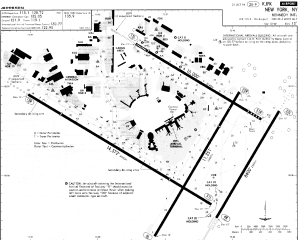 Try to land on an inactive runway, or at least on a runway that is not being used by the airlines. |
When faced with the likelihood of a wheels-up landing, there are several things you cando to minimize damage that don’t involve getting heroic/stupid. For one thing, you mightconsider landing at an airport where the airplane can readily be repaired if necessary. Ifyou’re not too far from home base, you might consider going there (but don’t fly 210 NMwith an engine out to do it).
It’s a good idea to land on an inactive runway, or at least on a runway that is notbeing used by the airlines. If you land gear-up on an active airline runway, the airportmanager is very likely to do whatever it takes to clear the runway quickly, even if itinvolves a bulldozer or fork-lift. Countless airplanes have landed wheels-up with onlyvery minor damage, only to be wrecked by ground crews in a rush to get the runwayre-opened. Something to think about.
If it looks like you might have to land with one main gear locked and the other up orin a questionable state, consider choosing a crosswind runway where the wind is blowingfrom the side of the down-and-locked gear. That way, you can land on the good main gearand get slowed up a bit before the gear-in-doubt contacts the runway. At airports withmultiple runways, the crosswind runway also has the advantage of being inactive. Just trynot to come to a stop in the intersection!
Finally, some pilots figure that they’ll sustain less damage in a wheels up landing ifthey land on the grass instead of the asphalt. Wrong! Even the best groomed grass runwayhas hidden rocks and sticks that can raise havoc with your belly skin. You’ll also slidefurther on the grass, increasing the probability of sliding off the runway edge orotherwise losing directional control.
Stick to a wide, hard-surfaced runway, preferably an inactive one. Make a smooth,normal landing and you’ll be amazed at how little damage the airplane sustains. Prepareyour passengers to egress the aircraft quickly. As soon as you come to a stop (it won’ttake long), gang-bar off the electrical system and shut off the fuel selectors. Then getout. Plan to stick around to keep the bulldozers and fork lifts at bay.
Most important, don’t forget to carry your aircraft insurance agent’s phone number inyour wallet. Remember, it’s his problem, not yours.
