








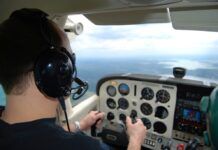

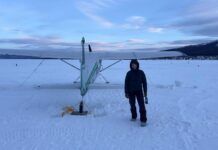










 My passions are skiing, flying and flying to skiing destinations as a way to combine the first two. My fly/ski destination of choice is the Truckee Tahoe Airport (TRK) in Truckee, California, a GA facility nestled in the southern end of a valley in the central Sierras, 15 miles from Squaw Valley. Squaw Valley averages 34 feet of snowfall per year and, in the winter, Truckee frequently records the low temperature reading for the nation. In the summer months, with temperatures in the 80s at 5,900 ft. msl, density altitudes over 8,000 feet are common. In completing more than 175 flights to or from Truckee (and canceling countless others), I have compiled my own Top Ten list of practical considerations for mountain flying.
1. Takeoff And Climb Performance
 It is elementary that, before takeoff, pilots need to be able to predict the airplane’s performance and ensure it will have he capability to takeoff on the available runway and clear surrounding terrain during initial climbout. The simple fact is that, at high altitudes, more is demanded of the plane and the plane has less to offer. Takeoffs demand more of the plane because the reference rotation airspeed and climb airspeed are indicated airspeeds. The actual airspeed necessary to yield a given indicated airspeed increases as altitude increases.
Let’s say your rotation speed is 72 KIAS. On a standard day in still air at 6,000 feet, you would have to accelerate from a standstill to 79 knots — not 72 — in order to reach rotation speed. On a day with an 8,000 foot density altitude, one would have to accelerate to 81 knots. That is a 12.5 percent increase over the standard day, sea level value. Similarly, at a density altitude of 8,000 feet, you have to be moving through the air at 103 kts to achieve a Vy of 90 KIAS.
Of course, unless you are flying a turbocharged airplane or burning Jet A, the engine will also have sharply reduced performance available to meet this increased demand. Therefore, you need to pull out your dusty old pilot’s operating handbook (POH) to see what you can expect to see in terms of takeoff and climb performance.
|

Unfortunately, the POH’s bleak report is only half the story. The POH values are for still air but the mountain air you will soon be flying in is often circulating. Unlike in the flatlands, when air circulates in the mountains, it moves up and down because it follows the terrain. If wind is blowing down a hill there are downdrafts. Conversely, if wind is blowing up a hill there are updrafts. If you are looking down the runway into a strong wind and see sharply rising terrain off the end of the runway, you can expect to encounter downdrafts during your initial climbout. If the plane is capable of climbing at 400 fpm and you encounter a 600 fpm downdraft, the math is relatively easy: You will not climb.
Neither the POH nor the local Automated Weather Observation System can quantify the downdrafts you can expect. Nevertheless, it is your obligation as pilot in command to determine in advance of the takeoff roll that the plane is capable of achieving a positive rate of climb on climbout. That is where experience comes into play. An early turn to a heading away from the down drafts is usually a good idea. Sometimes, waiting until the winds subside is an even better idea.
Of course, you can also use the presence of mountain updrafts and downdrafts to your advantage. The updrafts generated by air encountering rising terrain can extend thousands of feet above the surface. If you are circling in a valley to gain altitude to clear surrounding terrain, you might as well camp out in a column of rising air. On a windy day, you can generally find one on the downwind side of a valley or the upwind side of a hill. Adding a 500 fpm updraft to your plane’s meager 300 fpm rate of climb is like adding a turbocharger, only it’s cheaper, lighter and easier to maintain.
2. Landing Performance
Ground Effect…
If it is harder to get an airplane into the air at altitude then shouldn’t it follow that it is easier to get an airplane onto the ground? Nope. Increased ground effect, increased touchdown speeds, runway ice and (once again) downdrafts make mountain landings a challenge. The point is that you can float a long way if you fail to control your airspeed when landing in rarified mountain air.
|

Ground effect is an often misunderstood phenomenon. It results because the ground interferes with the circulation of wingtip vortices, causing an abrupt reduction in induced drag and — since thrust remains the same — a corresponding excess of thrust over drag. When thrust exceeds drag, the airplane will accelerate, or climb, or both. That, coupled with an increase in the wing’s angle of attack, is the sensation you feel in ground effect.
Wingtip vortices result from the circulation of air from the high pressure area under the wing to the low pressure air over the wing. A by-product of the vortices is wing downwash: The air flowing from the portion of the wing influenced by the wingtip vortices is pushed down. At that portion of the wing, the relative wind is from a more upward direction and lift, which is perpendicular to the relative wind, is tilted rearward. The reward-tilted lift force has a vertical component, which is lifting the plane, and a horizontal component, which is holding the plane back. That induced horizontal component of lift is what we refer to as "induced drag." When ground interference impedes the circulation of the wingtip vortices, induced drag is diminished. That is ground effect. Induced drag increases at higher altitudes as air density decreases and so does ground effect. It follows then, that the greater the induced drag, the greater the effect of eliminating induced drag.
When you finally make it through ground effect and contact the runway, your ground speed will be higher than normal. As discussed above, if your airspeed is 72 KIAS at touchdown on day with an 8,000 foot density altitude, your ground speed will be 81 knots or 93 mph. If you land at, say, 80 KIAS, your groundspeed will be 90 knots or 104 mph. Try that in your car; that’s moving. It’s best to keep your airspeed under control during the approach to landing and to keep the airplane pointed straight after touchdown.
…Icy runways…
If it happens to be a winter touchdown, you have the potential of ice on the runway to contend with. If you encounter ice on the runway while braking there are two possibilities: One, the entire airplane may not stop or, two, half the airplane may stop while the other half keeps going, an undesirable maneuver also known as a groundloop. You need to plan on having less than optimal braking and, to the fullest extent possible, minimize use of the brakes on rollout if there is a possibility of encountering runway ice.
…And Downdrafts On Approach
Finally, there are issues with downdrafts. Beware the perched atop a mountain plateau. If the ground drops off sharply in front of the approach end of the runway and there is a strong wind along the runway, you can expect to encounter a strong downdraft on short final if you use the runway numbers as your landing target. You will be low and slow and will need to overcome both the airplane’s established sink rate and the down draft before you can even think about climbing — all this with an airplane that is already hampered by the effects of high density altitude.
Any time you are concerned about encountering down drafts, altitude above the ground is your best friend. When landing on a mountain plateau runway in windy conditions, you should select an aim point about a quarter-length down the runway. Given the wind, your touchdown groundspeed will be lower so you shouldn’t need the entire runway to stop the plane. Your extra altitude when you approach the threshold will keep you up out of the downdraft or on the runway if you do encounter it.
3. Cold Starts
Winter overnight temperatures in the minus 20s give a whole new meaning to the phrase "cold start." The best options, in order, are: Leave the plane in a heated hangar; transfer the plane to a heated hangar the night prior to departure; preheat the engine before the departure; pull the prop through before attempting to start the engine.
If a heated hangar is not available, the airframe requires special attention as well. If the plane has been parked outside for several days in a freeze/thaw cycle, there is a possibility of ice buildup anywhere that water could penetrate. The empennage, ailerons, and flaps deserve special attention along with all vent lines (fuel tanks, battery, and crankcase). An overlooked icicle could ruin your whole day.
If a heated hangar is not available you may need to deice the plane. You can purchase covers for the wings and empennage and they can save you hours of time in deicing an airplane at below-freezing temperatures. Other useful equipment includes a nylon-bristle push broom (to brush off loose snow), a good snow shovel, deicing fluid, scrapers, plus warm waterproof gloves and apparel. Allow plenty of time. Airplanes have a lot of surface area.
4. Hot Starts
At least starting the plane for a warm weather mountain departures should not be a problem, right? Wrong again. If you have cooked in the mountains you know that boiling or steaming food at high altitudes takes longer because water vaporizes at a lower temperature. The same holds true for avgas. It is difficult to hot start some fuel injected engines at sea level because the heat from the engine causes vapor lock in the injection lines. That problem is magnified in the lower ambient air pressure at high altitude airports as the fuel vaporizes at a lower temperature. Be sure that you have your hot-start procedures down cold.
5. Winter Weather
The Sierras have winter weather systems that blow in from across the Pacific and storms or low visibility conditions that seem to arise from nowhere. You can plan for the storms that blow in from the Pacific because they will be highlighted on the morning reports of the Weather Channel. You have to anticipate the possibility of the storms that arise from nowhere by understanding their cause.
The three essential ingredients to storm cloud development are moisture, an unstable airmass and a lifting mechanism. If a moist, unstable airmass is blown up the face of a mountain range, the terrain provides the lifting mechanism. Therefore, you can have clear weather in the valley but sudden storms in the mountains. Similarly, you can encounter a sudden low overcast in the mountains if a moist, stable airmass is blown up the face of a mountain range. Winter weather in the mountains is changeable and unpredictable. Again, the well-prepared pilot will anticipate these potential changes — based on a thorough understanding of weather theory and the surrounding conditions — and will be ready to execute the standard 180-degree turn when necessary.
6. Summer Weather
Summer weather in the mountains can be even less predictable and more severe. The summer sun heats the surface and generate rising air that only exacerbates the inherent topographical lifting mechanisms. Also, summer mountain storms tend to occur in the afternoons and then subside in the early evening as the sun’s heat dissipates. It’s best not to plan on a mid-afternoon summer departure. If you are looking at level three thunderstorms at 5:00 in the afternoon, wait a couple of hours. Conditions could be CAVU by 8:00 p.m.
7. IFR Operations
Your IFR capabilities will be of limited use to you in flying to and from mountain airports. Generally, your use of instrument approach procedures is limited to descending through a high overcast layer or to climbing through thin ground fog. Conditions more severe than this usually require that light-plane operators take risks that many pilots would consider to be unacceptable.
Approaches…
Instrument arrivals are of limited use because most of the available approaches have very high minimum descent altitudes. In most cases, the problem is that, given the terrain surrounding the airport, there is no way to fashion a missed approach procedure beginning at a low altitude over the runway threshold.
|

Truckee has an RNAV approach and a GPS approach, but the MDAs are 2,300 ft. AGL and 1,440 ft. AGL, respectively. The localizer approach into South Lake Tahoe Airport, 27 miles to the South, is directly over Lake Tahoe which is notably flat. However, the approach terminates into a box canyon and the MDA is 1,026 ft. AGL in order to meet TERPS missed approach obstacle clearance standards.
…And Departures
There are at least three factors that limit the use of instrument departure procedures. First, at the higher altitudes, many GA aircraft would be unable to meeting the climb gradient requirements imposed by the terrain surrounding the airport. For example, the departure procedure for TRK requires a climb gradient of 425 ft. per nautical mile (635 fpm at 90 KIAS). Second, given the mechanical lifting generated by the mountainous terrain, IFR mountain weather is almost always accompanied by forecasts for at least occasional moderate rime ice in clouds and precipitation. Third, if the weather is anything lower than a high overcast, the IAP for the departure airport would probably not have minimums low enough to facilitate a return to the airport. Therefore, if you were to encounter problems (such as icing) during an instrument departure, your closest available landing airport could be many, many miles away.
8. Night Operations
|

Your instrument flying capabilities will come in handy for nighttime VFR mountain operations. Particularly if there is a new moon and a high overcast, the mountains can be pitch black at night. Flight under those conditions is IFR for all practical purposes, despite the absence of any measurable restriction to visibility. There may be no visible horizon, no lights on the ground and no means of differentiating between the sky and shear granite walls. It is up to you to devise the blind departure procedure. The published instrument departure procedure (if you can meet climb gradient requirements) is one alternative. Another, if you know you can safely climb to pattern altitude, is to climb in the pattern to a safe en route altitude and then turn on course. That would allow you to keep track of your position on climbout, make it easy for you to report your accurate position to other departing and arriving aircraft and keep you close to a lighted runway in case a problem arose early during the flight.
9. En Route Operations
|

Even if you can land and take off from your mountain destination, you still need to be able to get there and make it back home. Mountains can be desolate and inhospitable terrain, as the namesakes for Donner Lake (8 nm West of TRK) would attest. IFR is a good idea for en route operations, but this time it stands for "I follow roads." Keep civilization close at hand if possible. I overfly Interstate 80 to Truckee and carry minimum survival gear, including a down sleeping bag, just in case.
Some GA aircraft may be unsuitable for operations in actual IMC because of the high MEAs. The MEAs en route to Truckee, for example, are between 11,000 and 13,000 feet MSL. The risk of icing is ever-present in IMC over mountains and, if your plane is not equipped for flight in icing conditions, you always need to have a plan in mind to escape any icing conditions you might encounter.
Remember the downdrafts. If you are flying at or near the MEA you will probably be low enough to be within the influence of the mountain waves over the highest terrain. You are most at risk when you are flying into the wind toward rising terrain.
10. Plan B
In light of all the considerations discussed above, it is more imperative than ever that you have a Plan B in mind at all times when flying GA aircraft in the mountains. You should have another means of completing the trip, an alternate route to get you out of trouble or the option of delaying your return to the flatlands. Any time you feel that you are required to complete a flight you run the risk of feeling pressured into making a bad decision. If bad weather is a risk, whether forecast or not, you should have a Plan B in mind for completing the flight to a safe alternate or via a return to your departure airport. If icing is a risk, you should have in mind a plan for escaping icing conditions (preferably by being able to descend to an altitude where the temperature is above freezing).
A Final Thought
Even if you do everything I recommend in this article, it is not an adequate substitute for training and experience. However, if you give consideration to these ten issues before your next venture into mountainous terrain, you will be a step ahead.
