























| The designation “unusual” connotes something that is either unexpected or extraordinary. Leave it to the FAA to slap the label “unusual” on an event that is predictable and routine. If you leave an airplane to its own devices, it will enter a descending turn. If airspeed is not a consideration, recovering from a descending turn requires merely that you roll to wings level and pitch for level flight. We’ve all done it a thousand times. However, if the airspeed indicator is advancing beyond Vne while you are descending and turning, the flight regime would indeed qualify as “unusual.” Speed kills and we do not accumulate a lot of practice time flying at airspeeds in excess of Vne. The skill we need to perfect, without the benefit of any practical opportunity to practice it, is not “recovery from unusual attitudes” but rather “recovery from usual attitudes at unusual airspeeds.” |
The Predictable Spiral
In his recent AVweb article "The Deadly Spiral," Paul A. Soderlind made the convincing case that an airplane’s ultimate equilibrium flight state is the spiral dive. I will not repeat his analysis, but will report the results of my own empirical testing of Mr. Soderlind’s theory. The table below reflects the various conditions I encountered in 20 attempts at protracted hands-off flight:
| Spiral | Stall | Spin | Inverted Spin | Snap Roll | Tail Slide | Split-S | Reverse Cuban 8 |
| 20 | 0 | 0 | 0 | 0 | 0 | 0 | 0 |
Try it yourself. Feel free to invent your own categories.
In another recent AVweb article, "Training at FlightSafety," Mike Busch reported that his FlightSafety instructor had succeeded in inducing inverted flight during a simulator-based unusual attitude recovery exercise. That is all great sport, and it is fun to imagine what the instrument indications would be if you were unexpectedly to encounter a truly aerobatic flight regime (e.g., a tail slide) in IMC. However, in training for the real world you need to play the odds. The overwhelming odds are, if you have failed to pay the airplane the attention it deserves and the instrument indications are awry when you look back at the panel, you are in a spiral dive. That is the condition you should expect and is the principal condition you should train for.
When Spirals Become “Unusual”
It is not the pitch angle or bank angle that makes a spiral dive “unusual.” Since there is no redline on the attitude indicator, you can fly an airplane through a 360-degree range in bank (a roll) or pitch (a loop). Airspeed is another story, which is why airspeed indicators are marked so colorfully with red lines, blue lines, white arcs, green arcs, yellow arcs, and so on. Although a plane will fly at any attitude, it cannot be counted upon to fly at 1.5 Vne or .8 Vso.
Airspeed can quickly get out of control in a spiral dive, leading to a flight regime that is without question “unusual.” One such event is the subject of a recent NTSB report which begins: “On July 16, 1999, about 2141 eastern daylight time, a Piper PA-32R-301, Saratoga II, N9253N, was destroyed when it crashed into the Atlantic Ocean approximately 7 1/2 miles southwest of Gay Head, Martha’s Vineyard, Massachusetts.”
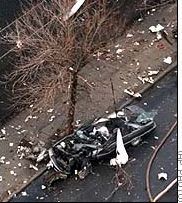
N9253N was descending into Martha’s Vineyard and was established on an easterly course, descending through 2,600 ft. msl at approximately 900 fpm. Power was set for a cruise descent yielding approximately 160 KIAS. At 2140:15, N9253N began to bank to the right at a nearly constant rate. In the next 10 seconds, the bank angle reached 45 degrees. The flight path was five degrees down. The bank and pitch angles continued to increase thereafter at a constant rate until, 35 seconds later, N9253N impacted the water at a bank angle of 125 degrees, a nose-down pitch attitude of approximately 30 degrees, and a descent rate in excess of 4,700 fpm. The instrument indications on the airspeed indicator and vertical speed indicator were at their maximum positive mechanical limits and the engine was developing full takeoff power. The transition from “usual” to “unusual” required but 45 seconds and there was no recovery in this instance.
Yes, this was the crash that killed John F. Kennedy Jr., his wife and his sister-in-law.
Speed Kills
Flight at extreme airspeeds can cause an in-flight breakup and, in the case of a high-speed dive, can prolong recovery leading to impact with terrain. Put simply, speed kills. More precisely, excessive airspeeds can dramatically diminish your prospects for survival. It is important to understand the risks of excessive speeds. It is equally important to understand that you may have a chance of surviving an unintended venture into the world of flight beyond Vne if you respond appropriately.
 Airspeeds in excess of those specified in the “Limitations” section of the Pilot’s Operating Handbook (POH) generally do not take apart an airplane in the manner that the Big Bad Wolf disassembled the little pig’s house of straw. Rather, flight at those airspeeds limits the plane’s ability to survive specific flight conditions. If those flight conditions do not arise during your period of transgression, you may survive. If they do, you may perish. In order to maximize your chances of survival, you need to understand these conditions and devote some thought to how you should recover from an overspeed situation.
Full, Abrupt Control Movements
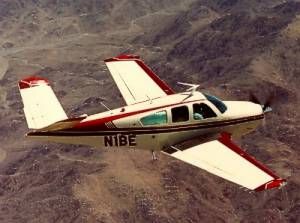
For a Beech Bonanza (BE-V35), maneuvering speed (Va) is 134 KIAS at full gross weight (3,400 pounds) and represents the airspeed beyond which the pilot should not use full, abrupt control movements (FACMs). That is because 134 KIAS is the airspeed at which the wing is first capable of generating 12,920 pounds of lift or 3.8 Gs (3,400 x 3.8 = 12,920). The positive design load limit for normal category general aviation aircraft is 3.8 Gs. If you were to pull sharply back on the controls at an airspeed above Va, the wing might accelerate the aircraft at an excessive rate.
Below gross weight, Va decreases because it takes less force to accelerate a lighter object at a rate of 3.8 Gs. The test data for this article was generated at a gross weight of 2,800 pounds. At 2,800 pounds, Va would be 121.6 KIAS (134 x sq. rt.(2,800 / 3,400) = 121.6). However, at 2,800 pounds, the aircraft would be loaded within the certified limits in the utility category. The positive design load limit for the utility category is 4.4 Gs. At 2,800 pounds, the airplane could exceed 4.4 Gs at airspeeds above 131 KIAS.
Although we pilots are not allowed to rely on this, the designers also add a safety factor of 1.5 so that the ultimate load factor is 1.5 x 3.8 or 5.7 Gs (normal) and 1.5 x 4.4 or 6.6 Gs (utility). At full gross weight, you could exceed the 5.7 ultimate load factor (normal) at airspeeds above 164 KIAS. Our lighter 2,800-pound test aircraft could exceed the 6.6 G ultimate load factor (utility) at airspeeds above 160 KIAS.
 So, what does all that mean in terms of your chances of survival? In a 3,400-pound V35, FACMs at airspeeds below 134 KIAS should not lead to injury to you or damage to the plane. The airplane was originally designed so that its essential components would remain intact in the event of FACMs at airspeeds between 134 KIAS and 164 KIAS, although the airplane would be expected to suffer damage. However, some of the airplane’s components may have been fatigued by prior events or the metallurgy of a key fastener may have been a little off-spec. It might not be your lucky day. At airspeeds over 164 KIAS, FACMs would demand performance from the airplane that its designers never contemplated. You would not survive unless it truly was your lucky day.
To place those G-force values in context, a 3-G pull is an aerobatic maneuver that will wear you out. Normal people “grey out” (suffer from loss of vision) after several seconds’ exposure to 4 Gs. Normal people “black out” (lose consciousness) after several seconds’ exposure to 6 Gs. If you were abruptly to pull back on the yoke, you could easily expose the airplane to excessive Gs without feeling the impact of what you’re doing to yourself and the airplane. If you apply back force more gradually with the thought that, if you’re feeling the effect of too much G-force then the force on the plane is probably excessive as well, you will have a much better chance of surviving the experience.
Mother Nature’s Control Inputs
Next of concern are the airspeeds at which airplanes are designed to survive MNCIs (Mother Nature’s Control Inputs). An MNCI arrives in the form of vertical gusts of wind. Total lift is a function of airspeed and angle of attack. At cruise flight at 151 KIAS, our test airplane would be capable of generating 4.8 Gs. However, the pilot maintains the 1 G necessary to sustain level flight by commanding a minimal angle of attack with the elevator. Problems could arise if Mother Nature serves up a vertical gust of wind. The vertical gust changes the angle of the relative wind which in turn causes an uncommanded increase in the angle of attack and a corresponding increase in lift. In turbulence we feel the increase and decrease in the wing’s lift, not the physical impact of wind gusts on the structure of the airplane.
GA aircraft are capable of withstanding vertical gusts of +/- 30 fps at maximum structural cruising speed (Vno) and Vno must be at least equal to design cruising speed (Vc) where Vc is 36 x sq. rt. (wing load factor). The V35 has a wing load factor of 18.8 pounds/sq.ft. so Vc is (36 x sq. rt. (18.8)), or 156 KIAS.
Off the top end of the V-G diagram is design dive speed (Vd). General aviation aircraft are capable of withstanding vertical gusts of +/- 15 fps at Vd which is at least 1.4 Vc (Normal) or 1.5 Vc (Utility). In a V35, the Vc of 156 KIAS requires that Vd be at least 218 KIAS (normal) or 234 KIAS (utility). Design dive speed can also be estimated based upon the published Vne value. Never exceed speed cannot exceed 0.9 Vd. Vne for the V35 is 196 KIAS. Vd must therefore be at least 218 KIAS.
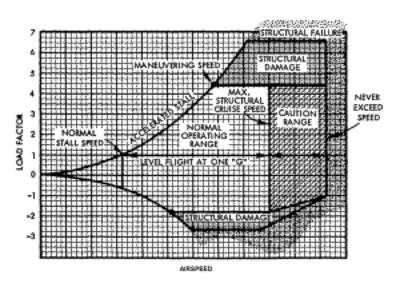 It would be neither legal nor sane to exceed Vne intentionally. However, if ever find yourself unwittingly in that position, take some comfort in knowing that some pilot was there before you and lived to certify the event. You, too, could survive if you play your cards right. In the context of unusual airspeeds that means understanding that the airplane will give you the same G-force performance right up to Vne and beyond. However, the plane is fragile at high speeds because of the much greater potential of exceeding the design G-loads. At its 218 KIAS design dive speed, a 3,400 pound V35 would be capable of generating 10 Gs. At its 234 KIAS design dive speed (utility), our 2,800 pound test plane would be capable of generating 14 Gs. One FACM and you’re toast. Moreover, although the plane will withstand a 15 fps vertical gust, if you happen across a 40 fps MNCI you are likewise toast. The moral: Go EASY on the pitch control and pray for smooth air until you get the plane slowed down to an airspeed that registers on the airspeed indicator.
Acceleration And Vertical Acceleration
It is reassuring to imagine being able to hit 234 KIAS in a spiral dive and, drawing upon your superior piloting skills, being able to slowly coax the airplane back into a cruise configuration. Before that warm and fuzzy feeling becomes overwhelming, let’s consider the box that a high-speed spiral creates for the unfortunate pilot.
Airplanes accelerate whenever thrust exceeds drag. As pitch angles increase, the component of the gravitational force along the airplane’s line of flight increasingly assists the engine in developing thrust. Airspeed increases rapidly. Worse yet, a component of airspeed is in a vertical direction which means that vertical speed increases as a function of both airspeed and descent angle. Astounding vertical descent rates can arise at seemingly benign descent angles.
The table below shows calculated terminal velocities and rates of descent for a V35 Bonanza in various configurations. (I will post the entire table and address questions about methodology in AVweb‘s threaded messages area if anyone is interested.) If you are flying a late-model Mooney or Lancair, the values would be even higher. If you are flying a Cessna 172, the numbers would be less severe.
| Descent Angle (Deg.) | 100% Power, Gear Up | 75% Power, Gear Up | Idle Power, Gear Up | Idle Power, Gear Down |
| 10 | 213 KIAS 3,748 fpm | 194 KIAS 3,414 fpm | 121 KIAS 2,129 fpm | 90 KIAS 1,584 fpm |
| 30 | 270 KIAS 13,680 fpm | 256 KIAS 12,972 fpm | 206 KIAS 10,438 fpm | 153 KIAS 7,753 fpm |
| 45 | 301 KIAS 21,570 fpm | 288 KIAS 20,638 fpm | 245 KIAS 17,556 fpm | 182 KIAS 13,042 fpm |
As you can see, these are big numbers. It should also be apparent that, at any given angle of descent, flying at an excessive airspeed imposes a substantial descent rate penalty. Finally, you pay a substantial penalty in terms of airspeed and rate of descent if you do not take the proper steps to reduce thrust and increase drag.
The Recovery Box
Airplanes that are designed to chew up air miles can rapidly digest altitude when they are pointed downhill. In the extreme case noted above, if you are passing through 7,000 feet at a descent rate of over 21,000 fpm, impact is less than 20 seconds away. You have to recover quickly but the airplane will disintegrate if you make a sudden move. The odds aren’t good.
Less obvious is the impact of high vertical speeds on the time that will be required to recover because of vertical inertia. If the available force to decelerate an object is constant, the recovery time increases in proportion to the established velocity.
Acceleration x Time = Velocity and therefore Time = Velocity/Acceleration |
In recovering from a high-speed dive, physiological constraints and structural limits restrict the available lifting force. Therefore, acceleration is a fixed value and recovery time will increase in direct proportion to the vertical descent rate. Recovery from a 20,000 fpm rate of descent will take about ten times as long as recovery from a 2,000 fpm rate of descent. At high airspeeds, you may not have enough time to recover even if you can succeed in holding the airplane together.
Control Your Airspeed!
For all the above reasons, the first order of business in a high-speed spiral is to control your airspeed. Airplanes accelerate for the simple reason that thrust exceeds drag. In order to keep airspeed under control you need to minimize thrust and maximize drag. In any airplane, the first step is to chop the power. In some planes you can further increase drag by dropping the gear, moving the propeller control to a high rpm setting, and/or deploying speed brakes. Leave the flaps retracted. The last thing you need at this stage is asymmetrical flap deployment.
Let’s see what Beechcraft has to say. The POH for the V35 Bonanza doesn’t address recoveries from a spiral dive but does contain a section entitled “Emergency Speed Reduction.” According to Beechcraft:
| “In an emergency, the landing gear may be used to create additional drag. Should disorientation occur under instrument conditions, the lowering of the landing gear will reduce the tendency for excessive speed build-up. This procedure would also be appropriate for a non-instrument rated pilot who unavoidably encounters instrument conditions or in other emergencies such as severe turbulence.” “Should the landing gear be used at speeds higher than the maximum extension speed [145 KIAS], a special inspection of the gear doors in accordance with shop manual procedures is required, with repair as necessary.” |
Beechcraft is telling us is that, at unusual airspeeds, we will start losing the wings before landing gear components (except for the gear doors) if the gear is lowered at airspeeds in excess of 145 KIAS. Easy enough to complete a flight safely with a bent gear door (just leave the gear down, please). Not so easy to complete a flight missing parts of the tail.
In a V35 in a 30-degree descent, if you chop the power and drop the gear you’ll decelerate to 153 KIAS (0.9 Vno) at a 7,753 fpm descent rate. Leave the gear up and the power in and you’ll be flying at 256 KIAS (1.3 Vne / 1.17 Vd) and descending at 13,000 fpm. Add full power and you’ll be at 270 KIAS (1.4 Vne / 1.24 Vd) and hurtling downward at 13,700 fpm.
Your options for controlling airspeed will vary from plane to plane. If the gear is fixed, dropping the gear is not an option. If you are accelerating through Vne in a C-182RG or a PA28R-201T you have the option of selecting gear down, but should you? I haven’t researched all makes and models. You need to determine that answer yourself for the planes you fly.
But, In A 13,000 FPM Descent, Don’t I Need Full Power To Climb?
Do not increase the power setting simply because you are experiencing a high rate of descent. If you are hurtling toward Mother Earth at airspeeds in excess of Vne you have available climb power in spades – it’s called “inertia.” Thinking about it in another way, although power is required to sustain a climb in unaccelerated flight, a wing’s capability of generating lift is merely a function of airspeed. In plain English, this means that you can generate as much lift as you want if you have excess airspeed to trade. The airplane will simply decelerate. If you are traveling at a speed in excess of Vne, deceleration is a good thing, not a bad thing. When the airspeed slows to the point that lack of power becomes a concern, add power.
Let’s attach some number to that proposition. At 2,800 pounds, Va for the test plane is 122 KIAS. By definition, the wing is capable of generating 3.8 Gs at Va. Depending on the loading, the Bonanza is also rated in the utility category (4.4 Gs). You pass out at 6 Gs. The ultimate load limit is 6.6 Gs. The airspeeds of concern, therefore, are:
| Desired lift: | 3.8 Gs | 4.4 Gs | 6 Gs | 6.6 Gs |
| Required Airspeed: | 122 KIAS | 131 KIAS | 153 KIAS | 160 KIAS |
What this means is that, if you are descending toward Mother Earth at 256 KIAS, you will be capable of generating sufficient lift to break the airplane until the airspeed decays below 160 kts, sufficient lift to render yourself unconscious until airspeed decays below 153 KIAS, and sufficient lift to exceed the positive design load limit of the airplane until the airspeed decays below 131 KIAS. Absence of power to sustain a climb is not one of your immediate concerns. By the time insufficient power becomes a concern, the world will be moving much more slowly. CHOP THE POWER!
Coffee-Table High-Speed Spirals
As mentioned above, unless you have access to a full motion simulator, you will not have a practical opportunity to practice recoveries from unusual airspeeds. You can’t perform them in an airplane. You have to rehearse them with your feet on your coffee table. Let’s walk through one.
Here’s the situation: You are in cruise in IMC and are attempting to insert the approach plate into the yoke clip when it slips through your fingers and flutters to the floor. “Where did it go?” You finally gather the plate from the floor in front of your rear seat passenger and glance back at the panel only to be confronted by a slew of aberrant instrument indications.
Step 1: Control Your Airspeed
You understand that airspeed is your mortal enemy so you direct your attention first to the airspeed indicator. The airplane is accelerating through Vne so you immediately chop the power and take whatever additional steps may be appropriate to increase the parasite drag for the specific plane you are flying (e.g., gear down, prop forward, speed brakes deployed).
Step 2: Roll To Wings Level
Look at the turn coordinator and apply coordinated aileron and rudder inputs opposite to the indicated direction of turn until your wings are level. Do not rely on the attitude indicator. Its indications may be confusing in an extreme attitude and a failed attitude indicator is a likely cause of your present predicament in the first place. The turn coordinator gives you a simple indication of whether you are turning to the left or to the right. If you’re turning left, use control inputs for a right turn. If you’re turning right – vice versa.
Leave pitch alone while you are correcting the bank. In a steep bank, a pitch up control input would only tighten the turn. In a very steep bank (over 90 degrees), you are partially inverted and a pitch up control input would actually increase your (inverted) descent. Finally, in a steep bank, the G-forces are distributed unequally on the wings which imposes greater stresses on the airframe.
Step 3: Recover From The Dive
The airplane is trimmed for straight-and-level flight so, once the wings are level at your substantially higher airspeed, it will be inclined to pitch up dramatically. Do not haul back on the yoke. You may actually have to use forward pressure initially to keep G-forces under control. Make slow pitch inputs so that you can experience the physiological effect of the G-forces before they get out of hand, remembering that the effects you feel roughly correspond to the forces that the airplane can withstand. If your eyesight is fading to gray, the forces are around 4 Gs or so and it’s time to release a little back pressure.
Whew! You made it! Every GA pilot alive has dreamt of being called to the cockpit of a 747 to bring it down after the flight crew succumbed to the effects of a fish fry. The next time those thoughts start to come to mind, think instead about how you might coax your four-seater down from Vd to Vno. It is a situation that is equally perilous and substantially more probable. In this context, a little daydreaming might actually save your life.
