



















| Bernoulli, Daniel (1700-1782) — Swiss doctor whose name was given to equations developed by Leonard Euler. These principles are widely credited with keeping aircraft aloft and the curving of baseballs. |
Dr. Bernoulli and Master Euler
No wonder Master Euler put somebody else’s name on this business. Few scientific ideashave ever been as widely misapplied. Poor Dr. B. must be rolling over in his grave everytime a school textbook pops off a printing press. What did he do to deserve this?
The principle now blamed on the good doctor enables us to make a simple predictionabout the behavior of fluid flow. Where the flow speeds up due to encountering objects,the pressure will be lower. When the flow slows down, pressure will rise. The cause of theworn upholstery in the doctor’s coffin is widespread confusion between"prediction" and "cause." It is as if Euler was describing the lifecycle of chickens. They start as an egg, they hatch, they grow, they become Sunday dinner.That description has been converted into conventional wisdom that eggs cause chickens.
Simply making air go faster will not lower its pressure! What Euler said is that achange in either speed or pressure will be accompanied by a change in the other …that’s "accompanied," not "caused." A balance will be maintained betweenpressure and flow. This fact is based on the inviolate law of conservation of energy, ofwhich both velocity and pressure are forms.
Bernoulli’s prediction does not apply in cases where energy is added to or subtractedfrom the system. If you speed up the air by adding energy from a source other than theflow, the pressure will not go down. Most textbook and popular press errors arise out ofconfusion over this fact. The reverse is also true. The speed of the air in a thin layernear the wing is slowed to nearly zero by the friction of the surface. Friction means theenergy of the airflow is being converted to heat. Since the energy is being drained by amechanism outside of the Bernoulli predictions, it is not necessary for pressure toincrease and, it doesn’t.
A wing moving through the air sets up a pattern of air motion, called "Circulation," in which there isfaster flow above the wing and slower flow below it. These changes in speed must beaccompanied by changes in pressure. The primary mechanism of lift is the reaction betweenthe wings moving air downwards and being pushed upwards in return. You can’t move airwithout having pressure differences somewhere. All of the changes in flow speed, pressure,and direction are linked manifestations of the same process. None of these changes causeanother any more than eggs cause chickens.
Separation
A flat plate will create lift but a cambered airfoil does it more efficiently. Air hasweight and inertia that set limits on how fast the direction of a flow can change. Look atthe flow over this flat plate wing:

Note first that the circulation process creates an upwash ahead of the wing. The airgoes over the leading edge and is then unable to turn the corner fast enough to follow thesurface. Since a vacuum in this situation is impossible, two things happen. First, theoverall pressure of the atmosphere pushes the flow down as far as it can. Second, the airbetween the main flow and the wing breaks off into slower moving eddies that fill thespace. The first result causes a vertical displacement of air from A to B. This is part ofthe downwards displacement of air that is lift. The second result is that the air in theturbulent region, moving slower, has a higher pressure than if it had remained part of thefaster moving main stream. This results in a lower pressure differential between the topand bottom of the wing, i.e., less lift. Look at point (C). If the flow had been able tofollow the line of the top surface of the wing, the air that went through (B) would passthrough (C), which is lower. This would be greater downwards displacement and more lift.The region of turbulent, slower moving air would also be thinner. The pressuredifferential above and below the wing, and the vertical displacements created by the flowpatterns, are inextricably linked. These are different aspects of the same process and cannot be thought of separately.
Now let’s add camber to our wing.

The camber basically fills up much of the space in which the eddies formed over theflat wing. This keeps the air in the region close to the surface moving faster, and thusthe pressure must be lower. An additional factor now comes into play. We have a gentlemannamed Coanda to thank for its first recognized description. Once a fluid flow is followinga curved surface, it will tend to remain stuck to the surface and follow it. Theapproximate explanation is that if it didn’t, a space or vacuum would have to form betweenthe flow and the surface. It remains stuck like a suction cup to a window. The real answeris much more complicated, of course, but we don’t need to get into it any deeper. What wedo need to notice is that the flow, following the surface, goes through point (D). This iseven lower than (C) in the previous figure. The camber, by picking up the flow and holdingit to the surface, creates even greater downward displacement of air and greater lift.
Another aspect of the whole process, applicable to both the flat plate and the camberedfoil, is the curved nature of the flow path. You can’t swing something on a string withoutit trying to break the string. The air, forced around the curve, is trying to move awayfrom the wing, lowering the pressure on the top. This is not a separate phenomenon. It ispart of everything discussed above but the relationship is harder to grasp intuitively. Ifyou want to know more, click here.
There is a limit to how quickly a flow can change direction without leaving the surfaceand creating a void of slower moving turbulent flow. If we increase the angle of attack onour cambered wing, the same events discussed for the flat foil will take place as the flowseparates. As long as the flow can remain attached, each increment of increase in angle ofattack will increase lift by a similar amount. Once the flow breaks loose from thesurface, increases in angle of attack will result in smaller and smaller gains in lift.Eventually, the gains will become reductions.

Boundary Layer
Even in the absence of flow separation due to excessive angle between the wing surfaceand the flow, there will be a thin region of turbulent flow over much of the wing. The airin this fraction of an inch thick Boundary Layer is slowed (and warmed up) by friction.The slowing increases as you measure closer to the surface until the air touching the wingis nearly motionless. The airflow at the leading edge is able to move in a smooth andorganized way for a short distance but the difference in speeds between layers eventuallycauses the lowest ones to trip over into rotating eddies. The smoothly moving flow thenrides over the top of the turbulence and the effect on lift is much as described above forflow separation. The result of separation due to excessive angle of attack is essentiallyto increase the thickness of the boundary layer over the after portion of the wing.
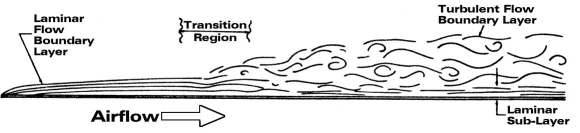
This is why laminar flow has been such a Holy Grail of aircraft designers. Keeping theboundary layer thin and avoiding turbulence increases the efficiency of the wing. Anotherapproach is the installation of vortex generating vanes near the leading edges of thewings. These look like small vertical wings and convert some of the energy of the flowinto tip vortices with a direction of rotation roughly 90 degrees to the eddies naturallycreated in the boundary layer. This has two effects. First, it locally increases the flowspeed without adding any energy to the system. Dr. B’s rule tells us that this must beaccompanied by a decrease in pressure. The increase in flow speed is largely sideways butit still has the desired effect. Second, the vortexes created by the vanes tend to suck inand organize the meandering eddies of the boundary layer. This shrinks the turbulentlayer, allowing the main flow to follow a steeper path and create more of the downward airmovement that is lift.
Ice on the leading edges of the wings also creates eddies, but they are not the tightlyorganized and located vortexes just described. Their rotation is aligned roughly with theairflow so, on the bottom where the rotation is towards the leading edge, the air isslowed relative to the wing surface and pressure must rise accordingly. This disturbancethickens the boundary layer sooner. The result is a wing that must operate at a higherangle of attack to generate the same lift. The increased drag of this higher angle ofattack is one of the most significant factors requiring higher power settings to maintainairspeed in an iced-up airframe.
Coefficient of Lift
In order to know the amount of lift generated by a particular wing, you have to knowthe following things: air density, speed, and angle of attack. We will pretend for therest of this discussion that density is always the same. We’re all at a sea level airporton a standard day and we’ll forget about it. The basic physics of the universe dictatethat speed be squared. A 40 mph wind has four times the force of a 20 mph wind. All elsebeing equal, a wing will generate four times as much lift at 200 knots as at 100 knots.
Take two wings of different shapes but the same area and they will probably generatedifferent amounts of lift. We introduce another number to the equation to account for thedifference. It is roughly a measure of the wing’s efficiency; thus "CoEFFICIENT oflift," hereafter called CL
For an idealized wing in a wind tunnel:
| lift = wingarea CL airspeed2 |
We’re forgetting about density, remember?
In the real world, CL will be different at each part of the wing. Pressuredifferences cause air to spill around the tips into vortices and flow effects of thefuselage and engines effect the efficiency of the wing nearby. For now, we will keepthings simple by considering CL to be the average over the entire wing.
This graph shows Coefficient of Lift, CL, at various angles of attack.
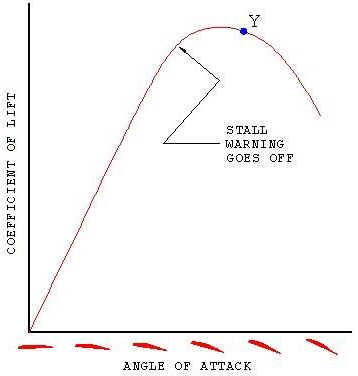
To determine lift at any point, you need to know the CL from the graph,airspeed (squared), wing area, and air density. Area will be the same for our hypotheticalairplane and we are pretending that density is always the same. That leaves airspeed. Youprobably know that airspeed is closely related to angle of attack and that, except nearstall, the airspeed gauge is pretty much an Angle of Attackometer.
Here is our plane in cruise at 80 knots: (Yes, I’d like it to be a Malibu but AVwebisn’t paying me enough for these articles.)

Cruise
Here is our plane gliding at 80 knots:
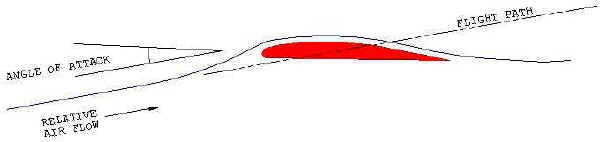
Glide
Here is our plane climbing at 80 knots:
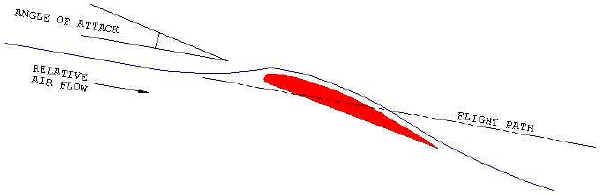
Climb
If you look closely, you will see that these are the same drawings copied to differentpieces of paper and simply rotated. The difference is the power input from the engine.
This brings us to some concepts that are rather difficult to visualize. It is temptingto think that you climb by increasing lift and descend by reducing it. As with mostthings, the real story is much more complicated. Lift is always measured perpendicular tothe relative wind or flight path; except for momentary disturbances, it is always equal tothe weight of the airplane. Since lift is measured perpendicular to the flight path, youactually have to say "the component of the aircraft’s weight that is perpendicular tothe flight path," in order to be strictly accurate. When climbing, the pull of theengine offsets some of the aircraft’s weight. When gliding, drag does the same thing.Minor corrections such as these are more significant to being completely accurate than tounderstanding the more basic principle. If the flight path is straight, then liftessentially equals weight.
This is a complex system of vectors with different reference points that can shift inthree dimensions. You do not rise or descend by changing lift but by altering your flightpath so that the sum of all these vectors will work out to lift equaling weight. Theaircraft does not care as much as ATC does whether you are climbing or descending, it justwants to maintain the lift/weight equality. If lift becomes less than weight, the aircraftwill sink. As we will see below, this will increase the angle of attack. CLwill go up and lift will increase. This process will stop when lift again equals weightand the plane will then proceed on a straight flight path (assuming, of course, that noone is moving the controls).
The initial action that alters your flight path is a brief change in lift. You changeone or both of the two basic factors you control, angle of attack or power. This createsan imbalance in lift and weight. The inequality is only momentary however and the planequickly seeks a new flight path where lift equals weight. If you change only one of thelift factors, the new flight path will have a different angle to the ground. If you changeboth, the new flight path can have the same angle but at a different airspeed.
It is beyond the scope of an article of this length to prove this, or even begin tofully describe the relationships. If you would like to know more, please read JohnDenker’s excellent web book, "See HowIt Flies."
Stalls (Finally!)
It is fairly intuitive that drag increases with Angle of Attack along with CL.After all, it is easier to make something go through the air edgewise than to drag it atan angle. This is closely related to the correspondence between speed and AOA.
The exact shape of the CL curve will depend on the cross sectional shape ofthe airfoil. Almost all shapes used as airfoils share the common characteristic that thefirst part of the CL curve is nearly straight. This is the region in which theflow stays mostly attached to the after portion of the wing. At these modest angles,doubling the AOA will double the lift, if you could maintain the same airspeed. But, youcan’t. Pull back gently on your Angle-of-Attack-O-juster (yoke or stick, personalpreference) and CL will increase while airspeed decreases. The amount of liftwill remain the same. The throttle setting will determine whether the flight path thatforms one side of the attack angle is a climb, a decent, or level. A slight powerreduction will need to be made so that the flight path that maintains lift equal to weightwill remain parallel to the earth’s surface and you don’t get a call from ATC remindingyou about your altitude.
Pull back farther and some sort of alarm will go off, depending on where your plane wasbuilt. Pull a little farther and there will be some control buffet. In simple planes, thismy be your first warning. Pull a little farther and, YIKES! Whew, it sure felt like youjust lost all your lift. But, just moments ago you had the same lift as you did at cruiseand CL was at maximum. When the nose dropped, you were about at point Y (for"Yikes!") on the curve above. Plenty of CL there.
Now get your plane moving along really briskly, right up near the red line. Yank hardon your Angle-of-Attack-O-juster, all the way back. One of two things are going to happen.Either the tail will break off, in which case you have no further interest in this articleand are excused. Still with us? Good. The plane is not going to be able to change flightpath that quickly and AOA will go right up and past point Y. Airspeed and CLwill both be high and you may actually be developing more lift than the plane ever didbefore. You might even over-stress the wings and face some huge repair bills on landing(if the wings don’t come off). Still, the plane will have stalled and felt like it justlost all its lift. Clearly, a stall is more complicated than the wings suddenly giving upand stopping their downwards movement of air.
This animation shows what happens to Angle of Attack when airspeed suddenly decreasesand the aircraft sinks. Watch the streamer on the frame ahead of the wing as a tailwindgust reduces the airspeed.
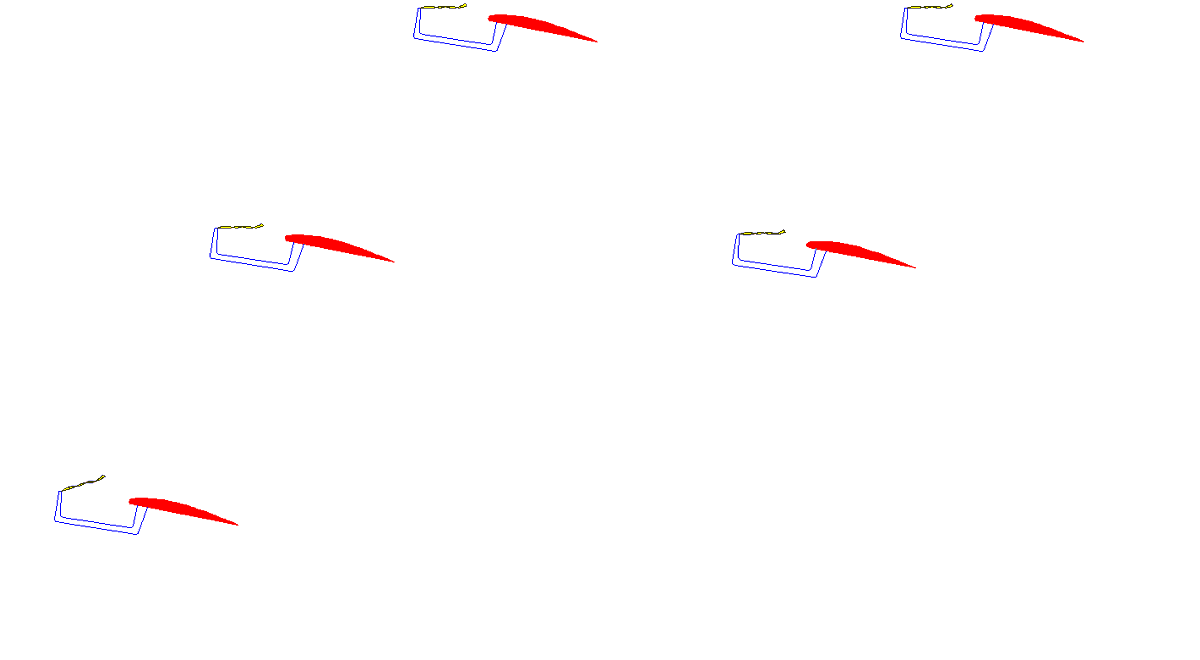
Headwind gusts will have the opposite effect.
This change in angle of attack with rising or sinking of the plane from the flight pathis the key to understanding basic flight dynamics. An excess or deficit of lift overweight will result in the plane rising or sinking accordingly. This will change the AOA sothat lift is adjusted in the opposite direction (at least in unstalled flight). If theplane is sinking, lift will increase. If the plane is rising, lift will decrease. Theaircraft, with controls held steady, will settle quickly on a flight path where liftequals weight.
Here is our CL curve again:
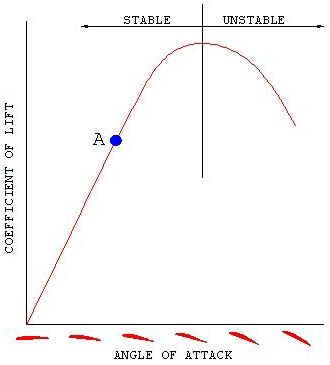
We are flying along at point A on the left side when a tail gust hits the plane.Airspeed drops so lift decreases and the plane sinks. The sinking increases the angle ofattack and, with it, the lift, restoring the equilibrium. There’s a bobble and yourpassenger yelps, but it’s no big deal.
Now put the plane at the top of the CL curve and bring on the same tailgust. The sink-induced increase in Angle of Attack now REDUCES the CL at thesame time that it is already being reduced by the change in airspeed. Further sinkingcauses even greater reduction in CL. With these changes in AOA come increasesin drag, slowing the plane, increasing sink, decreasing lift, slowing the plane. The wholesystem grabs its tail and starts going around, faster and faster, until either the pilotor the ground intervenes. For many planes, simply letting go of the controls will besufficient intervention. Holding the nose up in a panic is truly a "death grip."
To the left side of the CL curve, the airfoil is inherently stable in theairstream. Wind gusts and clumsy moves of the Angle-of-Attack-O-juster will cause theplane to quickly find a new equilibrium. There is plenty of lift to be had on the rightside of the curve but the system is about as stable as a pencil balanced on its eraser.One little disturbance and it falls over into a descending feedback spiral where lift canonly find equilibrium with weight in large diversions to a flight path so steep that it ishard to associate it with a concept like "lift." When the plane starts to sinkafter holding the nose too high, the same thing happens. Stall is not the cessation oflift but loss of stability of the airfoil in the airstream.
The CL graphs above are for airfoils that are fixed in place, unable tochange either flight path or airspeed. This is what the curve looks like in a wind tunnelbut not the way the wing will behave in free air. The ability of the aircraft to radicallychange flight path is an essential feature of stalls. I still remember building a windtunnel for a science project and being mystified as to why I couldn’t demonstrate stall.My measurement apparatus only showed a slight decrease in lift at high attack angles, butnothing that I could relate to the behavior of the model planes I flew and crashed. Ifyou could play with AOA while your plane was forced to stay in a straight line, likerolling along a runway, you would find stalls equally gentle. This is also why your handout the car window doesn’t seem to stall as you might expect.
Wingtip Dynamics
Stomp on your rudder pedals, whip those controls around. While you do, look out to yourwingtips. All that motion, superimposed on that of the aircraft as a whole, is doing somereally interesting things out there. Your manipulation of the controls, especially therudder pedals, can add considerable motion to the wingtips that is independent of theflight path. This motion can have a big effect on the angle of attack by making itdifferent at each portion of the wing.
Below is an animation that may take some study. The streamer, which shows the relativeairflow (and thus angle of attack) is mounted on a frame attached to a wingtip of anaircraft on final. Only the wingtip is visible. The center of the wing is following theindicated flight path at steady rate of descent while the pilot pushes the rudder pedals.For clarity, the animation pretends that the pilot also keeps the wings exactly level asthe plane yaws and that there is no change in airspeed due to the slip. The wingtip movesfirst forward and then aft. The overall angles of attack are exaggerated for clarity. Donot confuse the wingtip moving forwards and backwards from the flight path for sinking orrising above it. The center of the wing is maintaining a straight and steady line offlight as the aircraft yaws.
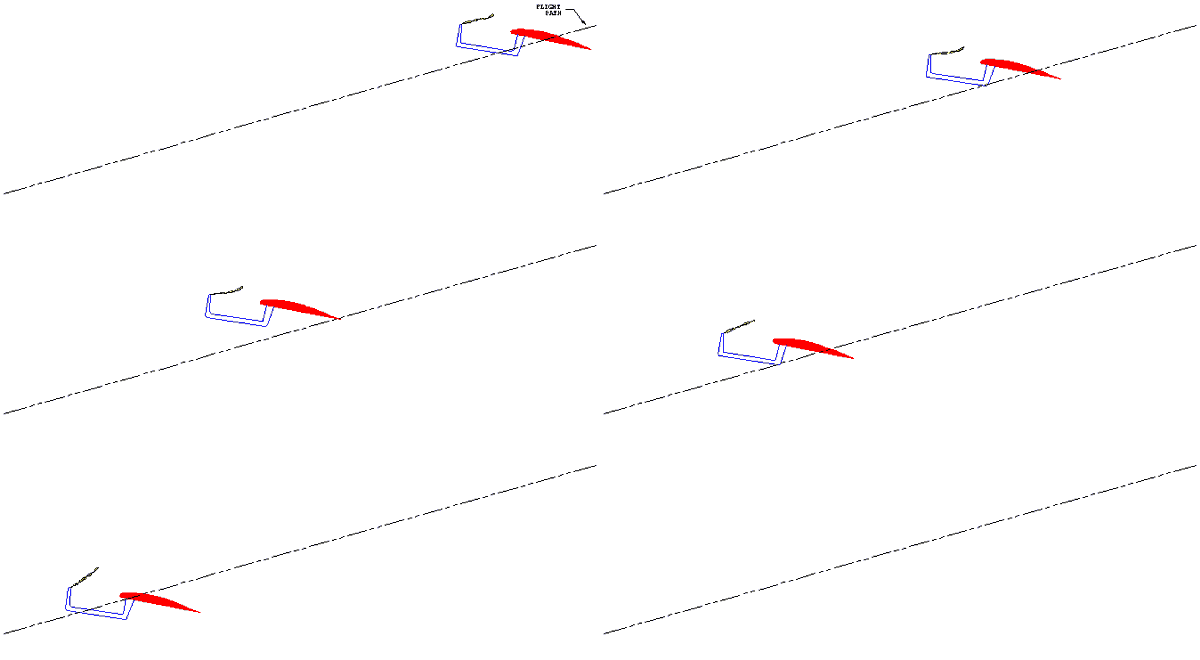
Note how forward motion of the wingtip decreases angle of attack and retreating motionincreases it. The changes are the result of the yaw motion of the wingtip being added orsubtracted from the overall airspeed of the plane. The vital fact is that these changesare rate dependent. Ease slowly into a slip and there will be very little change in angleof attack. Make a panicked or clumsy jab at the rudder pedals and there will be largechange. This difference can have important consequences for your future.
The next animation is a graph of the Coefficient of Lift for the colored portions ofthe wingtips. The tips are important not only because they experience the greatest changein airspeed as the plane is yawed but also because they exert a great deal of leverage inrolling. That’s why they put the ailerons out there. As the plane yaws, note how thecolored dots corresponding to CL for each wingtip move along the graph. Theadvancing wingtip has its angle of attack reduced so it moves down the graph. The angle ofattack for the retreating wingtip increases, as does its CL.
Once the plane is held in the slip, the rotational speed stops and the airflow over theends of the wings returns to that of the nominal airspeed. The CL‘s do not goback to matching values however. The end of one wing is now acting somewhat as a leadingedge and the other as a trailing edge. Greater lift is created at leading than trailingedges so there is a residual imbalance between the wingtips. This is why you can get intotrouble with crossed controls even in a steady slip. As the plane is yawed back to astraight course, the CL‘s for each wingtip move in the opposite direction.
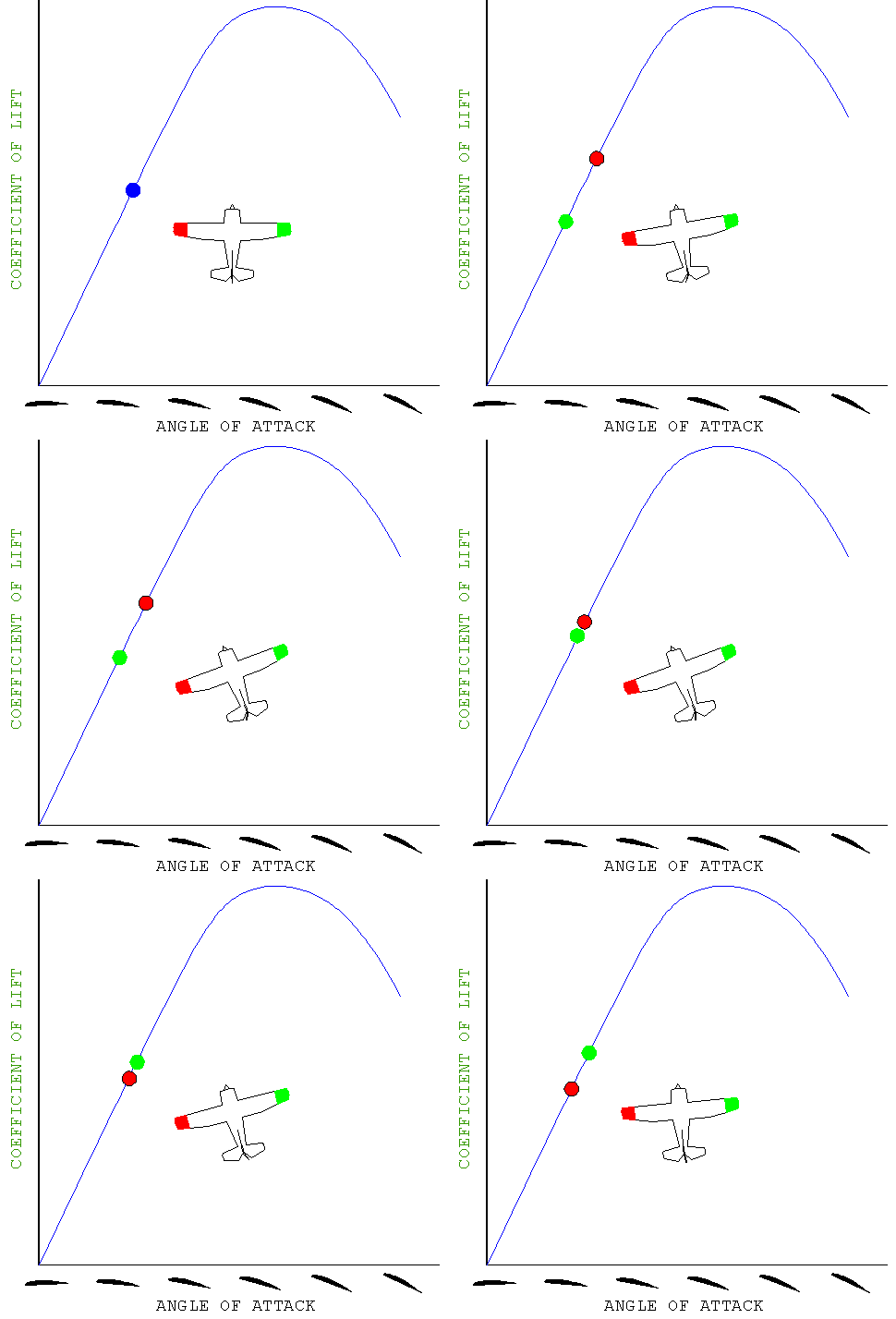
Again, the effect shown above is rate dependent. Ease slowly into the slip and the CLvalues will change very little because the fore and aft speed of the wingtips will be asmall proportion of the airspeed. The length of the wings is also a factor. Gliders arevery sensitive to rudder work because the combination of their slow speed and long wingswill let the pilot create very large angle of attack changes at the tips.
The animation shows average CL for the colored portions of the wingtips. Wecould construct a similar graph for any other portion of the wings. Everything would bethe same except the CL dots would not move as much. The relative fore and aftspeed of inboard wing sections will be less since they are not as far the center ofrotation.
The yaw in the animation above is taking place with the plane well down on the CLcurve. The graph shows CL, which is only one of the factors that determinesoverall lift. The advancing wingtip which is having its CL reduced is alsoexperiencing an increase in airspeed. This offsets the reduction in CL and liftremains close to what it was in steady flight. The same is true on the other side althoughCL increases and airspeed decreases. There will be some leftover rollingeffect, depending on the plane’s design, but the rolling force will usually not be verysignificant. Other factors, such as dihedral, blanketing of flow to one wing by the nose,etc. will have a greater effect on the aircraft’s roll response.
Now envision this taking place up near the top of the CL curve. The top ofthe curve is flatter so changes in angle of attack result in smaller changes in CL.The effect of airspeed on lift is unchanged, however. The plane will be slow up here nearthe top of the curve so the wingtip speed that can be generated by rudder action is apt tobe a greater proportion of the overall airspeed. The result is a much greater tendency forthe advancing wingtip to rise and the retreating wingtip to sink. This is why, in veryslow flight, the rudder is so effective in keeping the wings level. The reason you have tobe aggressive with the rudder is again, the fact that the changes in wingtip airspeed aredependent on the rate of the yaw.
We now move into the dangerous territory right at the top of the CL curve ora little to the unstable stalled side. As you envision the separation of the CLdots, it’s easy to see that the retreating wing is going to go over the hump into theregion where its CL will decrease; not increase with AOA. Now both CLand airspeed are going south on that side of the plane. The wing is going to sink. Theadvancing wing is now right up at the top of the curve where its increased AOA will havealmost no effect on CL. The effect of increased airspeed will be unchanged andthe wing will lift. The plane takes a sudden break to one side.
We saw above that sinking of an airfoil increases angle of attack. The sinking of theretreating wing tip further increases angle of attack as well as drag. The drag slows thewingtip and pulls the plane deeper into the yaw, increasing the airspeed over the now highwing and lifting it yet higher. At this point, the pilot may make matters even worse, asudden movement of the yoke to raise the dropping wing with the ailerons is the lastmistake many pilots ever make. An aileron is really just a mechanism for changing angle ofattack by altering the camber of the airfoil. Lowering the aileron in an attempt to raisethe wing increases the angle of attack on a portion of the wing that is already deep intostall where further increases in AOA result in large CL reductions. The aileronsticking down into the clear flow below a wing already operating at a very steep angle isjust like a speed brake. On the other side of the plane, the wing end is operating in aregime where angle of attack changes due to the aileron cause relatively little change inCL. The upward raised aileron is partially blanketed in the flow behind a wingclose to stall so it creates little offsetting drag.
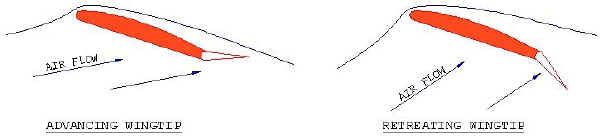
The overall result of all these forces can be as dramatic as if the low, inside wingtiphad suddenly pulled taut a rope attached to the ground. An eyeblink later, the plane ispointed towards the ground and possibly inverted. We all tend to do things faster whennervous, distracted, or panicked. A rapid rudder input will create large changes in CLbetween the wings. If you are already low on airspeed, and therefore pitched to a highangle of attack, the speed of the rudder input can be the difference between life anddeath.
Rapid recovery from an indiscretion of this kind is something that can only bepracticed in the air. It must be instinctive and decisive at low AGL or if a spin is to beavoided. Get the nose DOWN. That will slide the CL of both wingtips up over thehump in the graph to the left and stable side of the curve. Keep the yoke level. Jab onthe high side rudder pedal. The increased airspeed on the low wing will decrease its AOA,which now increases CL. Airspeed and CL rising together will liftthe wing. You will still lose a lot of altitude because you will have slowed below thespeed where you can establish an unstalled AOA in a flight path that is not inclinedsteeply downward. If this happens at low altitude, even the most rapid recoverywill only change the shape of the hole the airplane makes in the ground.
The rate dependency of these wingtip dynamics is a vitally important given the humanfactors in loss of control accidents. Practice and practice putting your aircraftcarefully on the edge of turning stall and recovering and you will gain a great deal ofconfidence. Get into a situation where you are panicked, or even just nervous, and yoursense of timing will change. Just as student pilots often flare too quickly when they arenervous, you may perform the same action slightly faster. The timing will feel the sameand the attitude and sight picture may be identical but the outcome can be very different.If things are tense, and you have made the mistake of getting backed into a corner whereyou really have to crank your plane around, slow yourself down. That will probably justbring your actions back to normal speed. More people have probably been killed in the airby doing things too fast then by doing them too slowly.
If you read this piece, you may conclude that I have above-average knowledge of the dynamics of stalls in uncoordinated flight. I must emphasize, however, that this knowledge does not make me any more likely to do the right thing if I stall out of a clumsy turn. When the windshield fills with trees, this knowledge will be locked away in a part of my brain that is no longer functioning. The only way to program the instincts that will be driving at that point is to go out with a competent instructor and do it, do it, do it.
