




























Over the years, I’ve had the opportunity to hang arounda lot of airports and participate in many hangar-flying sessions. (That’s morerotten coffee than you even want to think about!) One thing I never hear is apilot talking about going out to practice takeoffs. It’s always landings. Nobodybrags about his or her takeoffs. It’s always landings. Takeoffs are theforgotten maneuver. It’s just taken for granted that after the first hour or soof dual that EVERYONE can do a takeoff and no further thought on the subject isrequired.
Well, as you may have imagined by now, it’s just not quite that simple. It’strue that most takeoffs don’t seem to require the fine judgment and coordinationthat landings do. Also, who (besides a blimp pilot) ever heard of an emergencytakeoff? The consensus of opinion seems to be that takeoffs require little or noplanning and that just about anybody can finesse one. Almost true, but standbehind the fence someday and watch down the runway as folks takeoff. You’llalmost always see the tail swing to the right and the wing drop — even if justmomentarily — before everything straightens out and "flies right!"Maybe a little more practice is in order.
However, that’s not the major failing of most pilots in regard to takeoffs.There’s a major lack of planning and a certain complacency associated withtakeoffs that isn’t warranted. After all, at no subsequent point in the flightwill the airplane be heavier and using all of its available power to fly andclimb at a low speed. Yet lots of pilots simply turn onto the runway, advancethe throttle and launch into the blue. Ask most of them how much runway theairplane used to accelerate to takeoff speed or whether the acceleration wasnormal, and you’ll usually be met with a blank look.
Doing It By The Book
|
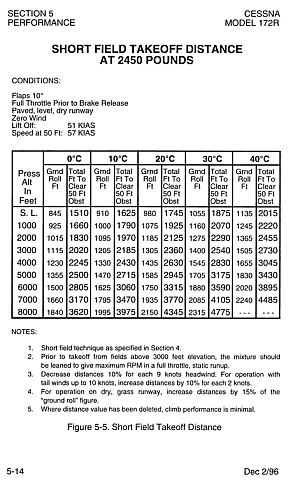
The tried and true Skyhawk is familiar to most of us, so let’s see what thebook figures are for this plane. (See Figure 1.) The key to understanding andusing any aircraft performance charts is in understanding how the manufacturerconstructs them. Notice the conditions listed in the upper left corner of thechart. They specify 10 flap; full power before brake release; a paved, level,and dry runway; zero wind; and liftoff at 51 KIAS. Just how you do every takeoff,right? "But," I can hear you protest, "I don’t need to do shortfield takeoffs, my home runway is 7,000 feet long." Nevertheless, this isthe only takeoff performance chart Cessna provides for this airplane. Since youwon’t duplicate the conditions listed, the chart is useless.
The book says that for a sea-level airport at 20 C it will take 980 feet onthe ground and 1,745 feet to clear that mythical 50-foot obstacle. There are nota lot of runways that are too short for that. Again, I hear you tell me aboutyour 7,000-foot runway. Well that 7,000-foot runway is one of the problems. Allthat concrete in front of you tends to lull you into complacency.
Remember Palm 90? That Air Florida 737 crashed into the Potomac River. Theengine gauges — erroneously — gave the proper readings, yet the engines werenot putting out the anticipated power. The acceleration took longer than itshould have. (The co-pilot pointed this out several times and then capitulated tothe captain who saw no problem. The aircraft staggered into the air, stalled andcrashed.) The crew had no guidance readily available in the cockpit to judge theacceleration — much like you in the 172. That’s where the 7,000-foot runwaybecomes a potential problem. The 172’s engine would have to be pretty sick tonot get off the runway in 7,000 feet so you are less likely to discover aproblem before you leave sweet mother earth. I think you’ll agree that the timeto find out about engine problems is before departure, not 300 feet in the airover houses. (That is NOT fun. I had it happen once, and it’ll really got methinking!)
Takeoff Reality Check
So, what can we use to determine whether performance is healthy? It’s apretty good bet that you’re not going to make every takeoff with 10 flaps orapply full throttle before brake release, so the book numbers aren’t going to beachievable. What’s a pilot to do? It just so happens that you DO have aninstrument in your cockpit that will help you gauge your engine’s performance —and, actually, the Palm 90 crew had it available to them, too, but apparentlynobody taught them how to use it.
That instrument is a plain old clock!
You’ve done this before — time x speed = distance.Also, time = distance/speed. Okay, I can just hear you saying, "Wait aminute! That won’t work because the airplane is accelerating." You’reright, but as it turns out, you can use the average speed and get close enoughfor our purposes. There is one complication, however. Speed is in knots(nautical miles per hour) and we’re going to be looking for feet and seconds towork with here. Just use this handy table. I’ve taken the liftoff speed inknots, halved it to get an approximate average speed, and then converted it fromnautical miles per hour to feet per second. (For those who are interested that’sspeed x 6000 = feet per hour/3600 = feet per second.)
This is inexact. (John Lowry could probably give us some exact formulas here,but I’m just not up to calculus right now.) We’re just trying to establish someguidelines here. Of course, you know that the propeller has certaininefficiencies that are not constant across the speed range and the accelerationitself is not a totally straight-line function, but this will be close enoughfor us to use.
Now you need to know what your ground roll should be for your takeoff. Youcan do this two ways. First, you can take the ground roll given in your POH andadd a fudge factor to account for your differing technique. The other method isto have someone note exactly where you lift off using your normal technique andmeasure the distance. No matter which method you use, you’re going to have to dothis for varying temperatures and altitudes to get a good idea what yourperformance actually is and to set some guidelines for judging futureperformance.
Let’s take an example from the Cessna 172R Short Field Takeoff Distancechart. How about a 1000′ MSL airport at 10C. The chart says the ground rollshould be 1,000 feet. Divide that 1,000 feet by the Average Speed (Feet PerSecond) listed for your liftoff speed (rounded up). That will be 51 knots forour 172R, which we’ll round up to 52 knots and use the table to obtain anaverage speed of 43.3 feet per second. Divide 43.3 feet per second into 1,000feet of ground roll and you get 23.1 seconds.
So it should take you about 23.1 seconds to accelerate to liftoff speed underthese conditions. That’s a number you can find in the cockpit. You can even seta countdown timer to measure it.
What makes this better than the numbers found in most POHs? Well, humans havebeen around for a long time and we move at a normal speed of about four milesper hour with very short bursts to about 15 mph. Our senses have a hard timemeasuring anything that is faster than that and one of the things we’re reallypoor at is judging distance during acceleration. The only numbers you get inPOHs tell you that you should be off the ground in X number of feet. Unlessthere are distance markers on the runway you’re using or you are familiar withthe airport, you have no reliable way of judging the acceleration of your planeduring the takeoff roll.
If it takes you significantly longer than your calculated number toaccelerate to liftoff speed, it would be prudent to apply the brakes, taxi backto the ramp and figure out what’s going on. That’s where the 7,000-foot runwayis handy — it gives you space to do this without having to change brake padsbefore the next takeoff. Remember, however, that the 7,000-foot runway can alsoallow you to take an inordinate time to accelerate without it being apparentbecause the end lights are not rushing up on you.
Plan For The Worst
So, what do you do if — in spite of all your planning — the engine doesstart to give up the ghost off the departure end of the runway? Well, the timeto think about that was during the preflight planning before you even untied theairplane. Pick out a place to put an airplane in an emergency and do it forevery takeoff. It’s easy at your home field because you are familiar with thegeography, but the information is available for other airports, too. You canalways ask the locals where they would go in the event of an engine failure. Theperceptive ones will have some good places picked out. The place that isprobably not available to you is the runway you just departed. There hasbeen much discussion about the turn back to the runway, and many words writtenadvocating this maneuver. Make your own judgment based on your experience andabilities, but in most cases at less than pattern altitude, it’s a riskymaneuver.
Altitude and airspeed are your friends on initial climb after takeoff, yetmany pilots sacrifice precious knots and feet by dragging the gear for aninordinate amount of time. What’s inordinate? Anything after a positive rate ofclimb is established and shows on the VSI and altimeter. I suspect the old sawabout leaving the gear hanging until there is no runway left to land on wasdevised by a flight instructor who wanted to keep new retract pilots frominadvertent gear retraction before a climb was established. Positive rate, gearup. Eliminate the drag and increase your speed and rate of climb. If the enginequits, the least of your problems is getting the gear back down. True, there aretimes you may want to leave the gear out a little longer — taxiing through snowand slush comes to mind — but as a practice, positive rate, gear up.
| Editor’s Note: There are exceptions to every rule, of course. Forexample, retracting the gear on a Cessna 337 Skymaster results in a huge initialincrease in drag as the gear doors open early in the retraction cycle, so thePOH advises against retracting the gear until obstacles are cleared. Know yourairplane. —MB |
If all the math has made your eyes glaze over, you can judge your takeoffperformance by picking out a prominent landmark alongside the runway at a knowndistance. You can use any number of things — taxiways, windsocks, wind tees—every airport has something. Just pick something that is about where you shouldbe ready to lift off. If you aren’t up to speed by then, stop. There can be anynumber of reasons for sluggish acceleration and most of them are best figuredout on the ground.
To sum it all up, know how long (time or landmark) it should take you to getto liftoff speed, clean up the airplane after liftoff to get the bestperformance (and that includes keeping the wings level and the ball in thecenter!) and know where you plan to go if the worst happens. You’ll probably belike most pilots and never need this planning, but if you do need it, YOU’LLNEED IT!
