













The FAA and I don’t agree on something — well, more than one something — but I think this one thing is rather important. It’s the way they wrote the Practical Test Standards. Oh, don’t get me wrong, I agree with the idea of the PTS and overall, it’s a good thing. It lets everyone know what is expected and is a great tool for instructors and students alike to keep training on track. It’s the titling of the one of the areas of operation that gets me a little crazy.
What Is Normal?
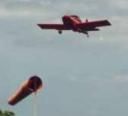 Why does the FAA insist on making students and instructors alike believe that crosswind landings are something fearsome? Area of Operation IV, Tasks A and B of the Private Pilot PTS are Normal and Crosswind Takeoff and Climbs and Normal and Crosswind Approach and Landing. If crosswind takeoffs and landings are not normal, they must be abnormal. If a maneuver is abnormal, perhaps it is difficult and to be feared or avoided. Crosswind operations are not abnormal. On the contrary, operations with winds straight down the runway are abnormal.
|
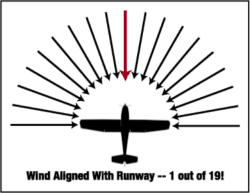
Look at Figure 1. If, for illustration purposes, you limit the wind direction to 10-degree increments, there are 19 possible wind directions from the extremes of a direct left crosswind around the compass to a right direct crosswind. Of those 19 possible directions, only one represents wind directly down the runway. It seems that not only is having the wind straight down the runway the abnormal situation, it is statistically unlikely. (I know that this is a simplification since runways are normally built to be more or less aligned with the prevailing wind at the airport location, but follow along with me here.)
Meet The Wind On Its Terms — And Deal With It
Wind is a fact. Wind is air in motion, and it is wind — air in motion in relation to the wing — that allows us this miracle of flight. Wind is a good thing. Wind is an everyday thing. Wind is not the enemy, but too many pilots leave the airplane on its tiedown because "there’s a 10-knot crosswind." Okay, if you don’t feel up to it, I guess discretion is the better part of valor, but perhaps you should grab an instructor and go out and polish your skills.
 How did we become such a bunch of wimps, anyhow? I think two things are at fault here. The first I’ve already mentioned — the FAA has called crosswind operations abnormal and pilots have believed that. Second, we have become lazy. Nosewheel airplanes — and especially low-wing airplanes — allow pilots to be less mindful of wind when taxiing around the airport than do tailwheel airplanes. Since we are not reflexively positioning the controls during all aircraft movements, it is abnormal when a wind other that one straight down the runway requires control deflection to keep everything straight on takeoff.
Anyone who knows me will tell you I am a big advocate of standard procedures. I believe in doing things the same way all the time. That way I don’t have to remember which procedure to call for. I’m getting older and these old brain cells are not so fast on the recall any longer. I have to keep it simple to keep it doable. Every takeoff is done the same way — line the airplane up, add power and use whatever controls I need to go straight. It can’t get much simpler than that. That kept me on the assigned pavement in the Beech 18 and DC-3 days and it works quite nicely in the jets, too.
CFIs, if you teach your students to deal with the wind from the FIRST move off the tie-downs on that first lesson, wind corrections will come naturally. You have a unique opportunity when you start a new student. That student has no idea what is "hard" and what is "easy." If you make wind correction operations a normal part of the day, then the fear won’t appear. You have a unique opportunity to make things easy for your students. They will come back to thank you.
What We Need To Do About Wind
Since many CFIs have not taught wind effectively and since taildragger pilots seem to be a vanishing species, some of us may have to go out and form some new habits. Be aware of the wind whenever the airplane is not tied down. Use appropriate controls deflections to taxi. Use aileron into the wind and rudder to go straight down the runway. Once you are airborne, use that rudder to keep the ball centered and make a turn into the wind (unless you are on an instrument departure on an assigned heading) and track straight out the centerline of the runway. But then you weren’t worried about the takeoff, were you? Pilots never seem to worry about takeoffs. Everyone worries about crosswind landings.
Crosswind Component
|
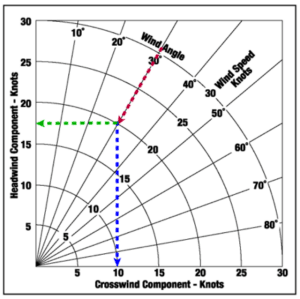
Your airplane has a demonstrated crosswind component. This number is not officially an aircraft limitation. It’s just the most crosswind encountered on the day the test pilots happened to be doing that phase of testing. It’s a good number to start with as a guide, however. The demonstrated crosswind component refers to the component of the wind that is 90 degrees to the runway. You’ll never get that figure from ATIS or the tower or Unicom operator. Figure 2 is a crosswind component chart. Your aircraft manual probably has one, too. If you are departing (or landing) on runway 28 and the wind is reported to be from 250 at 20, what is the crosswind component of that reported wind? Since the wind is 30 degrees off the nose (280-250) follow the 30-degree line down to where it intersects the 20-knot arc. Drop straight down from that to the scale on the bottom to determine the crosswind component of 10 knots and straight across to the vertical axis to determine the headwind component, which in this example is about 17.5 knots. (Notice that the sum of the components is more than the original 20 knot wind. This is common in vector math.)
Federal Aviation Regulations require that all airplanes certificated after 1962 have safe ground handling characteristics with a direct crosswind component of 0.2 Vso. If your airplane stalls at 50 knots in the landing configuration, it must have a demonstrated crosswind component of at least 10 knots. (0.2 x 50 = 10) Many airplanes do better than the minimum. The Cessna 172R Skyhawk, for example, lists a demonstrated crosswind component of 15 knots.
If you are not comfortable in crosswinds, I don’t suggest that you wait for a day of maximum winds. Start slowly and work up to the maximum. Again, the demonstrated crosswind component is not an airplane limitation; however, you are going to have a hard time with insurance company types and lawyers if something untoward happens and you are operating in conditions that exceed the demonstrated component. Just be ready to justify your position. Lots of practice will help with that.
The Crosswind Landing
Landing in crosswinds does take more technique that taking off in them, but so do all landings require more technique than takeoffs. You are using aerodynamic controls that depend on air movement over their surfaces for their effectiveness. As you slow down on the landing, the controls loose effectiveness. On takeoff, the controls are becoming more effective.
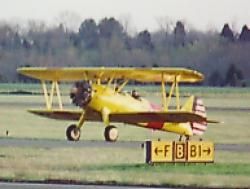 The FAA acknowledges two techniques for maintaining runway alignment on landing. The first is the crab-into-the-wind method, the second is called by the FAA "the wing-down" method. It’s a side slip to a landing. The side slip method has one big advantage over the crab — it lets you determine BEFORE the last second whether or not the wind present exceeds the combined abilities of you and your airplane. In addition, the crab method requires you to align the longitudinal axis of the airplane with the runway at the last second before touchdown. Do it a tad too soon or a tad too late and you will side-load the landing gear. I have never had reflexes that finely tuned, and I doubt that most pilots do.
The side slip method of landing will work in any wind. Bank the airplane to put the wing down into the wind. Use rudder to maintain runway heading. Pretty simple, isn’t it? The slip is maintained right through the flare and touchdown with the touchdown happening on the upwind wheel. The downwind wheel is allowed to settle to the runway when aileron effectiveness can no longer hold it up. (For you heavy jet folks that are now picking up pen [mouse?] to write and tell me that this doesn’t work in large, swept-wing airplanes because of the danger of dragging a wingtip or engine, I know. But until folks get to that point, this method works pretty well.)
Practice, Practice, Practice
Now, I know this sounds easy — and it is once you get the hang of it. Any good habit you want to form is going to take some practice and reinforcement and this one is no different. Dealing with the wind MUST become second nature to you if you want to be a proficient pilot. Grab your favorite CFI and go out and work on some exercises. One of the best I’ve found is S-turns across the centerline. (No, that’s NOT really my version of a localizer approach!) You’ll need the CFI to watch out for traffic and to keep track of what you’re doing because you’re going to be somewhat absorbed in this exercise.
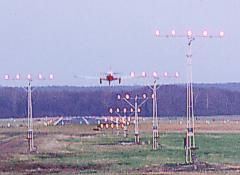 If you’re at a towered airport, ask the tower folks for a low approach over the runway. If you’re at an uncontrolled field, announce your intentions on CTAF. Fly whatever type approach you feel comfortable with to short final but make sure you are on the extended centerline. Fly over the runway at just above touchdown speed and bank the wings into the wind. Keep the heading steady with rudder. Now, if you start to drift into the wind, take out some bank until you stop drifting and modify the rudder pressure to maintain that centerline. If you are drifting downwind, a steeper bank and more rudder pressure will be needed. Keep practicing this until you can track down the centerline by reflex. Make sure you select runways that will give you winds from both directions.
When tracking the centerline like this becomes easy, go looking for more wind. Work up to your airplane’s demonstrated crosswind component. If you find yourself in a situation where full rudder deflection will not maintain the centerline with the bank necessary to correct for the wind drift, you know that the wind conditions exceed the control ability of the airplane. Go find another runway.
The Easy Part
Once you’re proficient at tracking the centerline, the touchdown and roll-out are a piece of cake. Just let the upwind wheel touchdown first, followed by the other main, then the nose wheel. Remember that as the airplane decelerates, you will need to input more aileron deflection to make up for the decaying effectiveness.
This technique works well. You don’t have to ask for a wind check on short final because you will be comfortable with your ability to handle the ambient conditions as you sense them. You will know without asking when the wind is too much for you and your plane. I’ve used this technique in everything from Cessna 150s to Beech 18s to bizjets and it’s never let me down.
Wind Awareness
Awareness of the effects of wind is not limited to takeoffs and landings. My instructor once told me (beat into my head is more like it) that a good pilot always knows three things:
Where is better weather?
Which way is downhill?
Where is the wind?
These are all, of course, predicated on the fact that you know exactly where you are at all times, but a good pilot would know that.
 It’s obvious that you need to know where the wind is to calculate your time, distance and fuel on cross-country trips. But you also need an awareness of wind at altitude and at your destination to predict what kind of wind shear and/or turbulence you may encounter on your approach to your destination.
If you are going to need to divert to an alternate either en route or because of deteriorating weather at your destination it’s always better to pick an alternate that is downwind from your position. Why? Obviously you will need less precious fuel to get to a downwind destination.
Make it a habit to be aware of and position the controls for the wind whenever the airplane is off its tie-down. You’ll find the terror draining right out of those crosswind operations.