



























High performance airplanes, those which fly at both very high speeds in combatand at modest speeds for takeoffs and landings, pose special problems ofbalance. Failure to manage balance can be catastrophic, while properlymaintaining balance enhances the airplane’s performance and saves fuel.
The wing (and sometimes the fueslage too) provides the necessary lift tosustain flight. But the center of lift (CL) along the wing’s surface is notstationary. Typically, the faster the plane goes the farther aft the CL shifts.And conversely, as the plane slows down the CL moves forward. This shiftcan be quite large on aircraft with wide speed ranges.
The center of gravity (CG) moves too. As the plane consumes fuel or dropsits payload (e.g., bombs), there is usually a shift of the CG.
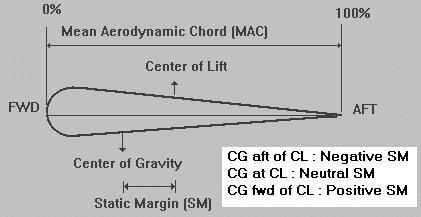
Imagine a line through the airplane’s wing, running fore and aft parallelto the nose-to-tail axis of the plane. This line is called the mean aerodynamicchord (MAC) and approximates the measure of the wing’s lifting surfaces.The foward end of that line is referred to as the “0% MAC” point, and theaft end is the “100% MAC” point. CG and CL are always somewhere in betweenthose extremes.
An airplane flies because of the balance between the forces of lift, gravity,thrust and drag. It climbs, falls, accelerates or decelerates as those forcesbecome unbalanced. More thrust will, not surprisingly, accelerate the plane.You get the idea.
But there is another kind of balance that’s just as important: the balancebetween CG and CL. That balance determines the stability of the plane inthe pitch axis. The plane can pitch up and pitch down or remain stable dependingupon the forces of gravity, lift and the effect of the elevators. There areother factors too, of course, but will not be included here.
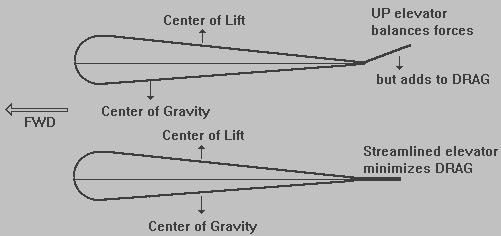
Your author flew in B-58’s, America’s first supersonic bomber. That planerequired constant monitoring and control of its CG, because it flew oversuch a wide speed range. At traffic pattern speeds the CG was usually keptin the 27% to 29% MAC range, but at Mach 2 the CL shifted aft and requireda comparable aft CG shift to minimize drag due to elevon position. (The B-58used control surfaces called “elevons” which combined the function of elevatorsand ailerons.) Minimizing drag to due up elevon position was important at1200 miles per hour!
The position of the CG was usually controlled by tranfering fuel fore oraft. And as fuel was consumed the amount available to use as a counter-balancediminished.
On a typical mission that included a Mach 2 segment, fuel would be shiftedaft to about 34% MAC to streamline the elevons and reduce fuel-consumingdrag. But before you could slow down to subsonic cruise you had to move fuelforward again to maintain a positive static margin. If you didn’t, you facedthe possibility of a negative static margin and an uncontrollable airplane.
Fuel and CG balance kept the crew busy, especially the fellow in the backseat who served as a combination flight engineer and defensive systems operator.
Failure to properly monitor and control the CG, according to the flightconditions, cost the Air Force several B-58 crashes and one in the B-1 twodecades later.
Add to the shifts of CL and CG during normal cruise the complications ofdropping bombs (some as heavy as 7000 pounds) and you have one more ingredientto worry about.
Balance is not only important, it’s crucial to safe flight. Think about it.
