





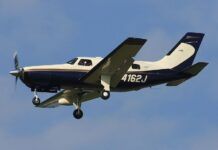










Sometime, watching a twin-engine aircraft taxi out and take off,you’ve probably wondered if you could fly one. When you pokeyour head inside the cockpit, it does look kinda complicated.Lots of knobs and dials there.
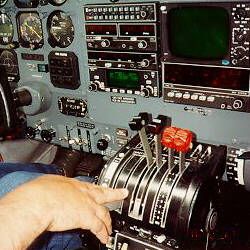 But to let you in on a little secret: it’s really not that tough— most of the time. When everything is working, you just grabtwo throttles instead of one, and away you go.
The systems can be a little more complex — the fuel plumbingis a bit bizarre in some types, there’s likely a gas-powered cabinheater in the nose [a la VW bug], the props are constant speed,and the gear retracts.
But when everything is working, it’s not really a lot differentthan flying a retractable single such as a Bonanza, Mooney, Comanche,or Arrow. In fact, if you’re considering getting your multi endorsement,one idea is to first get checked out in one of these retractable-gearsingles.
The transition from a simple, fixed-gear, fixed-pitch-prop singleto a twin is probably busier than it needs to be. Make life easieron yourself.
If you can, learn about constant speed props, cowl flaps, retractablelanding gear and other fancy frills in a cheaper single-engineaircraft before you start shelling out the big bucks renting amulti.
Why A Multi-Engine Aircraft?
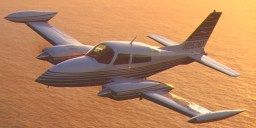 Have you ever wondered why a manufacturer puts more engines onan airframe? There are many people who think that it’s for safety;that a twin is safer than a single. After all, if one enginefails, well, you just keep on flying on the remaining one, right?
No. When one engine on a twin fails, you don’t lose half of yourexcess thrust, you typically lose 80% to 90% of your excess thrust,which means that if you were climbing at 1200 fpm with both engines,if you configure and fly the aircraft perfectly after anengine failure, you will likely see around 200 fpm, which is prettybad.
Most light twins, when operated anywhere near gross weight, havevery marginal single-engine performance, and are very intolerantof pilot error in achieving a positive rate of climb. A non-turbochargedtwin will typically have a single-engine service ceiling of around5000 foot density altitude. So, an engine failure in cruise insummer means you’re likely going to descend.
And remember, with two engines, you’re twice as likely to havean engine failure.
So why on earth would a manufacturer install two engines insteadof one? Apart from specifically-built multi time-builders andtrainers, the answer is: for more power.
If a manufacturer can’t get 500 hp from one engine for a 5000lb. aircraft, well, the answer is to put 250 hp on each side. However, there is additional drag created by the drag of theengine nacelle on each side.
It’s interesting to contrast the performance of the Twin Comanche,with a total of 320 hp, versus the 260 hp single Comanche.
Unless you need multi time in your logbook, I personally wouldtake the speedy single Comanche over the twin, especially whenyou add in the extra dollars per hour of the twin.
Newer, serious light business aircraft such as the TBM-700 orPC-12 use a single turbine engine to get the power required withminimal drag. Also, kerosene burning turbines can fly higherthan any piston-engined aircraft, may of which are restrictedto 25,000 feet. The TBM-700 goes 300 knots TAS at 30,000 feet,which isn’t too bad for a single, eh?
There is another problem with putting two engines out in the wings. When both engines are pulling, everything is nice and symmetrical. But when one engine fails, it is no longer providing thrust —the other engine is providing all the thrust, and in doing so,it causes the aircraft to yaw towards the failed, or dead engine.
It’s actually worse than that. The dead engine, in addition tono longer providing thrust, is also creating drag, since the propelleris windmilling, and the energy to spin the prop has to come fromsomewhere.
The drag the windmilling prop creates also causes the aircraftto yaw towards the dead engine.
Instinctively, the pilot will try to stop the yaw by stompingon the rudder pedal on the side of the engine which is still producingthrust.
In fact, this is how a pilot identifies the dead engine; the "dead"foot, which no longer needs to push on the rudder pedal, is onthe side of the "dead" engine.
At this point, the pilot "feathers" the dead engine. The prop control is pulled all the way back, beyond the featherdetent, and the prop blades rotate to maximum coarse pitch, whichminimizes drag. In fact, at this point, the propeller of thedead engine will stop rotating. It’s really weird, flying along,looking at the stopped blades of a feathered engine.
Back to opposing the yaw. We all know that as you slow down,flight controls get sloppy — they lose effectiveness. Belowa certain speed, the rudder will not have enough authority tooppose the yawing into the dead engine. This results in the aircraftrolling inverted into a spin, and nearly always the deaths ofall the occupants, which creates bad press for general aviation.
What is usually recommended in this situation is to reduce thepower on the good engine, and to lower the nose to increase airspeed,in order to maintain control. Neither of these is a particularlydesirable choice at low altitude, right after takeoff.
As a result, climbing at slow speeds is strongly frowned uponin twins. So strongly, in fact, that this minimum yaw controlspeed, known as Vmc, is painted as a red line on the airspeedindicator, in addition to Vne. Rotation on takeoff before Vmcis really discouraged.
Vmc
As a matter of standardization, Vmc is determined at maximum grossweight, with the center of gravity [C of G] at the maximum aftposition, at sea level, with the flaps set to the takeoff position,the landing gear retracted, with all engines developing maximumpower at the time the critical engine fails and windmills, witha maximum of 5 degrees of bank into the good engine.
Whew. And hold on just a cotton-pickin’ minute, you say.
What’s all this rubbish about a critical engine? And 5 degreesof bank?
Critical Engine
Let’s talk about the critical engine. Look at a twin from behind.
The two normal piston engines, that the manufacturer purchasedfrom Lycoming or continental, will rotate clockwise when viewedfrom behind, just like in a single. And remember slow flight,from your private pilot training? Having to stand on the rightrudder, because the downgoing blade creates more [asymmetric]thrust?
Well, exactly the same thing is at work here. If the right enginefails, and we slow down, looking at a twin from behind, the downgoingblade of the left engine will be inside the nacelle, closer tothe fuselage. This results in a shorter arm for the thrust, whichmeans less torque, or yawing.
But if the left engine fails, as we slow down, looking at thetwin from behind, the downgoing blade of the right engine is outsidethe nacelle, away from the fuselage, which means more torquingor yawing, which means you need more rudder.
All this handwaving boils down to that, as far as control goes,it’s worse when the left engine packs it in. This is why theleft engine is called the "critical" engine.
To help this, in the late 1960’s and early 1970’s, airframe manufacturersstarted installing a counter-clockwise rotating engine on theright side, so it wasn’t as tough to stay straight when the leftengine packed it in. The downgoing blade on the right engineis now close to the fuselage, just like on the left engine.
This why a twin with counter-rotating propellers is said to nothave a critical engine — from a control standpoint.
Banking Into The Good Engine
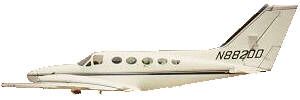 Now, what’s this weird business about 5 degrees of bank into thegood engine? Well, remember that as we bank an aircraft, thelift produced by the wing banks or tilts, too. We can break upthe tilted lift into two parts, the vertical and the horizontal. After an engine fails, if we bank towards the good engine, thehorizontal component of the tilted lift opposes the yawing intothe dead engine.
If a little is good, then more must be better, right? Well, ifwe increase our bank into the good engine, sure, we increase thehorizontal component of lift, and we don’t need as much rudder.
But there’s no such thing as a free lunch. As you bank the aircraft,the vertical component of lift decreases, and the aircraft startsto descend.
It’s important to realize when flying multi-engine aircraft thatcontrol and performance are totally separate issues, and in factare usually at odds with one another.
The 5 degrees of bank chosen for the Vmc demonstration is entirelyarbitrary, and has nothing to do with achieving maximum performanceat the higher single engine best rate of climb speed, known asVyse, which is painted on the ASI as a blue line.
Excessive bank at Vyse, which is nice but not needed for control,really hurts climb performance, which is usually already hurting. To achieve maximum [published flight manual] single-engine climbrate, a rule of thumb is 2 degrees of bank with a non-criticalengine failure, and 3 degrees of bank with a critical engine failure.
Past these bank angles, a sideslip into the good engine will result. And we all know how a sideslip creates drag, which is sure notwhat we want during a single-engine climb.
In fact, with enough bank into the good engine, you can take yourfoot right off the "good" side rudder pedal, and mayeven need some rudder on the side of the dead engine to stay straight.
Great control, but atrocious performance, with a big negativenumber guaranteed on the VSI.
You don’t have to take my word on this, by the way. Tape a yawstring on the nose of your favorite twin, and see for yourselfhow many degrees of bank you really need at Vyse with one engineout. Betcha you’re slipping into the good engine at 5 degreesof bank.
For more information about this, there’s a video you can orderon this subject for $28.00 (US):
"Optimized Engine-Out Procedures for Multi-Engine Airplanes"
Embry-Riddle Aeronautical University
University Distribution Center
Daytona Beach, FL 32014
(904) 239-6484
One fascinating example from the video: a Piper Seminole at 5.6degrees angle of bank (could you fly within 0.6 degrees angleof bank?!) had a ZERO climb rate on 1 engine. Best climb wasa little better than 100 fpm at just over 2 degrees angle of bank.
A small note here: to achieve maximum rate of climb at higherdensity altitudes, remember that Vy decreases as altitude increases,or as weight decreases. Slight finessing of your angle of bankand your airspeed after an engine failure could be the differencebetween a climb and a descent.
Some more information on multi-engine flying is available fromAOPA’s Air Safety Foundation.
The first paper is titled: "Principles to Bank On" andis the cover story for the April 1989 issue of the ASF’s FlightInstructors’ Safety Report (Vol. 15, #2).
The second is: "Engine-Out Booby Traps for Light Twin Pilots"and is the cover story for the April 1993 issue (Vol 19, #2).
Weight
So, we can see that the angle of bank into the good engine inaddition to affecting performance, most definitely affects Vmc. What else affects Vmc?
Well, the published Vmc figure is determined at maximum grossweight. Does weight affect Vmc? Sure it does.
Why? Well, remember, at a heavier weight, if the aircraft islevel, the wings must be producing more lift than at a lighterweight. Think of the lift vector being longer.
And when we bank the aircraft into the good engine, the longerlift vector gives us a longer horizontal component, which opposesyaw, helps the rudder, and reduces Vmc.
At least, according to conventional wisdom. But there’s a catch. At a heavier weight, the wing is at a higher angle of attackto generate the additional lift. And as the angle of attack increases,so does the asymmetric thrust from the downgoing blade of thegood engine, which is what we have to oppose with the rudder.
Altitude
What else can change Vmc? Well, remember that Vmc is determinedat sea level. Does altitude affect indicated Vmc? You betcha.
Why? Well, since the good engine is putting out less power atthe air higher altitude, there is less torque for the rudder tohave to overcome.
At the same indicated airspeed, the flight controls willof course have the same effectiveness.
This little detail has caused heartburn for more than one neophytemulti instructor, who in the interest of safety climbs to a whathe thinks is a nice, safe high altitude on a hot day for a Vmcdemo.
However, since Vmc has decreased below the stall speed, what thenew multi instructor ends up demonstrating is a full power single-enginestall and spin. Oops.
Curiously, the official Transport Canada Instructor Guide:Multi-Engine Class Rating [TP11575E] doesn’t mention thisat all in the Vmc demo guidelines, on page 32.
Center of Gravity
Does C of G affect Vmc? Sure does. Published Vmc is determinedwith the C of G at it’s maximum aft location.
If the C of G is moved forward, Vmc decreases because the "arm"of the rudder gets longer, so it can create more torque, to opposethe yawing.
Cool Video Games
As I said before, it’s not too tough to fly a multi-engine aircraft— most of the time. But when one engine packs it in, especiallyright after takeoff, there is probably no room for any error. The pilot must do everything perfectly, quickly.
One idea for multi pilots is to get some professional simulatortraining, just like airline pilots do, from FlightSafety or Simcom.
A good simulator should behave similar to the real thing, exceptthat crashing is less painful and expensive. It allows an instructorto do terrible things — like failing an engine at rotation —that no sane person would ever dream of doing in real life.
Most people that have gone through the professional simulatortwin training highly endorse it, but it’s sure not cheap. Ifyou have Internet access, for a C-310 pilot’s experience of FlightSafetysimulator training, take a peek at Mike Busch’s article "Training at FlightSafety."
