























How many times have you been approaching an unfamiliar uncontrolledairport and had difficulty determining the landing runway andhow to enter the downwind leg? The decision as to which runwayto use is often made in a hurry while preparing to land.
I have seen some situations of pilots using left turns when rightturns are clearly depicted by the segmented circle. When thesepilots are queried on the ground the common reply is that theythought all patterns are to the left at uncontrolled airports.You could imagine the results of two pilots trying for the samefinal approach from different directions. When was the last timeyou looked for traffic on an opposite base?
Clearly a transition technique from en-route procedures to trafficpattern procedures is needed.
By the book?
The Airman’s Information Manual recommends that we enter the trafficpattern at a 45° angle into the downwind leg. But which runwayis the best for the winds? Often an ATIS report from another closeairport does not completely portray the local surface winds. Andas Murphy’s law has it, nobody is talking on the radio, and fromthree or four miles out the wind sock is just a little orangespeck.
The procedure commonly taught has been to overfly the airportbetween 500 to 1000 feet above the traffic pattern and look atthe wind sock or wind-tee to determine the correct runway forthe prevailing winds. The traffic pattern direction is also observedfrom this glimpse of the segmented circle.
At this point we know what runway and which way our turns shouldbe, but now what? Some mental gymnastics are required as to whichway to turn. Do I make a U-turn, supposing my entry is behindme, continue straight ahead and descend directly on the downwind,or fly the long way around?
Without a unicom or other aircraft in the pattern, it is difficultto ascertain the correct runway for the winds and any non-standardpatterns.
Some pilots use a modified military overhead approach and maydescend onto traffic that might already be in the downwind legbut not communicating. Or some pilots may fly away from the airportafter confirming the runway direction and risk flying into a departingaircraft or noise sensitive areas.
Another scenario may entail being on the wrong side of the airportto enter the downwind directly, and needing to circle the airportsome distance away at traffic pattern altitude. This may conflictwith other aircraft departing at the same altitude, or cause aninadvertent excursion into controlled airspace.
A better technique
As pilots, we are always looking for procedures that are simpleand effective. I have used a "transitional pattern"entry technique for many years with much success. This transitionprocedure borrows a little from the IFR procedure turn and a littlethe military overhead entry procedure. The result is a technique,one that works every time and that doesn’t require the usual mentalgymnastics.

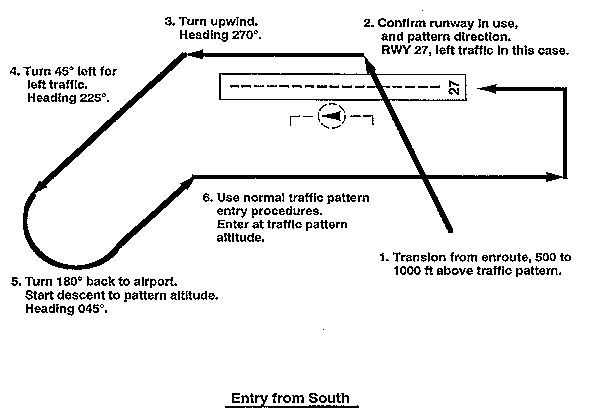
Here’s the procedure, step by step:
Fly directly to the airport between 500′ and 1000′ above thetraffic pattern altitude.
While directly over the airport (or a little offset so youcan clearly see the windsock or wind-tee and segmented circle),determine the intended runway of landing.
Turn to the upwind heading (i.e., runway heading) and flyaway from the airport a comfortable distance (less than 1 minute),still above pattern altitude. To avoid very steep turns if a 180°turn is needed away from the center of the airport, maintainingrunway centerline is not necessary.
Turn 45° in the direction of the traffic pattern (turnleft for a left pattern, right for a right pattern) and proceedoutbound a comfortable distance to maneuver (no more than a minute).Hold altitude to avoid any departing aircraft beneath you.
Perform a 180° turn back towards the airport in the samedirection of the pattern turns (left for a left pattern, rightfor a right pattern). This puts you on the correct 45° patternentry heading. Start descending to pattern altitude and slowingto pattern speed while in the turn. This turning and descendingmaneuver will expose more of your wings to any departing aircraftthereby increasing your chances of being seen.
Level off at pattern altitude before entering the pattern.Now you are on a 45° entry into the downwind, at the correctaltitude and airspeed. The rest is standard traffic pattern procedure,always vigilant of any traffic on final.
Possible traffic pattern radio calls could be:
Overhead at two thousand for runway 27.
Upwind for runway 27 at two thousand.
Outbound on a 45 for runway 27.
Inbound on a 45 entry to the downwind for runway 27.
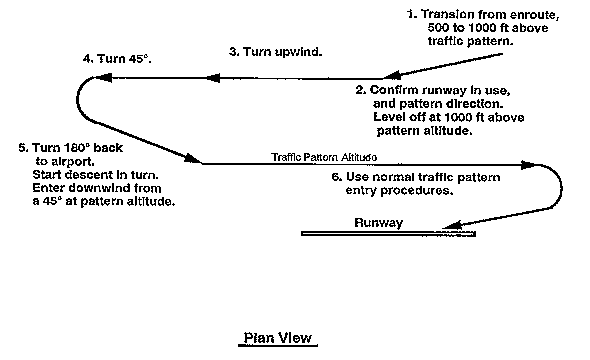
This technique is a good transition from enroute procedures totraffic pattern procedures, and can be used for almost any situation.Exceptions would be terrain or controlled airspace that may haveto be avoided.
This entry technique keeps you turning, which increases your chancesof being seen by other aircraft because of the large area of yourwings against the sky. The technique also keeps you close to theairport in low visibility conditions or when unfamiliar with theairport.
I know that the main reason to fly is to get from one place toanother quickly, and performing multiple turns takes more time.Yes, the transitional pattern takes a few extra minutes, but it’stime well spent avoiding other aircraft. It offers one simpleand easy-to-remember procedure that works for almost all situations.Statistics show that a good proportion of general aviation accidentsare in the landing phase.
