
































 Cessna is toast; Piper is roadkill; and Mooney? Fuggedabout it. The way A. Sandy Munro sees it, the established U.S. GA industry has a couple of years — a half-decade at best — to reform or face being gutted by the same people who dominate the auto industry, steel-making and machine tools: the Japanese.
According to Munro’s blueprint for the 21st century of general aviation, Toyota and Honda — and maybe some Japanese companies you’ve never even heard of — are poised to come out of the ground any day now with aircraft that, while not necessarily revolutionary, will be so favorably priced and of such irresistible value that the used-aircraft market will be reduced to a shambles. The onslaught of inexpensive, high-quality aircraft from Japanese companies, says Munro, will drive the U.S. light-aircraft industry to ruin in a few short years, paving the way to seizure of the real prize: dominance in business and commercial transport aircraft.
By the end of the decade and perhaps sooner, familiar GA manufacturers in the U.S. might be gone for good, not just flitting in and out of bankruptcy or downsizing the workforce to offset the vagaries of market demand.
Munro says there’s still time for the U.S. industry to respond to and blunt the Japanese challenge, but only if U.S. manufacturers reform quickly, instituting cost controls, manufacturing efficiencies and, above all, improved quality. That’s a change we would all welcome but we aren’t holding our breath. We’ve seen hidebound and its name is general aviation manufacturing.
Who Is This Guy?You might rightfully ask who Sandy Munro is and what he’s been smoking. For more than a decade now, we’ve been hearing rumors about projects from Toyota and Honda that never seem to materialize into real products. There have been vague sightings of intriguing aircraft and reports about piston and jet engine projects, and now along comes Munro stitching it all together with a fantastic theory of how the Japanese view business as war and how they’ll use military discipline to take over the world of GA.
Munro is the principal in Munro Associates, a Michigan-based consulting company with expertise in the automotive and manufacturing sector. He came up through the machine-tool industry, did a stint as a Ford auto engineer, and is a keen student of the way Japanese companies do business. He’s also intimately familiar with the work of famed industrial-quality guru W. Edwards Deming, who introduced manufacturing reforms to Japan after World War II. Deming is widely credited with making Japan the economic powerhouse that it is today, its current fiscal doldrums notwithstanding.
In a riveting paper presented to a Society of Automotive Engineers (SAE) aviation conference in April 2002, Munro sketched out what he believes will be the Japanese plan of attack in wresting dominance of aircraft manufacturing from the U.S. It would be easy to dismiss Munro as just another futurist crank, save for the fact that Americans who have worked and are working with the Japanese on aviation projects in the U.S. agree that he may be right. None of them seem to have Munro’s overarching view of Japan’s world-conquering ambitions, but the bits and pieces of the puzzle fit together in an intriguing way.
Munro believes the Japanese will enter the GA market first with an aggressive presence that will stun the established industry. He says Japanese companies will sell light aircraft at prices substantially below what U.S. manufacturers are currently offering, with comparable performance and with fit, finish, quality and customer support comparable to at least mid-priced or luxury automobiles. He believes Japanese companies — thus far, Toyota, in our estimation — are willing to sell airplanes at a loss for as many years as it takes to rid the market of competition. Given the chronic weakness and hand-to-mouth nature of the U.S. light-aircraft industry, we would guess if the Japanese really decide to do this, it’ll be akin to mugging a drunk in a dark alley. Good business sense has never been in surplus supply in the boardrooms of GA manufacturers. Unless it responds forthrightly, Munro gives the U.S. GA industry two to five years after the Japanese onslaught begins.
This is WarIn his paper, Munro says the Japanese laugh at Americans not out of disrespect but because they can’t understand why Americans just don’t catch on to the fact that “business and war are a single entity.” He describes three kinds of companies: those that make things happen, those that watch things happen and those that wonder what happened.
Ford was one of the latter in the 1970s when it ceded the small-car market to the Japanese because everyone knew there was no profit in small cars. But a couple of years later, Ford was shocked to see that Japanese companies had bagged a large share of Ford’s market by underselling cars of better quality.
Munro says they’ll do the same in the aviation industry, beginning with light aircraft. They’ll do it by canvassing current and would-be buyers to determine the market’s wants and needs, hiring the best engineering talent around, fielding an army of round-eyed lobbyists to pressure Congress for aviation-friendly reforms, and exhaustively testing prototypes before rolling out the production models.
These aircraft will be sold automotive style, with showrooms and in-stock delivery options at prices low enough to attract frugal buyers who wouldn’t normally look twice at anything new. This, says Munro, will devastate the used-aircraft market in the U.S. and spell the end of marginal GA manufacturers in the U.S. (In our view, “marginal” fairly describes the entire industry, in terms of profitability if not competitiveness.)
And when will this happen? Munro says the Japanese like dramatic introductions at major events where all competitors will be: His guess is Oshkosh at the 100th anniversary of powered flight. In case you’re rusty on the history, that’s 2003.
Is This Real?If the Japanese are about to burst full-blown into the world GA market, wouldn’t there at least be some clues about what they’re up to? There would and there are. Although Japanese companies have been extraordinarily secretive about their plans — this is, after all, war — as Munro contends, a number of U.S. aviation professionals have done and are doing developmental work for the Japanese. All of these experts have non-disclosure agreements, and none we talked to was willing to go on the record, at least in detail.
Nonetheless, we’ve learned enough to reveal at least some of what may be in the works. One executive we spoke to told us Japanese involvement in GA began far earlier than most people believe, probably reaching back to the 1970s. This is consistent with Munro’s observation that companies like Toyota and Honda have strategic business plans extending as far out as 50 years. One American engineer told us he was astonished to learn that Toyota even has a 200-year plan. “Hell,” he added, “in this country, we’re not looking beyond next month.”
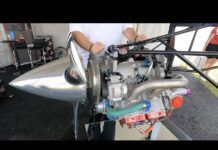
Most of what we know about Japanese GA activity has come through brief glimpses, rumor and speculation. We do know that between 1992 and 1995, Toyota funded an engine research project to explore the conversion of its sophisticated Lexus V-8 engine to aircraft use.
This became the FV4000, a 360-hp watercooled powerplant complete with fuel injection and full-authority digital engine controls (FADEC) that pioneered the current round of engine-control products just finding their way to market. According to those familiar with the project, the FV4000 was a promising engine and was actually certified by the FAA, including type and production certificates.
It was tested in a Piper Malibu and in a Burt Rutan-designed single, and could, conceivably, with further development, have replaced the ill-starred TIO-540 Lycoming used in the Mirage or the TSIO-520 found in the original Malibu. But when you’re an auto company making 6 million cars a year, re-engining a few hundred aging Malibus is lesser work than sweeping up shop tailings.
In any case, the engine was said to be heavy, had some exhaust problems and would have been expensive to manufacture, on the order of $100,000 per unit. (Admittedly, to a Mirage owner looking at his second engine in under 1,000 hours — as many owners have — $100,000 might look like mere pocket change.)
In reality, according to one insider we spoke to, Toyota may have had no intention of producing the engine for aircraft use in the first place. “These companies take the long view. They’re very patient. I think they looked at it as purely a learning experience. They wanted to get some experience in aircraft and certification projects,” he said.
Another engineer involved in the project told us the FV4000 was “a great engine, quiet, smooth and FADEC-controlled.” Further, Toyota left many with the impression that it’s a reputable company to do business with. It paid its bills and did what it said it would.
Toyota Flies | |
| Toyota’s Proof-of-Concept Aircraft In Flight Over California (click for larger photo) | |
More recently and, in our view, of greater import, is the Toyota Advanced Aircraft (TAA) project, the proof-of-concept for what Sandy Munro sees as the sharp end of the Japanese wedge into the world GA market.
As the photo here shows, the TAA is a four-place aircraft looking very much like a Cirrus or a Lancair. It appears to be an all-composite design but could just as easily be made of metal or be a hybrid. This version appears to be fixed gear but there’s room to stow the wheels for a retractable model. Although we believe Toyota is exploring a diesel powerplant, this prototype is reportedly powered by a Lycoming 360-series engine.
It was widely reported that the Toyota aircraft flew on May 31, 2002, from Burt Rutan’s Scaled Composite facility at Mojave Airport. At Oshkosh, Rutan spoke briefly about the Toyota project and confirmed that Scaled has been hired to wring out what is essentially a Japanese design. Rutan says the airplane “has some aggressive composite manufacturing” including single-cure technology for the wings and fuselage. It will also have Japanese-designed, user-friendly avionics similar to what’s found in luxury cars such as the Lexus.
When and how much? Rutan demurred, referring us to Toyota’s Torrance, Calif., headquarters, which is overseeing the project with a staff of about 40 people in the U.S. A spokesman for Toyota offered no additional detail, other than to confirm Toyota’s interest.
One source told us Toyota has committed some 1,000 people worldwide to the GA development project which, if true, is a measure of its seriousness. As for performance of the prototype, little confirmed data exists. AINonline reported that the prototype cruised at 140 knots, with a follow-on product to deliver 160 knots. At first blush, this is none too impressive, but speed may only be part of the Toyota plan, if indeed any plan goes forward at all.
Cheap, Cheap, CheapWhat would it take to ignite volume sales in GA? And by volume, we mean a sustainable world market of, say, 2,500 or more light aircraft. Many agree that price continues to be a major barrier to more aircraft sales, if not the only barrier.
Munro contends that when the Japanese enter the market, they’ll sell at a loss and shock the competition, just as they did in the automotive industry. When you’re willing to bleed a little — or a lot — to seize market share, there’s no downward limit on how cheap prices can be.
If the Toyota airplane sold for $160,000 — a figure that has been reported in the general press — and proved to be a 160-knot cruiser, with 900 pounds of useful load and a modern avionics package, it would certainly be a better value than a new Cessna 172 costing about the same. This price point would challenge the domestic U.S. manufacturers, but we doubt if it would put them under or lay waste to the used market.
GA: A Monument to Inefficiency On Munro and Associates’ web site, we found one of those clever 1940s-style graphics meant to convey an at-a-glance understanding of how to manufacture quality products efficiently. The cartoon depicts a lineup of what goes into a manufactured product — design, material, labor and overhead — and then poses the question, “Who casts the biggest shadow?” Answer: the design engineer. This notion encapsulates a concept pushed by Munro called DFM/DMA, or design-for-manufacture/design-for-assembly. In a nutshell, it means that efficient, error-free manufacturing begins at the design stage, not when the shop supervisor is handed a set of drawings and expected to build hundreds or thousands of a thing efficiently.
In Munro’s view, the aircraft industry — at all levels — lacks even a vague understanding of how to manufacture its products efficiently with as few errors as possible. “Airplane people are different,” says Munro, “they have a totally different way of thinking about things.” And it’s not necessarily a good way. Munro told us he was dragged into the aviation industry reluctantly, at the behest of colleagues working with NASA. His impression of general aviation — remarkably accurate, in our view — was of an industry where “companies die all the time, lose money, borrow some more and lose some more.” His impression of aviation manufacturing techniques: “The goofiest thing I’ve ever seen in my life.” Munro believes GA’s manufacturing woes are fundamental and chronic. “It’s the basic design that’s buggering everything up. It’s just too complicated; too many parts and parts that aren’t alike.” Surely the advent of composites must be an improvement, with wings and fuselages encompassing far fewer parts than in a metal airplane. “It may be a great idea. But I think we’re finding composites aren’t necessarily the best material for airplanes. Look at all those guys poking sticks and rubbing and sanding to get a decent modulus; that’s a killer.” Aluminum, he says, is even worse, with “the whole damn thing built with a 1/4-inch drill.” Although he once thought the industry was a lost cause fueled by passionate hobbyists, Munro now believes there are efficiency gains to be made in aircraft manufacturing. Of late, he has been advising one major aircraft company — you’d know the name — and one of the new-age start-ups making composite airplanes, where he says he found “a lot of 80-percenters,” an assembly task that could be done with 80 percent less effort. Further, he says, many assembly steps shouldn’t be done at all and are often artifacts of a design poorly suited for manufacturability in the first place. This, argues Munro, is a lesson the Japanese have learned well. And U.S. aircraft manufacturers had better learn it, too, if they hope to maintain a foothold in the world of building airplanes. | |

On the other hand, another number we’ve heard — and one Munro believes may be feasible — is under $100,000, say $95,000 for the same airplane specs described above. This would shift the equation dramatically. We know of no U.S. manufacturer who could compete with a deep-pocket company willing to undersell the market that aggressively to achieve quick dominance. And if you happen to own a 20-year-old Bonanza worth $165,000, how will its value fare in the face of a brand-new, high-tech cruiser costing a little more than half as much?
We wonder if the U.S. industry would respond not with better products and improved efficiency but with pleas to Congress for tariff protection, as Harley-Davidson did in 1983. Of course, the Japanese response to that strategy is already in place: The airplanes would be built not in Shimoyama or Hokkaido but in French Lick, Tenn., or some other nice little U.S. berg happy to have an influx of manufacturing jobs. (Toyota already has nine plants in the U.S.)
One point Sandy Munro’s paper doesn’t mention is that, in the automotive and motorcycle industries, the prize was volume eventually numbering in the millions of units. Once the competition was ruthlessly eliminated, there was money to be made.
Can the same be said of general aviation, however? Does Toyota think it can sell 20,000 airplanes a year or even 5,000? Yes, says Munro, they probably do. He believes the company envisions initial worldwide production of as many as 5,000 airplanes, perhaps increasing to 25,000 airplanes a year by the third or fourth year of entry into the business.
“No,” says one of the U.S. project partners we spoke to, “they were thinking in the 500 to 1,500 a year range.”
No Cake WalkIf meeting that mass volume goal is a must, we think the chances of Toyota or Honda or the Japanese in general achieving rapid world dominance in light aircraft manufacturing to be daunting at best. While we’ll stipulate that Toyota has succeeded brilliantly in the car business and could probably apply its acumen to the airplane market with similar success, we wonder if the sparse returns will make it worth their effort. It seems to us that there may be better industries for a company to invest its resources in, even if the 50-year goal is to snatch the commercial market away from Boeing and Airbus.
The fact remains that, due to the unique confluence of stodgy government certification, low volume, widely varying and economically sensitive demand, and complex manufacturing, making a buck selling little airplanes remains a difficult business.
In his paper, Munro argues that the Japanese will invent new rules and use materials traditional manufacturers never thought of to create unheard-of manufacturing efficiencies that will make cheap prices possible. Perhaps. Call us hopeful but skeptical, too.
Munro told us his sweep at the market reveals that 1 percent of the U.S. population — or about 2.8 million people — constitutes the universe of potential aircraft buyers. We’ve heard this number from marketeers before but the industry has never come close to tapping even a respectable portion of it.
Although purchase and operating cost is a significant gotcha for owning a new airplane, neither U.S. nor foreign airplane makers have proposed any serious ideas to eliminate what we increasingly see as the real barrier to GA expansion: jumping through the training and licensing hoops and reducing the sheer hassle of using a light aircraft for meaningful transportation in complex, congested airspace.
People who venture into the world of GA aircraft sales seem to stubbornly ignore this, adopting the over-optimistic, what-me-worry view that, once swept up by the romantic notion of the “freedom” of flight, suffering the training to actually learn to fly it will be trivial. In reality, many buyers who can afford the airplane don’t have the patience, time or aptitude to learn how to fly it.
In his paper, Munro identifies the training issue as a sales showstopper but in the next breath, he seeks what many in the industry will view as hopeless: “I am one of the new market and there are hundreds of thousands of us who don’t want to join your elite club of techno-geeks, masochists and daredevils. I want to learn to fly a jet (IFR) in a week; I don’t want to be a ‘pilot error’ statistic.”
Oh, is that all? From zero to IFR in a mere five days? We asked Munro to elaborate. Not being a pilot, he’s not intimately familiar with the current regime of flight training which, at best, entails weeks or months of often frustrating training.
Munro told us he has seen two radically new training approaches that may make it possible to learn piloting skills in a mere fraction of the current requirement. Because of non-disclosure agreements, he declined to elaborate.
We don’t know if it’s possible to learn to fly a jet IFR in a week. Maybe Toyota can figure that out. We do know that thus far, no one has come close to a fundamental revision in training doctrine that substantially reduces the time, effort and expense necessary to earn a plain-vanilla private-pilot certificate, never mind an instrument rating.
Even at that, the would-be one-week miracle pilot still has to land the airplane in bumpy crosswinds, deal with scary weather and handle the inevitable abnormals with enough coolness to survive.
In our view, if general aviation is ever to be a practical semi-mass market as convenient and accessible as the automobile, this will be the most difficult nut to crack. We’re not saying it can’t be cracked, just that we don’t see how it will be at this juncture.
PredictionsIs Munro right? If the Japanese launch the attack, will they put the U.S. GA industry permanently to rest? We think it’s a long shot, but if Toyota and other Japanese companies decide to move, history suggests Munro is correct. Yes, GA is different than the machine tool industry and the auto industry, but those industries also thought they had a unique understanding of their own markets.
The larger question is, will Toyota, Honda and others see enough long-term growth and profitability in aviation to suffer the pain of establishing a beachhead in a money-losing GA entry? And if not now, when?
Our guess is as good — or bad — as yours. That said, we think Toyota will come out of the ground with prototypes within three years. As Munro — and others — predict, they will test these extensively, sampling customer likes and dislikes, then show another round of prototypes. Munro is adamant that Toyota isn’t just fishing; they’re serious about getting into GA.
We expected to see Toyota at Oshkosh this year, and one engineering insider told us the company’s original plan called for prototype introduction in 2000, but this was delayed two to three years. We’ll be looking for the Toyota booth at Oshkosh next year, or 2004 at the latest. Beyond that, we can’t wait to see what Toyota decides when it comes to grips with the realities of selling little airplanes and training people to fly them.
Munro told us he’s “100 percent sure” Toyota will come into the market, although he’s less certain about timing. He sees this turn of events as both a warning and an opportunity for U.S. manufacturers.
He believes they’re being given more time than other vanquished industries had to institute quality and cost controls and to generally improve their products before the onslaught begins. If they do it correctly, U.S. products will remain competitive with anything the Japanese do.
Cirrus, Diamond and Lancair have certainly made strides in quality control, but as any new aircraft buyer can tell you, quality in general has much distance to cover for U.S. manufacturers.
Cessna’s reintroduction of what are, after all, half-century-old designs was beset with quality shortfalls, not the least of which is the recent grounding of the 206 fleet for crankshaft problems. GA buyers put up with this because they have no choice; there’s no standard-setting paradigm of excellence. If Sandy Munro is right, there soon may be.