

















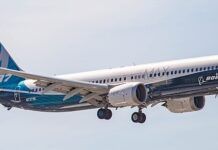

The FAA has just issued an Airworthiness Directive for Boeing 737 aircraft that incredibly does not offer to solve known problems with the aircraft’s rudder Power Control Unit (PCU), but instead mandates crew training so pilots can attempt to survive sudden control problems.
NTSB investigators remain unsure why two Boeing 737s crashed, one near Pittsburgh and the other in Colorado, although rudder problems definitely are suspected. The 737 is the most popular airliner today with 2,705 flying world wide, including 1,115 in the U.S.
The FAA mandate requires Flight Manual changes and crew training to instruct pilots how to correct jammed or restricted flight controls.
That’s right. The FAA has said that test by Boeing showed the 737’s rudder PCU under extreme conditions could jam and even go in the opposite direction desired. Imagine the fun of that on a gusty landing! I certainly would call a rudder movement in a direction opposite from input an extreme condition at time or altitude.
Is training to overcome a mechanical uncertainty a viable solution for one of the worst conditions a pilot could ever face? The FAA goes on to suggest a pilot lower the nose in such a situation to increase airspeed and regain control of the aircraft. The FAA does not clarify, to my knowledge, if this procedure is to be used only at altitude or maybe at Decision Height on an ILS night IMC approach.
Only a fool would do such a thing to an aircraft already out of control due to rudder hardover (sudden rudder movement) mere feet above a runway.
What? Just slam her down, split the gear, and maybe walk away saying that is what I was told to do?
The pilots who fly 737s, the Boeing Co., and the FAA have known about these problems for years. A fellow flight instructor I gave instruction to in aerobatics subsequently was hired by Piedmont (now US Air), and he told me in the early 1970’s that the 737 would get into a “Roll Oscillation” condition on approaches under gusty or turbulent conditions. He said the plane would then have to be flown manually, with locked elbows to force the yoke steady, until the aircraft stabilized.
Other pilots have told friends of unexpected and sudden rudder hardover at altitude and said they did not think they would have recovered had they been on approach. There was no indication of problems from the crews involved in the two approach crashes, so you know it happened suddenly and that it was unrecoverable.
If a Cessna or Beech or Mooney had a problem with the rudder jamming unpredictably, you can bet the FAA would ground the aircraft until the problem was fixed. But because the Boeing 737 is the world’s most popular jetliner – and the economic impact and loss of public trust that would be caused by a grounding order is simply unthinkable – the FAA is instead imposing upon crew members the edict to break the FAA’s own rules: namely those rules that require, in terms of aircraft and airman certification, that no unusual or extraordinary piloting techniques or abilities be required. This A.D. presents a ludicrous position unworthy of the FAA.
Additionally, a standby procedure is mandated that requires the switching off of the rudder’s hydraulic assist system under prolonged conditions and executing approach and landings manually. Let’s hope lady pilots type rated in 737s have had their Wheaties before preflight.
It is my opinion that there still exist the potential for disaster until the actual problem is solved. Components should be redesigned, if necessary. The resolution of this problem belongs to Boeing, the FAA, and the Air Carriers – certainly not to the pilots in the cockpit where it is just a little too late for engineering, or attempts at aerobatics on short final with a plane full of paying passengers.
This situation needs to be resolved immediately before the possibility of lives being unnecessarily lost becomes a reality.
| Editor’s Note: For a counterpoint to this article, please read Vince Massimini’s "Viewpoint 2: The Problem Can’t Be Fixed Until It Is First Understood." |
