


















The grass strips serving the towns of Banff and Jasper in Alberta,Canada, are scheduled to close forever. This fight has been going on formany years, and AOPA and COPA have been helping the local pilots make theircase, but if you’re the letter writing type, this would be a good time todo it. There’s a bit of Parliamentary juggling left to do before it’s a faitaccompli, but if you think they’re worth saving as destination ordiversionary airports, you’d better fire off a letter to Ottawa pretty soon.Parliament plans to take up the issue at the end of March 1997.
I was on a skiing vacation in that area last week and decided to visit theBanff airport to see about an hour of dual. I hadn’t had any luck findingan FBO before I left San Diego, and once I got there, I found out why.
Spectacular Country
The town of Banff lies near the eastern edge of Banff National Park, oneof four adjacent National Parks. I live at the beach in Southern California,so any mountains are a refreshing change of scenery. But the mountains atBanff are extra spectacular because the thin Bow River Valley means thatwhether you’re driving (the Trans Canada Highway runs through the valley),riding the train (the Canadian Pacific Railroad runs through the valley),skiing, fishing, hiking, or flying, you’re enveloped by towering cliffs.
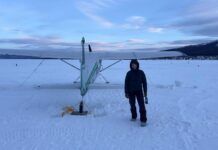
Banff’s airport is a 3,000 foot grass strip on the north end of town, elevation4,583 feet. It’s snuggled in a little corridor of flat land between the TransCanada highway and Cascade Mountain. There’s no FBO and no commercialservice…by law. There are about nine planes based there year round, andseveral more snowbirds that come back from warmer climes after the Aprilthaw. It’s one of those pure, pristine settings for a general aviation airportthat remind you of the glory days of early aviation.
Rumor is that Banff’s airport was created in the early 30’s by a petulantmovie star who wanted easy access to her vacation home. Over the years, ithas evolved into a staging area for mountain rescues and forest fire patrols,and, perhaps most importantly, a place for overflights to divert to whenthe fickle mountain weather changes.
Why Close These Airstrips?
A joint study by Parks Canada and Transport Canada determined that thereis little need for the airport for safety reasons. The pilots based at Banffhave countered that the “joint study” was authored by a commercial pilotfrom Victoria, (450 miles west of Banff in a different province and climacticzone) who didn’t talk to any of the local pilots and who had flown throughthe Bow Valley only once. About 60 days a year the east side of the Rockieshas upslope conditions which cause North or East winds and cloud blockagesand the East side of the mountains. Often the chinook winds and the venturieffect create very high winds at Exshaw, the next airport 25 miles to theeast. Apparently the commercial pilot chose to ignore or was unaware of theseconditions.
Parks Canada has determined that the airstrip impedes the movement of wildlife.Parks Canada used their staff wildlife biologists to develop their conclusions.The pilots comissioned their own study by three independent wildlife biologistswhich shows movement of elk, coyote, deer, wolf, cougar and numberous smallmammal tracks on the airstrip, adjecent to it or on the lower slopes of Cascademountain. The pilots’ study determined that the actual blockage to animalmovement is the Trans Canada Highway fence which runs into Mt. Stoney Squawless than a mile to the southwest. Parks Canada has no plans to relocatethe highway.
A similar situation exists in Jasper, about 150 miles to the northwest.
Parks Canada has decided to close all airports in their parks unless it canbe demonstrated that they’re needed:
for access to a nearby town (that isn’t the case here because the Trans Canda Highway and the Canadian Pacific Railroad serve both Banff and Jasper)…or,
for emergencies or enroute weather diversions.
Environmental Considerations
The more I learned about this the more I thought about the old joke: anenvironmentalist is someone who thinks it’s okay for him to builda house in the woods but wants to keep you from building one. Obviouslythe pilots that live there and pilots who visit do so because of the naturalbeauty, and no one would want that to vanish. Parks Canada claims that theyneed to close the airstrip to promote endangered wildlife, but then theyargue that it’s okay to have a national highway full of cars, trucks andRV’s, a national railroad and the government’s heliport just a few hundredfeet away. The elk are not shy about using the airport. On hot days theylook for shade just like homo erectus. One of the local pilots gaveme a picture taken last summer of his 172 with an elk under each wing.
In talking to the local pilots I got the feeling that the Parks and Transportdepartments had decided to work together to accomplish something neithercould do on its own, then tried to steer the facts in their direction. Maybefor the sake of the animals it’s the right thing for these airports to close.But I agree with the local pilots that the wildlife study the governmentbased that decision on is far from thorough or independent.
What will happen if these two airstrips close? Local pilots will relocateand be less available for fire patrols and mountain searches. All GA pilotswill lose convinent access to a great summer and winter destination, and,since weather reporting stations are far and few between, it’s not hard toimagine a dramatic increase in controlled-flight-into-terrain accidents aspilots flying through the valley encounter unexpected conditions and aredeprived of a place to divert.
What You Can Do
If you’re a Canadian citizen and you think these airports are necessaryfor safety reasons, send a letter to your MP. I’m told you don’t even needa stamp from within Canada. If you’re from below the 49th parallel, send aletter to:
or send a fax to: 613 991-0851.Margaret Bloodworth, Deputy Minister
Transport Canada
Ottawa, Ontario, Canada
K1A 0N8
Since the Parks Canada Act states that "Banff and Jasper will have airservice," they’ll have to amend the Act before they can implement the BowRiver study. But hurry, they plan to debate the issue during this sessionof Parliament.