






























You’ve purchased a new-to-you airplanewith a panel-mount IFR GPS — but the placard reads “VFR-only.” AsLarry Anglisano explained recently in AviationConsumer, you can upgrade yourunit to IFR (but you may want to sell it and start from scratch). Here’swhat it’ll take to make it happen.
This article appears in the April, 2002 edition of AviationConsumer, and is reprinted here by permission.
With the world of avionics changing faster thanyou can cycle a master switch, even those of us who deal with this stuff everyday have our hands full keeping track of it all. What’s new? What’s best? And,increasingly, what’s legal?
Because of the massive influx of new technology, there’s a long tail ofradios, navigators and displays stretching back more than a decade, leading manyowners to ask us if the old RNAV, loran or even first-gen GPS they still have inthe panel is legal for IFR.
Surprisingly, the answer is often yes. On the other hand, some recentinstallations we’ve seen of supposedly IFR-approved navigators aren’t legal atall. They don’t have the right components, lack the switching networks and therequired paperwork can’t be found.
As more used GPS units find their way to market, expect to see more of theseinstallations in an airplane you might consider for purchase. Does it matter ifit’s legal or not?
It depends on what you plan to do with the airplane. In most cases, the legalnits don’t matter on day-to-day, practical basis. If you file /G with a VFRpanel-mount, you’re unlikely to get busted — but it’s still not legal. And ifyou think you’re buying an IFR navigator, make sure that’s what you’re getting,not a “VFR-only” installation.
VFR-Only
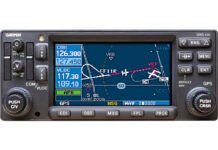
[Click any image for a larger version.]At a quick glance, both of the Garmin navigators shown here appear to be identical. Yet the 150XL, top, is a VFR-only GPS while the GPS 155XL, lower, is IFR approved. However, that doesn’t mean it was certified for IFR in the aircraft it was installed in. Check the logs and AFM to find out if it’s legal. The number of VFR-only GPS navigators in the fleet is relatively high. Someare even “IFR approvable” but not legally certified. It’s not uncommonto see something like an older Garmin GPS 155 or even a Bendix/King KLN90B –both IFR units — installed on the cheap, with a “VFR-only” placardsomewhere on the panel. That might lead you to conclude that the placard is anartifact, left over from a previous installation.
Chances are, however, the IFR navigator was put in by an owner who just got agood price on it and had no intention of using if for IFR. The shop complied –which it can legally do — and put the placard on the panel, thus avoiding thetime and expense of an IFR flyoff and the additional paperwork.
Some owners, upon discovering this, assume that since they have an”IFR-approvable” GPS, getting it officially blessed for legal IFR is apiece of cake. Sometimes it is, but usually it’s not. Nor is it cheap. Let’sexamine what’s required.
Keep in mind that every airplane is unique and we see all kinds of strangescenarios that suggest that what works for one won’t always work for another.


TSO Or No TSO?
As with most other avionics equipment, GPS units and their components arebuilt to a TSO specification and, in the world of GPS navigators, the two mostimportant are TSO C129 (A1) and TSO C129 (A2) — A1 being en route, terminal andnon-precision approach-certified while the A2 versions allow en route andterminal navigation only, no approaches.
There are some en route only boxes out there, such as the UPSAT GX-55 andsome versions of Garmin and Bendix/King navigators, that weren’t signed off forapproaches in the particular airplane they were installed in.
What’s the difference between en route and terminal operations? CDI scale,mainly. The terminal mode allows a 1-mile scale while en route is 3 miles.
The IFR TSO is quite specific about what an IFR navigator is supposed to doand how it must be installed. Some of the specifics include one-second positionupdates, fixes stored in a non-corruptible database, pilot selectable CDIsensitivity, RAIM integrity alarms and paths between fixes defined only by TO-TOnavigation.
Now, if your TSO’d receiver has the official approved designation, it will doall this stuff and a lot more. But unless it’s installed with all the requiredannunciators — including the required coupling to a CDI– it may not beIFR-legal.
Sometimes, a box that looks just like an IFR-approved navigator isn’t. Forexample, you can put two physically identical GPS units– the Garmin GPS150XLand the GPS155XL –side by side. The difference is that the GPS155XL is blessedwith TSO C129 (A1) while the GPS150XL isn’t, falling under AC 20-138 for VFR-onlyguidance.
Similarly, before it made the KLN89B and the KLN90B — bothIFR-approved navigators — Bendix/King had VFR-only versions.
To qualify for installation approval, the GPS sensor or antenna must alsomeet the TSO. Some of the earlier Bendix/King KLN90 navigators, for example, hada non-TSO antenna system. After all, they weren’t IFR boxes so they didn’t needa TSO’d antenna. Don’t assume that you can use the existing antenna with any IFRnavigator. Have your shop check the part numbers before proceeding with anupgrade.
Transplant It
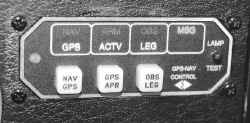
Two must-have items for most GPS IFR installations include a TSO’d antennna, top, and a remote annunciator / switching panel, such as the MD41, lower photo. Some navigators have self-contained annunciation. Our advice is that, if you’re in the market for a quality used IFR system,find an entire system that was removed from the same aircraft and purchase allcomponents as a package. For example, the aforementioned IFR KLN90A/B can be hadon the used market quite reasonably, complete with the required annunciationcontrol panels and appropriate antenna removed from the very airplane it wasapproved on before.
While on the subject of antennas, the shop may want to replace any cable youalready have in place. Let them. Although the existing cable from a VFRinstallation will likely work for feeding signal to the receiver, low-losscoaxial cable is required and for good reason.
You’re guaranteed top performance with the bonus and flexibility for longercable runs with minimal signal loss. Most common is the expensive RG142 coaxand, if you don’t have it already, it should be added to meet the IFR criteria.
With some navigators and applications, an RF signal notch filter, appropriatefor the 1.5GHz band, should be installed to provide uninterrupted GPS signalflow. These filters were imperative with many earlier GPS systems and your shopmay recommend one.
As a side note: with panel and fuselage space often tight, optimum placementof components is an ever-increasing challenge. Major manufacturers are learningwhat works well and not so well with different airframes and/or when mixingequipment. You can only hang so many antennas on a airplane without conflict.Even with the best possible combination of placement, outside factors such asnoisy strobes and beacon power supplies will make their presence known, even ifthey have previously caused no problems.


The Baro Connection
It’s a 50/50 deal whether that old beater VFR GPS currently in your paneltalks to your altitude encoder — but your new IFR GPS will have to.
Altitude information must be fed to all IFR installations from an encodingaltimeter or blind encoder. Why? Because the altitude feed is necessary for RAIMcomputations and is also used in conjunction with navigators that have VNAVdescent profile features.
Most common altitude encoders output “gray code” data formataltitude information. However, some navigators — the entire line of UPSAT/Apollounits, for example — accept only serial data, a more precise data stream.
In these cases, either an appropriate serial encoder must be installed or agray-code-to-serial “happy box” converter will be needed.
The point is, while better shops go the extra mile to provide the barointerface to even VFR boxes, some shops don’t bother. Plan for it if you want anIFR-approved system.
Similarly, if the transponder/encoder system is getting tired, now’s the timefor upgrade because there’s little room and tolerance for marginal equipmentwhen interfacing IFR GPS. As we have reported, newer transponders such as theGarmin GTX327 and UPSAT SL70 output altitude data in either serial or gray codeformat for the purpose of feeding a navigator. It’s nice to have the choice butit’ll cost money to get there.
En Route Only | |
When making the switch to IFR from a VFR install or buying a new or used navigator, many owners struggle with the question of certifying for enroute only or enroute and approaches. As always, the cost Delta comes into play and when its all added up, it almost always makes sense to opt for full approach certification, if theres a choice. As far as the legalities are concerned, if you have an (A2) box — enroute/terminal only — you can freely use it as a DME substitute, for off-route IFR navigation and to substitute for ADF on ADF-required approaches. DME substitution also applies to precision approaches. The good thing about an (A2) box is that you neednt have a current database for legal IFR navigation. Youre allowed to use current paper charts to check fix accuracy. (As if anyone actually does that.) For approaches, youll need a full-up (A1) box, installed with all the remote hardware, flight checked and with an approved AFM supplement. Were quite certain there are owners out there flying approaches with properly installed IFR GPS that isnt legally approved. If youre picky about such things — we are — get the flyoff and paperwork done. If your existing GPS is VFR-only, its probably what we call standalone, meaning it doesnt drive a CDI and/or it isnt interfaced with the altitude encoding system. To make it en route or (A2)-approved, a flight test will have to be done and a Flight Manual Supplement prepared and youll still need mode annunciator lights. So the steps and equipment required to make it IFR-legal are similar whether you go C129 (A1) or (A2). Of course, if the navigator is only approved to C129(A2), such as the UPSAT GX55, youll have no choice other than another navigator entirely. Some owners have suggested that an approach-approved navigator be interfaced for en route and terminal only, in hopes of saving some money. But that makes little sense. Get a quote for both options and youll see why. And last, if youre still on the fence about the IFR versus VFR issue, but want to install a GPS navigator, buy a box thats TSO C129 (A1) approved. You can always add the required accessories and interface later on. The cost difference between a basic VFR versus basic IFR navigator is surprisingly little. Its the interface and accessories that drive the cost up. |
Remote Hardware
All IFR installations require varying degrees of remote annunciation, exceptthe Garmin GNS530/430 and Bendix/King KLN94 in which annunciation is integral tothe navigator. But when remote annunciation is required, it must be positionedwithin the pilot’s normal instrument scan.
These mode annunciators and control switches advise the pilot of any messagestransmitted from the navigator and appropriately arm and activate the approach,if the navigator is approach-capable.
Also required for both en route or approach certification is a coursedeviation indicator which displays GPS navigator left/right and nav flaginformation. This can be accomplished with most HSI systems and many options arepossible for interfacing with rudimentary nav heads, as we reported in the Marchissue of Aviation Consumer.
In any case, if your existing VFR GPS doesn’t display steering information ona remote head, this will be the most costly part of getting it approved for IFR,assuming it’s a TSO’d box.
The Paper Chase
Now that IFR GPS has become relatively routine, most FAA FSDOs seem to knowwhat’s required to make these systems legal. We don’t hear many horror storiesabout FSDOs requiring a $10,000 contract to a DER to write a POH supplement.However, there’s no question that some FAA regions are quicker at IFR approvalsthan others.
We polled several shops on both coasts and most report that the IFR GPSapproval process and satisfying the expected criteria usually goes without ahitch. What’s important is that approval paperwork is clearly drafted and allthe details appropriate to the installation are noted.
System integrity has to be proven and all of the hardware and interfaceswe’ve described here must be referenced.
Most shops that routinely turn out IFR GPS installs aren’t running into snagswith the FAA. Buyers should remember that until it’s officially approved, thesystem is to be used for VFR navigation only and placarded accordingly. Consultwith your shop beforehand and review the exact procedure for your region.
Generally, what FAA offices seem to want is proof of absolute systemintegrity. Most owners underestimate the amount of paperwork and testingrequired for an IFR GPS, whether approach or en route-certified. A Flight ManualSupplement is drafted and this booklet is specific for each installation. Itdescribes all aspects of the GPS installation and includes general systeminformation and specifications, emergency operating procedures in case ofmalfunction, system limitations, normal procedures, proof of flight testing andapplicable FAA paperwork, such as FAA Form 337.
Most FSDOs are specific about flight test data. If the navigator isapproach-approved, multiple GPS/overlay approaches must be flown to prove thatthe system will navigate the approach and the missed procedures. If thenavigator is interfaced with an autopilot, it must also be proven that theautopilot will fly correctly. Other parameters include passing through fixeswithin a specified degree of accuracy and proper interface with existingon-board stuff, including a radio interference test.
Once the Flight Manual Supplement is approved by the FAA and the shop, it hasto remain in the aircraft at all times, since it’s part of the AFM.
We’re not sure how interested the FAA is in enforcing these fine points inthe regulations. Theoretically, if you fly an IFR approach and are ramp checkedand found wanting in the paperwork department, it’s no different than gettingramped without having required weight and balance aboard the aircraft. Accordingto our polling there have been violations, but we don’t know how often it hashappened. We don’t think it’s a good idea to ignore these legalities, but it’syour ticket.
If the navigator and/or installation are certified for only VFR, a placardmust be installed on the instrument panel that says as much. We’ve even heard offolks failing an IFR ride because they filed a /G plan without having the GPSapproval paperwork. We assume the examiner was paying back the applicant backfor weaseling out of the ADF portion of the test.
Conclusion
Although system certification has become straightforward, we have seen manyinstances in which a customer has purchased an aircraft that was represented asbeing IFR GPS-equipped, only to find that the documentation was missing.
Either the seller had an IFR system slapped in to make the aircraft moreattractive but never followed through with the certification paperwork or thework was done and never filed properly. We have also worked on a few factory-newMooneys, going back to the early 1990s, that were represented as IFRGPS-equipped but didn’t have appropriate annunciation for the GPS system.Somehow, they slipped off the assembly line unfinished.
In any case, expect your shop to proceed through the installation with afine-toothed comb because they’re accepting responsibility for the integrity ofthe system.
In short, making an IFR system out of a VFR system can be relatively painlessor a nightmare, or anything in between. In many cases, it may actually becheaper and more practical to buy a used transplant system and keep the VFR GPSin the panel as back-up — or sell it on the used market and apply the proceedsto the IFR installation.
About the author…
Larry Anglisano is the Aviation Consumer avionics editor. He works with EXXEL Avionics in Hartford, Connecticut, where he does GPS flyoffs, among other tasks.