




























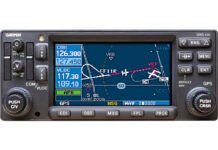

VHF Comm
Many years ago it was decided that civil aircraft communications radios would use the118-137 MHz band, and would use amplitude modulation ("AM"). Like many otherthings in aviation, this has remained unchanged for many decades. It’s a pity, because ourair-ground communications would have much better audio quality if we could switch tofrequency modulation ("FM") as the majority of commercial broadcast stationshave. But it looks like we’re stuck with AM for the foreseeable future.
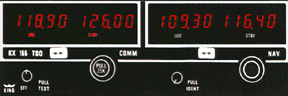 Inthe old days our aircraft communication radios were limited to ninety channels spaced 200Khz apart. As more channels were needed, the channel spacing was reduced. Modern aircraftcomm radios have 760 channels spaced 25 Khz apart. These comm frequencies lie in theportion of the radio spectrum known as "Very High Frequency" or VHF, defined as30-300 Mhz. Military aircraft use a different band in the "Ultra High Frequency"or UHF spectrum (300-3000 Mhz).
Power, range, and modulation
Frequently I hear a pilot say "I wish I had more power so I could talk to Centerwhile on the ramp." General aviation comm radios transmit at a power output of 2 to25 watts. In most cases, more power wouldn’t help. VHF radios operate strictlyline-of-sight. If Center can’t hear your 5-watt radio because there’s a hill in the way,100 watts wouldn’t do any better. Think about the ELT for a moment. It can send a signalto a satellite thousands of miles away on just one watt of power, because there’s a clearline-of-sight.
I figure anything over ten watts is a waste and is added load on the radio. Anotherthing to look for is the way the manufacturer measures power output. Some use phrases likePEP, RMS, average, etc. If you’re attempting to compare the power output rating of tworadios, make sure you’re comparing apples with apples (e.g., PEP with PEP).
The best way to improve the range of an aircraft comm radio is by installing a goodantenna system. As with all radios, the antenna is the heart of the system and a poor onewill do a poor job regardless of how good a radio you have. I recommend that if you’reinstalling a new comm radio, you have the antenna system checked out also. Nothing worsethan paying $4,000.00 for a new radio, only to find out that it preforms no better thanthe old clunker you pulled out because the antenna is no good.
King makes a little gizmo that is installed between the antenna and the aircraft radioand permits you to plug in a handheld transceiver. When plugged in, the handheld uses theaircraft antenna for its antenna, providing greatly increased range. Normally, at seventhousand feet, you should be able to receive and transmit a range of around fifty miles.This is of course is true only if it is line of sight and no big rocks like the Rockies orSierras in the way.
The receiver
Another important thing that must be set properly is the modulation level of thetransceiver. Most radio manufacturers call for 90% modulation of the carrier by voice. Ifmodulation is too low, your voice will sound weak; if too high, it will be badlydistorted. This adjustment must be done by a shop with the proper testing equipment. Newerradios have build-in protection against overmodulation, but most older radios do notincorporate this feature. If you overmodulate the radio, your transmissions will begarbled, and may also interfere with adjacent channels.
The receiver portion of a comm radio is every bit as important as the transmitter.Receivers incorporate a "squelch" circuit to eliminate background noise whennobody is transmitting on the frequency. On most of the older comms, you manually adjusteda squelch knob until you heard the back ground noise, then backed it off slightly untilthe noise went away. Most of the newer comms have "auto-squelch" in which thesquelch level is pre-set on the bench and the pilot simply has a switch to turn thesquelch on or off. Most auto-squelch circuits are set to open at a signal strength ofthree microvolts (just in case you wanted to know). If the received signal is less thanthree microvolts, then you hear nothing. If the signal is greater than three microvolts,then you hear whatever is there.
Reliability
Older comm transceivers (particularly those from the vacuum tube era) have a highfailure rate. The newer solid-state units like the King KX-155 and Narco MK-12D seldomfail. The older radios had crystals to determine the frequency in use. These get out oftolerance often and are expensive to replace. The newer radios use a synthesizer to selectthe desired frequency and are very reliable.
Many of us use "nav-comm" units that combine a VOR/LOC navigation receiverwith a communications transceiver in a single chassis. Even though they share the samebox, very few components are shared between the nav and comm sides. So if the nav receiverfails, the comm is still likely to be working…and vice-versa.
VHF Nav
The most used piece of navigation equipment in the world today is the VOR or"very-high-frequency omnidirectional range". They are around 800 VOR stations inuse today in the U.S. The VOR operates from 108.00 to 117.950 Mhz which is in the VHF bandlike the comm is. This is good because VHF frequencies are relatively immune to static andinterference, making them excellent for navigation. All VOR stations have a three letteridentifier and some have voice weather.
The VOR station produces a radial pattern by transmitting a 30-Hz reference and a 30-Hzvariable-phase signal. The nav receiver in the aircraft compares the phase of these twosignals and figures out what radial from the station it is on. It then compares thecomputed radial to the radial that the pilot selected with the "omni bearingselector" (OBS) and deflects the "course deviation indicator" (CDI) needleto indicate any deviation between the desired radial and the actual one.
How it works
To understand how the receiver can tell what radial it is on, let me give you ananalogy. Suppose you have a lighthouse that sends out a powerful light beam which rotatesone full revolution each minute. Suppose also that the lighthouse has a strobe light ontop which flashes precisely when the beam passes magnetic north. Now if you were flying invisual contact with the lighthouse, you could start a timer when you saw the strobe flashand stop it when you saw the searchlight beam. The time difference between the two wouldalways tell you what radial you were on relative to the lighthouse. If you saw the beam 15seconds after the strobe, you’d know you were on the 090 radial from the lighthouse; if 30seconds, you’d be on the 180 radial, and so forth.
The VOR station and receiver work exactly the same way, except that both the"beam" (variable signal) and "strobe" (reference signal) are replacedby radio signals, and the "beam" rotates 30 times a second. If the reference andvariable signals are the same phase, then the nav receiver knows it’s on the 360 degreeradial. If the variable signal is 90 degrees out of phase with the reference signal, thenthe nav receiver knows it’s on the 90 degree radial.
As with comms, the older nav receivers use crystals for selecting the correct frequencyand these fail with age and are expensive to repair. The newer radios use a synthesizerfor tuning and are very reliable.
Localizers and glideslopes
Almost all VHF nav receivers handle localizers as well as VORs. The localizer is in thesame band as the VOR, and uses certain channels in the lower portion of the nav bad thatare dedicated for that use. Localizers have four letter identifiers starting with"I" (for ILS).
The localizer beam is produced by two transmitters operating on the same frequency butmodulated with different audio signals. The transmitter on the left has 90 Hz signal on itand the right one has a 150 Hz on it. The two signals are carefully aligned so that theyare of equal strenth precisely on the extended runway centerline. If the aircraft is leftof course, the 90 Hz signal is stronger than the 150 Hz signal, and the nav receiverdeflects the CDI to show a "fly-right" indication. Conversely, if the aircraftis right of course, the 150 Hz signal is stronger than the 90 Hz signal, and the receiverproduces a "fly-left" indication. Basically, that’s all there is to it.
Interestingly enough, although we’re required to check and log the accuracy of our VORreceivers every 30 days for IFR operation, there’s absolutely no regulation that requiresthe localizer or glideslope receivers to be checked…EVER! But I’d strongly suggestchecking them at least once a year if you do IFR approaches. Can you imagine shooting anILS in low weather and discovering that the indicator is three dots off? Most radio shopshave a portable battery-powered checker that allows checking the VOR, LOC, and GScalibration right on the ramp in just a few minutes.