







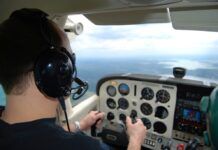






 After what felt like an eternity, I finally soloed. I then completed my three supervised solos, flights where I stay in the pattern and John my instructor watches from the ground rather than from the seat beside me.
I say that I flew all by myself, but of course I had my imaginary instructor in the cockpit with me. Some aircraft come equipped with an automatic pilot; mine comes with an automatic CFI. "How’s your heading?" "Did you identify the VOR?" "How about doing a GUMPS check." No matter how long my flying career is or where it takes me, I will undoubtedly always have this voice in my head reminding me of proper procedures. Voices that will sound an awful lot like my primary flight instructor, John. Of course, if need be, I suppose I could have that voice exorcised.
Despite all of that solo flying, the airplane still works so it is now time that I had my first taste of flying somewhere solo. Not just flying around, but flying "somewhere." John and I had completed a couple of dual cross-country trips to introduce me to the notion that airplanes can actually take you somewhere. On this day, I did my first solo cross-country flight. I flew 59 nm from Ellington, Conn., to Keene, N.H. And then home again. All by myself. So this is what flying somewhere is all about!
 To begin my day, I first meet with John to go over my flight planning. We talk a bit about VORs, which are still not one of my strong points. Armed with that refresher, I should be all set to fly to Keene. John and I wrap up our discussion and I get busy getting busy. First of all, I call Flight Service and file a couple of flight plans. One for the trip up to Keene, and one for the return. They are placed on record, waiting for opening and closing with each leg of my flight. It’s a simple process of detailing to a briefer the specifics of a trip. Information such as your aircraft identification, departure point and time, destination airport, how long you expect the flight to take, the amount of fuel you have on board and a number to contact should you not show up as expected. This makes it ever so important to close your flight plan when you are safe and sound, back on the ground. If you do not return as expected, they start looking for you, which is a good thing only if you are truly overdue.
False Start
I then head out to the airplane and do a thorough pre-flight following the printed checklist. I don’t want to miss anything that someone deemed important enough to include on this checklist. I find that all is well with my airplane, climb in and prepare to fly. Taxiing to the active runway, I do the run-up, throttle up and away I go. I begin the climb out, but something’s amiss. I hear nothing on the frequency. Surely there’s something going on here at Ellington on this early Thursday morning, but as I climb I still do not hear a peep. I hear nothing from Block Island. I hear nothing from up in Keene, N.H., two fairly busy airports on the same Unicom frequency as my home base, 7B9. I don’t like this; I am heading back down. I land and come to find out, there is something wrong with my headset. I am pleased to find that it wasn’t just my imagination. It wasn’t a case of "automatic rough," where the airplane develops quirky problems and sounds only when it’s alone with me. I plug in a new headset and once again I’m off. By this time however, I’m feeling a bit frazzled. Things are not going according to plan.
As I start out on-course, I tune in the frequency for the Keene VOR, turn up the volume, listen to the Morse code and identify the station. I dial in the course with the OBS. Then I promptly forget all about it. Do I check the To/From indication? Nope. Do I match my heading to the one that I just set in? Nope. Do I even attempt to follow the needle as it swung about? Of course not, I am on a roll of making mistakes. Perhaps I expected the airplane to fly itself on the proper radial, I just don’t know. All I do know is that I was well on my way, unbeknownst to me, to getting lost.
Maybe contacting Flight Service through the Bradley RCO to open my flight plan distracted me. It’s a good excuse and I am going to stick with it. Whatever the reason, I stopped paying attention to my heading and busied myself with other, less-important matters. Next I called up Bradley Approach to get flight following. I suppose this was so they could follow me on my journey to I’m Lost International. I was so concerned with the little things that before I knew it, I was off-course. Had I remembered my earlier discussion with John about VORs, life would have been easier. Why, just that morning, John had explained that when you center the needle with a TO indication it is basically screaming at you that if you fly this heading you will get TO the VOR.
VOR Navigation …
 VOR navigation is truly simple, even though it seems quite difficult at first. Among the first things you want to do is to set your heading indicator or directional gyro to your compass. This is very important, and very easy to forget. Next you set the VOR’s frequency and identify it to make sure that it is working properly. When that is all done, set the OBS to the radial that you chose during your flight planning. Always keep your heading the same as what’s selected on your OBS to avoid reverse sensing. Reverse sensing happens when your OBS course and heading are 180 degrees different, and you are tracking the radial opposite your intentions. You won’t be going in the direction that you want. Noting your TO/FROM indicator will let you know if your direction is TO the station or FROM it.
What it all boils down to is that flying a heading is the important part. If you fly a constant heading to determine how it affects your position relative to your desired course (VOR or visual), then you can adjust your heading in the proper direction and see how flying that heading affects the flight. If you don’t fly a constant heading, you will never know what heading caused you to be right or left of course and therefore do not know what change to make. These were the basic things that we reviewed that morning.
Why didn’t I use this information? Instead of following my course, tracking the VOR, or even looking at the big picture out the window, I was more focused on where I was at that exact moment in space and time. An exact moment that certainly changed with each passing moment. Like a dog chasing her tail, I was staying one step behind in my navigating. No wonder I became lost; I actually deserved it. Instead of looking out the window at the miles and miles of visibility, I concentrated on my immediate vicinity allowing myself to miss big landmarks nearby.
… and Pilotage
 And speaking of big landmarks nearby, I don’t know how I did it but I missed the biggest landmark on my course to Keene: the Quabbin Reservoir. You can see that body of water for miles and miles on a nice VFR day, which today certainly is. On this day I did not see it, much to my embarrassment. I could blame it on the "Quabbin Triangle," something akin to the Bermuda Triangle, only here there are no ships to disappear mysteriously; the body of water does. Truth be told, I missed this large lake because I flew west of it. My VOR receiver didn’t keep me on course, the darn thing. I will have to put in a squawk to my mechanic on that problem.
I ended up finding and flying up the Connecticut River, fully knowing I was off course but too nervous to leave a known quantity for the unknown. If I turn east here to try to find the Quabbin, I might miss it entirely and end up really lost. What I should have learned that day was that, in oh so many ways, altitude is your friend. I am flying and lost with just a long ribbon of water underneath me that will lead me home — my safety rope. As long as that river stayed below me and didn’t move like that steenkin’ reservoir, I would be all set.
Well, the kind folk at Boston Center sensed this student pilot’s error and they kindly asked if I was headed for Keene, N.H. When I replied in the affirmative, they vectored me back on course. If I had climbed higher and looked beyond my narrow focus, I would have seen my course laid out there and would have been able to position myself accordingly without ATC’s help. But did I? Heck no. I held fast to my position, wrong as it was.
With altitude you can truly get "the big picture." With altitude you will see how the world looks more like the sectional as you go higher, except not quite as colorful. (That’s why one of the Four C’s of a pilot’s "I’m lost" procedure is climb. — Ed.) Staying at cruise altitude until I have the destination airport in sight is a very wise bit of advice, as I learned countless times later. It is much easier to do 360s to get down to pattern altitude than do 360s trying to find where the heck I am.
Another good consideration when flight planning is to pick out some terrain "brackets" in case one becomes temporarily misplaced. Here in New England, I have some terrific easy-to-recognize topography. We have an ocean and a couple BIG north/south rivers. Up to the north it gets "bumpy" with the Berkshire/Green/White Mountains of Northern New England. Viewing the terrain with the big picture in mind certainly aids in navigation. When we fly we are given the ability to see for miles and miles, using that gift is a good idea.
Getting Reoriented
 I suspect that getting disoriented is all part of the learning process and good to experience early. If you never become lost how can you learn to get un-lost? Once again, by using your VORs you can accomplish this and work your position out in reverse. To find your current location using a couple of VOR stations, you simply center the needles with a FROM flag. Draw a couple lines on the sectional chart to match and where the lines intercept is where you are. You can use this information to help orient yourself. In any plane, but most especially in a plane with only one VOR receiver, it helps if you circle something that looks as if it should be on a sectional. Stay there while you play the intersecting radial game. The lines should intersect at or near the feature you’re circling. It’s sort of like you are standing on a street corner and you don’t know where you are. Look at street sign #1 then look at street sign #2, bingo, I am at the corner of Madison and 42nd. "You are here." John showed me this trick with a sectional and the dual-purpose ruler, also known as a plotter. The first purpose of the ruler is to draw a straight line. The second purpose is to whack me on the head if I don’t get it right.
Not having the experience base to accomplish such a sophisticated maneuver as triangulating VORs, I am grateful for my guardian angel at Boston Center who ushers me back on course. Isn’t flight following grand? With that help, I find the airport just fine. I enter at a 45 degree angle for the left downwind to Runway 20 and land with nary a bump. Okay, maybe ONE bump. I taxi off, clean up the airplane, and head towards the terminal building. I shut down the plane and head inside. First on my agenda, close my flight plan. Then call my husband. At least I have my priorities straight.
As I’m talking to my husband, I start shaking. My body is shivering, trembling uncontrollably. It’s as if I’m freezing cold. My voice quivers, my legs are weak and my hand shakes. Phil wonders what is wrong with me, as he can hear upset in my voice. What in the world is going on? It’s chilly but it’s not THAT cold. I can only assume it was the stress of the flight coming out now that I didn’t have to be so calm, cool and collected. I didn’t feel all that stressed during the flight, but I was lost if you’ll remember. I suppose that could make anyone nervous. I remained there for a bit, calmed down, had something to drink, chatted with the airport manager, and when I felt fine again, I headed out to get ready to go home.
The Get-Back
I walked outside to the airplane and was embraced by a tremendous sense of ownership. All of the local flying, the dual flying, that didn’t give me a feeling of ownership such as this. But walking up to the airplane sitting there on the ramp, unlocking the door with my key, doing the preflight in a different state, all contributed to a very proud feeling. This was "my airplane" and I was just about the coolest person on the planet. It’s a wonderful feeling to swagger around a strange airport and get into "your" airplane. I really felt like A Pilot In Command!
 My trip home was almost perfect. I found each and every checkpoint, held the heading, held the altitude. Heck, I even enjoyed the flight! My two "mistakes"? One, I couldn’t rouse Bangor Radio over the Keene VOR. I tried a few times but there was no response. Yes, I’d turned up the volume on the VOR so I could hear it. Perhaps I was too low in trying to contact them, there are some "mountains" about that could interfere with radio reception. If I had really needed to open the flight plan I could have checked the sectional map and found an RCO around Keene, or another VOR with voice. I have the theory that sometimes "flying the airplane" takes all of my brainpower. Limited brainpower sometimes, so to expend that brainpower on opening my flight plan seemed wasteful to me. Also, I do hate having my head inside the cockpit for too long and searching the sectional chart for another VOR would make me do that. Additionally, I wanted to have the flight following in place, so I bagged trying to open my flight plan, and called Boston Center for flight following. With this, the flight plan would actually be redundant. Certainly if flight following had been denied, I would have pressed harder in opening my flight plan with Flight Service.
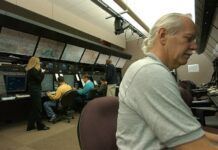
Thankfully there was no difficulty in getting ATC assistance that day. It made me feel more confident to have another pair of eyes out there looking with me. And to think, my biggest fret not too long ago was being forced to talk to them. There was a time that I was so afraid that I’d get all tongue-tied and mixed up while talking to air traffic control, not sounding like the professional that I wasn’t, that I avoided it. I guess the fear of getting all lost and mixed up by NOT talking to them took precedence here, huh? I do think that my trip to the tower at Bradley International Airport helped me a great deal. I was able to chat with the guys in real life that I talk to on the airplane’s radio. I saw that they were regular human beings. Well, they were humans, at least.
I recommend that any student pilot (heck even seasoned ones) takes a tour of a Class C or larger facility for a peek into their world. They can be of tremendous help. But remember that they work with you on a time-available basis. So, an eagle eye is still very, very important. But, ask them a question and they will do their best to help. Both Boston Center and Bradley Approach went out of their way to help me on this flight. I did mention at the start of the flight that I was a student pilot on my first solo cross-country. I don’t think that hurt my chances for finding help. Someday it’ll come easier, that I’ve learned, that I’ve already mastered. I’m learning to learn.
Reflections
 En route home, the flight was a piece of cake. After departure and reaching cruise altitude, I started hearing all the different sounds around me. The engine and the wind, and for the first time, my behind felt as if it belonged to the fuselage. Feet and legs, hands and arms, they felt like organic extensions of the rudders and yoke. It was all starting to feel more natural to me, the "natural-born pilot." Sometimes the absolute beauty of flying can be so peaceful and right. I knew that this is going to be one of those sometimes.
Out by Westover ARB I flew with a C-5 transport plane for a while. Now that was something amazing. I hear the controller call to the "Heavy" that he had traffic at his 3:00. He couldn’t see me. Then ATC called to me to see if I could see the traffic. Are you kidding? It’s as big as a house! No, it’s BIGGER than a house. How could I not see that thing? The rest of the flight was pretty much uneventful.
I knew I was getting close to home, I didn’t quite know how close I was, however. Bradley called to ask that I let them know when I would begin my descent. Okay, fine. Bradley then calls to tell me that I’m six miles north of the airport. This was my second "mistake." Not realizing how close to home I really was. At 4,500 feet my town looks much different than 1,800. I am only six miles away? My, I cannot see anything down there but a bunch of gray looking earth. Oh wait. That ridge line? That looks familiar. That lake over there, that’s my dog lake, a reservoir shaped like a dog that points its nose to "home." There is the big picture. Now I see the airport, I’m home. I tell Bradley I have the airport in sight, I change frequency, squawk 1200, and I bring it home again. And I land with a thunk. Oh well, one out of two isn’t bad.
Editor’s Note:
Additional articles in this series by Tina Gonsalves include:
