












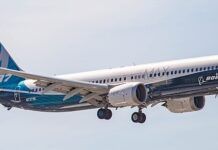

 The Continental Airlines flight is en routeback to my home outside of Denver. The B-737/300 is climbing through FL 280. Mysix-foot-five frame is packed into seat 5D and there still appears to be blood circulationto the extremities. The ride is going well, but I harbor a secret wish. If only the flightattendant would announce calmly, but with just hint of tension: “Ladies andgentlemen. I regret to inform you that the pilot crew has passed out. It seems they atethe bad fish. Can anybody fly this airplane?”
With a certain amount of feigned modesty, I would look up from my laptop where I wasperusing the latest edition of AVweb, push the call button, and calmly say,”May I be of some assistance?” You see, as these very words are being peckedinto my laptop confuser, tucked into my wallet is a brand new Temporary Airman Certificatewith these words: Type Ratings: B-737.
It was just last night that my proficiency with the 100,000-pound Boeing staple wasdemonstrated to the FAA. Grandly, I paraded the ship all dressed up in ContinentalAirlines livery through the Nebraska skies near Omaha. For nearly an hour as we struttedthe approach courses into KOMA and neighboring airports, I WAS Captain Phillips. Withfirst two, and then one, and then two of the engines humming, a permanently postponeddream of flying for the majors was briefly realized.
What am I doing here?
 What is so remarkable about this journey to the heavy iron? Withnearly 7,000 flight hours, the logbook tallies less than 50 hours of multienginepilot-in-command time. At that, the heaviest twin flown was the beefy little Piper Seneca.What was it like for a straight-ahead general aviation type to make that quantum leap frompiston to turbojet? And why?
A good story always includes the terminology, “One day….”
One day, a colleague who sells and coordinates training for a major airline’s contractcustomers asked, “How would you like to teach our clients to fly Boeing 737s? The payis good. You can instruct on your own schedule. You can teach until you’re dead (no age 60limit). Best of all, you might have some fun. All you need is a 737 type rating.”
The idea of instructing at but not flying for an airline as a career path is notfar-fetched. With hiring at an all-time high and with about 15,000 pilots finding jobs inthe airline industry last year, training demands by both large and small carriers arestretched. Some airlines will hire contract instructors to teach systems, procedures, andsome simulator sessions. To conduct simulator training, a B-737 type rating is required.
Of course, another reason someone would contemplate investing in the “type”is to bolster personal flying credentials and make oneself more marketable in the hunt foran airline cockpit job. A notable example is Southwest Airlines, which requires a Boeing737 type rating before extending an offer of employment.
Imagine sitting at the table that night with a life mate of 22 years (which, if you dothe math, puts me well past the average hiring age of airline pilots) and asking,”Honey! You know that basement remodeling job we’ve been saving for and, uh, what doyou think about me spending the better part of that $10,000 for me to learn how to fly aBoeing 737? Pass the chicken. And how was your day?”
With support uncommon to most aviators’ spouses, Cindy said, “Go for it.”Thus, with the official green light, the research began.
What are my options, and what’s it gonna cost?
 At the time of my training, two basic programs were available to anairman looking to add the coveted B-737 make and model to the list of flying skills. Thepath to pursue – and the expense – were dictated by certain requirementscontained within the Federal Aviation Regulations.
Presume that you are an experienced professional who has spent some time flying in themilitary or have a real job driving a kerosene-powered airplane. In this instance, youhave probably qualified for the economy route to the rating. It was possible under theFARs to earn a B-737 rating and forego any practical test in the actual airplane (at$55 per MINUTE!) and demonstrate proficiency solely in an FAA approved B-737simulator. Such a device is not your basic Microsoft PC-based simulator software programbut a mega-million-dollar box that moves and shakes through the entire range of flight.The most sophisticated of these magic marvels is termed a “Level C or D”simulator and must be landing approved. These contraptions are so realistic that it ispossible to log landings in the “sim” … including teeth-rattling”arrivals.”
With no previous turbine experience, I was not qualified for the simulator-only track.I resigned myself to the fact that I would need to ante up for and fly thehonest-to-goodness airplane … oh, darn! I then commenced burning the phone lines totraining resources.
I quickly discovered that the magic inscription “B-737 Type Rating” on apilot certificate can vary dramatically in price.
Do you want to do it at United Airlines just like the pros? According to UAL FlightTraining Services, an investment in the neighborhood of $25,000 will take you throughabout three to four weeks of training conducted by United pilots and instructors. Thetrainee will experience a similar regimen that a United Airlines Flight Officer does, withthe exception of the airline’s two-week basic indoctrination track. The United programoffers additional training in evacuation and ditching, Cockpit Resource Management (CRM),and Line-Oriented Flight Training (LOFT). Airplane not included.
Flight Safety International’s Long Beach training center also offered 737 type ratingsin a month-long format but the cost can be as high as the mid-teens if there is only onepilot in the class. Additionally, the company required a minimum of 3000 hours of totalflight time to enroll.
Not able to swing either thirty days off or the equivalent cost of a 95 Chevy, Ibegan to peruse the aviation trade journals oriented to the future airline pilot. I founda half dozen or so display ads by a number of “type shops” each advertising 737type ratings in the $7,000 range for those qualified for for the simulator-only path toabout $9,000 to $10,000 for individuals who would be required to take a portion of thepractical test in the airplane.
There are some very important things to look for when talking to the representatives attype rating schools. Prices may or may not include lodging and examiner fees. Courtesyground transportation could be unavailable. A school might cancel a class in the event aminimum number of students are not recruited for a given start date. There is apossibility hefty surcharges will be assessed in the event you are the only student in aclass. Deposits may be non-refundable in any circumstance. Some companies simply do notwelcome low-time pilots and set high entrance qualifications. A few sources offer only a”restricted” B-737 type rating to a piston pilot like myself, wherein there isno airplane flight test option available. (Such schools typically cite”liability” and “insurance” as an issue.) A restriction is placed onthe pilot certificate which can be removed once “Initial Operating Experience”at an airline is completed.
Okay sign me up!
 When all was said and done, I settled on Jet Tech International in Phoenix (800-FLY-JETS). Thecompany, founded over eight years ago by US Airways pilot Shane LoSasso, has earned anindustry reputation as having trained more pilots for the 737 type rating than any othersimilar organization. I figured that the school must have it “right” by now.
A call to Jet Tech revealed that the two-week course, including 50 minutes piloting thereal airplane, costs $8,995. Yes, you are welcomed with only a commercial/instrumentrating but you should have advanced instrument skills …. no other time requirement. Yes,lodging at a brand-new motel is included. Yes, the hotel provides courtesy transportationto both the airport and the school. Yes, examiners’ fees are part of the package. Yes, theschool begins a class weekly with even one student … and there are no additional fees ifyou are the only person in class. The refund policy is more than fair.
In addition, Jet Tech is just about the only type-rating company in its price rangewhich has its own simulator right on the property, thus making training time moreefficient and cost effective. However, since the Jet Tech “sim” is not landingcertified, final preparation and the simulator evaluation is normally conducted at AmericaWest’s or US Airways’ training centers.
I then contacted graduates of the program and even the local FAA Flight StandardsDistrict Office. You see, type-rating schools are under the supervision of FAA OperationsInspectors who monitor a program’s content and quality. In fact, I learned that Jet Techis even under closer FAA scrutiny than the run-of-the-mill “type shop” becausethe company trains pilots from airlines around the world. I did eventually meet a crewfrom the old Russian airline Aeroflot who came to Jet Tech for B-737/300 transitiontraining as they tooled up to fly for a new carrier in the Ukraine.
With nothing but commendable reports, I said, “Sign me up, Shane!” With a$1,500 deposit, I ventured into 737 school, which includes over 50 hours of systems groundinstruction, four hours of cockpit procedures training, 22 hours of simulator experience,and 50 minutes in a genuine, big-as-a-boat 737!
Homework
 Oh! There is one hitch. Within 48 hours of sign-up, an expressdelivery box comes to the door with no less than thirteen pounds of Boeing manuals andchecklists covering every system and procedure to be learned. In addition, Shane LoSassohimself has authored and edited a mega-manual entitled “The Straight Word” whichdoes a superb job of translating Boeing jargon and keys in on “the meat.”
With the box of books comes a syllabus. Be prepared to spend a minimum of eighty hoursof home study BEFORE showing up for class! This requirement, which runs from a two-hourjunket on “Air Conditioning and Pressurization” to eight hours understanding andmemorizing “Procedures,” is absolutely essential to surviving the on-campusground school. Do not call up today to enroll in a class next week. From my perspective,it just cannot be done.
For two months, every free moment was wrapped up in the @$##* manuals! On the bus tomom’s? Reading the manuals. Instead of watching the tube with the family after dinner?Reading the manuals. In the porcelain library? Reading the manuals. Lots of memory items,too. “Don’t extend the airstair with winds in excess of forty knots.”Don’t exceed 420C degrees EGT during engine start when outside temperature is above15C degrees.” “Don’t use the autopilot roll channel above FL 300 with the yawdamper inoperative.”
Finally, after weeks of cramming information into the brain and hoping it will not fallout, it is time to show up for class at 8:00 a.m. on a Thursday morning.
Let me relive the adventure with you.
“Welcome to Jet Tech,” says every staffer. Each team member is so veryfriendly and goes out of the way to make the student comfortable. Why, even donuts andbagels are served up for the recruits on that first day. That’s because the”Tech-ees” know that you will need the energy. Shortly after the”hello’s,” the office manager plops a test on the table before you with it’seighty questions and a variety of “memory item” scenarios to probe the successof your home study efforts.
The missed episodes of “Fraser” were worth it. I manage to get through theexamination in great shape.
Mastering the systems
 For five days, Jet Tech Instructor Jim Milton pumpsmore and more and more information into the heads of his two charges: myself and Anne, aFederal Express Caravan pilot looking to break into the “majors.” Diagrams,memory aids, trivia, minutia, more diagrams, facts, figures. Why, did you know that theforward lavatory flush motor is powered by the #1 AC Main Electric Bus and takes less thanten seconds to flush? Arghh!!!!
From 8 AM to 5 PM every day including the weekend, Jim pours it on, all for the dreaded”orals” the following Tuesday. It did not end at 5 PM either. Each night back inthe very comfortable Sleep Inn, I pass on the hotel hot tub and work the 50-questiontake-home test along with more study.
Finally, after the better portion of the B-737 is reviewed, diagrammed and dissected… including a pre-flight inspection of a Southwest Airlines B-737 parked at PHX … itis time for the oral section of the practical test.
For two hours, the FAA Examiner probes, cajoles, picks, prods, and pokes into the innerrecesses of my overloaded grey matter. “What items are powered by the A’Hydraulic System? What happens when you arm the alternate flaps switch? Is this takeofffield or climb limited? What conditions must be met to deploy the thrust reversers and howdo they operate on both the basic and the advanced airplane? Can you take the extra 2000pounds of lobster that the airline’s best customer wants to take with him?” Huh?
By noon, the hurdle is hurdled. Pass!
Fortunately, Jet Tech’s customer-focused approach and systematic schedule allows mesome time off between Tuesday’s “orals” and the following Monday to conduct somebusiness back home. But, at 1 PM on Tuesday afternoon, I am back at it. This time,ex-America West pilot and training guru Carl Wobser is the taskmaster.
Learning to fly the thing
 For six days including six hour simulator sessionsdaily plus two hours of briefings, Carl mercilessly piles on normal procedures, abnormals,fires, engine start aborts, V-1 cut after V-1 cut, rapid depressurization scenarios,overheats, emergency descents, APU fires, two-engine approaches, single-engine go arounds,landing gear malfunctions, asymmetrical flaps, jammed stabilizer, runaway trim, and on andon and on. Uncle!!!!
But, it finally gels. In those five days, my crewmates and I (Dan, a Saab 340 Captainfor American Eagle and Don, an F-16 test pilot for the Air Force) cope with more problemsand emergencies than any airline pilot would in a lifetime of flying.
The time has come! The flying portion of the practical test is conducted in two phases.
It is Tuesday night and the heavy-duty emergency procedures and flying proficiencydemonstrations are evaluated in a Level C simulator at America West Airlines. For twohours, the heat is turned up by the FAA Examiner. Stalls, steep turns, and every approachin the book with two engines, one engine, and engines flaming are flown to minimums. Throwin a half-dozen or so system failures and glitches to keep it interesting. The “RightGuard” gives up about 23 minutes into the session.
Made it! Despite every curve ball thrown in that simulator, this ol’ boy bats into basehits: maybe not home runs, but definitely in the game.
Next, the final phase of the practical test means it is AIRPLANE TIME!!!
I’m due to have a date with the Boeing in Omaha a week later. At the courtesy ofContinental Airlines and Jet Tech, I am flown into Eppley Airport for my checkride.
It is 10 p.m.. Ohmygawd! It is sitting there at the ramp, and I’m going to get intothis giant aluminum can and actually fly it! After the extensive pre-flight under thewatchful eye of the FAA Designee and a Continental Airlines representative, I slip intothe cockpit … and it is home. I’ve been here before. Other than the view out the window,it is the familiar environs of the 737 simulators I have been flying all along.
 I fire it up …. the CFM-56 engines come alive …. ahhh … thisis a 737-500! No screamy little “Pratts” on this beauty. Outstanding!
Blast off down the runway …. this ain’t my ol’ 182, momma!!!
At 135 knots, pull the wheel up to 15 degrees pitch. We are smokin’!!!! “Positiverate … gear up!” I’m looking straight up into the stars at a 16-degree angle thatwould have rendered my little Skylane flightless.
I desperately attempt to keep the outward appearance of a cool airline Captain, but I’mrevved up inside. Not since the first solo has anything been so electrifying andexhilarating. It’s almost as good as … well … uh, ya know!!
Despite my initial rush, I settle down to business … and it is serious business. Wedo the checkride drill. All too soon, though, the 50 minutes flash by and I nudge themachine back to the jetway. It’s done: three B-737 landings along with a few instrumentapproaches and maneuvers to boot.
Everybody was right. It IS easier to fly than the simulator. The Boeing 737 is nothingmore than that fine Piper Seneca on steroids. I loved it. I want one!!
Damn … I did it!
Now that it is all over, there is most certainly a sense of accomplishment. Of course,in my case, this new achievement will be put to some commercial use in a trainingenvironment which will in the long term (hopefully!!) justify the expense. But if I neverearned a dollar from the investment, it was a heckuva trip!
In retrospect, the most challenging aspects of this endeavor were these.
I admittedly had difficulty juggling the tasks of flying the beast and alsocoordinating the crew and calling for the proper procedures and checklists at theappropriate time. For example: An engine out occurs on an IFR approach to minimums. AtDecision Height there is no airport in sight. Now, in addition to preventing the airplanefrom smacking the turf, the pilot must have the presence of mind to call in sequence:”Set go-around thrust …. flaps one …. positive climb …. gear up.” At 1,000feet, announce: “set max continuous thrust … set flaps up …. engine failurechecklist …. after takeoff checklist …. engine restart checklist.” Meanwhile, youare bathing in your own sweat.
The B-737 is extremely pitch sensitive. In straight and level, the nose attitude isabout five degrees up. Vary from that three degrees one way or another, and the airplaneis either climbing into orbit or getting cozy with the terrain. In roll, though, it is anelephant. The secret is to shepherd the airplane … to coax and lead it gently. Manhandlethis 100,000 pound assemblage of aerospace parts and the pilot will be plowing a giantslice of sky trying to keep up.
Committing to the 80 hours of home study is brutal if you have a life. There is so muchdetail to digest. Naturally, you forget the fact that the duct overheat light comes on at190F degrees which will trigger a PACK trip-off at 250F degrees when you start readingabout generators three days later. So, it is necessary to review constantly. Justretaining it all is an immense mental juggling act.
By the way: There is no prohibition against earning a type rating as even a privatepilot provided he or she has an instrument rating. However, during the practical test inboth the simulator and aircraft, the applicant must fly the checkride to Airline TransportPilot standards. Thus, if an aspiring 737 pilot is contemplating this investment, it wouldbe the wise course of action to wait until all of the requirements for the ATP certificateare met, including passing the knowledge test. In many cases, BOTH the 737 type rating ANDthe ATP certificate are earned during the same practical test! If as a private orcommercial pilot you pass the 737 type rating practical test then take the ATP knowledgetest sometime later, there is no “grandfathering.” In other words, even thoughyou demonstrated ATP proficiency during the 737 checkride, you were not qualified for theATP certificate at the time of the practical test.
Despite all of the stumbling and fumbling along the way, the good people at Jet Techsmoothed out the rough spots and made me a 737 pilot duly certificated by the FederalAviation Administration to fly as a Captain. And it’s a good thing, too. I see that thelead flight attendant is about ready to make an announcement …. and she looks awfullyworried about something!!!!!
