

















 Whenthe United States was celebrating its 200th anniversary back in 1976, theChairperson of the Ninety-Nines asked Fay Gillis Wells, one of the originalorganizing founders of the Ninety-Nines,to come up with an idea to participate in the celebration. Fay’s answer was theInternational Forest of Friendship. Fay, who has outstanding skills at gettingpeople to do things, somehow talked the City of Atcheson, Kan., birthplace ofAmelia Earhart, into donating the land and convinced the Ninety-Nines, theInternational Association of Women Pilots, to pay for the work. It was certainlyfitting for the president to assign this task to Ms. Wells, as she is a truepioneer aviator, and was the Ninety-Nines’ first secretary. It is also fittingthat this park and forest is located at Atcheson and sponsored jointly by thecity and by the Ninety-Nines, since the city was Amelia Earhart’s birthplace andEarhart, of course, was the first president of the Ninety-Nines.
The International Forest of Friendship
Why the “International Forest of Friendship”? Well, in part becausethe organization’s motto is “World Friendship Through Flying.” In thisbeautiful park, a tree from every one of the 50 states and most of the countriesof the world has been planted, and a genuine forest has grown with a realinternational flavor. There is even a “moon tree” grown from a seedtaken to and brought back from the moon by one of our astronauts. The moon treeis located near the entrance to the park and the Fay Gillis Wells Gazebo, and issurrounded with granite plaques on which are engraved the names of ourastronauts.
 |
At the entrance to the park is a lovely, large gazebo, dedicated to Fay andnamed the Fay Gillis Wells Gazebo. Adjacent to the gazebo is a life-sized bronzestatue of Amelia Earhart. Meandering through the forest so that it comes closeto each of the state and country trees is a concrete path called “MemoryLane.” Embedded in this concrete walk are granite plaques engraved with thenames of men and women who have made some kind of contribution to aviation. Eachyear a few outstanding aviators are selected to be added to the list of honoreeswho have their names engraved on new plaques embedded in the path, and althoughthe plaques are reminiscent of headstones in a cemetery, persons both living anddeceased are honored in the Forest.
Such luminaries as, General H. H. (Hap) Arnold, former President George Bush,Lt. Gen. Claire Lee Chenault, Jacqueline Cochran, Glenn Curtis, Lt. Gen BenjaminO. Davis, General James (Jimmy) Doolittle (my personal aviation hero), formerPresident Dwight Eisenhower, William (Bill) Lear, and Charles A. Lindbergh, toname just a few, have been honored by being memorialized in the forest.
 Inlate June of each year, there is an impressive weekend-long ceremony at theForest to enshrine a few new honorees, who have been nominated by variousrecognized aviation bodies and approved by the board of trustees. There is abanquet, highlighted by a prominent aviation speaker on Saturday. Then onSunday, the induction ceremony is conducted at the Forest, with a brief rundownof that person’s contribution to aviation and the presentation to the honoree,or his or her heirs, a wall plaque and photo of the granite stone. During thisceremony there is a parade of flags from all over the world and all the statesof the Union. Participating in this parade are Boy Scout troops from Atchesonand representatives of the Atcheson Police Department.
The 1999 ceremony was held on June 19th and 20th. The Greater Detroit AreaChapter of the Ninety-Nines nominated one of my students to be honored with aplaque in the forest, and I was asked by the chairperson of the chapter to writethe brief bio that is published in Atcheson’s daily newspaper, The AtchesonGlobe, and read at the induction ceremony. Here is what I wrote:
Sue Siporin’s contributions to aviation are far too numerous to even list in the limited space allotted, so all that can be done here is to highlight just a few of them. She donates her time, talent, and airplane (a full-deice Seneca II) to fly for Mercy Med Flights, Inc. For over 3 years she served as secretary to this group. Sue has been a member of the Greater Detroit Area Chapter of the 99s for 22 years and has held every office except treasurer. She chaired the chapter in 1988-89 and under her leadership it grew to become one of the most active of all the 99s. She has also flown children to Camp Catch-A-Rainbow, a camp for kids with cancer as well as regularly flying handicapped children for Challenge Air, and for many years she has used her airplane to deliver Christmas gifts to needy children in the Spirit of Good Cheer program. She has participated in the SMALL race on numerous occasions as well as the Michigan Air Tour. She speaks (and arranges) for other speakers to classes in the local school system. The Greater Detroit Area Chapter of the Ninety-nines nominated her for the Governor’s Service Award, which she was awarded in 1996. She is a long-standing member of EAA Chapter 13, the longest continually running chapter in the United States. And all these are merely a few of Susan Siporin’s accomplishments in the field of aviation.
A year or so later Susan showed up at my office and said she wanted me to train her for an instrument rating, a multiengine rating and a commercial pilot certificate (at that time she held a bare bones private pilot certificate). I thought to myself, “Oh Boy! This is going to be an extremely difficult project. She’s going to want me to open up her head and pour it in. I’ll have to do all the work for her, but as long as her pocketbook and my patience hold out I guess I can do it.” I have to tell you that I’ve never been so pleased to be wrong in my entire life. Susan turned out to be an absolutely outstanding flight student. She did her homework and came prepared. I would demonstrate a maneuver or principle and then she’d do it, and do it right the first time! It was a joy to instruct her, and since that time she and her husband, Sandy, have become good friends of mine. If anyone is deserving of enshrinement in the International Forest of Friendship it is Susan Siporin. |
 And now, if you will forgive me, I will inject a personal note. I first met Susan when she was a young college girl, and although she never knew this, I got the (mistaken) impression that she was a stuck-up snob. She appeared to be cool and aloof, and I was sure she didn’t like me. Several years later when I was a volunteer flight instructor in the Pinch Hitter Program run by the Greater Detroit Area Chapter of the Ninety-nines, one of my students remarked, “Boy, I understand I’m lucky to have you for my instructor. My response was, “Where did you ever get an idea like that?” “That lady over there says you’re the best!” and she pointed at Sue. Needless to say I was shocked.
I have been attending the induction ceremony at the Forest for the pastseveral years as has Susan. Needless to say, it brought me great pleasure towrite this tribute to Susan, and an even greater pleasure was observing thesurprise, even shock, when she arrived at the forest for this year’s celebrationand found that she was to be an honoree.
The GDAC
For many years I had been laboring under the impression that the Ninety-Ninesis a sort of social club for women who have some kind of (possibly remote)relationship to the world of aviation. I’m sure this is true of some chaptersand some members, but I was in for a real awakening when I became aware of the GreaterDetroit Area Chapter of the Ninety-Nines. This particular group is made upof active aviators who actually do things, good things. Some examples includepainting compass roses on the run-up pads of airports all over Michigan, raisingmoney to sponsor aviation scholarships for deserving young women, and providingspeakers for school programs. They also sponsor and participate in aviationsafety programs throughout the year, and every spring they have an all-daysafety forum for VFR pilots and another one in the fall for IFR pilots.
The Pinch-Hitter Program
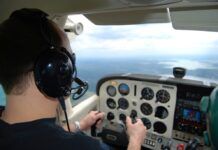
But most impressive of the many things the GDAC does is the Pinch-Hittercourse they offer annually in May. They literally take over thetower-controlled Ann Arbor, Mich., airport for a weekend and, using AOPA’sstructured curriculum, which includes four hours of ground instruction, fourhours of flight instruction, and four hours of debriefing, they teach a bunch ofnon-pilot, frequent passengers (usually spouses), sitting in the right seat, tofind an airport and get the airplane on the ground without hurting themselves oranyone else and without bending the metal. And it is all done with volunteerhelp.
 Organizingthis program is an absolutely monumental task. Enrollment is limited to thirty,broken up into three groups of ten pinch-hitters. While one group is receivingground instruction (from a member of the Ninety-Nines who is a certificatedground instructor), another is flying with a volunteer certificated flightinstructor, and a member of the Ninety-Nines is debriefing the third group. Thepinch-hitters supply the airplanes, and every attempt is made to match thepinch-hitter with a debriefer who flies the same make and model. Eachpinch-hitter must also be paired with an instructor who is familiar with themake and model airplane they fly. Paperwork for the airplanes (including annualinspections, insurance, etc.) must be carefully checked. For the most part, eachflight instructor has two students, occasionally only one, and sometimes as manyas three.
For 13 years, I have volunteered my talent and my time for a weekend to teachin this program. Because of my experience with a wide variety of generalaviation aircraft, I have used a Cessna 414 (a pressurized twin in which Itaught the student to use the autopilot to find an airport), a Cessna 180 with aSTOL kit, and a TriPacer.
Job Satisfaction
 Oneof the most gratifying experiences I have ever had as a flight instructoroccurred at the GDAC Pinch-Hitter course several years ago. A man had broughthis wife and 15-year-old daughter in for the program in a beautiful old StinsonStation Wagon (a wood and fabric four-place taildragger). If the daughter hadhad a student pilot certificate, I could have soloed her. She was that good. Hermother, the guy’s wife, was another story altogether. The poor woman was souptight and nervous that she had to excuse herself and go to the ladies room tobarf before we ever got to the airplane!
When we finally took off, she crossed her arms across her chest and refusedto touch anything! I abbreviated that session by merely flying around thepattern and landing. Of all my accomplishments as a flight instructor, I am mostproud of the fact that by the end of the second day of flying (her fourth hour),I had that woman landing that airplane unassisted! And I’m sure that if she isever flying as a passenger with her husband and becomes incapacitated, she willkeep her cool and get the airplane on the ground with little damage and noinjuries. She may run off the runway, but nobody will be seriously hurt and theairplane won’t get seriously bent.
I am a great believer in the value of this program. Over the years, thepinch-hitter program has been credited with several saves when a pilot could notcomplete a flight and a passenger who had been through the program has takenover and brought the airplane safely home to mother Earth.
These are but two examples of the fine work performed by the Ninety-Nines.
Blue skies and sunshine to you all.
Usual Boilerplate: If you have a comment regarding thiscolumn, please post it here rather than sending it to me by direct email. Thatway others may benefit from your input