












 Areader who requested that I discuss making perfect landings, – with animation, noless – prompted this column.
In a perfect world it would be easy to consistently make those neat landingsin which our passengers, as we are rolling out after a real greaser, look aroundand exclaim, “When did we land?” However, I don’t live in a perfectworld, and I doubt if you do either. In my world conditions of wind and trafficdictate that each approach and landing shall be different from the last one, soapplying a set procedure of initial power reduction at a specific point on thedownwind, extending approach flaps at a specific point, turning base at aspecific point, another power reduction, more flap, etc. does not work. At atower-controlled airport we must be flexible so that we are prepared and able torespond to instructions such as, “Make short approach – cleared toland,” or “Extend your downwind – I’ll call your base.” And atnon-towered airports the wind and traffic control our activity in the pattern.It is also important to note that a good landing starts with a good pattern.Everybody enjoys hearing his/her passengers say, as they are rolling down therunway after a perfect landing, “When did we land?” They’ve lookedaround, and discovered they were on the ground without ever feeling thetouchdown. I know I enjoy this, and I’m sure you do too.
What Does What?
 Forover 50 years I’ve been listening to the argument as to which controls what.Does the elevator control airspeed or altitude, or does the throttle? Obviouslythere is an overlapping function and either or both control either or both. Idemonstrate this by taking the pilot who claims that the elevator controlsairspeed out for a takeoff, line up on the runway and furiously start pumpingthe yoke back and forth. When asked what I’m doing, I reply, “I’m trying toget up enough airspeed to take off.”
Okay then, power must control airspeed and the elevator must controlaltitude. We then go up to a nice, safe altitude and I reduce the power to idleand ask the pilot to honk back on the yoke and climb. He does this and we climbfor a bit, after which we run out of poop and start to sink. Of course you cancheat and use an Angle of Attack (AOA) Indicator instead of relying on theairspeed indicator.
Final Approach And Landing
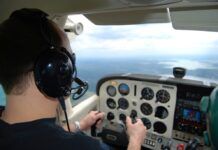
Now back to the landing approach. In this situation, if you want to make agood landing (under visual conditions), you must use the throttle to controlaltitude (sink rate) and the elevator (yoke) to control airspeed. From the timeyou make the initial power reduction on downwind until you start the flare, youkeep glancing from the airspeed indicator to the runway and back, and you areconstantly asking yourself, “Am I high, low, or just right?” Ofcourse, finding the answer to this question is easy when the approach is to arunway with VASI (Visual Approach Slope Indicator) lights or a similar visualaid, but it is not difficult once we become skillful at judging our angle ofdescent as we make each turn from downwind to base to final, and then throughoutthe final approach.
View video of a base leg (MPEG file, 160Kb) View video of a final approach (MPEG file, 610 Kb) As you can see, these videos were made on a gusty day. |
Flare And Touchdown
Then comes the flare, or round out. The object, of course, is to run out ofairspeed and altitude simultaneously. We must strive to be going just as slowlyas we possibly can at the moment of touchdown. The way this is accomplished isto put the airplane just where you want it – an inch or two above the runway,and hold it there, by taking the slack out of the stick, or yoke. As the speedbleeds off, the elevator control will tend to become loose in the pilot’s hand.The object here is to maintain a steady backpressure on the stick or yoke. Toomuch pressure and we will trade off airspeed for altitude and zoom up, resultingin having the flying machine drop down onto the runway from three or more feet(or, perhaps, resulting in a go-around). Not enough pressure and the airplanewill do a one-wheel landing on the nose wheel, possibly even crumpling up thefront end of the airplane. As you know, neither of these situations is adesirable result. Both can be extremely embarrassing, or even worse, damaging tothe metal or even the human body.
 Gettingback to the idea of going as slowly as you possibly can at the moment oftouchdown, remember, you can go slower with power than without it, so sometimesit behooves us to keep just a tad of power throughout the flare, and at theinstant of touchdown, kill it all off. And while we’re on the subject of killingoff all the power at the moment of touchdown, there’s something else that I do:I retract the flaps as soon as the wheels kiss the ground. I know there is aschool of thought that says a pilot should not retract the flaps until therunway is cleared for fear of inadvertently retracting the landing gear insteadof the flaps, but I feel that if a person can’t tell the difference between aflap handle (usually shaped like a flap) from a gear knob (invariably shapedlike a wheel), he or she shouldn’t be flying in the first place. The advantageof retracting the flaps right away is that it plasters the airplane firmly onthe ground by spilling off the excess lift produced by extended flaps. Thisprevents any excess speed from enabling the airplane to skip down the runway.
Throughout the flare, not only are motor skills involved (coordination ofhand, foot, and eye), but judgment as well. And to acquire these skills it takespractice and lots of it. As with any motor skill, perfecting a landing requiresrepetition and drill, repetition and drill, and more repetition and drill untilit becomes “second nature.” As a general rule, the larger and heavierthe airplane, the easier it is to make smooth landings. Wheel landings in ataildragger are particularly difficult to get used to because it goes againstthe grain to push the stick or yoke forward when the mains touch the ground.Students are taught to hold the stick or yoke firmly back to prevent theairplane from taking off again, to keep it stalled. Judgment comes into play inknowing just when and where to start holding the airplane off the ground withback pressure, and here again practice and repetition are required, morerepetition and drill until the point is reached at which the pilot can tellexactly where the airplane is with respect to mother earth – that point an inchor two above the runway. To do this one must sight along the edge of the runwayquite a way in front of the airplane. Looking straight down fails to give therequired perspective.
Being Graded
No matter how the trip is flown, the non-pilot passengers always judge thepilot’s performance by the landing at the end of the trip. And the “airportbums” that hang around the airport and observe the arrivals always havesome comment regarding every landing they observe. It is a fact of life. Haveyou not noticed this? A pilot can be a hero and bring an airplane in through thenastiest weather imaginable, but if he/she botches the landing he or she isthought of as a poor excuse for a pilot. It may not be right, but that’s justhow it is. And this principle applies to the air carrier pilot as well as onepiloting a J-3 Cub.
 They(whoever “they” are) say that after a long trip the landing is notlikely to be a good one, and I’ve found this to be true. Perhaps it is fatigue,perhaps the result of boredom, or merely having several hours pass withouthaving the perspective that one gets when close to mother earth, but I know myown landings are not quite as smooth after a long (more than two hours) leg.
Some airplanes, of course, are easier to land well than others. The PiperPA-32/34 series of airplanes are particularly difficult to land smoothly unlessthey are loaded to gross. With two heavyweights in the front seats and the restof the airplane empty, these particular models are right at the very front endof their center-of-gravity envelope (if not slightly out forward). Unless loadedto gross and in the middle or aft portion of the envelope, the only way to landthese models smoothly is to carry a bit of power right through the touchdown. Onthe other hand, all Cessnas and the PA-28 Pipers with the tapered wings and astabilator on the fuselage (Warrior IIs, Archer IIs and Arrow IIIs, for example)are so easy to land smoothly that anyone should be able to consistently”grease ’em on.” The same always cannot always be said of Pipers withthe constant chord (Hershey Bar) wing.
Problem Landings
Crosswind …
 Toparaphrase Gertrude Stein*, a landing is a landing is alanding. In one respect they are all the same – you want to run out of lift andaltitude simultaneously. However, conditions frequently dictate that they beaccomplished differently one from another. Many pilots seem to have quite a bitof trouble with the “dreaded” crosswind landing. This is no doubt aresult of improper rudder usage. For most light airplanes the forward slip isthe recommended technique as opposed to the crab method. It is really verysimple. The pilot, on turning final, should lower the upwind wing and applywhatever opposite rudder is required to track straight down the centerline ofthe runway and do nothing else. The airplane will touch down on the upwind wheelfirst, followed by the other two wheels and continue to roll straight down therunway. The upwind wing should still be kept low, and Voila!, the task isaccomplished. What could be easier? The pilot’s eye and mind should be kept onthe objective, and he or she should do whatever is necessary to reach thatobjective.
… Soft Field …
 Thesame principle of thinking in terms of the objective applies to the soft-fieldlanding. Here we are faced with getting the airplane down on a surface coveredwith slush, or mud – glue, if you will. Our objective here is to avoid a suddenstop and possibly nosing the airplane over or at least damaging its front end.In order to do this the airplane must be going as slowly as it possibly can atthe moment of touchdown, and the nose must be held up out of the mud until theairplane is almost stopped. Remember what I pointed out earlier? It can be madeto go slower with power than without it. For practicing this maneuver, we arehypothesizing an infinitely long landing surface, covered with some kind ofsticky substance. By carrying a bit of power through the touchdown, and thenholding the elevator control (yoke or stick) back to force the tail down, wehold the nosewheel up out of the mud.
… Short Field
Once again, when we are confronted with the necessity of getting down insomething other than the usual situation, if we keep the objective in mind andthen do whatever we have to do to make it come out right at the end, the problemwill solve itself. In this case we have a nice, flat, smooth surface, but onethat is substantially shorter than what we are used to. The objective, ofcourse, is to get on the ground and stopped before running off the end or intosomething. The dear old FAA puts one of their imaginary 50-foot obstacles on theapproach (I’ve personally never seen one of these 50-foot obstacles – 85-foottree lines, yes; 50-foot anything, no).
Here again we must be going slowly (good idea – practice slow flight atminimum controllable airspeed, or “cheat” by using an AOA Indicator)as we encounter mother earth. This maneuver can be accomplished by mushingsteeply down, with some degree of power, flaring abruptly, spilling off the liftby retracting the flaps and applying heavy braking. Here’s a tip: just prior totouchdown retract the flaps! You will stall the airplane onto the ground andcome to a quick stop.
By understanding these basic techniques and practicing, practicing,practicing, you can make the outcome of all of your landings safe, predictableand smooth. Try it, you’ll like it!
| * | A wonderful family is Stein There’s Gert, there’s Ep, and their’s Ein Gert’s verses are punk, Ep’s statues are junk And nobody understands Ein. |
Usual Boilerplate: If you have a comment regarding thiscolumn, please post it here rather than sending it to me by direct email. Thatway others may benefit from your input.
