

























 Wepreviously discussed the subject of flying by “sight picture” asopposed to “flying by the numbers.” Now we will undertake to considerall the sensory cues that a pilot uses in manipulating the controls of anairplane and making the machine do what he or she wants it to do (or, at leastkeeping it from doing that which he/she doesn’t want it to do).
Sight
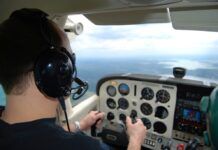
 The first of these is, of course, sight. Whether we are VFR or IFR, sight is themost important of the senses we use in flying. In VFR flying we keep theairplane upright by noting the position of the wings and nose of the airplane asthey relate to the horizon. We not only control our pitch attitude by sight, butwe judge our angle of bank by sight as well. And when we’re IFR it is sight (theinformation we get from looking at the instruments) that enables us to remainupright. We simply must disregard the feeling we get through the inner ear andrely on what the gages tell us through our eyes. Also, the kinetic feeling weget from our deep muscles may be entirely wrong as a result of receiving falseinformation from our inner ears. So much has been written about spatialdisorientation and vertigo that we need not address that subject here. It issufficient to note that a false sensation of turning when in fact we are flyingstraight can be almost overwhelming. It is at these times that we must forceourselves to rely on the messages from our instruments received through our eyesand interpreted by our brains.
Sound
 We also gather useful information from the sense of sound. Any change in theengine sound as it drones along through the sky alerts us to a change in ourflight condition. And if it gets really quiet in the cockpit, we know we’re indeep doo-doo. If anybody should ask what a propeller on an airplane is for, tell’em it’s to keep the pilot cool, and if they don’t believe you, just watch thepilot sweat when it stops! Adrenaline really starts flowing when a pilot hearsthe engine cough! When the engine skips a beat it really gets our attention. Weimmediately start paying a lot more attention to the engine gages. Are themanifold pressure and tachometer needles steady? Are the oil pressure andtemperature needles in the green? Any unusual sound and we are instantly alert.
 The sound of the wind caused by our movement through the air also tells usthings we should know, but not nearly as well as it did in the days of the open-cockpit airplanes, of course. There used to be a saying that as the tone of themusic caused by the wind through the wires grew deeper the pilot didn’t need toworry until he started to hear “Nearer my God to Thee.” Then it wastime to bail out. Any major change in the pitch attitude of the airplane willcause a change in the engine and slipstream noise, and this provides useful datawhether we are VFR or IFR. Of course, the pilot must process the data his sensessend him for it to be useful. But even when we’re IFR, a change in the enginesound may very well be the first clue we get that all is not well. At least ittells us that something has changed, and nothing we did brought about thechange.
Touch
Although pilots are admonished to not trust what they feel when they are in IMC(instrument meteorological conditions – in cloud), there are some kinds of feel(sense of touch) which are useful even then. For example, the tension (or lackof tension) one feels on the controls. Is the yoke getting loose in your hand,or does it seem to take more than usual pressure on your part to move the yoke?This kind of feel will alert us to a change in airspeed. In other words, thepilot must force himself (when in IMC) to ignore what he feels through the seatof his pants, but should pay close attention to what he feels through the yokein his hand. Is it becoming slack, or has an inadvertent increase in speedrequired us to exert more pressure to move it? Of course, you really can’t tellanything if you have a death grip on the yoke. You must still strive for a lighttouch on all the controls, particularly the yoke and the rudder pedals. If theairplane is properly trimmed, a very light touch is all it takes to command thedesired response. The old saw about holding the stick as if it was a littlesparrow works in this situation. If you don’t have a firm grip, it will flyaway, but if you grip it too hard, you’ll kill it.
All Together Now
Now to expand on this business of sight, sound, and feel. With respect to sight,we’ve already had a lot to say about the “sight picture” by which wefly in the VFR environment. We have the whole world at our disposal, a25,000-mile reference by which we can not only keep the airplane upright, but bywhich we can maneuver it and make it comply with our desires. This allows us toignore the instrument panel except for the occasional scan to monitor the gagesand see that all is well while we spend our time looking around outside,enjoying the scenery and keeping the airplane on course by reference to groundobjects, and, obviously looking for traffic, which we can’t avoid if we don’tsee. Of course seeing alone is not enough. We have to understand what we’reseeing, analyze and interpret the messages we’re getting and take appropriateaction. And again, this is true whether we’re VFR or IFR. Even when VFR, we useour sense of sight to monitor the gages that inform us of the state of healthof the engine(s). If the heading or altitude should wander off, it is our senseof sight that tells us about it, and tells us when we’ve made just the rightadjustment to correct the situation. In this situation sight is supplemented byboth sound and feel.
 Any change in the sound of the drone of the engine(s) will alert us to the factthat something is happening even sooner than the engine instruments themselves(manifold pressure gage and tachometer, but not the oil temperature, oilpressure, and cylinder head temp gages, as well as those instruments thatadvise us regarding the health of the electrical system). If the engine skips abeat we hear it do so long before we see it on the tachometer (unless we happento be watching the tach at the instant it happens). If there is a subtle changein the pitch attitude of the airplane our ears alert us to the fact, and ifwe’re in good VFR weather, we probably will notice the change in the sound ofthe engine before we catch it on the altimeter or the vertical speed indicator.So it can be seen that the sense of sound (hearing) can be quite important to apilot. This sense may also be coupled with feeling to give us even more input.We “hear” by feeling a change in subtle vibrations.
Seat Of The Pants …
 Given enough experience, we all develop an “educated rear end.” Inother words we feel a slip or skid in the seat of the pants without the aid ofthe spirit level (the so called ball bank indicator or slip and skid indicator).Some people are more sensitive than others to this kind of unusual motion. Forexample, my wife, who had been exceptionally prone to motion sickness all herlife, could always detect the slightest change in motion, but it took manythousands of hours of flying before I became as good at it as she alwayswas. Now, however, if the airplane isn’t perfectly balanced, if there’s any slipor skid at all, I can feel it in the seat of my pants. I sometimes wonder at howsome pilots can fly along in a steady slight skid or slip and be totally unawareof the condition. I’ve sat in airplanes and sworn that the pilot must beunconscious not to feel what’s happening as the airplane slides sideways throughthe sky.
Another kind of sense of feel occurs when we encounter turbulence. After slowingto maneuvering speed and cinching the belt and harness up tight we sometimes geta jolt that causes the head to meet the ceiling, and believe me, you feel thatbump! A downdraft resulting in a sudden drop in altitude causes a sensation inthe pit of the stomach similar to what is experienced in the start of a rapiddecent in an elevator, or on the downside of a roller coaster ride. This, too,is feeling. Conversely, the added force of gravity (“g” load) feltwith an abrupt pull-up or steep turn pushes us down in the seat and wedefinitely feel this, too. We know it when we get heavy. Here, too, the controlstighten up, just as they do with an increase in speed.
… And One Other Sense
In addition to sight, sound, and feel, even the sense of smell enters into theequation. And although it does not properly belong with sight, sound, and touchas one of the primary senses we use when flying, still it should be coveredhere. How about that faint whiff of electrical fire? Or worse yet, gas or oilfire?
 I had a friend whose passengers got a strong odor of gasoline while flyingat 7,000 feet, but he just kept going (he was only 30-odd miles from home andreturning from a long trip). About then the engine in his Cessna 210 sputteredand quit. It died of fuel exhaustion, in spite of the fact that he was one ofthose guys who kept very careful records of the time in his tanks, rather thanrelying on notoriously unreliable fuel gages. He glided to an uneventful landingon a small, rough, sod private strip, which by happenstance was almost directlyunder him when the engine died.
I happened to be overhead at the time and bychance I was monitoring the frequency, so I landed behind him and flew him andhis two passengers out, but not before we found the belly of his airplane fullof avgas. The fuel line that runs down inside the right door post had sprung aleak and all the gas (we drained out well in excess of a dozen gallons the nextday) from his right wing tank had descended to the space between the cabin floorand the bottom skin of the airplane. Any errant spark could have spelled fini tothe airplane and its occupants. Thank goodness none of the people aboard haddecided to smoke on that flight! I later learned that the reason nobody aboardlit up was because of the strong odor of gasoline.
Usual Boilerplate: If you have a comment regarding thiscolumn, please post it here rather than sending it to me by direct email. Thatway others may benefit from your input.
There are two things about which everyone who holds an airman certificate is deeply concerned, and rightly so. One, the holder of any pilot certificate is concerned about the possible loss of his or her medical certificate. Two, all certificate holders are concerned about the possibility of being hit with a violation, unknowingly and inadvertently. My third book, VIOLATION!, addresses this subject. It may be ordered by emailing me at [email protected]. The cover price is $29.95, but AVweb readers may have it for $23.95 plus $4.50 shipping and handling. Order by Visa, Mastercard or American Express. – Howard
