














 Although all kinds of sport flying are for fun rather than transportation, all you “power pilots” don’t know what fun is until you try soaring; it’s so quiet the instructor can hear his students cry. Soaring in a glider or sailplane is just pure joy. With the sophisticated aircraft of today that most of us fly, in even the basic four-place, fixed-gear, fixed-pitch-prop airplanes, the pilot is basically an equipment manager. Flying a glider, on the other hand, is pure stick-and-rudder flying, based on the skill of the pilot rather than the sophistication of his equipment.
All Over Again
For years I had ridiculed the idea of flying anything without an engine to keep it aloft, but I learned better the first time I went up in a glider – I fell in love all over again.
I had been occupying various portions of the airspace for over 30 years when I was inspired to try soaring. It happened like this: My wife and I were in a hotel in Innsbruck, Austria, waiting for breakfast early one beautiful morning when I looked out the window of the hotel room and saw two sailplanes going back and forth along a ridge rising straight up for several hundred feet above a meadow on a plateau in the Alps. They were so graceful as they flew silently by that I was inspired to say to my wife, “Just as soon as we get back home I’m going to undertake glider training.”
Back To School
 Most glider training in the part of the country where I live is accomplished through soaring clubs, but there is an excellent commercial glider school about 120 miles from where I’m based. As soon as we returned from Europe, I rushed right out and signed up for a commercial glider transition course. It being October, the glider school had cut back their operations to weekends only. They operate daily through September, but in the fall the regular soaring season ends and they go to weekend-only operations. However, the school operator agreed to have a tow plane and pilot as well as a glider instructor meet me each Wednesday afternoon for the next three weeks so that I might complete the transition course. I bought an 18-flight package and I had a very good young woman instructing me who was an excellent teacher and who soloed me on my second tow.
At that time the experience requirement for transition from powered aircraft to glider was the same for Private or Commercial privileges. The only difference was in the skill requirement. For the Commercial certificate, the spot landing required much less tolerance. This particular glider school uses aero tows to launch the glider, so my glider rating was restricted to “AERO TOW ONLY.” By the bye, I had sort of cheated on the package deal that was based on very short flights. Instead, I had read up on soaring and had done a bit of thermalling during my solo flights, so I spent more time in the air than was normally expected.
During that winter, I took the written examination for adding “GLIDER” to my Flight Instructor Certificate and the following summer I spent every Sunday afternoon at a local glider club that uses a winch to launch the sailplanes. By the end of the summer, I took the flight test for the glider instructor rating. I used a borrowed glider and did three tows from a small airport, on the third of which the inspector who was administering the test and I towed to 4,000 feet. We soared and glided the dozen miles or so to the club’s glider field where the inspector had me do three winch launches so I would have an unrestricted glider certificate. (The rating is limited to the kind of launch demonstrated on the flight test.)
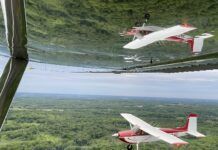
 Throughout that winter I worked over the other two principals in the company, and by spring I had them talked into adding glider training to the programs offered at our flight school. We already had a Citabria we were using for taildragger checkouts and aerobatic training, and which was equipped with a hook and thus suitable for use as a tow plane. For starters we bought a two-place glider to use as a trainer. We later added a single-place glider to our fleet, and over the next three years we trained quite a number of glider pilots, both from scratch and transitions from power ratings. This glider-training program lasted until the airport we were using for glider training was sold to a large corporation. That company used the property to build a plant, and another nice little airport bit the dust.
Today, of course, there are three ways to get a sailplane aloft; aero tow, ground launch (winch or auto tow), and self-launch, the so-called motor glider. The glider rating on one’s pilot certificate restricts him or her to using the type of launch demonstrated on the check ride, and to remove the restriction the pilot must demonstrate to an examiner or inspector his or her ability with each type of launch.
Keeping the thing up without an engine requires the use of nature’s power, and this comes in three basic forms: thermals, ridge lift, and wave soaring. Being a flatland resident of the Midwest, my personal soaring has been limited to using thermals for lift, except for an occasional expedition to a mountain soaring site where both ridge and wave soaring may be found. Even so, by only using thermalling for lift, I have made altitude gains on more than one occasion of as much as 8,000 feet, releasing from the tow at 2,000 and thermalling up to 10,000 without much trouble. Unless you’ve done it, you simply cannot comprehend the thrill of meeting the challenge of climbing in a heavier-than-air machine with nature’s power alone.
Benefits
One very tangible benefit of flying a glider is this: Many of today’s pilots who trained in airplanes after the manufacturers started putting a training wheel out in front of the airplane simply have no idea what the rudder is all about. If you want a dramatic demonstration of the principle of adverse yaw, try turning a glider with aileron alone, and watch how the nose swings away from the direction of the turn. Many modern pilots plant their feet firmly on the floor and steer the airplane through the sky like an automobile, with the “steering wheel.” And they can get away with this because modern airplanes are designed to permit it, but it makes for sloppy flying.
 It was entirely different when pilots were trained in J3 Cubs and Aeronca 7AC Champs. In those days a great deal of pilot training was concentrated on coordination of hand and foot. Because of the long wingspan of all gliders, the extraordinarily long ailerons, and the extreme differential in aileron travel, the down aileron on the up wing in a banked turn in a glider produces substantially more drag than does the up aileron on the down wing. The result is extremely pronounced adverse aileron yaw. Therefore, the glider pilot must coordinate rudder with aileron when entering or rolling out of a turn. And this results in greatly improved precision in all his flying, airplanes as well as gliders. Try it. I guarantee that not only will your eyes be opened, but you will actually enjoy it.
Transitioning
If you already have a power certificate, the transition to gliders is quite simple, and the investment in a transition course is really very modest. In addition to being required to learn to coordinate stick and rudder, there are really only two new techniques to learn. One, the glider pilot must follow the tow plane in a very specific position – this can be a bit tricky at first. The other new technique for the power pilot is in landing the glider. One doesn’t flare for landing as is done in an airplane. Instead, the glider is flown right down to the ground. Once these tasks are mastered, it is simply a matter of taking the check ride. There is no written examination for the pilot who has a power rating. Then comes the fun and challenge of learning to thermal with the sailplane and gain altitude without an engine.
 There is sure to be a glider school or glider club within a reasonable distance, so why not go out and take a ride. Be forewarned, however, if you do, you are likely to be hooked.
Fun
I can put my ATP Certificate in my pocket, climb into a pressurized, turbine-powered airplane, and get along just fine in the high-altitude structure where I’m operating as an equipment manager instead of a real pilot. But if I want to have pure fun, I get in a glider and soar with the hawks. And there must be lots of others who enjoy soaring as I do, for according to a recent edition of the “General Aviation Statistical Databook” published by the General Aviation Manufacturers Association, there are many thousands of active glider pilots with glider-only certificates, and countless others who hold certificates with power ratings as well as glider ratings, including a substantial number of air carrier pilots. These are the guys who fly for the sheer joy of it.
There is absolutely no practical application to flying gliders, but the intangible benefits are immeasurable. There is a saying in the glider community that flying a glider is the most fun you can have with your pants on. Believe it!
