









Staggerwings flock to Tullahoma, Pipers fly to Lock Haven and antiques gather in Blakesburg, Iowa. Pietenpols have their own annual gathering at Brodhead, Wis., that draws, if not quantity, definitely quality and a passion from those who come to see these distinctive little homebuilts. For Pietenpol builders, going to Brodhead means the chance to actually talk face-to-face with other Piet builders and see finished and flying airplanes.
 For years, the annual Brodhead Pietenpol Fly-in happened during Oshkosh, but this year, it was moved to the weekend before the start of its bigger brother 90 miles to the north. Still, most Pietenpolers prefer the slow pace and intimacy of Brodhead to the vastness of Oshkosh.
I go to Oshkosh every year, but I’d never heard of Brodhead until two years ago, when I started thinking of building an Air Camper. I decided to go to Brodhead months ago, as I got deep into building the fuselage of my Pietenpol.
The Pietenpol Pilgrimage
Choices…
Since builders from plans start with only sheets of paper, changes and modifications to the airplane don’t require us to discard or cut up expensive kit parts and assemblies. Theoretically, we can decide to make changes and then acquire the raw materials needed for those changes at the same time we’re getting the rest of our materials. The kicker is realizing that you want to make the change before you’ve gone too far into the project. That’s where Internet list-serves, websites, builders groups and type-specific fly-ins can really help.
Often modifications are changes that a builder may have seen on another airplane. Many builders are very generous about sharing copies of working drawings of modifications they have made to the basic design.
Because the basic Air Camper design can accommodate a variety of engines, landing gear designs and even fuselage lengths, builders are faced with a number of decisions, most of which center on the fuselage. Incorporating brakes (the plans call for a tail skid) affects the design of the landing gear and location of the axles relative to the center of gravity. Engine choice dictates the engine mount and cowling design.
|
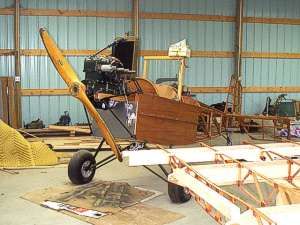
Even the size of the builder may influence the choice of a long or short fuselage. The long fuselage provides an additional two inches of legroom in both the front and rear cockpits. Some builders have even opted for adding width to the fuselage. Many add to the length of the cabane struts, raising the wing up to four inches for easier access to the ‘pits. This is especially helpful as far as getting into and out of the front hole. Going to Brodhead allows the builder to talk to builders with finished airplanes about the relative merits of these and other tweaks to the basic design.
I’d already decided on fuselage length, choice of engine and that my airplane would have brakes and a steerable tailwheel. But, there remain many other unresolved detail issues. I was looking forward to getting some answers at Brodhead.
…Arrivals…
|
My plan was to fly our Bellanca to Brodhead on Friday, the opening day, spend Friday night and all day Saturday, then fly over to a friend’s strip about 25 miles away Saturday after dinner to meet our regular Oshkosh gang. By mid-afternoon, the GPS said I was overhead the Brodhead airport, but it took me a minute or two to find it. The airport has three runways, one with lights, but all are turf, and in the midst of all that Wisconsin farmland, it all blended together to me. Then I spotted a biplane below me, which led me to a group of buildings with airplanes parked nearby. This must be the place.
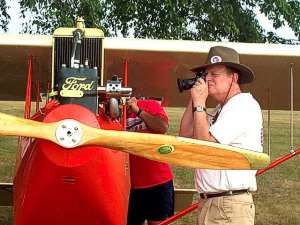
This part of southern Wisconsin was experiencing a dry, hot summer. After landing, I pitched the tent and tied down the plane beside some other non-Piets in a dry, brown field. Then I grabbed a camera and a note pad and headed for the area where the Pietenpols were parked. About a dozen were there when I arrived, with a diversity of engines and other design features. Four airplanes in a line showcased a Ford “A” engine, a Warner radial, a Corvair engine and a Continental. Owners were buffing paint, talking to bystanders and tinkering. Periodically, one would climb into the back seat and offer a lucky individual a flight around the pattern.
…Details…
Active builders weren’t hard to spot. They poured over the airplanes with tape measures, cameras and note pads. We look at certain areas of the plane that give us all fits, such as the landing gear brackets and attachments and the shock absorption system. We argue the merits of a wing cutout in the center trailing edge versus a “flop” or hinged section that folds up allowing easier access to the back seat. We quiz other builders about the techniques for bending strut attach fittings. We look at various methods for installing brake pedals and cylinders. We debate various options for finishing, from straight Stits process to traditional butyrate dope, to unconventional finishes like latex house paint! That’s the beauty of building an experimental aircraft – you can experiment with a vast variety of options and paths to a successful flying aircraft.
|
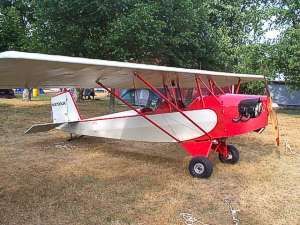
Several Piets drew my attention. One was Bill Rewey’s Continental-powered Air Camper, which I had seen and photographed at Oshkosh last year. Bill’s Piet has several useful additions, including a simple but effective trim system using a screen door spring and an Adel clamp and a very good brake pedal/master cylinder installation. He’s also generous with providing drawings and had sent me the plans for his brake installation. I stopped to say hello.
Jim Kinsella, of Louisville, Ky., brought a beautifully finished Continental-powered Air Camper. I snapped numerous pictures of his simple but effective cowling and main gear/fuselage bracket attachments, which may well end up being imitated on my airplane. Piet builders are famous for scavenging parts from a variety of sources, but we are even more avid idea scavengers.
Another notable airplane on the field was Ken Perkins’s orange/red Ford-powered Piet, “Perk’s Time Machine.” Like Kinsella’s, the workmanship was superb. The Ford engine was tuned perfectly and ran smoothly with no characteristic popping. Perkins’s Piet went on to win a bronze Lindy at Oshkosh the next week. It deserved it.
…And Forums
|
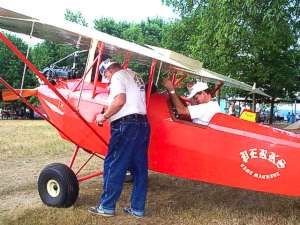
For serious builders, Brodhead offers forums where experts pass on some of their accumulated knowledge and answer questions. Ken Perkins gave a presentation on one of the mistakes he made in building his award-winning Piet. Like all of us, he had to redo some parts and assemblies because he wasn’t satisfied with them or they didn’t perform to his standards. He covered some of the known problem areas with the design and with the Ford Model A engine conversion.
Vi Kapler presided at a forum also dealing with problem areas, and he fielded many questions from the audience on a variety of issues. Kapler as a teenager assisted Bernard Pietenpol with some of his earliest projects, designed and drew the plans for the three-piece wing, and sells hinge kits for the tail surfaces. He is among the last people around who originally worked with Pietenpol on the Air Camper.
The day ended with a great grilled pork-chop dinner followed by the buzz of Piets flying around the pattern in the twilight.
Benefits
Type-specific fly-ins like this are usually small affairs with a few dozen airplanes at most. Perhaps because of the increasing interest in the Pietenpol, the Brodhead event is well-attended, at least in numbers of people. Considering the number of Piets that are airworthy, and the fact that they aren’t the most practical of cross-country machines, the turnout in airplanes is quite good.
While those that fly their Pietenpol in to Brodhead must derive a lot of pleasure from the admiring looks and compliments, those of us who are immersed in the building process probably benefit the most from the experience. We get to see what works, what looks good, and even what we may choose to avoid. I can’t speak for other builders who were there, but I came away with renewed enthusiasm to push ahead with completing the project. I also decided how I was going to handle several vexing construction details, based on what I saw and people I talked to.
I’m betting that deep down more than a few of us were thinking, “I can’t wait to be able to fly mine to Brodhead, too.” I know I was.
