







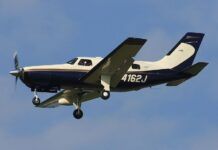










My first flight instructor introduced me to the touch and go: power off, flare, flare, flare, “chirp” go the mains, hold the nose (“If the nose touches, it’s not a touch and go,” he said), flaps up, power up, carb heat in, adjust the trim in there somewhere, and up we go. The touch and go (T&G) is a staple, almost sacred, ritual of flight training. But what is the purpose of a T&G landing? What are the risks? And are the risks worth any training benefit?
Why Touch And Goes?

There are two compelling cases favoring T&G practice (as opposed to full-stop landings): time and money.
- Time. T&Gs result in more landings per flight hour. A common justification for T&Gs is that they speed the process of learning to flare and land by compressing more landings into a flying lesson. A student flying T&Gs can log seven or eight landings per hour, far more than if he/she stops and taxis back.
- Money. Another significant factor is the cost of T&Gs as opposed to full stop landings. This factor has two components:
- The “cost of currency.” If your entire objective on a flight is to log the three takeoffs and landings required for currency to carry passengers (under U.S. rules), you can do so in less time and therefore for less money by flying T&Gs. Note: This is only valid for tricycle-gear airplanes flown in daylight hours, as the U.S. Federal Air Regulations (FARs) require all landings for currency in tailwheel airplanes to be full stops, and that night currency in all airplanes requires full-stop landings.
- Landing fees. In many locations, landing fees are charged for every terminating landing, i.e., every full stop. You may be able to avoid landing fees by flying T&Gs.
Another, less frequently cited advantage of T&Gs is that it teaches pilots what’s involved if, for any reason, the pilot needs to abort the landing once the airplane has touched the pavement. A T&G landing, in effect, can be considered an emergency procedure. It’s a good idea to teach the “landing abort” by carefully presenting and evaluating T&Gs.
The Risks

The biggest risk associated with T&Gs is loss of control because of excessive pilot workload. One of my scariest moments as a new CFI was when a solo student unleashed the awesome power of a Cessna 150 in a go-around and began a graceful arc to the left as he lifted off. This despite quite a bit of satisfactory dual in T&Gs beforehand. He finally added enough rudder to stabilize a course about 30 degrees off runway heading, managing to avoid the airport’s rotating-beacon tower. In debrief, he told me he just had too many things to do and forgot to add right rudder with power application. (After significant additional instruction, he aced his checkride on the first try.)A very common T&G mishap is an inadvertent landing-gear retraction on the ground, a classic workload-management problem. There’s a lot to do in the short time on the ground in a T&G, and in retractable gear (RG) airplanes there’s the added risk of moving the landing gear switch when you intend to retract the flaps or perform some other function. I personally do not routinely teach T&Gs in RG airplanes, except as a “landing abort” emergency maneuver. Shouldn’t RG airplanes’ landing gear squat switches protect you from unlocking the landing gear? That’s the design, yes. But at least in some cases the answer is no. See my observations on squat switches and gear collapse mishaps.The FAA obviously thinks there’s enough different about night and tailwheel landings that it will not let you count T&Gs for landing currency. It’s an easy risk management decision to avoid T&Gs in tailwheel airplanes, or any airplanes at night.
Evaluating the Risks

To evaluate the risk, let’s look at the pilot’s workload during T&G landings:
- Directional Control. Directional control is very dynamic in the T&G, from a flare with perhaps some crosswind correction, changes in control input as the airplane decelerates on the runway, then fairly large control inputs to counteract engine torque on power-up, with reduced control deflection and return to crosswind control as the airplane accelerates and lifts off. Distraction, fatigue, or lack of familiarity with the airplane or the conditions can put the pilot behind the airplane in the fast-paced T&G. Like my Cessna 150 student, the pilot may be overloaded to the point he does not compensate for airplane tendencies or winds.
- Flaps. Most light airplanes are usually landed with full flaps and take off with zero flaps. In larger airplanes, the takeoff flap setting may be critical to a safe departure. For all, there will usually be a big flap change during the short time you’re on the runway. There’s risk in setting the flaps correctly during the T&G and there’s risk that the pilot may inadvertently change something else trying to rapidly reconfigure the flaps.
- Trim. Depending on the airplane, the amount of trim change required from landing to takeoff may be minimal, or it may be substantial. Mis-set trim has been cited as a factor in many takeoff accidents, especially in larger airplanes or when an airplane is heavy and loaded toward the aft end of its loading envelope. Regardless of the airplane, most likely the trim will require some adjustment during the T&G, a vital task that is yet another potential distraction in the T&G maneuver.
- Power. A T&G requires the pilot to quickly and correctly manage power to get maximum takeoff performance. In piston-engine airplanes, the pilot may have to adjust propeller, mixture and carburetor-heat controls and perhaps compensate for high density altitude. Turbine airplane pilots may have to aim for a precise, less-than-full power setting to stay within temperature or torque limits. In all cases, engine management is going to draw the pilot’s attention into the cockpit during the rapid, on-runway portion of a T&G.
- Debrief. Each landing in a training session should be reviewed and debriefed. There simply isn’t time for this in a T&G, and if the instructor attempts to teach as a result of a particular touchdown, the discussion will distract the student at this critical time.
Mitigating Risk

The best way to avoid risk is to avoid risky situations. When possible, then, replace T&G practice with full-stop landings or, if sufficient runway remains and you can minimize your time on the runway, “stop and goes” where you come to a complete stop, reconfigure the airplane, then depart from the stopping point.Your mission may make it desirable, however, to conduct T&Gs, and at times instructors will want to present them as a landing-abort emergency maneuver. If you elect to conduct T&Gs, you can mitigate the risks by the following:
- Consider permitting T&Gs only in two-pilot operation. Make the pilot-flying (PF) responsible for power and aircraft control and the pilot-not-flying (PNF) responsible for trim and flap reconfiguration. The division of responsibilities to essentially “outside” (PF) and “inside” (PNF) roles gives each more time to complete their tasks without an overwhelming workload and, in RG airplanes, the risk of accidentally moving the gear selector.
- If flying T&Gs single-pilot, train the pilot to manually reconfigure the trim first, then set flaps, and then advance power during the ground portion of the T&G. This discipline requires the pilot to look down momentarily at the trim setting, creating a slight pause that might interrupt any impulsive actions and that forms a mental “break” between one landing and the next takeoff.
- If training pilots to fly T&Gs for single-pilot operations in RG airplanes, have the instructor use a clipboard, notepad, etc. to cover the gear selector during the on-ground portion of the T&G to prevent inadvertent gear movement. It’s amazing how many landing-gear-related mishaps occur with an instructor in the right seat.
- Encourage pilots to avoid T&Gs when flying alone except in the case of a real-world landing abort.
- Decide for yourself why you’re doing T&Gs, and whether it makes good risk management sense.
Rethinking Touch and Goes
Touch-and-go landings are an almost sacred part of flight training and many pilots will have a very emotional response to even the suggestion that they may not be worth the risk. But we should never do anything just because “That’s the way we’ve always done it” or “That’s how my instructor taught me.” Talk to your instructor, but decide for yourself whether and when T&Gs make sense for you.Fly safe, and have fun!
