























When I learned to fly on the East Coast thirty-something yearsago, turbocharging was a dirty word. Everybody said turbos wereexpensive, inefficient, maintenance-intensive, problem-prone,shortens TBO drastically, and makes sense only for folks basedin the Colorado Rockies. As a young, impressionable airman, Ibought it…lock, stock and intercooler.
I bought my first airplane in 1968, a nice conservative normally-aspiratedCessna 182. After flying the Skylane for four years and 1,000hours, I traded up to a higher-performance retractable, a BellancaSuper Viking, which was also normally-aspirated. Following theBellanca, I flew a succession of retractable singles includinga Bonanza and a Cessna 210. All normally-aspirated.
My turbo initiation
And then nine years ago, I bought my first turbocharged airplane.Not just any turbocharged airplane, mind you. A turbocharged twin.My first twin. A 1979 Cessna Turbo 310, to be exact, with a pairof turbocharged TCM TSIO-520 engines.
I was scared to death that this twin-turboed machine would eatme out of house and home. In fact, I promised myself that if the310 started showing signs of being a lemon or a hangar queen,I’d sell it in a heartbeat…and buy some nice conservative normally-aspiratedsingle.
Well, here I am nine years and nearly 2,000 hours later. I stillown the T310R. Astonishingly, it has proven to be the most reliableand trouble-free airplane I’ve ever owned. And a truly wonderfultraveling machine.
As a result, my attitude toward turbocharging has made a completeone-eighty. My next airplane may not be a twin, but it certainlywill be turbocharged. I’d never again consider purchasing a normally-aspiratedairplane. That’s how strongly I feel about the many benefits ofturbocharging.
By the way, most of the discussion that follows really isn’t limitedto twins: it is equally applicable to singles.
Turbos and ice
If I had to pick one benefit of turbocharging above all others,I guess it would have to be ice avoidance. Prior to buying theT310, most of my scariest flying experiences had been due to airframeicing. Flying a normally-aspirated aircraft in IMC when the freezinglevel is below the MEA is no fun at all. Even if the tops arebelow the airplane’s service ceiling, trying to top an icing layerin an bird with anemic climb performance is seldom a winning proposition.Trust me, I’ve been there and tried that.
So when I first got my twin, you can imagine how excited I wasabout having all that fancy known-icing paraphernalia: boots,hot props, windshield hot plate, heated static and fuel vents,etc.
But in nine years of flying my T310, much of it coast-to-coasttrips in all sorts of weather, I can’t recall a single flightin which having the boots and other deicing gear offered a decisiveadvantage.
You know why? Because the airplane is turbocharged!
With turbocharging, there’s always some ice-free altitude available…eitherbelow the freezing level, on-top, or up where it’s cold enoughthat icing isn’t a problem. And with full takeoff power availableup to 20,000 feet, getting above the ice becomes do-able.
If I had to make a trip in icing conditions and was given thechoice of turbocharging or deicing boots (but not both), it wouldbe no contest. I’d pick the turbo every time.
Of course, having both a turbo and boots is even nicer.
Avoiding the bumps
Thunderstorms are the other great producer of sweaty palms andstained underwear, and turbocharging offers some significant benefitshere, too.
Being able to cruise in the high teens and low twenties won’tlet you top a line of frontal thunderstorms. But when penetratinga field of air mass thunderstorms, FL200 is often high enoughto offer a good visual perspective and let you circumnavigatethe buildups visually. And personally, I’d much rather use eyeballavoidance than rely on a Stormscope or weather radar.
Even when icing and thunderstorms are not a factor, turbochargingoften makes it possible to find smooth air when normally-aspiratedaircraft are being badly beaten up by bumps. While turbulenceis usually considered more of an annoyance than a serious threat,it can be a major cause of discomfort and fatigue, especiallyon the long trips I often fly. I’ll happily give up 10 or 15 knotsof groundspeed to get out of rough air.
Speed and climb
Turbocharging is often touted as a "speed mod" and sometimesit is. I’ve had the pleasure of catching a few 100-knot tailwindsup in the lower Flight Levels that treated me to 300 knots onthe groundspeed readout and enabled me to make it more than halfwayacross the country nonstop…and boy is that ever fun! But frankly,this sort of scenario doesn’t happen often enough to justify turbocharging.
Ignoring winds (which always hurt more than help over the longrun), turbocharging offers modest speed benefits. A normally-aspiratedCessna 310 cruises at about 180 knots at 6,000 feet and 75% power.At the same power setting, my T310 will do 195K at 12,000 feet(where supplemental oxygen isn’t required) and 215K at 20,000feet.
But I don’t fly it that fast because doing so would shorten enginelife and burn a lot of fuel (more on this later). I prefer tothrottle back to 65% power or less and cruise at 185K down lowor 205K up high. Flown that way, the turbo gives me a small speedadvantage, but nothing that gets me too excited. That’s why speedrates rather low on my list of turbocharging advantages.
Ironically, improved takeoff and climb performance in high density-altitudesituations is perhaps the benefit most often cited for turbocharging,but it comes at the very bottom of my list. This might be a bigdeal for folks who live at higher elevations or who do a lot offlying into mountain airports. I just don’t happen to be one ofthem. When I fly to Colorado or Wyoming, my destination is usuallya big airport with a 10,000+ runway. So takeoff and climb performanceisn’t usually a major issue.
Come to think of it, I do recall a few "exciting" takeoffsin the Bellanca at full gross on hot summer days from South LakeTahoe or Albuquerque or Santa Fe, despite the generous runwaylengths. That doesn’t happen anymore now that I fly a turbo.
Shorter TBO?
Reduced TBO is and increased engine maintenance is probably themost frequently cited disadvantage of turbocharging. For example,the published TBO for the IO-520-MB in a normally-aspirated Cessna310 is 1700 hours, while the TSIO-520-BB in my T310 is rated atonly 1400 hours.
But what does published TBO really mean? Damned little, actually.Some TCM engines virtually never make it to TBO, while other enginesoften make it well past TBO.
Take my T310, for example. When my engines reached their 1400hour TBO, they were still running beautifully and showed everyindication of good health. So I continued flying and checking.And flying and checking. Finally, at 1900 hours, the #6 cylinderin the left engine started losing compression due to an exhaustvalve leak. So I pulled both engines and had them majored.
The inspection reports from the engine shop were quite interesting.Except for worn exhaust valve guides, all twelve cylinders fromthe two engines at 500 hours past TBO were still within new limits!The cranks, cams, bearings and gears all looked like new, too.
With the benefit of hindsight from the teardown inspection, thoseengines could have been re-valved and run for another 1000 hours.So much for published TBOs.
What does it cost?
How about the increased maintenance costs associated with turbocharging?Even if you accept the reduced TBO theory (which I don’t, basedon experience), the costs really aren’t as high as many think.Let’s try to quantify them.
A normally-aspirated IO-520-MB factory reman has a street price(exchange) of about $17,000 and has a published TBO of 1700 hours;this computes out as a reserve-for-overhaul of $10 per hour. Aturbocharged TSIO-520-BB reman sells for about $21,000 and hasa TBO of 1400 hours; reserve-for-overhaul is $15 per hour. Sofigure the overhaul cost penalty for turbocharging at $5 per hour(per engine).
Now let’s be pessimistic and say that you don’t fly your turbochargedengine at reduced cruise power settings (the way I do), and thereforeassume that the turbo engine burns an extra gallon-per-hour morethan its normally-aspirated sister. That adds $2 per hour (perengine) to operating costs.
Now let’s be even more pessimistic and assume that because yourun your engine so hard, the turbocharger, wastegate and controllerall need mid-TBO overhauls (mine didn’t). That costs about $2,800,so adds another $2 per hour (based on a 1400-hour TBO). What theheck, let’s even toss in an extra $1 per hour for exhaust systemrepairs!
.Using this worst-case analysis, the additional cost of turbochargingcomes to $10 per hour (per engine). It certainly isn’t more thanthat, and very likely is less.
If we’re talking about an airplane in the Bonanza or 210 class(which costs $100 to $150 per hour to fly), the additional $10/hourcost of turbocharging is chump change. The same is true of the$20/hour cost for a twin (which costs $200 or $300 per hour tofly).
Inefficient?
How about the poor fuel economy that critics of turbochargingoften cite?
Well, it’s true that most normally-aspirated engines have a 8.5-to-1compression ratio and most turbocharged engines have only a 7.5-to-1ratio. The turbocharged engine is a bit less fuel-efficient (whichis why we tossed in that extra 1 GPH in our cost analysis).
But looking at engine efficiency doesn’t tell the whole story,because it ignores the fact that airframes are much more efficientup at the higher altitudes that turbocharging allows. By throttlingback from 75% to 65% power and climbing from 6,000′ to 12,000′,my T310 can fly 5 knots faster than a normally-aspirated 310,and do it at lower fuel flow. If I’m willing to put on a cannula,I can climb to FL200 and beat the non-turboed 310 by 25 knotswith no fuel flow penalty.
The normally-aspirated airplane is more efficient than the turboonly if you force both airplanes to fly at the same low altitude.And that’s simply unrealistic.
Why the bad rep?
If turbocharging is such a panacea, why does it have such a lousyreputation? There are some good reasons.
For one thing, turbocharged engines are far more vulnerable toabuse in the hands of a ham-fisted pilot. You know, the kind thatslams the throttle in and out, doesn’t bother to lean accurately,runs tanks dry, etc. A normally-aspirated engine can toleratea certain amount of such abuse, but a turbocharged engine can’t.Turbos need TLC.
So if your airplane is used for training or rental use and flownby lots of pilots, you probably don’t want a turbo. But if you’rethe sole pilot and you make a real effort to treat your enginewith care, you’ll probably have excellent luck with turbocharging,just as I have.
Problem engines
Some engines use turbocharging to gain additional sea-level horsepower,rather than simply to maintain sea-level performance at altitude.Highly ground-boosted engines like the 325 hp TSIO-520 foundin late-model T210s and P210s and many RAM-converted twins havea dismal record of making published TBO, much less going beyondit. The same is true of the 225 hp TSIO-360 in the P337.
All other things being equal, the higher the MP redline, the poorerthe longevity of a turbocharged engine. The best candidates forgood engine longevity are "turbo-normalized" engineslike the 285 hp engines in my T310 (red-lined at a very conservative32" of MP).
If you fly a highly ground-boosted turbo with a MP redline of38" or more, one of the best things you can do for enginelongevity is simply to "derate" the engine. Fly it atlower power settings and it’ll last far longer.
Some lower-cost turbocharged airplanes like the Piper Turbo Arrow,Mooney 231 and Piper Seneca II use the problem-prone ContinentalIO-360-series engine coupled with a fixed-wastegate system thatmakes the turbocharger work hard even when you don’t need it.These installations rarely make TBO and usually require a mid-termturbo overhaul. Fixed-wastegate engines also demand high pilotworkload because the manifold pressure tends to be quite unstable.
Fortunately, Cessna never produced an airplane fixed-wastegatesystem. However, the T337 and P337 do use the troublesome ContinentalTSIO-360 but with an automatic wastegate.
Aftermarket turbos
Back in the ’70s, it was all the rage to hang aftermarket turbochargerson all sorts of normally-aspirated engines. Rayjay made STC’dkits to turbocharge a wide variety of airplanes. Most of theseinstallations were a real disaster, and proved extremely unreliableand maintenance-intensive. Avoid them like the plague.
I used to advise staying away from all aftermarket turbo conversions.But nowadays, I make an exception for the turbo-normalizing conversionsto Bonanzas and Cardinals done byFliteCraft Turbo in Pagosa Springs,Colorado (phone 970-731-2127, FAX 970-731-2524, email[email protected]).These conversions are every bit as good as any factoryturbo installation, and better than most.
Intercoolers
There have also been serious problems with aftermarket intercoolersthat many turbo owners add to factory-turboed airplanes.
In general, intercooling is a good idea, because it allows a turbochargedengine to breathe cooler air, thereby improving detonation margins,lowering CHTs, and increasing efficiency. The problem usuallyisn’t with the intercoolers themselves, but with the fact thatthe STCs often don’t require a proper flight manual supplementwith revised performance charts.
Because the engine is breathing cooler, denser air, the MP mustbe adjusted downward to compensate, often by several inches. Butmany owners wind up installing an aftermarket intercooler andthen trying to fly using the original factory performance data.Doing this, it’s easy to believe that you’re cruising at 70% powerbut actually be cruising at 85% power instead. You can imaginewhat this does for engine longevity.
If you’re flying an airplane with an aftermarket intercooler,you’ll need to reduce the MP shown in the POH performance chartsby 1 to 3 inches, depending on altitude. The higher you fly, themore adjustment you need to make.
In general, fuel flow is an excellent indicator of power output.If you find your airplane is burning more fuel than the POH callsfor, it’s very likely that you’re pulling more horsepower thanyou think you are.
Oxygen versus pressurization
To take maximum advantage of turbocharging for getting above theice and bumps (and for catching that occasional 100-knot tailwind),we need to climb up to the high teens or low twenties. And thatmeans we must either breathe supplemental oxygen or we must havea pressurized aircraft.
Until the early 1980s, flying high and unpressurized meant wearingan oxygen mask. And frankly, oxygen masks are a real pain in thepatoot.
Personally, I find masks seriously uncomfortable. When I wearone, my glasses usually fog up and my mustache always becomesdrenched with perspiration.
Masks also interfere with communications. You can’t use your normalheadset microphone, and those in-the-mask microphones sound aboutas intelligible as using a speakerphone from across the room.
In other words, oxygen masks suck!
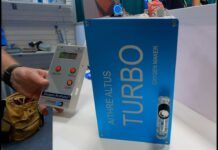
In the early 1980s, the FAA approved the use of cannulas for breathingsupplemental oxygen in-flight. This proved to be a tremendousboon for turbocharged-but-unpressurized aircraft. Cannulas areextremely comfortable, so much so that it’s easy to forget you’rewearing one. Cannulas allow you to breathe normally, communicatenormally, even eat and drink in-flight. And so-called "conserving"cannulas, coupled with calibrated vernier flowmeters, permit youto stretch your oxygen supply by a factor of two or three comparedto a mask.
Cannulas solve many of the problems associated with breathingsupplemental oxygen, but not all of them. Cannulas are approvedfor use only up to FL180; some of us have been known to push thislimit a bit, but I can personally testify that a cannula doesnot provide adequate oxygen much above FL200.
Furthermore, some folks simply don’t do well on 100% oxygen, period.It tends to dry out the mucous membranes of the nose and throat,and prolonged breathing gives some people middle-ear problems.Others suffer from "altitude sickness" that is a mildform of "the bends."
Supplemental oxygen can also be problem if you carry a lot ofpassengers. That oxygen bottle can last a long time if only oneor two people are breathing from it, but four or six can emptyit pretty fast. Furthermore, some passengers simply don’t careto fool with oxygen paraphernalia (cannulas or masks), and otherpassengers (particularly children and infants) can’t easily bepersuaded to use oxygen.
So if you tend to carry passengers or if you’re one of those folkswho have a problem breathing through a tube, you may want to giveserious thought to a pressurized aircraft.
What does pressurization cost?
The costs involved are significant, however. Pressurized aircraftare more expensive to buy, more expensive to operate, and moreexpensive to maintain.
Let’s look at a specific example. According to the latest BlueBook, a pressurized 1980 Cessna 340A sells for an average retailprice of $265,000. Its unpressurized counterpart, a 1980 CessnaT310R, has an average retail price of $168,000. So the pressurizedairplane commands nearly a $100,000 premium.
At the same time, the 340A weighs about 500 pounds more than theT310R (but has no more useful load), burns 3 gallons-per-hourmore, and cruises a few knots slower at most altitudes.
Maintenance of the pressurized bird is also more expensive, butnot for the reason you might think. The pressurization systemitself requires very little maintenance and seldom gives any trouble.When it does, the fix is usually quite simple: repairing a baddoor seal or cleaning a sticky outflow valve.
But pressurization makes certain other maintenance tasks muchmore difficult and time-consuming. Installing a GPS antenna, afuel totalizer, or a multi-probe EGT system, for example, is afar more difficult job on a pressurized airplane because of theneed to bring wiring through the pressure vessel. Changing anengine control cable or a fuel line are also far more labor-intensivefor exactly the same reason.
It’s difficult to quantify the additional maintenance cost ofpressurization in terms of a dollars-per-hour figure. Most routinemaintenance operations are no more difficult on a pressurizedairplane. But certain functions that involve penetrating the pressurevessel can be a great deal more difficult, and therefore expensive.
In addition, pressurized airplanes tend to have more engine problemsthan non-pressurized ones. Again, this is not the fault of thepressurization system. It’s simply because pressurized airplanestend to spend a lot more of their life flying at high altitudesthan non-pressurized ones. A Cessna T310R pilot will think twicebefore climbing up to the flight levels simply because doing sorequires him to use oxygen, while a Cessna 340A pilot will climbup there without thinking twice about it.
At high altitudes, the turbo works harder and the engine runshotter. In the long run, this means that all other things beingequal, a pressurized airplane will generally experience worseengine longevity than its unpressurized sibling.
Of course, all other things don’t have to be equal. A pressurizedairplane in the hands of a pilot who pays meticulous attentionto proper powerplant management (warm-up, cool-down, power settings,leaning, temperature control) can have very good luck with engines.And a turbocharged-but-unpressurized airplane in the hands ofa ham-fisted pilot can prove to be a maintenance disaster.
Bottom line
If you use your airplane as a serious traveling machine—especiallyif you fly long trips in instrument weather like I do—you shouldseriously consider turbocharging.
If you pay careful attention to powerplant management, use conservativepower settings, avoid troublesome engines (e.g., highly-boosted,fixed-wastegate, or most aftermarket add-ons), and be carefulwith aftermarket intercoolers, I think you’ll find—as I did—thatthe benefits of turbocharging far outweigh its very modest costs.If you don’t do much flying to high-altitude airports, the greatestbenefits of turbocharging lie in avoiding icing, thunderstorms,and turbulence.
And sooner or later, you’ll catch one of those 100-knot tailwindsand put a big smiley-face in your logbook.
