






























Myrecently-completed annual inspection of my Cessna T310R included a considerable amount ofscheduled maintenance work, as well as several significant unscheduled items (i.e., nastysurprises). One of the scheduled maintenance items this year was 500-hour magnetomaintenance, which is a relatively significant item on a twin because there are four magsto do.
Many owners aren’t aware (and an alarming number of A&Ps conveniently forget) thatboth Bendix (TCM) and Slick (Unison) mags need a minor tune-up every 100 hours and a majordisassembly inspection, cleaning, lubrication and adjustment every 500 hours. The 500-hourmajor maintenance is frequently neglected, and it’s not unusual to see an engine reach TBOwithout the mags ever having been removed. The fact that mags can continue to function inthe face of such neglect is a testament to their inherent reliability.
As we’ll discuss shortly, mag performance deteriorates significantly if this routinemaintenance isn’t done. This usually shows up as hard starting, high-altitude misfire,and/or general deterioration of engine efficiency. Occasionally, the result is much moreserious (e.g., deafening silence).
What Makes ‘Em Tick?
A magneto is a self-contained ignition system that converts mechanical rotation intohigh-voltage pulses that are used to fire the spark plugs, and does so without the needfor external power from a battery or electrical system. For years, magnetos have been theignition system of choice for aircraft engines because they continue to function perfectlyeven in the face of a total electrical failure.
The Rotor
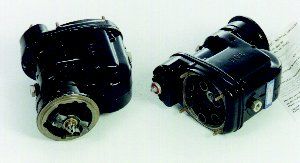 Bendix S-1200 mags are larger and more powerful than other models. |
The term "magneto" comes from the permanent magnet rotor which is spun by theengine’s accessory gearing. In a four-cylinder engine, the rotor turns at engine RPM — ina six-cylinder engine, it turns 1.5 times crankshaft speed. This magnetized rotor,together with the primary winding of the magneto’s coil, function as a specializedalternator which generates alternating current flow in the primary as the rotor turns.Each full rotation of the rotor induces two waves of electric current in the primary coil,of opposite polarity.
The amount of energy generated in the primary coil winding is a function of how rapidlythe magnetic field across the primary changes. This varies with two things: how strong therotor’s magnet is, and how fast it turns. Big mags (like the Bendix S-1200) generate moreenergy than do little ones (like the Slick 6300 or the Bendix D-3000 dual-mag) becausetheir rotors have bigger, more powerful magnets.
As a mag gets older, its rotor gradually loses magnetism, so its ability to generateenergy weakens. Fortunately, the rotor can be re-magnetized and this is typically done atmajor overhaul of the mag.
Equally important as the strength of the rotor’s magnetism is its rotation speed. Likeany alternator, mags generate their maximum energy when turning at full operating speed,and put out a lot less energy at slow RPMs (such as idle).
The Coil and Breaker Points
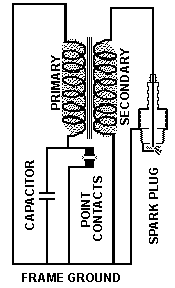 Basic magneto schematic diagram. |
The primary winding of the coil consists of 200 turns or so of heavy-gauge copper wirewound around a laminated iron armature. One end of the coil is permanently grounded to thecase of the magneto, while the other end is connected to a set of cam-operated breakerpoints similar to those used in automotive distributors in the pre-electronic-ignitionera. Normally, the breaker points are closed, grounding both ends of the primary coil andallowing current induced by the rotor magnet to flow continuously around and around thecoil. This current flow produces a powerful magnetic field in the coil’s iron core.
At the moment of ignition, the magneto’s cam opens the breaker points, interrupting theflow of current in the primary coil winding, and causing the magnetic field in the coil’score to collapse quite suddenly. The collapse of the core’s magnetic field induces a largevoltage spike in the primary, which may be as high as 200 or 300 volts.
Now, that’s enough voltage to give you a nasty jolt if you grabbed a hold of themagneto’s low-tension terminal while the engine was running, but it’s not even close toenough voltage to jump the gap of a spark plug. That’s where the coil’s secondary windingcomes in.
The secondary winding of the coil consists of a very large number of turns of very finemagnet wire — perhaps 20,000 or so — wound around the same core as the primary. One endof the secondary winding is grounded, while the other end is hooked to the high-tensionterminal of the coil. The two coil windings act as a special sort of step-up transformer.Since the secondary winding has something like 100 times as many turns as the primary, the200- to 300-volt spike produced in the primary when the breaker points open induces avoltage 100 times as large in the secondary: 20,000 to 30,000 volts. Now that is enough toproduce a nice, hot spark!
The Capacitor
One little fly in this ointment has to do with what happens at the breaker points atthe moment they’re opened by the cam. Since the points are being opened by mechanicalaction of the cam, it’s obvious that the process of point opening isn’t exactlyinstantaneous. During the first microseconds that the cam is opening the points, they’restill so close together than the 200-volt spike in the primary coil winding can arc acrossthem.
Such arcing at the breaker points is a Bad Thing for two reasons. First, arcing causesa tiny amount of metal transfer from one breaker point to the other, and if left uncheckedwould cause the points to erode and pit quite quickly. Second, arcing causes the magneticfield in the coil to collapse more slowly, resulting in a lower voltage induced in thesecondary, and therefore a weaker spark at the plugs.
To solve these two problem, mags are equipped with a capacitor connected across thebreaker points. Here’s how it works. At the moment of point opening, the initial voltagespike charges the capacitor for 50 microseconds or so instead of arcing acrossbarely-separated breaker points. By the time the capacitor is charged, the cam hasseparated the points far enough that the 200- or 300-volt spike in the primary coil cannotjump the gap. The result is a nice, predictable waveform and much longer-lasting points.
The size of the capacitor is critical. If it’s too small, arcing won’t be effectivelysuppressed. On the other hand, if it’s too large, the coil’s field will collapse so slowlythat the magneto’s voltage output will be seriously reduced.
The Distributor
The high-voltage pulses produced by the secondary winding of the coil must be directedto the spark plug of each cylinder in sequence. The magneto accomplishes this by means ofa mechanical distributor. The high-tension lead of the coil is connected to a rotatingwiper electrode on a large distributor gear that turns at half crankshaft speed inside themag’s distributor block, passing in close proximity to individual electrodes connected tothe four or six or eight spark plug lead wires.
The distributor block is made of insulating (dielectric) material capable ofwithstanding tens of thousands of volts. It is essential that the inside of thedistributor block remain scrupulously clean and dry. The slightest bit of contamination —moisture, oil, or dirt — can impair the dielectric properties of the block and allowinternal arc-over between distributor block terminals, causing enginemisfire…particularly at high altitudes. Once such arc-over occurs, it tends to leave acarbonized track in its wake, facilitating subsequent arc-over events.
The P-Lead
 Slick 6300-series mags are compact and reliable. |
The "P-lead" is a wire that runs from the ungrounded end of the magnetocoil’s primary winding to the cockpit ignition switch. (The "P" stands for"primary.") Its purpose is to allow the ignition switch to disable the magnetoby grounding the hot side of the primary. As long as the P-lead is grounded through theignition switch, the breaker points are unable to interrupt the primary current flow,making the mag incapable of generating a spark.
The P-lead is normally a 16-gauge shielded wire, with the shield grounded to themagneto case. Shielding of the P-lead is essential, because an unshielded P-lead acts asan antenna that radiates the ignition pulses generated by the magneto and createsinterference with aircraft radios.
Broken P-leads are a frequent problem, since the lead is exposed to engine heat andvibration and air blast. A broken P-lead center conductor results in a dangerous "hotmag" condition in which the ignition switch is unable to shut off the magneto. Abroken P-lead shield usually causes radio interference which disappears when he particularmag is shut off with the ignition switch.
Mag Tune-Up
Tuning up the magnetos for optimum performance involves two sets of adjustments:internal timing (point gap and E-gap) and external timing (or "timing the mag to theengine"). The internal adjustments require that the mags be removed from the engineand opened up, and should be performed at least every 500 hours of operation. Externaltiming is performed with the mags mounted to the engine, and should be checked every 100hours or at annual inspection.
Internal Mag Timing
There are two internal adjustments that must be set correctly for a magneto to operateproperly: point gap and "E-gap."
The point gap should be set first. To do this, the drive shaft of the magneto isrotated to the position at which the cam has opened the breaker points to the maximumextent. Then the point gap is measured with an ordinary wire-type feeler gauge. The pointsare then adjusted until for the specified gap (normally about .018 inch for Bendix mags).
Once the point gap is correct, the "E-gap" can be set. First, rotate therotor slowly until you can feel a "magnetic detent." This is known as the"neutral position" of the rotor. Now, with a timing light ("buzz box")attached across the breaker points, rotate the magneto until the points just start toopen. The number of degrees of rotation from neutral to point opening is called the"E-gap" and needs to be set to a specified value (e.g., 10 degrees +/- 2) sothat the points open exactly when magnetic field induced in the coil by the rotor is atits maximum. On the big Bendix S-1200 and dual Bendix D-2000/3000 mags, this adjustment ismade by loosening the screw that attaches the cam to the rotor shaft, and rotating the camuntil the "E-gap" is correct. Other magneto models have non-adjustable cams, sothe "E-gap" adjustment is made by adjusting the breaker points.
These adjustments are essential to ensure that the magneto is able to generate enoughenergy to produce a hot spark. If the "E-gap" drifts out of limits, the mag willcontinue to work but the spark it produces will be weak.
External Mag Timing
 Checking external mag timing with a timing light. |
Once these internal adjustments have been made, the magnetoes must be mounted on theengine and ignition timing set correctly. To do this, one of the spark plugs in the #1cylinder is removed and the crankshaft rotated until the #1 piston is at top-dead-centerposition. Once this TDC position is established, the crankshaft is rotated to thespecified firing position (typically 20 before TDC).
Using an ignition timing light ("buzz box"), each magneto is adjusted so thatits breaker points open precisely at this desired firing position. The adjustment is madeby loosening the two magneto base clamps and rotating the entire magneto on the enginemounting pad until the points just start to open (as shown by the timing light connectedto the mag’s P-lead terminal). The base clamps are tightened and the timing is re-checked.
External timing is critical to proper engine operation. It should be within a degree orso of spec, and should be re-checked every 100 hours.
Bumping The Mag
When ignition timing is checked routinely at 100-hour or annual inspection, it’s notunusual to find that it has drifted off-spec by a degree or two. The drift can be ineither direction. Wear on the rubbing block causes the points to open later, retardingignition timing. Erosion of the breaker points themselves (due to arcing, etc.) causes thepoints to open earlier, advancing the timing.
The usual procedure is to loosen the magneto hold-down clamps and to "bump"the mag a little bit to bring the timing back to specifications. This procedure is fine sofar as it goes. The problem comes when mechanics fail to keep track of how far the magnetotiming has been "bumped" in the course of successive inspection intervals. Yousee, the same factors that cause the external timing to drift (rubbing block wear andpoint erosion) also cause the magneto’s internal timing to drift away from the correctE-gap, which degrades the quality of the spark that the mag produces.
So, while it’s certainly okay to bump the mag timing by one or two or even threedegrees to correct timing drift, drift beyond that should be considered a "redflag" that it’s time to pull the mag and re-adjust the internal timing. Naturally,unless you keep track of each time you bump the mag timing, you have no way of knowing thecumulative amount of timing drift that has occurred since the E-gap was last set. (Onemore reason for including more detail in your maintenance log entries.)
Getting Started
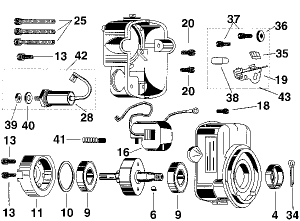 Slick 6300 mag, exploded view. |
Once the engine is running, a properly-adjusted magneto does a fine job of providingthe required ignition. Starting the engine is another matter altogether.
There are two major obstacles to starting a magneto-ignition engine. For one thing, ourelectric starters crank the engine at very low speed — typically 10 to 20 RPM. But, amagneto is not capable of generating enough energy to fire a spark plug at less than, say,150 RPM (referred to as the mag’s "coming in speed"), and even at that speed,the spark would be marginal at best.
Then there’s the problem of timing. Magneto-ignition aircraft engines have fixedignition timing, typically at something like 20 BTDC (before top-dead-center). Thissetting is a compromise between takeoff and cruise (where we’d really like the ignitiontiming to be advanced even more) and idle (which would be a lot smoother if the timing wasretarded). But there’s no way that an engine is going to start with ignition timing likethis. If you crank an engine at 20 RPM and a spark plug fires 20 before thecorresponding piston reaches the top of its compression stroke, the engine will backfire— guaranteed.
So, to have a prayer of getting our engine started, we need to do two things: (1)figure out a way to coax the magneto into generating enough energy to fire the spark plugsat slow cranking speeds, and (2) figure out a way to retard the spark enough to ensurethat the engine won’t backfire during cranking.
Two rather different methods are commonly used to accomplish these things — onemechanical, and the other electrical. Which you use depends on what kind of airplane youfly. Most Cessna singles use the mechanical method (impulse coupling), while most Cessnatwins and many Beech Bonanzas use the electrical method (retard breaker).
Impulse Coupling
The impulse coupling is an extraordinarily clever mechanical solution to the startingproblem. It’s a mechanism that’s contained within a hub that attaches to the magneto’sdrive shaft and is driven in turn by the engine. Here’s how it works.
When the starter cranks the engine, a spring-loaded flyweight in the magneto drive hubcatches on a stationary stop pin mounted on the magneto case. This stops the magneto shaftfrom turning further. As the engine continues to turn, an impulse spring in the hub iswound up for 25 to 35 of engine rotation (the "lag angle") until a drive lugon the coupling body trips the flyweight, disengaging it from the stop pin. At this point,the wound-up impulse spring "snaps" the magneto through its firing position at aspeed much faster than cranking speed.
This has precisely the two effects desired: the ignition timing is retarded (by lagangle of the coupling), and the magneto rotor is turned fast enough to generate a decentspark. Neat trick, eh?
Once the engine starts, centrifugal force causes the spring-loaded flyweights in theimpulse coupling to retract so that they no longer catch on the stop pin. When thishappens, the engine drives the magneto directly and timing returns to its normal settingof 20 BTDC or whatever.
It’s easy to tell whether or not your engine uses impulse couplings. If you hear a loud"snap" when you pull the prop through by hand, and if you hear "snap snapsnap" just before your engine stops at shutdown, then you have impulse couplings.
Some installations provide an impulse coupling on both magnetos. Others use an impulsecoupling on only one mag, and employ an ignition switch that grounds out the P-lead of thenon-impulse mag during the start.
Because impulse couplings have moving parts, they need to be disassembled and inspectedcarefully during each 500-hour magneto maintenance cycle. In addition, there have been alot of Airworthiness Directives against impulse couplings in recent years — both Bendixand Slick — and these have to be taken very seriously. An impulse coupling failurein-flight can result in total engine failure, and some failure modes can cause parts ofthe impulse coupling to drop into the engine gearbox, causing catastrophic destruction ofthe engine. So be sure your impulse couplings are not worn excessively and that allapplicable ADs are complied with.
Retard Breaker
An alternative solution to the starting problem is the retard-breaker magneto. This wasfirst pioneered by Bendix in its "Shower Of Sparks" system, but nowadays bothBendix and Slick make retard-breaker mags.
As the name implies, the retard-breaker mag makes use of a second set of breaker pointsto generate a spark at retarded ignition timing during engine start. Generally, only theleft mag has the extra breaker points, and starting is done with the right mag disabled inthis scheme.
While the extra set of points solves the problem of retarding the spark for starting,the fact remains that the magneto is still turning too slowly to generate the energyrequired to fire a spark plug. To deal with this problem, aircraft battery power isconverted into pulses by a starting vibrator — basically, a little electric buzzer — andthose pulses are fed to the magneto coil’s primary winding via the P-lead, inducinghigh-voltage pulses in the secondary winding that do contain sufficient energy to fire thespark plug.
This scheme has some advantages. It eliminates the mechanical risks associated withworn impulse couplings. It also produces easier starting because the spark plug fires adozen times or so during each ignition event, rather than just once. (Hence, the"Shower Of Sparks" trademark that Bendix uses for this system.) Finally, itsaves a little weight.
There is one big disadvantage of the retard-breaker ignition system, however: You can’tstart the engine with a dead battery. Don’t bother trying to hand-prop a twin Cessnaunless you’re simply looking for a new and different kind of aerobic workout.
SlickSTART
In 1997, Unison Industries introduced a product called SlickSTART, which is really asolid-state replacement for the old starting vibrator used in the retard-breaker system.Interestingly enough, however, Unison got the SlickSTART approved for use with bothTCM/Bendix mags as well as their own Slick mags, and also got approval for use withimpulse-coupling-equipped mags as well as the retard-breaker kind. In fact, just about theonly engines that the SlickSTART is not approved for are those that use the Bendix D-2000or D-3000 dual magneto.
The SlickSTART produces a much hotter spark for starting than either a startingvibrator or impulse coupling, and is far better at firing carbon-fouled plugs. (Note thatnothing can help if the plugs are lead-fouled, other than removing and cleaning theplugs.)
Is it worth retrofitting your engine with the new SlickSTART system? If your engine ishard to start or you operate in frigid temperatures, it’s an excellent idea. On the otherhand, if you’re not having any problems with starting, there’s probably no reason to makethe change.
Flying High
Starting is one phase of operation that is especially challenging to the magnetoignition system. Flying at high altitudes is another, particularly when we’re talkingabout turbocharged engines and flight-level flying.
When a magneto generates a high-voltage pulse, we want that pulse to create a sparkinside the cylinder by jumping the air gap between the electrodes of the spark plug. Whatwe don’t want to happen is for the spark to occur anywhere else — such as inside themagneto distributor block, or inside one of the ignition harness wires, or between theignition harness wire and a nearby piece of the engine, etc. Such an undesirable spark iscalled an "arc-over" and results in what we call "misfire."
To ensure that the spark occurs where we want it to occur, we must make sure that thespark plug represents "the path of least resistance" for the high-voltage pulsegenerated by the magneto. If we set our spark plug electrode gap to 0.018 inch, forexample, and make sure that any place else in the ignition system that the spark couldjump is a whole lot bigger than 0.018 inch, then we can be pretty certain that the sparkwill occur at the spark plug electrodes.
Here’s the problem: Air is a pretty good electrical insulator, but its insulatingcapability (dielectric constant) varies with pressure. The higher the pressure of the air,the better it insulates — the lower the pressure, the easier it is for electricity topass through it (in what we call a spark).
High-Altitude Misfire
Imagine a turbocharged airplane departing a sea level airport. At the moment ofignition, the air pressure in the vicinity of the spark plug electrodes is quite high(since it has just been compressed by the piston), so it’s a pretty good insulator. Theair pressure inside the magneto is outside ambient, which is considerably lower, so thatair isn’t nearly as good an insulator. But the air gaps inside the magneto are at leastseveral tenths of an inch wide, a great deal longer than the spark plug gap. So the sparkplug gap is the path of least resistance and that’s where the spark occurs.
Now suppose this airplane starts climbing up to a cruising altitude up in the flightlevels. The air in the vicinity of the spark plug remains at high pressure, thanks to thecompressive effects of the turbocharger and the compression stroke of the piston. But theair pressure inside the magneto decreases with altitude, making it easier and easier forarc-over to occur there. At some altitude, the breakdown voltage inside the magnetobecomes lower than at the spark plug electrodes, and "high-altitude misfire"begins to occur.
Let me tell you from firsthand experience that this will really get your attention!
If you ever experience high-altitude misfire in flight, the first thing you should dois throttle back. This will reduce the combustion-chamber pressure in the vicinity of thespark plug electrodes, and make it easier for the spark to occur where it’s supposed tooccur. Your next move should be to descend to a lower altitude, thereby increasing the airpressure inside the magneto and thereby raising the breakdown voltage.
When you get back on the ground, you should probably have a mechanic open up the magsand inspect the inside of the distributor blocks for carbon tracking. Such conductivedeposits produced by previous arc-over events can make it much easier for subsequentarc-overs to occur, and should be cleaned off.
Preventing Misfire
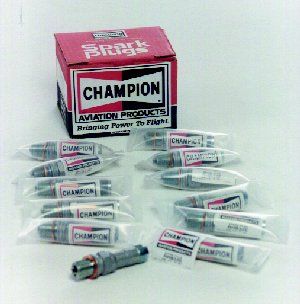 Spark plug gaps are critical for high-altitude flying. |
There are basically two fundamental strategies for preventing such high-altitudemisfire: make it easier for the spark to occur where it’s supposed to, or make it harderfor it to occur where it’s not.
One obvious way to make it easier for the spark to occur where it’s supposed to (at thespark plug electrodes) is to tighten up the spark plug gap. The specs say that a RHB32Espark plug should be gapped to between 0.016 and 0.019 inch. I gap mine to 0.016 inch togain increased margin against high-altitude misfire. Of course, the gaps increase as thespark plugs wear, so it’s important to clean and re-gap the plugs on a regular basis: atleast every 100 hours, and perhaps even every 50 hours if you have a history ofhigh-altitude misfire.
Many operators who fly regularly at high altitude prefer to use fine-wire spark plugsinstead of the usual massive-electrode type. Fine-wire plugs are more than twice asexpensive, but they tend to hold their gaps much longer, so part of their cost is offsetby less frequent plug maintenance. Fine-wire plugs also last a good deal longer than domassives.
How can you make it harder for arc-over to occur inside the magneto? There are twoways. One is to use magnetos that are as physically large as possible, reducing the chanceof internal arc-over between the widely-spaced electrodes. For example, the hugeTCM/Bendix S6-1200 mags that I use on my airplane have distributor block electrodes thatare spaced 1.2 inches apart, so they’re much more resistant to high-altitude misfire thanthe smaller Slick 6300 mags that are also approved for my engines.
The other way to minimize the chance of arc-over is to pressurize the mags by pumpingbleed air from the turbocharger into them. RAM Aircraft, for example, fits pressurizedSlick mags on all its TSIO-520 engines. For really high altitudes, a pressurized versionof the big Bendix S-1200 mag — the S-1250 — is available, and used by RAM on theirGTSO-520 engines used on the Cessna 404 and 421.
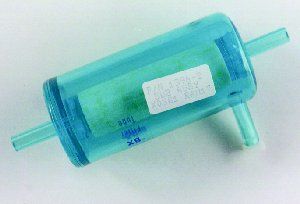 New-style pressurization line filter helps keep moisture out of pressurized magnetos. |
Pressurized mags are a mixed blessing, however. Although the pressurization is aneffective way to eliminate the high-altitude misfire problem, it also creates a newproblem — internal contamination of the magneto — particularly when flying throughmoisture (rain or clouds). As a result, pressurized mags need to be opened up and cleaneda lot more frequently than do non-pressurized ones. In fact, Slick Service BulletinSB1-88A recommends a teardown and internal inspection of pressurized mags every 100 hours(compared with 500 hours for non-pressurized mags).
The smaller Slick pressurized mags also do not produce nearly as energetic a spark asdo the big TCM/Bendix S-1200s. While they certainly produce an adequate spark, they haveless margin for misadjustment (E-gap drift, etc.).
If you do have pressurized mags installed, make sure they receive frequent maintenance,and change the filter in the magneto pressurization line often. TCM has an improved largegreen pressurization line filter (p/n 653386) that is more effective than the small, clearones at removing moisture from the pressurization air before it reaches the magneto. RAMAircraft also sells an improved filter. Both of these filters provide a sump and drainline for moisure.
Putting It All Together
Every 100 hours or annual, check ignition timing (i.e., external timing) with a magnetotiming light. If the timing has drifted off by more than a degree, "bump" themag to return the timing to specifications. Keep track of how far the timing has been"bumped" at each inspection, and in which direction. Cumulative"bumping" of more than about three degrees is good reason to remove the magsfrom the engine and readjust the internal timing, even if the normal 500-hour maintenanceinterval hasn’t yet arrived.
Every 500 hours, remove the mags from the engine for major maintenance. For TCM/Bendixmags, it’s easy enough to perform the 500-hour inspection and adjustment procedurelocally, and replace the wear-prone parts (points, carbon brush, and distributor block).For Slick mags, consider simply exchanging the mags at 500 hours for reconditioned unitsfrom Unison. (Slick tends to discourage field maintenance of their mags by setting partsprices high and offering very reasonable prices for overhauled-exchange units.) If yourengine uses impulse couplings, be sure to inspect them very carefully for excessive wear,and make sure all ADs have been complied with.
If hard-starting is a problem, consider installing the SlickSTART solid-state unit,which will work with almost any installation except for the TCM/Bendix dual-mag.
If you fly at high altitudes (especially if turbocharged), you need to take extraprecautions to prevent high-altitude misfire. Clean and gap your plugs frequently (every50 to 100 hours) and keep the gaps at the low end of the allowable range. Consider usingfine-wire spark plugs. For high-altitude operations, you should be using either the bigTCM/Bendix S-1200 mags, or pressurized Slicks with the big green TCM or RAM line filtersto keep moisture out of the mags.
For even more information about magnetoes, I recommend JohnSchwaner’s book The Magneto IgnitionSystem.