


























Oneof the most perplexing maintenance problem areas that owners of high-performance pistonaircraft have to deal with is the turbocharging system. I often hear from unhappy ownerswho have already incurred considerable expense in overhauling or replacing costlyturbo-system components without having resolved the trouble. As always, I advise that it’salmost never a good idea to "throw money at the problem" until sufficienttroubleshooting has been done to identify the actual cause of the problem.
There are very good reasons that turbocharging problems tend to be difficult formechanics to troubleshoot. They’re hardly ever reproducible on the ground, often occuronly at quite high altitudes, and are sometimes quite erratic or intermittent. In mostcases, the mechanic has no choice but to rely entirely on a description of the symptomsprovided by the owner or pilot. Unfortunately, that description is often incomplete ormisleading because the owner or pilot doesn’t really understand what the mechanic needs toknow to diagnose the problem correctly.
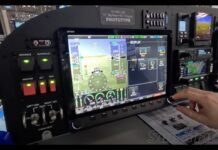
Furthermore, there’s precious little cockpit instrumentation that offers any directmeasurement of what the turbocharging system is doing. We don’t have a turbochargerspindle speed gauge or a wastegate position indicator on the panel. Turbo problemsgenerally show up on the Manifold Pressure gauge, and that instrument provides only a veryindirect indication of what’s going on with the turbocharging system.
To make matters even worse, the fundamental design of the automatically-controlledturbocharging systems used on most high-performance and pressurized aircraft tends tocompensate for-and therefore conceal-problems with the engine and turbo-system, oftenleaving pilots blissfully ignorant that mechanical problems are developing until thoseproblems get quite serious.
Nevertheless, if the owner or pilot understand how the system works and knows that tolook for, and if the mechanic employs a logical procedure for troubleshooting the system,it’s usually possible to isolate turbocharging problems problem without having to resortto the "shotgun approach" of replacing or overhauling one component afteranother until the problem finally disappears.
Turbocharging Basics
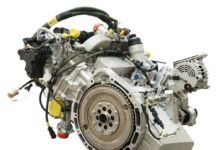
The basic principles of turbocharging are quite simple. The turbocharger itselfconsists of exhaust-driven turbine wheel mounted on one end of a shaft, and a centrifugalcompressor impeller mounted on the other end. Engine exhaust gases, which would otherwisesimply be wasted energy, are used to spin the turbine at very high speed (typically 50,000to 100,000 RPM). This drives the compressor, which is used to boost the pressure of theengine’s induction air and therefore increase the engine’s power output.
Turbocharging can be employed in two ways. One, known as turbonormalizing, isused to maintain sea level manifold pressure (roughly 30 in. hg.) at altitude, therebyeliminating the progressive horsepower reduction that occurs with normally-aspiratedengines as the aircraft climbs. The other, known as turboboosting, boosts manifoldpressure to a value significantly higher than sea level ambient (usually 35 to 45 in. hg.)to provide increased sea level horsepower. Boosted engines normally employ some means toprovide adequate detonation margins, such as reduced compression ratio and intercooling.
In either case, the turbocharging system needs to include a means of controlling theturbocharger’s compressor output pressure. Without such a control system, a turbochargedengine would be fundamentally unstable.
For example, a small increase in engine power would result in a small increase inexhaust volume. This would cause the turbocharger to spin faster, which would increase thecompressor speed and therefore the manifold pressure. This would result in an additionalincrease in engine power, producing more exhaust volume, faster turbocharger speed, highermanifold pressure, etc. In other words, the system would "run away" and verypossibly exceed maximum engine operating limits.
Likewise, a small decrease in engine power would cause a reduction in exhaust volume, adecrease in turbocharger speed, a reduction in manifold pressure, a further decrease inengine power, and so forth. In short, the engine would be nearly impossible to control.
The way turbocharger output is regulated is by means of a butterfly valve called a"wastegate" which allows a certain amount of exhaust gas to be vented overboardwithout going through the turbocharger. If the wastegate is fully open, almost all of theexhaust bypasses the turbocharger; if it is fully closed, virtually all of the exhaustmust go through the turbocharger.
Automatic control
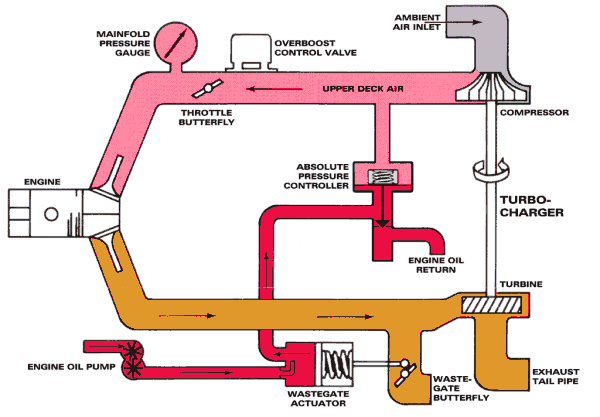
Most high-performance turbocharged aircraft (including all pressurized piston models)employ an automatic wastegate control system to regulate the turbocharger. (A few aircraftsuch as the Mooney 231 and Piper Seneca use fixed wastegates, while Cessna’s T182/TR182and some older aftermarket turbo conversions use manually-controlled wastegates.) Theautomatic system employs a hydraulic wastegate actuator and an pressurecontroller to maintain turbocharger output at the desired pressure.
The wastegate butterfly is normally held in the full-open position by a strong spring,allowing exhaust gas to bypass the turbocharger. Engine oil pressure applied to thewastegate actuator causes the wastegate butterfly to close, forcing exhaust gas to gothrough the turbocharger. The more oil pressure is applied to the wastegate actuator, themore the wastegate closes until, at about 50 PSI, the butterfly is fully closed.
The pressure controller monitors the output of the turbocharger’s compressor (alsoknown as "upper deck pressure" or UDP), and regulates the oil pressure to thewastegate actuator to hold the turbocharger output constant. The controller is a simpledevice that consists of an aneroid and a poppet valve. Here’s how it works.
If the turbocharger output is less than the set-point of the controller, theaneroid expands and closes the poppet valve, increasing the oil pressure in the wastegateactuator and causing the wastegate to close. This causes more exhaust to pass through theturbocharger, spinning it faster, and increasing the compressor output.
If, on the other hand, turbocharger output rises above the set-point of the controller,the aneroid contracts and opens the poppet valve, decreasing the oil pressure in thewastegate actuator and allowing the wastegate to open a bit. This lets more exhaust gasbypass the turbocharger, slowing it down and decreasing compressor output. Thus,equilibrium is quickly reached whereby the turbocharger output stays right at theset-point of the controller and the system remains stable.
Most unpressurized turbos use an absolute pressure controller (APC) set tomaintain turbocharger output at a few inches over engine red-line. The controllerset-point is easily adjustable by screwing the controller’s poppet valve seat in or out,and should be adjusted so that application of full throttle produces the proper red-linemanifold pressure for takeoff.
Most pressurized piston aircraft use a variable absolute pressure controller(VAPC). The difference between an APC and VAPC is that the VAPC’s set-point is varied bymeans of a cam connected to the throttle control. At full-throttle, the VAPC works justlike an APC (and is adjusted to produce proper full-throttle MP in the same fashion). Butat partial throttle settings, the VAPC set-point is reduced so that the turbochargerdoesn’t have to "work so hard" when the pilot throttles back to reduced manifoldpressure.
What Really Happens
To gain a better understanding of how the system works, let’s follow it through anactual flight profile and see what it actually does. To make things simple, let’s supposewe’re flying an unpressurized airplane like my T310R that uses a simple absolute pressurecontroller. (The differences when flying a pressurized airplane with a VAPC are minor andnot really significant for purposes of this discussion.)
You’ve probably noticed that when flying a normally-aspirated airplane, full-throttlemanifold pressure at takeoff never quite reaches sea level ambient (around 30"), buttops out at a few inches less than that due to unavoidable pressure losses in theinduction system. Likewise, for a turbocharged airplane to achieve rated red-line MP ontakeoff, the APC set-point must be a few inches higher to compensate for induction systemlosses. My T310R’s manifold pressure red-line is at 32", and the APC set-point isadjusted to about 3" higher (about 35") to produce red-line MP on takeoff.
Let’s start the engines and taxi to the runup area. The APC sees that the turbochargeroutput is less than its set-point of 35" so it closes its poppet valve to call forwastegate to close. As soon as engine oil pressure comes up, the wastegate (which isspring-loaded to the full-open position) will close all the way. However, since the engineis at idle, there’s not enough exhaust flow to spin up the turbocharger enough to produce35" of UDP, so the wastegate remains fully closed throughout the taxi and probablyeven during the runup.
Now we taxi onto the runway and slowly apply full throttle for takeoff. As the enginedevelops more and more power, the exhaust flow increases dramatically and spins theturbocharger faster and faster, causing UDP to increase until it reaches the controllerset-point of 35". At that point, the controller opens its poppet valve to relieve theoil pressure to the wastegate actuator, allowing the wastegate to open as necessary tostop the turbocharger from spinning up any faster and thereby holding UDP right at35" (and indicated MP right at the 32" red-line).
Climbing out of 1000′ AGL, we reduce to 75% cruise-climb power (which in my T310R is29" MP and 2350 RPM). Throttling back to 29" MP reduces the exhaust flow fromthe engine, and reducing RPM from 2700 to 2350 reduces the exhaust flow even more. Thiscauses the turbocharger to start slowing down, but the controller immediately notices theresulting decay of UDP and closes its poppet valve to command the wastegate to close andforce more exhaust through the turbocharger, causing the turbo to spin back up to thepoint where UDP is steady at 35". This all happens so quickly that we’re never awarethat it’s going on.
Climb
As we climb on up to the Flight Levels, outside ambient pressure decreases by about1" per 1,000′ of climb. This decreased pressure would normally cause a correspondingdecrease in UDP (and therefore MP), but once again the controller compensates for thisdecay by gradually closing the wastegate more and more as we continue to climb, forcingmore and more exhaust through the turbocharger and spinning it up faster and faster asrequired to maintain UDP at a constant 35". In the cockpit, we notice that MP isstaying more-or-less right where we set it (at 29"), without theinch-per-thousand-feet drop-off that we’d expect in a normally-aspirated airplane.
Of course, this can’t go on forever. If we were to keep climbing higher and higher, andthe controller were to keep closing the wastegate more and more to compensate for thedecreased ambient air pressure, eventually we’d reach a point where the wastegate wasfully closed and the controller was no longer able to maintain 35" of UDP. In myT310R at 75% cruise-climb power, this occurs at around FL220, while in many otherturbocharged aircraft, it occurs somewhat higher (FL250 or more). At this point, when thewastegate is fully closed and the automatic control system is no longer able to maintainconstant UDP, the engine is said to be "bootstrapping" because the system isunregulated (and therefore unstable) and large MP variations may be observed.
Cruise
But we don’t want to go that high today. Let’s suppose we level off at FL180 and letthe airplane accelerate to cruise speed. As the airspeed increases, the ram air effectcauses a small increase in induction air pressure and a corresponding (somewhat larger)increase in UDP. Again, the controller notices this happening, and commands the wastegateto open a bit in order to slow down the turbocharger and hold UDP right at 35".
Now that we’re trimmed for level cruise at FL180, we slowly pull back on the propcontrols to reduce RPM from 2350 (top of the green arc on the tach) to 2250 RPM. As wereduce engine RPM, exhaust volume is also reduced, causing the turbocharger to spin slowerand reducing UDP. The controller reacts by commanding the wastegate to close in order tospin the turbo back up and restore 35" UDP.
Suppose we continue to reduce RPM gradually from 2250 to 2100 RPM, which is the bottomof the green arc on my T310R. As we do this, the controller closes the wastegate furtherand further in order to compensate for the reduced exhaust flow and maintain 35" UDP.But at some point around 2150 RPM, the wastegate will reach the fully closed position andany further reduction in RPM will cause the engine to bootstrap (indicated both by loss ofMP and instability of MP readings). Upon observing the onset of bootstrapping, we increaseRPM by 50 or so and see that the bootstrapping stops.
Descent
Okay, we’ve had enough fun, and it’s time to head back to the barn. We switch offaltitude hold on the autopilot, and roll in enough nose-down pitch trim to start a 1,000FPM descent out of FL180.
As our indicated airspeed rises from its cruise value of 160 KIAS to around 200 KIAS,increased ram air tries to increase UDP above 35", but the controller sees this andopens the wastegate enough to hold UDP steady. As we descend, outside ambient increases byabout 1" per 1,000′, so the controller must continually open the wastegate more andmore to prevent UDP from rising. In the cockpit, all we see is that MP remains rock steadyat 29", right where we set it.
By the time we get down to pattern altitude, the wastegate is most of the way open. Itstays there until we throttle way back for our final descent and landing. When we do that,the reduction in engine power causes exhaust volume to fall, and the controller has toclose the wastegate to make up for it and maintain 35" UDP. Eventually, as we closethe throttle all the way prior to touchdown, even full-closed wastegate is not enough tomaintain 35" UDP because the idling engine is hardly putting out any exhaust volumeat all. The wastegate remains fully closed as we turn off the runway and taxi in to theramp. It remains fully closed until we pull the mixtures to idle cutoff, at which pointengine oil pressure goes away and the wastegate returns to its spring-loaded full-openposition.
What Can Go Wrong?
The preceding discussion is all predicated on an engine and turbo-system that isworking properly, of course. A wide variety of mechanical ailments can interfere with theproper operation of the system. These include:
Induction leaks
Exhaust leaks
Internal engine problems
Wastegate problems
Controller problems
Turbocharger problems
All of these problems can result in improper operation of the turbocharging system, buteach one tends to produce symptoms that are subtly different in character. Therefore, acareful analysis of the symptoms can often help pinpoint the cause of the problem, or atleast rule out some of the possibilities and help narrow the search. But since-as we notedearlier-most turbo problems show up only at high altitudes and seldom on the ground, it’soften up to the pilot (rather than the mechanic) to make critical observations of thesymptoms and decipher what they mean.
Induction leaks
One of the most common causes of turbo-system problems are leaks in the inductionsystem. I recall, for example, helping a member troubleshoot his Cessna T310 in which itturned out that an engine control cable had been chafing against the engine’s inductionmanifold in a hard-to-see location. Eventually the steel cable wore a slot all the waythrough the wall of the cast aluminum induction pipe, creating a fairly significantinduction system leak.
The pilot squawked the problem when he notice a significant manifold pressure"split" between the two engines while cruising at the Flight Levels. The enginesappeared to be operating normally on the ground, during takeoff, and when operating at lowand middle altitudes. The problem only showed up when the airplane was flying up high. Ifyou think about the consequences of an induction leak, that’s not surprising.
Consider what happens during a full-power takeoff at or near sea level. (Once again,let’s assume the airplane in question is my Cessna T310R so we can use the same numbers aswe did before.) Manifold pressure inside the induction manifold is at red-line (32"),but that’s only a trifle greater than outside ambient pressure (around 30"). Sorelatively little induction air escapes through the leak. What little loss there is willbe sensed by the turbo controller as a loss of UDP, and the controller will cause thewastegate to close just a trifle, compensating for the small loss and effectivelyconcealing the problem. From the cockpit point of view, both MP needles are right wherethey should be and everything appears nominal.
At 1,000′ we throttle back to 29" MP for cruise-climb. What’s the outside ambientpressure at 1,000′? About 29"! So now, the induction leak becomes a totalirrelevancy, since the pressure inside and outside the induction manifold are virtuallyidentical, and so there’s no loss of pressure through the leak at all.
As we continue to climb at 29" MP, outside ambient decreases by about 1" per1,000′ so the pressure differential between inside and outside the induction manifoldincreases steadily. More and more induction air escapes through the leak. However, theturbo controller senses this loss and keeps closing the wastegate and cranking up theturbo output to compensate for it. In the cockpit, the MP needle never wavers from29" and so the pilot remains blissfully unaware of the problem. The wastegate on theleaky engine is closed more than it should be, and the turbocharger on that engine isspinning faster than it should be, but the engine is running just fine and there’s nocockpit instrumentation to provide the slightest clue that something’s awry.
The pilot’s first indication of a problem comes as the airplane climbs through 15,000’and the MP on the troubled engine starts to fall and become erratic, while the MP on theother engine remains rock-solid at 29". What’s happened, of course, is that thepressure differential across induction leak has become so great (about 15" now) thateven the maximum output of the turbocharger can no longer keep up with the loss. Thecontroller, it its now-futile attempt to compensate for the leak, has commanded thewastegate to go fully closed, and the engine has started to bootstrap…something thatshould normally not happen until the airplane climbs well into the Flight Levels.
These are the classic symptoms of an induction leak problem: normal operation attakeoff and low altitude, and the premature onset of bootstrapping (i.e., loss of MP andMP regulation) at higher altitudes. Unfortunately, there are other kinds of problems(e.g., exhaust leaks) that can produce the same symptoms.
So how can you be sure?
Good question! It turns out that there’s another symptom-one that the owner of thisaircraft missed-that can often be used to distinguish an induction leak problem like thisone from various other kinds of turbo-related problems. Best of all, this symptom is onethat can be checked without having to take the airplane up to high altitude, or evenleaving the ground at all! The tip-off is higher-than-normal MP when the engine isthrottled back to idle.
Consider an engine idling on the ground. The engine is "trying to breathe"but the throttle is retarded to idle, closing the throttle butterfly and choking off mostof the available induction air. (It’s called a throttle because it chokes off theengine’s airway!) The result is a significant vacuum in the induction manifold, asthe engine consumes the air in the induction manifold but the closed throttle butterflyblocks the inflow of air to take its place. In the cockpit, this shows up as a very low MPreading (typically, something on the order of 12" to 15") far below outsideambient (around 30" at sea level).
But suppose there’s a substantial leak in the induction plumbing somewhere between thethrottle and the cylinders. What happens? Ambient air rushes in through the leak becauseof the vacuum in the induction manifold. In the cockpit, this shows up as ahigher-than-normal MP indication at idle…perhaps 17" instead of 14". Theengine will also be idling leaner than usual-since the leak lets in more air but not morefuel-so the engine may tend to stumble a bit when you throttle-up for taxi (at least ifthe leak is big enough).
High MP at idle isn’t a perfect tool for diagnosing induction leaks. Some inductionleaks won’t produce this symptom (e.g., leaks in the upper deck portion of the systemprior to the throttle body). Also, the symptom can be produced by other things besides aninduction leak (e.g., a non-firing cylinder or a badly misadjusted idle mixture).
But certainly if you see both abnormal bootstrapping at altitude and high MP at idle,certainly the odds favor an induction leak, and that’s probably the first place you shouldlook for trouble.
If you suspect an induction leak (based on the observed symptoms), the first stepshould be to confirm the diagnosis by performing a critical altitude check. Theprocedure is described in detail in your aircraft service manual, and consists of a testflight at altitude in which certain power settings are established at certain altitudes,and the MP readings are recorded. The service manual has tables that establish how much MPyou should be able to obtain at these benchmark altitudes under specified conditions ofRPM, fuel flow and temperature. If your engine falls significantly short, then you can besure you have a problem…and odds are that it’s an induction leak (although there areother possibilities that we will discuss later on).
If you can’t find anything obviously wrong after careful visual inspection of theinduction system, a simple pressure check may be in order. All that’s required is topressurize the induction system with a few PSI of air-one good way is simply to pump airinto a cylinder as if you were doing a compression check, but rotate the prop so that thecylinder’s intake valve is open-then close the throttle and go over the entire inductionsystem with a soapy water spray, looking for leaks that reveal themselves by blowingbubbles. Some leaks are expected at the induction system drains and, to a lesser extent,around the throttle shaft, but the rest of the induction system should be completelyairtight.
Exhaust leaks
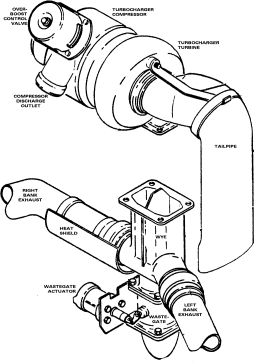 An exhaust leak canproduce similar symptoms to an induction leak-the onset of bootstrapping at alower-than-normal altitude-because any exhaust that escapes through a leak bypasses theturbocharger just as if it escaped through an open wastegate. Just like with an inductionleak, the turbo controller will try to compensate for (and thereby cover up) the problemby commanding the wastegate to close, so the symptoms generally won’t show up until theairplane is at high altitude. (Unlike a lower-deck induction system leak, an exhaust leakwill not affect MP at idle.)
Exhaust leaks are inherently much more dangerous than induction leaks, because of thevery serious threat of in-flight fire. Fortunately, exhaust leaks are usually a lot easierto detect because they typically leave brightly-colored exhaust stains (and sometimes alsoobvious heat damage) that can be detected visually during an engine-compartmentinspection. All turbocharged aircraft should have their exhaust systems meticulouslyinspected for leaks every 50 hours, and this is required by Airworthiness Directive forcertain aircraft such as the Cessna T210 and all turbocharged twin Cessnas.
Because the exhaust system operates under extreme heat and pressure, and becauseexhaust gas is so very corrosive, exhaust leaks can sometimes develop suddenly (a"blowout") rather than gradually. The pilot of a turbocharged aircraft whoexperiences a sudden unexplained loss of manifold pressure in-flight should assume that anexhaust failure may have occurred, and should put the airplane on the ground at theearliest possible moment. If the aircraft is a twin, the pilot should consider thepossibility of shutting down and securing the engine to minimize the threat of in-flightfire.
I don’t mean to frighten you with this statement. I have done extensive investigationof exhaust failures in turbocharged aircraft, and has concluded that the risk of anin-flight exhaust failure (particularly one of the "blowout" variety) isextremely remote on aircraft whose exhaust systems have been properly maintained andinspected. The vast majority of in-flight blowouts and exhaust-related fires involvedexhaust components with very high time and usually ones with poor-quality weld repairsthat failed.
Internal engine problems
A third possible cause of bootstrapping at a lower-than-normal altitude is an internalengine problem that prevents one or more cylinders from firing. This would most likely besomething that reduces the compression of a cylinder to near-zero (such as a valve that’sbadly burned or stuck open), or something that prevents both spark plugs in the cylinderfrom firing (such as severe lead fouling of both plugs). A non-firing cylinder reduces theexhaust output of the engine by one-sixth (assuming a six-cylinder engine), and this meansless flow through the turbocharger. As usual, the controller will try to compensate (andcover the problem up) by closing the wastegate, but this means that the wastegate will gofull-closed at a lower-than-normal altitude.
You’d think that a six-cylinder engine that was firing on only five cylinders would bevery obvious to the pilot, wouldn’t you? Well, I can tell you from firsthand experiencethat unless you have a probe-per-cylinder EGT system that shows one cylinder running icecold, you’re very likely not even to notice the loss of one cylinder…particularly ina twin where any roughness or loss of power is masked by the other engine. Trust me onthis one!
So if you notice bootstrapping at unusually low altitudes but can’t seem to find anyleaks in the induction and exhaust, it’s definitely worth doing a compression check andhaving a look at the plugs to make see whether one cylinder is not firing and/or operatingat near-zero compression. If so, you’ve probably found your culprit.
By the way, a zero-compression cylinder will generally cause the same abnormally highMP at idle as an induction leak. This is a symptom you should watch for before everyflight. If you see it, it’s usually a tip-off that something significant is wrong.
Wastegate problems
The other most common cause of turbo-system problems, besides induction leaks, areproblems with the wastegate and wastegate actuator. It makes perfect sense that thewastegate would be one of the most problematic parts of the turbocharging system, becauseit performs such an unenviable job: regulating the flow of incredibly hot and corrosiveexhaust gases.
Most wastegate problems are of the "sticky wastegate" variety in which theshaft on which the wastegate butterfly pivots gets "coked up" with byproducts ofcombustion (a nasty concoction of lead, carbon and sulfur) to the point that it no longeropens and closes smoothly when commanded to do so by the wastegate actuator. Anothersomewhat less common cause of "sticky wastegate syndrome" occurs when thewastegate actuator itself starts to bind as a result of the accumulation of oil-bornedeposits, O-ring deterioration, and/or scoring of the actuator cylinder.
Whatever the exact cause of the sticky wastegate, the result is that the constantseries adjustments commanded by the turbo controller-which are normally executed sorapidly and smoothly that they are unnoticeable to the pilot-become jerky and erratic. Theresult shows up as abnormal MP fluctuations, especially during periods of constantwastegate movement such as climb, descent, and flight in turbulent air.
It’s easy to confuse the erratic MP fluctuations caused by a sticky wastegate with theunregulated MP fluctuations caused by bootstrapping, but they’re really quite different ifyou know what you’re looking for. Bootstrapping (due to a fully-closed wastegate) is acondition that predictably occurs at high altitude and low engine RPM, and which can bemade to disappear at will by increasing RPM a bit or descending a bit. On the other hand,erratic MP fluctuations due to a sticky wastegate generally occur at various altitudes andRPM settings, and are most obvious during changes in altitude, power settings, andairspeed (all times when wastegate adjustments are most likely to be commanded by thecontroller).
If you suspect you might have a sticky wastegate, it’s easy to check in the shop.Simply remove the oil line that runs from the engine oil pump to the wastegate actuator.Hook a source of adjustable air pressure to the oil inlet port of the actuator-an ordinarycylinder compression tester is ideal for this purpose. Now simply watch the wastegateassembly as you slowly and repeatedly vary the air pressure from zero to 50 PSI and back.As air pressure reaches 15 PSI or so, the wastegate should start to close smoothly,reaching its fully-closed position when the pressure reaches around 50 PSI. As you backthe pressure down towards zero, the wastegate should open smoothly. Watch for any signs ofjerkiness or binding as you exercise the wastegate in this fashion. Any tendency to stickshould be obvious during this test. Also make sure the wastegate butterfly opens andcloses fully, a total movement of approximately 90 degrees of shaft rotation.
If the wastegate appears to be sticky, it’s possible that you might be able to"rescue" it by giving it a good soak overnight in a strong penetrant like MouseMilk or AeroKroil. But don’t count on it. If a penetrant soak doesn’t result insilky-smooth action, it’s time to yank the wastegate and send it out for overhaul. Expectto pay around $400 for the overhaul, plus a couple of hours of labor to remove andreinstall. Make sure that the overhauled wastegate is installed with the proper high-tempattaching hardware and new gaskets.
Controller problems
When the turbocharging system starts acting up, pilots and mechanics alike have atendency to name the turbo controller as prime suspect. In fact, the controller is hardlyever the culprit, and it’s an unfortunate fact that lots of perfectly good controllers aresent out for overhaul in the course of "shotgunning" turbo system problems.
The turbo controller is seldom the culprit for two reasons: it has a terribly easy job,and there’s not a whole lot that can go wrong with it. Think about it for a minute: thecontroller never sees hot exhaust gases or high engine temperatures like otherturbo-system components. It spends its life in almost air-conditioned luxury, watchingupper-deck pressure at one end, and regulating oil flow to the wastegate actuator at theother. If I had to come back as a turbo-system component in my next life, I’d almostsurely apply for the job of turbo controller!
That’s not to say that the controller cannot cause turbo problems, only that it’s oneof the system last components you should suspect. Before you send the controller out foroverhaul (which doesn’t come cheap), there are a few things you should try first:
If you’re flying a twin, try swapping the left and right controllers and see if theproblem changes sides or stays put (or goes away altogether). The swap generally takesless than an hour and could save you many hundreds of bucks and a week or two of downtime.
If the controller is at fault, it might just be that the poppet valve is sludged up.Disconnecting the oil lines and shooting a few shots of shop air into the oil return portmight dislodge the gunk and fix the controller problem. (At least it worked for me lasttime I tried it.)
The controller’s upper deck air reference line and inlet port should contain nothingbut air. Disconnect the line and inspect for any signs of liquid contamination (fuelor oil). If you see any, purge the line with solvent and shop air, and disassemble thecontroller’s aneroid chamber and clean it out, too. (That’s a whole lot less scary than itsounds.)
If the problem follows the controller when you swap sides (twins only) and a simplecleaning doesn’t resolve the problem (singles or twins), only then should youconsider sending the thing out for overhaul.
Turbocharger problems
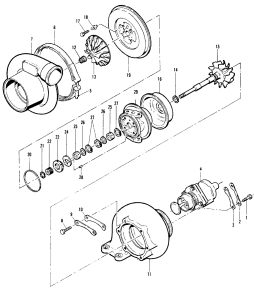 Of course, turbochargingproblems can also be caused by-ta da!-the turbocharger itself. I’m listing this componentlast, not because it seldom fails, but because when it does fail, the failure is more orless obvious. While a turbocharger can last a full engine TBO if the engine is operatedwith sufficient TLC, it’s certainly not unusual for a turbo to need a mid-term overhaul.
Turbochargers have several failure modes, most of which are more-or-lessself-diagnosing. For example, turbos sometimes fail catastrophically-the engine suddenlygoes normally-aspirated (or quits from over-rich mixture) and the aircraft starts trailingblack smoke (actually, oil being pumped into the hot exhaust). You put the airplane on theground fast, the tower rolls the equipment, and your mechanic doesn’t have much difficultyfiguring out what to do next. A catastrophic failure like this generally stems from aturbocharger that suddenly develops a serious out-of-balance condition while spinning at50,000 RPM or so, often because the turbo ingested some foreign object (like a nut, bolt,alternate air door hinge, or chunk of exhaust valve) that damaged the compressor orturbine wheel.
A less spectacular failure mode occurs when the turbocharger center section wears out,generally resulting in engine oil winding up where it doesn’t belong: in the compressorand/or turbine portions of the turbo. If oil leaks into the compressor, it will result inoil-soaked induction plumbing (you’ll likely see oil dripping from an induction systemdrain) and oil-fouled spark plugs. If it leaks into the turbine, it will result in anabnormal accumulation of oily deposits on the tailpipe and belly, and sometimes oildripping from the tailpipe after shutdown. A visual inspection of the turbocharger willconfirm oil where it doesn’t belong, and often excessive play when the shaft is wiggled.Time to yank and overhaul the beast.
A third turbocharger failure mode is a bit more subtle, and stems from the fact thatthe turbine wheel operates under tremendous centrifugal forces as it spins at 50,000 to80,000 RPM, while the metal loses much of its strength at the white-hot 1600Ftemperatures at which the turbine operates. The result is that the turbine blades developa very gradual "stretch" over the life of the turbocharger-particularly if it’srun hot and hard-and ultimately they can stretch enough that they actually start to scrapeon the turbine housing. The turbo should be inspected for signs of blade scrape at eachannual (and any other time the tailpipe is removed). If it is noted, it’s overhaul time.
A Troubleshooting Strategy
If you have a turbo-system problem, the best way to avoid falling victim to theexpensive, time-wasting "shotgun" approach is to devise a logicaltroubleshooting strategy. Your strategy should seek to find or rule out potential causesin a sequence that starts with the most common failure areas and the quickest, easiest andcheapest troubleshooting steps, and then gradually works towards rarer failures and moredifficult and costly actions. It’s impossible for me to suggest a one-size-fits-allstrategy, but here’s a starting point:
The first step in any turbo troubleshooting strategy should be a thorough test flight to document the exact symptoms. By all means do a "critical altitude check" as documented in the service manual for your airplane, to determine if you have a premature bootstrapping problem and to quantify just how serious it is. Be sure to note whether any erratic or abnormal MP indications occur only at high altitudes and/or low RPMs (indicating bootstrapping), or if they occur primarily during climbs, descents, and/or airspeed changes (indicative of a sticky wastegate). Also note whether MP at idle is higher than normal (indicative of an induction system leak).
Do a quick compression check and spark plug inspection to determine whether you have a cylinder not firing or with near-zero compression.
Visually inspect the induction system looking for any sign of a leak (chafed-through manifold, cracked induction coupling, loose hose clamp, etc.). If nothing suspicious is found, pressurize the induction system and use soapy water to search for leaks.
Visually inspect the exhaust system looking for any sign of a leak (tip-off is usually brightly colored exhaust stains). If nothing suspicious is found, pressurize the exhaust system and use soapy water to search for leaks.
Connect a source of variable regulated shop air (such as a cylinder compression tester) to the oil inlet port of the wastegate actuator, and exercise the actuator by repeatedly varying the air pressure between 0 and 50 PSI, watching for any sign of sticky operations. If the wastegate is sticky, try an overnight penetrant soak. If that doesn’t free it up, pull the wastegate and have it overhauled.
Remove the oil lines from the turbo controller and blow shop air through the poppet valve to dislodge any sludge. Remove the air reference line and inspect for any signs of fluid contamination. In a twin, try exchanging the two controllers to see whether the problem moves with the controller. If it does, and if cleaning the controller doesn’t help, send it out for overhaul.
Check the turbocharger for signs of FOD, oil in the compressor or turbine, excessive center section play, and turbine blade scrape. If any of those problems are noted, pull the turbo for overhaul.