































When an assembly is engineered, loads to be encountered by thebolted joint are calculated and a safety factor is applied toallow for unexpected loads. The engineer then sizes a fastenerto maintain the proper pre-load which will withstand the tensile,bending and shear loads imposed upon the assembly.
Developing Pre-Loads
When a fastener (bolt) is tightened, both a tension and torsionalstress is established within the bolt. This establishes a pre-load(clamping force) that is developed and applied to the assembly.When we torque a bolt to develop a clamping force of 8,000 pounds,this is the force the bolt is applying to the assembly, Figure1.
Figure 1. A clamping load of 8,000 pounds is being appliedto two plates.
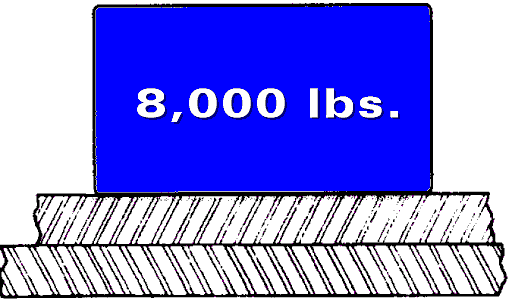
If a bolt developing 8,000 pounds of force were used to hold twoplates together, this force would be the equivalent of placinga 4-ton weight on top of the two plates, Figure 2. You can seein Figure 2 that any force applied to the plates that is lessthan 8,000 pounds would not be enough to separate the plates.
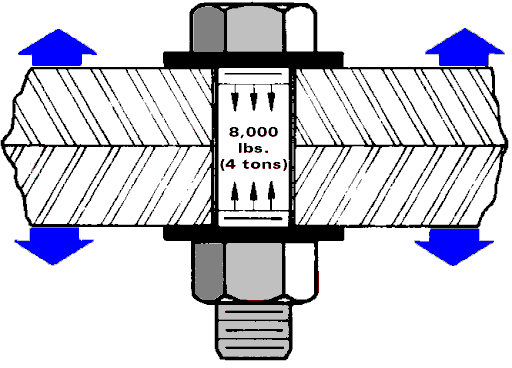
Figure 2. An 8,000 pound clamping load is developing the sameforce that a 4-ton weight would develop if placed upon two plates.
The reason for developing a high pre-load (clamping force) usinga bolt is to make the bolted joint as strong, if not stronger,than the original material used for the assembly. Obviously, thegreater the pre-load the greater the joint’s resistance to theworking loads which act to pull, bend, or shear the bolted jointapart. Increasing the torque over the manufacturer’s specificationswill not only increase the pre-load, but can actually cause thebolt and/or assembly to fail.
In order to ensure that the proper clamping force is obtainedon every application, we must follow some rather simple proceduresregarding matched fasteners. When the proper bolt, flat washer,lock washer and nut are selected we have a matched fastener thatwill perform to the designing engineer’s specifications. Whenthe assembly is properly torqued, this matched fastener systemwill ensure the fastener will withstand all design-specified loadsplaced upon the bolted joint.
Washers placed on the jointed material between the head of thebolt and the nut provide a larger load-bearing surface for attaininghigher clamping loads. In addition, flat washers provide a consistentsurface for head, or nut rotation during installation and reducegalling and burnishing by providing a smooth flat bearing surface.Flat washers should always be used under the bolt, or nut whena calibrated torque wrench is used. Where a high load distributionis required, e.g., when used with soft, thin and/or compositematerials a flat washer is always used.
In addition, the washer must be correctly sized to fit the shankof the bolt to prevent damage to the bolt’s shank and be concave(dish) resistant. If the washer is too soft, the washer will concaveand fail to provide a uniformed load transfer and smooth bearingsurface. When exposed to pounding loads a washer that is too hardcould fracture and fall out of position, releasing the bolt’spre-load.
The function of the nut is to have its threads deflected slightlyto evenly distribute the load through the nut and its successivethreads. When an inferior nut is used with a superior strengthbolt, it is very likely the threads in the nut will fail beforesufficient torque can be applied to the nut. In cases where theimproperly matched nut does not fail during the application oftorque, a high load placed upon the bolt and/or nut can causethe nut’s threads to fail while in service.
As a nut and bolt are tightened, the bolt and nut will elongatein the gripping area causing some thread deformation. Nuts generallyfail when the threads of the nut strip (tear out). In other casesthe nut will not fail, but a tensile failure of the bolt occurs.To help assure the bolt fails first and not the nut, the nut shouldhave a higher proof load then the bolt.
Whenever a mismatched bolt, flat washer, lock washer, or nut assemblyis used, we have unintentionally created a bogus fastener. Whilethis mismatch can be easily prevented, a matched fastener’s strengthcan easily be compromised when a job must be completed and wefind ourselves reaching for any available hardware that will allowthe job to be completed.
Bolt Stress/Strain Diagram
By over tightening we can easily damage a fastener assembly. Let’sexplore this further with a review of the mechanical propertiesof a bolt, figure 3.
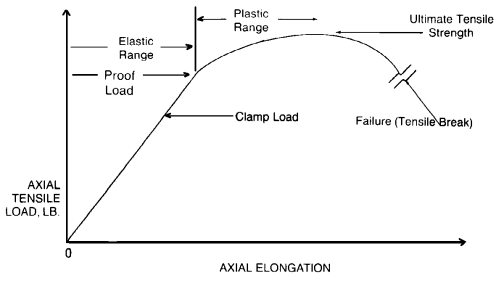
Figure 3. Bolt stress/strain diagram.
Every bolt behaves like a spring. If we apply a tensile (a metal’sresistance to being pulled apart) pre-load to the bolt it willelongate (stretch). Also present within the bolt is a force waitingto return the bolt to its original length. This force, known aselasticity, is a property that allows a piece of metal to resumeits original shape after a deforming force is removed. It is thisproperty of the bolt trying to return to its original length thatgives the fastener its holding ability. As long as the bolt’spre-load is within the elastic range of the stress/strain diagram,permanent deformation of the bolt will not result. Once the pre-loadhas been removed, the bolt, just like a spring will return toits original length.
When an excessive pre-load is placed on a bolt beyond its proofload, the bolt will stretch. This limiting value of stress atwhich the bolt’s elasticity ceases is known as the elastic limitrepresented as the proof load in figure 3. Beyond the proof loada bolt will not return to its original length. The bolt has nowentered the plastic range where permanent deformation occurs.Therefore, when a pre-load is placed on a bolt that exceeds thebolt’s proof load, the bolt will be unable to return to its originallength.
A bolt can be placed in a device that will allow the bolt’s clampingforce to be observed. The clamping force the bolt creates canthen be read on a conventional pounds per square inch scale. Whenthis test is performed the following can be observed:
A new matched fastener (bolt, washer and nut) when torquedto specifications, will easily reach its designed clamping load.
Remove the pre-load and retighten the bolt and nut. The boltwill not reach the same clamping load as the previous test. Now,remove the nut and flop it over. Retorque the bolt. The clampingload will again increase to just below its original value obtainedin the first test.What caused this to happen? The small amountof burnishing that took place on the contact threads increasedthe turning friction between the threads, thus changing the pre-loadto an unknown value. Rotate (flop) the nut and the unused surfaceof threads (from the first torque application) are now makingcontact with the bolt’s threads reducing the turning friction.Add some oil to the threads and the clamping load will again changeby decreasing the thread’s turning friction.
Next, the bolt is tightened without a torque wrench. The clampingforce continues to increase and then levels off even though thebolt and nut is still being tightened. The bolt has now enteredthe plastic range. Clamping force will no longer increase dueto the bolt’s elongating (stretching). The revealing part of thisdemonstration is when the bolt is removed in many cases thereare no glaring signs that the bolt has been damaged. If however,the bolt has gone well into the plastic range damage will showup as a necking (narrowing) in the threaded area of the bolt.
Retorque the bolt to the specified torque value and in mostcases the bolt and nut will take the torque value as set on thetorque wrench, but the bolt will not be able to obtain its designedclamping force. Thus, the technician will have applied the correcttorque, but the fastener may not be applying the correct clampingforce.
Once the bolt enters the plastic range and yields, the threadpitch increases (elongates) in a small section of the bolt. Byplacing a nut on the bolt and tightening it by hand, this damagecan, in some cases, be detected, Figure 4.
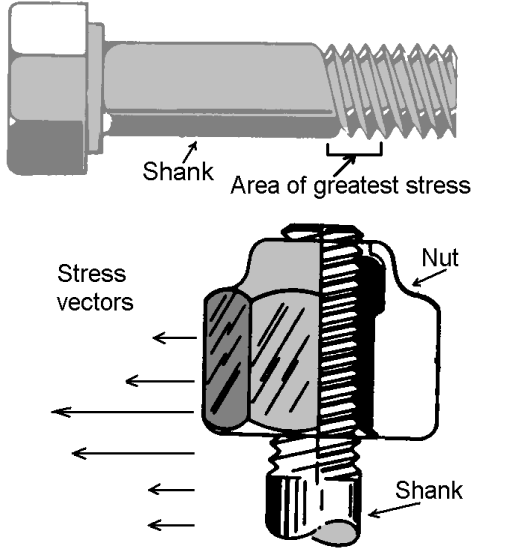
Figure 4. Maximum stress in a bolt occurs within the first1- 2 threads from the shank and within the first several threadsof the bolt closest to the contact surface as indicated by thevectors.
Where the elongation damage has occurred, the nut generally becomestight on the threads. The nut can in most cases still be turnedby hand with a slight increase in turning resistance when passingover the threads in this damaged (elongated) area.
This area of excessive tightness between the nut and bolt maybe your only clue that this bolt has been damaged beyond serviceablelimits. Checking the bolt in this manner is a fast and easy checkwhen no other non-destructive inspection (NDI) method is available.Upon closer inspection the bolt will show slight signs of damagein the form of galling or burnishing. In any case the bolt andnut should be discarded if any doubt exists.
The Need to Pre-Load a Bolt
By applying a specified torque to a bolt, we are pre-loading,or stretching the bolt so the applied pre-load exceeds the stresslevel the bolt is expected to encounter during normal service.This pre-loading of the bolt allows the bolt to exist in a levelstress condition. When in this state the bolt should never exceedits elastic limit and will not be subjected to fatigue stress,Figure 5.
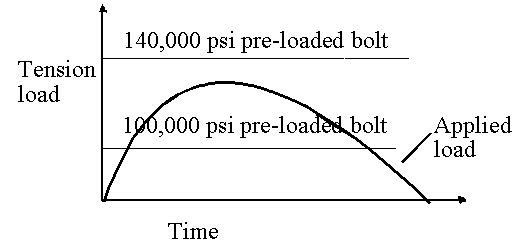
Figure 5. Applied loads must remain below the pre-load establishedin the bolt to prevent fatigue failure of the bolt/fastener assembly.
Therefore, when the bolt has the proper pre-load, also known asa pre-stressed condition, the bolt will not be affected by thecyclic, or changing loads occurring during normal flight operations.
Furthermore, to assure that the proper pre-load value has beenobtained, a calibrated torque wrench must be used. Using torquetables will ensure the proper pre-load is obtained and referenceto these tables is one way the technician has of assuring thebolt is pre-stressed correctly.
Tribology — the study of friction — plays an important rolein obtaining proper pre-loads. Any lubricant, burrs or irregularitieson the threads of the bolt, nut or washer will affect the torquevalue and the amount of pre-stress applied to the fastener. Torquetables are very specific and will state if the torque appliedis obtained using dry, or oiled threads.
Oil when present on threads will reduce the turning friction.This reduced friction will cause the bolt to be over stressedby placing a greater pre-load on the bolt if oiled threads werenot intended. With too much pre-load on the bolt, the bolt mayencounter a tensile failure.
Alternatively, burrs or some other irregularity can cause excessiveturning friction. In this case the bolt may never reach the intendedpre-load (an under stressed) condition. Paint or corrosion underthe flat washer can become displaced during usage and this willallow the pre-load to diminish. The bolt will now be subjectedto all the destructive cyclic forces of fatigue acting upon it.Fatigue failure will eventually occur.
Extremely critical bolts (such as connecting rod bolts on pistonengines) are pre-stressed based upon the actual stretch of thebolt, rather than by a torque value. Measuring the actual elongationof the bolt is the most accurate method of ensuring the correctpre-load has been applied. This method is not affected by thefriction variances caused by dirt, burrs, paint, worn threadsand inaccurate torque wrenches.
Summary
A technician must be aware that in the everyday removal and reinstallationof bolts, many variables are at work to undermine quality work.Every technician must be alert to anything that might affect thepre-loading of the bolt. Some good practices to follow are:
Bolt and nut threads must always be cleaned and in good conditionbefore their reuse.
All mating surfaces should be flat, clean and free of paintso the washer can distribute its load properly.
Holes should be free of nicks and corrosion before installingthe bolt.
Torque wrenches must be properly calibrated and used! Elbowtorque is never a proper substitute for a torque wrench.
Every technician must be made aware of the needs to properly pre-loada bolt and the factors affecting a bolt’s clamping force. By followingproper procedures in selecting matched fasteners and applyingproper torque, every technician may rest assured an importantlink in the safety chain remains strong.