






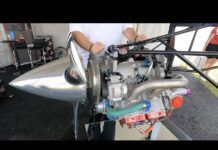




















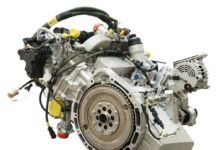






Some overhaul shops claim beneficial cooling effects of blackpaint on their engine. The theory is that black is a betteremitter of infrared (heat) energy. A hot engine in a cold surrounding,radiates energy from the hot object to the cold. The amount ofradiant cooling (thermal emissions) is generally dependent uponthe temperature of the emitter (engine) and how efficient theengine is at radiating energy — its emissivity. This derivesfrom Kirchoff’s Law where good absorbers are also good emitters.Since black is a good absorber of energy (that’s why it’s black),it’s also a good emitter. A black object emits more radiant energy(cools faster) than a white or gold object that emits less radiantenergy per unit of time. Painting an engine black increases theamount of radiant energy emitted by the hot engine to its coldersurroundings and it will be cooler than a non-black engine.
There are fallacies to the above argument. Most heat energy emittedby the engine is in the invisible infrared portion of the spectrum.What appears to us as black, white, red, or green in the visiblespectrum is not what we would see in the infrared spectrum. Anycolor of paint that uses organic (non-metallic) pigments is blackin the infrared spectrum. For example, white paint emits 90-95%depending upon pigment type. Black emits 96%, blue 94%, green92% and red 91%. The best emissivity surface coating is acetylenesoot at 97%. Painting an engine increases radiant cooling butthe color of the paint doesn’t.
The second fallacy is that you also have to ask what happens tothe radiant energy being emitted by the engine. Engine cowlingswith bare aluminum on the inside reflect about 95% of the radiantenergy back to the engine where the black paint of the engineabsorbs at the same high efficiency as it emitted. Black painthas high absorbency and high emittance. Better would be whitepaint that has low absorbency and high emittance. An engine containedwithin a bare aluminum cowling should be painted white not blackto reflect the radiant energy back to the cowling. Another techniquewould be to paint the inside of the cowling black to eliminatereflection of heat energy. If the aircraft had a plastic cowlingthen the engine need not be painted white because of the low reflectanceof plastic.
Most heat from the engine is transferred to the atmosphere byconvection rather than by radiation. Radiant cooling of an engineis negligible. Engines run quite nicely no matter what color they’repainted. Now when you’re at that trade show and the engine shopsalesman is talking performance and how his paint scheme helpscool the engine just tell him that his black engine is the samecolor as a red, white or blue engine — in the infrared spectrum.
Although engines get all the attention, the engine compartmentcan be engineered to better manage temperature. The engine compartmentis one of the most heat damaging environments there is. Packedin the same compartment are glowing exhaust components, rubberproducts, electronics, wiring, pumps and magnetos. Little efforthas been made at controlling heat exchange by changing the infraredemissivity and reflectivity of components. Small changes, suchas the addition of reflective heat shields, can be very effective.
Engine mounts are often corroded where they pass next to an exhaustpipe. Mounts painted with dark shades of organic pigmented paintefficiently absorb radiant energy causing the mount to get hot,burn the paint, and cause corrosion. Black or white paint isall the same as far as emissivity or cooling a hot object. However,when keeping an object colder than its surroundings, such as amount section next to an exhaust stack, we need to reflect theradiant energy and not absorb it. In this case white paint reflectsmore radiant energy than black paint. A metallic pigmented paint,such as aluminum, is even better yet.
Another method of keeping objects cool in a hot environment isby using heat shields that reflect radiant energy. Small shieldsmade out of aluminum or stainless steel are highly reflectivenot only at visible wavelengths but well down into the infrared.Your mechanic may be able to fabricate these small heat shieldsor contact me for pre-fabricated shields.
Aircraft, such as some Aerostar’s, use heat shields to keep themagneto cool. We may be able to forgo the shield and add the reflectiveproperties of the shield to the surface of the magneto. For thiswe want the magneto surface to have high reflectivity to bounceradiant heat off and we want high emissivity to radiate heat outof the magneto.
Bare aluminum or a metallic pigmented paint would not be desirablebecause it has high reflectance but low emissivity. Black paint,as most magnetos are painted, also is not desirable because ithas high emissivity but poor reflectance. A white organic pigmentedpaint is best because it has both high emissivity and high reflectance.
Painting engines black is more effective as a sales tool thanit is at cooling an engine. However, the concept of regulatingtemperature within an engine compartment by controlling radiantenergy can be both effective and easily and inexpensively applied.
