





















300
The modern dry vacuum pump — when it works — is economical ($200 to $400), low-weight (under three pounds) and capable of high-output operation. The dry pump displaced its traditional competition (venturis and oil-lubricated “wet” pumps) in a matter of only a few years during the late 1960s and early 1970s.The Achilles heel of the dry pump is — as the FAA said in a 1987 letter to the NTSB — that “pumps fail catastrophically, without warning, and there is no degradation of performance obvious to the pilot to warn him of imminent failure.” Pump failures are not new stuff; what’s changed is the magnitude of the media sensationalism surrounding a crash, especially with a senator on board.
On the Inside

300
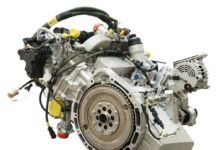
Both Airborne (now out of the vacuum pump business, although theirs are the majority of the installed base of dry pumps) and Sigma Tec pumps utilize carbon-graphite rotor construction, with carbon vanes riding loose in the rotor slots. In normal operation, the vanes are thrown against the pump housing by centrifugal force, rising and falling on the elliptical walls and compressing the air trapped in vaned compartments.Airborne units came in “CW” (clockwise) and “CC” (counterclockwise) models, and for longer life, the proper direction must be observed on installation. In either case — Sigma or Airborne — the vanes run dry on aluminum-housing walls. The constant, gradual, wearing away of the graphite is the only lubrication the pump gets. Hence the term “dry pump.”Dry pumps can be used to suck air (vacuum) or blow air (positive pressure), depending on which side you hook the plumbing to. When dry pumps are used to provide pressure (as in de-ice boot systems), in-line filters must be employed to remove carbon dust from the system.Both Sigma Tec and Airborne pumps have a standard, spline-drive mounting for use on Lycoming or Continental accessory cases. Also, both makers incorporate frangible drive couplings designed to shear in the event of rotor lockup, thus sparing the engine accessory gears of possible damage.The pump makers differ in their approach to drive-coupling design. Sigma’s coupling transmits torque straight to the rotor along a thin quill-shaft (which has since been changed to a speedometer-type cable in the so-called “dash three” pump models). Airborne transmits drive torque to the rotor via a coupling sandwiching shear pins between a nylon torque plate and an upper torque plate, with the rotor spinning on three finger-spools, which “grab into” the rotor.The Sigma Tec pump drive is “more frangible” than Airborne’s nylon torque-plate drive. The Sigma is designed to fail at 100 inch-pounds of torque, whereas it takes 250 inch-pounds to snap an Airborne drive.That said, even experts can have a tough time pinpointing the primary causes of a given pump failure.
A Complex of Causes
What causes pumps to fail? The use of carbon graphite as a structural as well as a lubricating material certainly seems intrinsic to the problem. Ironically, it’s carbon graphite’s unique qualities that make current “self-lubed” pump designs possible in the first place.In our research (which included talking to pump manufacturers as well as mechanics, owners and overhaulers), we identified 10 things that could cause a dry pump to self-destruct:
- Solvent Contamination: Oil or oil vapor rapidly contaminates carbon graphite, turning the lubricating powder at the rubbing surface into sludge. Oil from the engine can enter the pump via several routes: a bad pump-mounting gasket, oil blown rearward from the crankcase breather, or drawn into the pump by its own suction.Additionally, entry into the pump of degreasing solvent (the type sprayed on the engine for routine inspections) can cause failures unless exceptional care is taken. Varsol can enter a pump through its exhaust tube or drive seals. This is something to watch for during any engine spray-down.
- Foreign Object Ingestion: Carbon graphite is fragile. A small sliver of rubber hose (liberated by wiggling the plumbing during pump installation) — or even the carbon bits left in the lines by a previous pump — can cause immediate failure.Generally, this type of failure occurs shortly after installation of a new pump. Pump manufacturers lay the blame for a large percentage of warranty claims to this cause. (A filter change is usually required for warranty coverage to be in effect after installing a new pump.)There is concern that particles small enough to pass through filters can mix with the lubricating powder at the rubbing surfaces of the vane and rotor, increasing the wear rate and leading to early pump failure. Even cigarette smoke is bad for the pump — yours and your engine.
- Drive Misalignment: One of the more controversial (with manufacturers) aspects of the pump-life problem is a parallel misalignment of spline-drive gears caused by “engine drive gears not being where Continental says they are.” Efforts to accommodate misalignment continue.
- Heat and Altitude Stress: The heat of compression developed in a dry pump operating at or near full output is conceptually similar to a turbocharger. The higher you fly, the harder the pump works. Internal pump temperatures can easily exceed 200 degrees F.Cooling is often poor, in part because of low humidity at high altitude and because aircraft designers don’t always expose the pump to ram air.
- Over-Speed: Exceeding engine red line can trash a dry pump. Most pumps begin to provide usable suction (or pressure) around 1,500 rpm and provide optimal life at engine rpm below 2,000. (Not surprisingly, this is the speed chosen by designers of electrically powered backup pump systems.)The maximum continuous operating speed of Airborne pumps is 4,000 rpm (rotor shaft); for Sigma it’s 4,200 rpm. Lycoming pump pads generally turn 1.3 times crankshaft speed. Continental pump pads turn 1.5 to 1.545 times crank speed. This equates to a Continental engine exceeding 2,588 rpm for Airborne or 2,700 rpm for Sigma.Combine high rpm with high demand (as in a Continental-powered Cessna P210 with de-ice boots flying at 20,000 feet), and you can begin to see why some operators experience so many problems with pumps. Add in a prop over-speed incident to the scenario and you are pushing the pump where it was not designed to operate — for long.
- Rapid Acceleration: Rapid engine acceleration (on a go-around, for example) can apparently put unusual loads on the rotor and vanes, which may be why test-stand pumps often run trouble-free for many hundreds of hours, while operators in the field continue to rack up failures.
- Reverse Rotation: As mentioned earlier, Airborne pumps come in clockwise (CW) and counterclockwise (CC) flavors. The profile of the elliptical rotor bore is not symmetrical in an Airborne pump; also, the rotor slots are cut at an angle.Attention to instructions can eliminate incorrect installation of pumps. But avoiding occasional engine “kickback” on start-up (or shutdown) is not such an easy matter. If vane/ slot clearances have opened up, one kickback may be all that’s needed to jam a rotor and trash a pump.
- Shock and Awe: The FAA’s Service Difficulty Reports (SDR) file abounds with examples of “fresh out of the box” pump failures where just spinning the drive shaft by hand locked up the rotor. Assuming that the manufacturers exercise quality control, what could be the cause? One likely cause is transit “ship-shock,” which can jar vanes enough to chip a corner (or cause other mischief).Of course, pumps respond poorly to having their housings squeezed in a vise, which many installers do while installing fittings. The makers have express warnings not to do this, but installers do it anyway.Float plane operators (who suffer a relatively high incidence of shock-related avionics and panel problems) have reported replacing vacuum pumps every 50 to 200 hours, on average — further evidence that shock and vibration can have a destructive effect on pumps.
- Pump Lugging: A recent focus on pump failures in Cessna 210 wing boots has underscored that de-ice boots place a heavy burden on vacuum pumps — ultimately detracting from reliability. Whether the erosion of reliability is due to the higher average pump loads or to other factors is not clear.The FAA has received SDRs describing sticking de-ice boot valves in some aircraft. Ordinarily, pneumatic de-ice boots cycle on and off, alternately inflating and deflating, at the behest of a small timer and solenoid-actuated de-ice boot flow valve.If either the timer or the valve hangs up in the “inflate” position, however, the vacuum pump can quickly lug and overheat. Until recently, the loss of a vacuum pump in this manner meant not only the loss of boot action, but gyro instruments as well.
- Normal Wear: Dry pumps inevitably wear out and if it is left in service long enough, any dry pump is eventually going to stop working. The question is, how long should a pump last?According to overhaulers’ figures, under the best of circumstances, smaller (211-type) dry pumps are unlikely to operate reliably much over 600 hours, as the vanes will have worn to the point where they are likely to cock and jam.The pressure regulator valve (note the safety-wired head) is easily visible in late-model Bonanzas. The area at the base of the valve should be checked visually for excess carbon at each preflight. Rapid carbon buildup is indicative of pump distress.The so-called “boot pumps” (high-capacity Airbornes) are unlikely, in most applications, to last more than 300 to 400 hours. Of course, there are always exceptions.

300

300
In short, then, the modern dry pump, by virtue of its design and construction, is acutely sensitive to almost everything in its normal environment: heat, oil, solvents, dirt, water, vibration, mechanical stress and (some would say) the moon and tides.Even under the best of circumstances — with a new (gyros only) pump installed by experts, with cleaned lines and new filters — you still cannot expect much more than five years of normal flying before your pump is a real candidate for failure. The only thing certain is that it will fail. You just can’t say when.
Detecting Imminent Failure
What if your pump is on the verge of giving out? Is there a way to tell? Do you have to wait until the DG dies to learn that your vacuum pump has pumped its last breath?On every preflight (if your cowl is openable), you should get into the habit of visually inspecting your vacuum pump and the pressure relief valve or exhaust tube. Look for oil at the base of the flange (indicating a bad gasket) or tiny bits of stripped nylon in the coupling area (which is open for view — although you must look closely). Bits of nylon are an indication that the coupling is nearing failure.In a pressure-type system, give the relief valve (in the firewall area) a visual once-over periodically. Look for carbon buildup (i.e., black soot) indicating possible rotor/vane distress. By checking at set intervals, you can get an idea of the normal soot buildup produced by your pump. Abnormal buildups will then be easy to detect.In the cockpit, learn to include the suction gauge in your normal visual scan. In a dry-pump system, any rapid fluctuation of the gauge (no matter how intermittent) is a definite warning signal that something is amiss. See that your system is properly adjusted to give the correct readings at 1,500 rpm or above. (Most regulators don’t begin to regulate until 1,500 rpm.)Dual vacuum-pump installations have received a lot of attention, what with Cessna’s experiences with the 210 series. Unfortunately, not every small-plane engine has an extra pad available for a standby pump. While the engine manufacturers have developed T-drive adapters for some applications, the drives are not widely “retrofittable.” Still, if you want a standby vacuum pump in your system (and you don’t want to trade up to a twin), there are ways to do it.
Pump Replace Checklist

300
Replacing a vacuum pump need not be a major hassle, if you follow a rational sequence of procedures.
- Troubleshoot Cause(s) of Last Pump Failure:
- Booted aircraft: Check for normal de-ice timer operation. The timer should inflate boots for six seconds. (This is somewhat variable in pressure-dependent de-ice systems, but should not exceed 15 seconds for any one cycle). Boots should be pressure bleed-down checked for leaks using an Airborne 343 Test Kit.
- Inflatable Door Seals: Check that the system inflates and holds pressure without recycling (no leaks).
- Pneumatic Autopilots: Check autopilot regulators, servos and filters per manufacturer’s specifications.
- Other systems: Check pneumatic camera doors, avionics cooling, etc., per aircraft service manual.
- Replace All System Filters: Failure to change filters may void new-pump warranties. Pump inlet filters (pressure systems) and garters (suction) should be replaced once a year or every 100 hours. Central gyro filters should be replaced once a year or every 500 hours (ditto for auxiliary in-line filters).
- Verify Replacement Pump: Do not merely replace the existing pump with an identical part number. Consult the parts catalog or pump maker’s application list. Also, if using an Airborne pump, conduct a rotation check: Remove the old pump and manually rotate propeller in normal direction while the drive pad gear is observed. (Observe proper safety precautions when turning propeller.) If the drive gear rotates clockwise, a “CW” pump should be specified. If counterclockwise, order a “CC” pump.
- Remove Old Pump and Gasket: Your old pump (even if damaged) has salvage value. Do not reuse old gaskets. New pumps should be mounted on the new gaskets that accompany them.
- Remove Fittings From Old Pump: Discard stripped or damaged fittings, or fittings with rounded wrench flats, etc. Thoroughly clean and dry serviceable new fittings before using them.
- Install Fittings In New Pump: Here, it is permissible to clamp the new pump in a vise at the base flange only, never at the center housing. Spray clean fittings with silicone lube and allow to dry before screwing them in by hand.Do not use Teflon tape, pipe dope or unapproved thread lubes. Tighten fittings one-and-a-half turns maximum, using a box wrench. Align fittings for plumbing connections in the aircraft.
- Check Drive Pad For Oil: The pad should be dry, with no oil leaking out. Replace the pad seal if necessary.
- Install New Pump: Be sure to lay the gasket in place first, then install the pump. If you drop the pump, discard it. (Likewise, if the pump shows obvious signs of damage, exchange it for another one.) Replace all locking devices. Cinch all four mounting nuts alternately to 50 inch-pounds minimum, 70 inch-pounds maximum.
- Install Hoses: Inspect hoses inside and out for contamination, condition, etc., and replace questionable hoses. (Replace brittle or aged hoses to avoid separation of inner layers of hose, which can break loose during handling and be ingested by the pump, leading to premature failure.)In a pressure system that has experienced pump failure, be sure to blow out all lines with compressed air from the panel side, to get remaining bits of carbon. Make sure hoses are connected to the proper fittings (do not swap inlet/outlet hoses by mistake). Use only specified fittings, not pipe fittings.
- Check Pressure/Suction Regulation: Run the engine to 1,500 rpm and check that the suction gauge is reading in the green (or per manual specs).
Airborne specifies a life limit of six years for nylon drive couplings. Factory kits are available for replacing couplings: Kit No. 350 for 211/212 series pumps, No. 352 for 440-series pumps.In short, don’t sit and wait for a failure, and be proactive.
More aircraft repair and prevention articles are available in AVweb’s Maintenance Index. And for monthly articles about aircraft maintenance, subscribe to AVweb’s sister publication, Light Plane Maintenance.