

















 Rememberthe late Illinois Senator Everett Dirksen’s classic line about money? “Abillion here, a billion there, and pretty soon you’re talking about realmoney?” Well, no matter your perspective, real money was in ampleattendance at the 53rd annual convention of the National Business Aviation Association,which wound up its October 10-12 run of the Crescent City with the annual awardsbanquet and entertainment gala Thursday evening.
The tab, before vocalist Natalie Cole brought down the banquet curtain, ran intoserious money – an convention-day average exceeding $700 million in announcedsales, more than $2.2 billion according to some accounts. Maybe delegates andexhibitors couldn’t say, “Let the good times roll” in the Cajunvernacular, but they did know it when they saw it. And they saw, heard and readplenty of good times during their days in the Big Easy.
 Between new models, new variants of existing models, new equipment for oldermodels and new services that span the spectrum, NBAA 2000 was, indeed, a busyplace to work and play. In fact, so vast and so crowded was this convention thatby closing day, more vendors than in recent memory seemed genuinely interestedin seeing future NBAA conventions grow by at least a day – not an inexpensiveprospect for the hundreds of companies who collectively spent hundreds ofmillions of dollars just to meet their market for three days of face-to-facecontact, feedback and outreach. NBAA President Jack Olcott conceded that hisassociation would think about the suggestion. Given that so many members comeearly and stay late to attend various workshops, it may make less difference tothe membership than to the exhibitors and vendors.
Since we only skimmed the cream for Thursday’s report, let’s jump right into oneof the best deals in aviation: our wrap-up of NBAA convention number 53.
Z-Z-Z-Z-Zoom: Superheated Sales Reflect The Hot Times At Hand…
Times That Could Cool – Without Going Completely Cold
Forecasts of a fine future rang true when planemaker after planemaker announcedsales of a dozen of these, a few of those, some more of them and a few of that.Sure, some of ’em are arguably in the funny money category – as in, one unit ofa company ordering airplanes from its parent. But when you recognize that theordering unit has its own customers, you also have to recognize that the netresult is the same: more people buying more new planes for more use.
And more and more of those new planes are going to customers new to generalaviation, thanks to that no-longer-new phenomenon known as fractional ownership- multiple owners sharing ownership of individual airplanes that they sharewith each other and other part-owners of other identical airplanes – all ofwhich is operated by a firm that sells the shares, supplies the pilots, performsmaintenance and dispatches the planes on behalf of those shareholders.
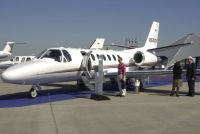 NBAA-commissioned research predicts that the number of airplanes flown infractional programs will increase dramatically – to nearly 1,700 airplanes fromabout 400 – over the next decade. Other research forecasts a slightly smallerincrease – by a factor of three or so, instead of four and more. Regardless ofthe difference, no one we hear from disputes the overall expectation: Thealready considerable influence of fractional programs – hundreds of companiesand individuals who never before used business aircraft – will continue wellinto the future.
Here’s where an example seems due: Raytheon Aircraft’s fractional unit, RaytheonTravel Air (RTA), placed an order at NBAA for 50 of those future Hawker 450s we toldyou about Thursday – along with options for another 25. Not a company toneglect any of its parent’s products, RTA also penned an order at NBAA for 22Premier I light jets to complement the 49 already on order. Throw in a diverse$80.5-million order for 12 Hawker and Beech models from Mexico’s AerolineasEjecutivas, and some other sales, and Raytheon netted a whopping 144 ordersworth about $892 million, with the options worth another $213 million. See, withRaytheon alone, we’re more than halfway to that $2.2 billion, already.
Here’s some more of the sales scorecard, as available at the end of theconvention:
-
Gulfstream with an order for 20 of the upcoming GV-SP ultra-long-range jets fromExecutive Jet Aviation’s NetJets program in an $800-million deal that includes anew long-term maintenance plan;
-
Nearly $140 million in orders for Cessna Aircraft that included everything froma 206 Turbo Stationair on floats to 22 Citations that cover the gamut from CJ1sto the Citation X;
-
Sino-Swearingen booked an order for another one of its SJ30-2 light jets;
-
Socata announced a distributor’s order for 31aircraft worth about $31millionthat covers a bit of everything from the TBM700 propjet single to the TB 10Tobago piston single;
-
Italy’s pride and joy, the Avanti P-180, was back with a new U.S. wing -Piaggio America – that netted its first sale worth a few million more;
-
Brazil’s Embraer – which launched its Legacy business jet, a $19 millionvariant of its successful EMB-135 regional airliner – booked 31 orders worth$589 million, plus another 31 options.
Dibs on the biggest buck-bang for a bird went to the big boys, Boeing BusinessJets, with orders for four more, and Airbus, which added an order for one AirbusCorporate Jetliner and an option for a second of the bizjet variant of the A320for buyer Qatar Airways to put on its charter ramp. The per-plane, finished tabfor these birds? A cool $45 to $50 million, apiece. Please, make ours champagnesilver with caviar-black trim. All these zeros gave us an appetite – and a bigthirst.
Sunny Daze: Staggering Backlogs Strengthen Sunny Forecasts
Views May Differ, But There’s No Arguing With Realities…
Regardless of whether you buy into crystal ball gazing, it’s hard to argue withnumbers – despite the old line that figures lie and liars figure. Whencompanies up and down the planemaker spectrum report record backlogs – whetherstated in terms of record dollars, record units, or both – and can back upthose claims with contracts, it’s hard to doubt which way the wind blows.
It blows favorably for the future. For example, Honeywell released a forecastthat shows times slowing somewhat in the four years ahead, with deliveriesdropping to under $8 billion in 2003 after peaking this year at more than $11billion.
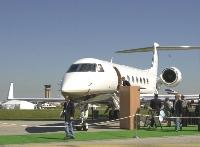 Not so, says Cessna’s executives, citing their own company’s record $6.1 billionbacklog of more than 782 Citations, 50 Caravans and 335 piston singles; andthese sorts of numbers come from almost every corner of the market. Still, somewonder whether the bubble isn’t about to burst and the market come back down toearth.
That’s doubtful at this point, since folks as diverse as NBAA President JackOlcott and AvData Inc.’s expert analyst John Zimmerman echo these growthfigures, as do private reports from outfits like Honeywell. The market mayplateau, growth may even slow. But the growth outlook remains strong, in highsingle digits, for the decade to come – barring, of course, catastrophic eventslike an economy-busting oil crisis or worse.
…Meanwhile, Another Fractional Player Arrives…
Yes, folks, there’s another player in this high-growth market – and it’s CessnaAircraft, which partnered 50/50 recently with TAG Aviation USA to launch theCitationShares program around the CJ1and Bravo models. CitationShare HoldingsLLC, the $20-million joint venture company, has 50 jets on order already and itbarely has an executive staff in place to run the show. And by offeringcustomers the prospect of buying as little as a 1/16th share – of two ofCessna’s lowest-price models, no less – the new fractional program shows thepotential to cover a segment of the market well below the radar sweeps of itsbigger competitors – one of them a big customer in its own right: NetJets.
…While Another New Program Offers No-Buy Shares
Here’s a new twist on a proven idea: A time-share program that doesn’t – nope,does not – require participants to buy a share of the airplane. Cartersville,Ga.-based Corporate Aircraft Partners (CAP) is the brainchild of Rolly Bergeson andTom Keough – two aviation veterans from opposite sides of the regional airlineindustry. Under their vision, CAP offers participants blocks of 200 hours a yearin the program’s corporate Jetstream 32 aircraft for as little as $75,000 peryear – plus $25,000 a month and $750 per block hour. If you don’t need it aftera year, you don’t have an investment to sell – no depreciation considerationsand few hassles.
 “Not everybody wants to deal with the investment or the commitmentsinvolved in buying a share through the fractional ownership programs,”Keough said. “We eliminate that element – and offer a product more in linewith what’s more typical for many business travelers.” To meet a six-hourservice guarantee, Corporate Aircraft Partners plans to establish centers thatare much like airline domiciles – starting first with the eastern seaboard andmoving west. The operation should have four Jetstreams by year’s end, 10 bymid-2001 and up to 20 by the end of next year.
Paying The Piper…
Suma’s Soldiers Got Meridian To NBAA 2000 – On Time, On Budget
Somehow Thursday, we neglected to mention one of the newly deliverable models onthe ramp of the static display: The New Piper Aircraft’s hot Meridiansingle-propjet, which received its FAA certification shortly before theconvention. At a time when so many new programs seem unable to adhere to a timeline, New PiperPresident and CEO Chuck Suma was understandably happy to havethe Meridian available for first deliveries on schedule and without busting thecompany coffers. Yes, the 270-knot propjet still has some certification hurdlesto clear – but none that should hold up deliveries.
 And Meridian deliveries are a major factor in the company’s expectation thatsales revenue will increase about 50 percent in 2001 to $300 million – up from$200 million the company expects to collect for delivering 425 new Pipers thisyear. Between 40 and 45 percent of that $100 million in revenue growth is basedon advanced orders for the Meridian. That’s 35 to 40 Meridians, New Piper’sbiggest gamble since emerging from bankruptcy in the mid-1990s.
Meanwhile, don’t hold your breath for yet another hot new model from New Piperin the near future. Suma wants to focus on revamping how the company builds itsbirds in order to lower costs, reduce cycle times and improve manufacturingefficiency and quality. Of course, there are those rumors of a New Piper jet…
…Elsewhere, A Sound Barrier
Rumors, hopes and dreams of a supersonic business jet didn’t perish with thelate Allan Paulson, who in 1991 tried to launch such a project in partnershipwith Russia’s Sukhoi Design Bureau. The folks at Sukhoi still lust after such aprogram and call it possible – as is anything when money’s available in enoughquantity, not something Mother Russia’s currently known for.
 Now comes Reno Aeronautical Corp. and its Asset – yep, a supersonic businessjet. Now before you get your Mach meter all wound up, this bird takes a totallydifferent approach to making its Mach 1.6 cruise speed: a straight (as in NOTswept) wing uses a laminar-flow foil design that provides such a low dragprofile that company research shows he airplane is capable of making high-triple-digit speedswith one of aviation’s most-common mills – an off-the-shelf Pratt & WhitneyJT8D-219 similar to that used on the 727, 737 and DC-9 – rather than by dint ofextraordinary power and complicated, low-drag swept wings.
Timeline, according to company president Richard Tracy, depends on launchinghardware development. But the numbers do seem reasonable – or as reasonable isthey get in the hyper-expensive world of big globe-trotting business jets andbig-fuel burning SST operations: about $5.35 per mile flown, compared to almost$6.50 per mile for birds like a Boeing Business Jet or Airbus CorporateJetliner. The price expectation: $57 million to $60 million – not 20 percentmore than those behemoths of the business jet world.
New Panels
Meggitt’s Magic First TSO’d FSD For Us Light Types…
It’s guys like these that keep folks like Honeywell and Collins awake at night- companies that come from seemingly out of nowhere and make a mark: in thiscase, the first fully TSO’d all-encompassing electronic attitude, air-data,navigation and engine-management package for light planes built solely onelectronic displays and sensors. The standard panel for the New Piper Meridianis not going to be the last.
…Close Behind: Sierra, Honeywell, And More
 Yepper, between the hardware and software flying for Sierra Flight Systems, forBFGoodrich’s SmartDeck (see more later) and Honeywell’s own take (as coveredThursday by AVweb), it’s beginning to look like an all-electronic panel world isfast headed our way. So hold on to that last vacuum or pressure pump you pulloff your plane to make the switch; could be a valuable museum piece in a fewmore years.
Beyond Tomorrow…
Wouldn’t You Really Rather Fly A Honda?
Yep, folks, looks like Japanese engine giant Honda Motor has its U.S. researchand development arm readying to tackle turbine-engine development. Honda R&DAmericas is setting up shop in hangars and offices leased from Atlantic Aero inGreensboro, N.C. The goal: research a new small jet aircraft. And given that thecompany – known widely for its cars, motorcycles, generators, lawn mowers, yardtractors and other applications – developed and tested its own light turbofanengine back in 1995 and flew a small jet in 1996 in conjunction with a projectat Mississippi State, it’s not hard to imagine where this work will lead.Working with engineers at Atlantic Aero, the Honda staff will be looking intolightweight materials, machining technologies, and how to make the most of bothareas in development of a new light aircraft.
How About A Toyocoming? A Lycotoyota?
 What’s in a name, the Bard once pondered. Whatever name might result, industryinsiders are intrigued at reports that Toyota and Textron Lycoming are indiscussions that could lead to mass production of a new line of light, pistonaircraft engines. Between Lycoming’s successful boxer engine designs, accordingto the Japanese media reports, and Toyota’s advanced electronic engine controltechnologies, the team could produce a breakthrough in piston engines thatdistills the control system down to a single lever. Of course, that soundsfamiliar. Lycoming is already hard at work with partner Unison Industries on theEpic single-lever engine control system, a blend of the Lasar ignition systemwith new mixture and prop control management.
Give Us Liberty?
Here’s one that may escape any connection to NBAA – except for the newsannouncement. Scaled Technologies, of Montrose, Colo., has been pegged by LibertyAerospace as the company that will build up to 400 new XL-2 piston singlesstarting as early as 2002. Many AVweb readers have heard of the Europa compositetwo-place kit airplane, through coverage of Sun ‘n Fun and AirVenture fly-ins -but never felt the urge to build, despite any attraction they may have had tothe model or its price. Well, keep an eye out for the Liberty XL-2, a newtwo-place design scheduled for certification by the end of 2001. Powered by thepopular 100-horse 912S Rotax four-cylinder, the XL-2 is being promoted as a120-knot two-seater with tricycle landing gear and a bubble canopy. Look formore on this $92,000 single next week, after we have a chance to examine themock-up expected at AOPA Expo in Long Beach Oct. 20-22.
Visionaire Visions
After staying afloat for almost two years while revising its proof-of-conceptprototype and raising more funds, Visionaire is still moving toward developmentand certification of the single-engine Vantage – but we’re still a ways outfrom frequent sightings of the forward-swept-wing composite. According tocompany sources, work is continuing to complete proof-of-concept flights withhopes of test flying two conforming prototypes beginning late in 2001. Engineand panel changes have been made to improve the utility and serviceability ofthe Vantage. Completion of a 1,500-hour certification program should takeanother 12 months, according to chairman Jim Rice, with first deliveries to comeshortly afterward. The company already has a factory ready and waiting in Ames,Iowa.
“Eclipse”-ing Itself?
 The folks at Eclipse made enough of a stir with talks of the Fusion Stir Weldingprocess they plan to use to make airframes for their debut product, thesix-place, under $850,000 Eclipse 500 twinjet, to have little interest inconfirming rumbles that a larger model is already under consideration. But, asone noted, when was the last time you saw an airplane company hang its entireexistence on a single model? Hint, hint. Expectations are that the timing of anysecond model would differ little from the timing exhibited by fledglingplanemakers Cirrus Design and Lancair, which are both following their debutmodels with more-powerful versions.
Growing Places
No better example of the above exists than Williams International, which hasbuilt one of the most dynamic powerplant companies around on the basis ofengines developed for the Boeing cruise missile. The latest rundown of Williamspowerplants ranges from the FJ44 used on the CitationJets, the Premier I andSJ30-2, to the EJ22 going on the Eclipse 500; with the FJ22, the FJ33 (first runback in July), and models designated TSX-1 and TSX-2 in development. These guyscould become light general aviation’s biggest fans.
More Power
Pratt & Whitney Canada (PWC) continues development of its own down-sizepowerplant, the diminutive PW600, first broached at NBAA last year in Atlanta. Afull-scale demonstration program begun during AirVenture is still going on andcomplete validation of the basic core should be complete by the end of nextyear. With thrust ranges from 1,000 to 1,200 pounds, 1,500 to 1,800 pounds, and2,200 to 2,500 pounds, PWC intends to cover most of the ground currentlydominated by Williams.
An Imminent Leap
Sino Swearingen executives smiled even more than usual at this year’s NBAAconvention, thanks to knowing that back home in San Antonio crews were nearingthe final preparations for the first flight of the first conforming prototype.And right on the latest schedule – but not the schedule Ed Swearingenanticipated when he launched the original SJ30 program back in 1987. Shown andflown at Paris in 1991, money and development problems pushed back efforts toclear many of the hurdles until the fast, innovative light jet had beencompletely lapped by Cessna’s original CitationJet. With the arrival from Beechof current president Jack Braly, the program was recast, the airplane stretched,its numbers improved, and the proof of concept demonstrator reworked into areflection of the SJ30-2. Rollout of the prototype a few weeks before NBAA putthe company over yet another hurdle and headed into the stretch known as finalcertification. That first flight could happen any time now and we’ll keep youapprised of when it happens.
Waiting In The Wings
Century Jet, which made its presence known at NBAA in 1993 and was re-launchedwith a new configuration in 1998, seems closer to the reality of flight,according to company president Bill Northrup. Similar to what occurred with SinoSwearingen and Lancair, the bucks to make the bang could come from Taiwan -specifically, the Aerospace Industrial Development Corp. – which appears readyto sign on for about $25 million of the estimated $60 million needed. Success infunding still puts final certification and the onset of deliveries of theCentury 100 somewhere out in the three-year range.
Mo’ Mail
Thursday, we mentioned the FAA’s approval of an in-flight email system forbusiness jets and today we want to tell you about another, this one from theleader in in-flight entertainment gear, Airshow Inc. The new AIRSHOWM@IL(tm) received its first STC and PMA from the FAA after tests in a Falcon 50 fittedwith the AirCell and Universal Aero-M SATCOM phones. Each cabin seat of the jethas its own Ethernet port to attach a computer to the LAN installed on the jet- and there’s even wireless access and a printer/scanner. Yet another steptoward never being able to escape the office.
Online And Lovin’ It
 Bombardier Aerospace moved into the e-commerce arena earlier this year bypurchasing Skyjet.com, a fledgling enterprise created to connect chartercustomers and charter provides in the virtual world in much the same wayPriceline.com has connected paying passengers and the airlines. But it doesn’tend there. Bombardier is also offering its clients and customers with new online services to track aircraft maintenance, provide a secure site forrecords, to manage flight departments, follow flights, order spares, and more.
As Reported Earlier
Readers of AVweb‘s coverage from AirVenture 2000 should remember the newsBFGoodrich generated upon the launch of its new SmartDeck Integrated FlightDisplay & Control System – yup, another all-flat-panel system for lightaircraft. In an example of how general aviation markets overlap, BFG brought itsprototype SmartDeck demonstrator to NBAA – a Beech C90 King Air, fitted withthe equipment. Designed to work as a single 10-inch flat-panel display, or withup to four in all, SmartDeck replaces conventional gyros, dials and gauges, aswell as all the sensors that generate data for the display. Along with theout-the-window, Highway-in-the-Sky symbology all these systems share or mimic,SmartDeck is also being developed to provide pilots with a synthetic visionsystem for ground operations and instrument approaches.
Between the systems coming from Meggitt, Sierra Flight Systems, Honeywell andBFG, flying blind never sounded so good. Please pass the DVDs.
The End Is Here
That brings us to the end of the tip of the iceberg on this one – or, to thebottom of the etoufe, to keep this in Crescent City vernacular. What more we cansay and tell, we may not get to work in later – like the ambiance of Cessna’swind-blown, fireworks-studded gala, a sternwheeler cruise powered by Rolls-Royce(money wise, at least) and other aspects of business aviation’s most-involvedconvening for in the Big Easy.
But fear not, New Orleans fans. There are barely 11 months to go before NBAAconvenes its 54th meeting, and once again the throngs will fill New Orleans’French Quarter for another fling. If you can wait until then, we know the newswill change, if not the food, the street artists, the throngs staggering alongBourbon Street, or the coffee and beignets of the Caf du Monde. So, if youdidn’t get your fill this time, just sit tight for a few months.
Meanwhile, let the good flights roll: AVweb will be back at you in another weekfrom AOPA Expo.

