






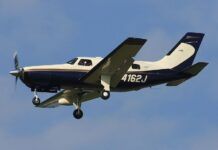






 How frustrating this could be, my mind kept musing. Not three hours earlier the magnificent Three Sisters mountain peaks reached upward through clear skies toward the window seat of a Southwest 737 flying me to Portland International (PDX). No overcast blocked my view until we flew to about 40 miles south of PDX. But the clear skies shrank out of existence completely during the next 90 minutes, making for an IFR descent in the de Havilland Dash 8 that carried me back southeast to Redmond, Ore. My mission? Rendezvous with Mike Schrader, Lancair Certificated Airplanes’ marketing guru, to fly the prototype Columbia 400.
 Now at 10,200 feet MSL, that unexpected overcast capped off my plan to tear high around the Oregon sky, limiting me to that portion of the sky below the clouds. How frustrating this could be, unable to scramble up another mile and a half to where the turbocharged big-bore Continental churns out the ponies in defiance of the dwindling atmospheric pressure? Only up there, well into the flight levels, could the sleek, composite airframe realize its full potential. Unfortunately, Lancair had yet to seek instrument status for the prototype, so below the cloud layer we remained.
But with only two days to work this opportunity, my only option amounted to the aviating equivalent of a punt: adapt to the moment and get on with the work. Nothing new here. More often than not, that’s what happens when someone turns me loose in one of these high-altitude screamers with a turbocharger on the engine.
More often than not, when an opportunity to go very fast very high arrives, circumstances diminish the experience.
 When Raytheon sat me down in the left seat of its fire-breathing B36TC a few years back, convective weather and ATC constraints around the Louisville Class Charlie kept us down in a bumpy, gnarly haze layer with visibility limited to around four miles; 75 percent power down there did no more for the turbocharged Bo than for the naturally aspirated A36. In the Mooney Bravo, we penetrated a seemingly endless overcast and climbed into clear air beneath a thinner layer up at around FL250 or so. The lack of landscape and an ill-defined horizon eviscerated considerably the visceral visuals of flying a parabolic trajectory from 1,328 feet MSL to FL210 and back over a mere 170 nautical miles of missed scenery that took under 40 minutes.
In Cessna’s stallion TurboStationair T206, the weather cooperated, but the timetable did not. But at least time allowed me a climb to above 12,000 feet MSL, to where the continued availability of 75 percent power began to show its impact on true airspeed.
Likewise, during my hour-plus flight in the Columbia 400, the availability of 75 percent power at 9,500 feet MSL presented me with a gratifying contrast: the 400 gobbling up the miles at 213 knots true, compared to the sub-180 knots you’d get from the naturally aspirated 300 at the same altitude. Mentally calculating the numbers possible up at the 400’s service ceiling gave me enough of a rush to dissolve the unpleasant memory of my recent travels by human mailing tube. My between-the-ears calculations kept moving farther above the offending layer to altitudes where masks would be mandatory to keep my lungs saturated with O2.
Just imagine the silence on the flight deck after you blow by a few propjets, that cost two, three and four times more than the approximately $400,000 needed for a Columbia 400 with all the bells and whistles.
 The real appeal for many pilots will be finding propjet speed packaged with a personality that should comfort even the non-novice-but-not-too-much-time pilot. The eye-watering speed that lets you pass many kerosene-burners at jetway altitudes will be an added reward. Yeah, the minor frustration of the overcast limitation did put a damper on sampling the Columbia 400. But despite that limitation, the 400 gave away enough of its potential to impress me even more than its stablemate. And last year, that bird repeatedly came to mind as “impressive” in its own right.
Before you submerge yourself in more details, let’s take the time to talk about one, perhaps the only, shortcoming of this airplane as flown: built-in oxygen. Lancair hadn’t decided to make integral oxygen standard equipment and was mulling whether to offer it as an option. Speaking as a routine captive of the canula, the lack of an installed system sentences any turbocharged-airplane owner to a lifetime of bottle battles. That decision may be understandable on the Columbia 300, a plane that tops out short of FL200.
But in an airplane that doesn’t even really open it up until you’re above at or above FL180? Think about it, Lancair folks, and take a clue from the Mooney and Beech models you’ll so capably challenge. Whether you chose to mount a Kevlar bottle down near the metal gear truss, a pair of smaller bottles in the wings (symmetrically mounted for balance) or something better than my feeble suggestions, if ever an airplane deserved integral O2, the 400 is it.
As you’ll see below, methinks this new model Lancair takes the lowly four-place piston single into territory where many propjets fall short of five miles a minute. Yeah, 300 mph, in case seeing the 400’s cruise velocity in knots didn’t give you the same speed thrills it gives me.
Serious Speed The Weekend Warrior, Skylane or Tiger PilotCan Handle
From fixed gear to forgiving flight, the Columbia 400 reflects the best of its unblown stablemate, the 300. Last fall, my review of Lancair’s highly capable Columbia 300 included some caveats that somewhat balanced “impressive” as my view of that model. Highest among those cautions: the potential for an airplane of its 190-knot-plus performance to outpace the average pilot’s thought process. And you might understandably expect me to press that caveat even more to the Columbia 400. With its big, turbocharged TSIO-550 Continental capable of pulling full power until you get into the flight levels, you need only enough altitude to reach air thin enough for the 400 to clear the 250-knot bar.
 And with the upper limit for VFR flight at 17,999 msl, my instinct leans me toward believing that the majority of 400 owners will come from among those capable of legally plying the Flight Levels – instrument pilots. Sure, a VFR pilot tooling along at 17,500 in a 400 will cover considerably more ground during the same decision-making period as a 300 pilot at 7,500. But there is no legal way around the need for an Instrument Rating to go to above FL180, where the 400 achieves its best performance. And what pilot won’t want the option of using every inch of cruise-altitude potential available in an airplane of this capability?
Furthermore, when an airplane crosses the time zones at Columbia 400 speeds, its pilot enjoys the potential to cross a continent faster than the average coach-class airliner passenger rebounding back and forth through the hub-and-spoke system. Generally, when you cross the continent in a few hours, you must transit several systems.
Serious Systems For The Full Spectrum
The composite airframe employs a mix of carbon fiber, fiberglass and honeycomb panels into a bridge-strong structure. So strong are these airframes that Lancair plans to earn the same Utility Category approval for the 400 that it earned for the 300. Lancair, in fact, broke parts of its “Iron Bird” test rig trying to break parts of the Columbia airframe during the static-test phase of certification.
The graceful, compound curves of these birds belie their toughness as much as their sleek lines telegraph their balanced handling. And among the advantages of this airframe is an unlimited-life rating; even extraordinary use shouldn’t show beyond replaceable items. Imagine the age disparities possible in an airframe immune to all of flying’s environmental challenges: corrosion, work hardening, flexing – everything save a collision with another object.
 Which means somewhere in the not-too-distant future, I’d expect an improvement in the boot-up time required for the computer and avionics feeding Columbia’s new, highly sophisticated flat-panel display. Stationary is the word until the system boots – perhaps like the computer you’re using to read this – and the solid-state AHARS (attitude, heading and reference system) sensors orient. Of course, this slight delay (the avionics system uses an even more stable version of Microsoft’s almost-bulletproof Windows NT) generally won’t pose a problem during cold starts – particularly cold-weather cold starts. By the time the engine oil warms into the green, the avionics and displays are oriented and up and ready for flight planning.
On the arrival end, if you start the system shutdown procedure when you turn off the runway, you should have the classic Windows permission screen: It’s now safe to turn off your avionics. And this isn’t as noticeable a wait as the wait in the Columbia 300 last year at Gilbert Field in Winter Haven, Fla. Taxi slowly enough to let the turbine wheel cool – the Continental book calls for five minutes at idle turbine-inlet temperatures – and the Windows-based display hardware is ready to switch off. Besides, it’s in between launch and landing where the Columbia 400’s performance should earn plenty of slack and TLC from its pilot for its relatively minor ground-side idiosyncrasies.
Other than the avionics and turbine-wheel considerations, the Columbia 400 is every bit the same piece-of-cake to prep and fly as its elder, albeit less-capable sibling. Sure, I still need something to boost me up when I check the oil; Mom and Dad made both my younger brothers taller, what can I say? The ground checks, in general, are all within reach of even my 5′-9″ stature.
 While we’re at the hatch, you should hear about the clever way Lancair made sure you can’t launch with an unlocked luggage door. The aft, port-side hatch uses two cylindrical-tumbler locks that share the cabin-door key. The second, more-critical of the two baggage-door locks traps the key until you return the tumbler to the locked position. So you should never inadvertently remove the key for another chore and then start off with the door insecure. Not that any of us would do that, right? Now, last thing before you board: do remember to point the castering, non-steerable nosewheel straight or in the direction you plan to turn on taxiing out. Doing so makes steering the first few feet a relative snap.
After completing the walk-around, securing both luggage-door locks and checking the nose gear, it’s saddle-up time. Here, my stature again presents me with a challenge: getting up on the wing. This particular Columbia lacked the production-standard fuselage steps aft of each wings; with my own mount a low wing like the 400, a stepstool has never been part of my flight gear.
Nope, the solution for me was to back up to the port-side leading edge and hoist my PIC-seat ballast package up and onto the wing, slide back to the wing-walk area and hoist myself to my feet. From here, the pre-strap-in drill matches the sequence after coming up from the fuselage step: shed flight jacket and cap, step down onto the wide, flat floor, sit and strap. A consideration to note: Make sure you can reach the top-hinged cabin door before you buckle the belts. (Take it from someone with short arms who learned from experience.)
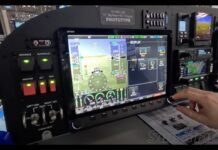
 With the doors down, the handles rotate into the locked position and then lock into a slot in the door. It’s very tight, very solid, very secure. Felt like latching closed a bank vault. Insert the ignition key, lock the brakes, close the master switch and it’s time to begin the starting process, a typical sequence for today’s injected engines: Mixture at idle cut-off, cycle the boost pump, switch it off. The lightweight starter spun the big-bore Continental to life on the first turn of the key. After setting idle speed at about 900 rpm, my focus shifted to a quick briefing by Lancair’s amiable Mike Schrader on the flat-panel equipment. We went over the process of inputting flight-plan data using the AvroTec displays and the full-stack complement of UPS Aviation Technologies avionics.
Although Redmond isn’t exactly a high-density field where traffic is concerned, on this particular Thursday afternoon the tower crew handled traffic enough to keep us parked while the engine warmed and the AHARS got its dose of stationary operation to orient itself to drive the full-screen display of HSI and attitude indicator.
Within a few minutes, after enough additional time to recheck the ATIS and perform all the pre-departure checks but the engine run-up, the Redmond ground controller cleared us to taxi. A short, circuitous taxi later and we reached the active.
Time to travel. Our destination: Bend, the prototype’s home field a whopping 15 miles south. In between, we plan to cover plenty of additional mileage wringing out the control system and letting the engine unlimber. Come along, you can see for yourself.
The In-flight Verdict? Stable, Dynamic, Predictable,Forgiving
Takeoff, Climb And Airwork…
Just as we finished the engine checks, final control-integrity, door-latch and seat-belt checks, Redmond tower cleared us to launch, and out onto the active I steered us. With the brakes released, the Columbia 400 eagerly rushed ahead as I eased the throttle forward to about 27 inches of manifold pressure; after letting the turbine catch up, the throttle advanced continued smoothly to its physical limit and the 400 rushed ahead to 70 knots and more as I rotated.
By using my usual practice of adding a bit of additional nose-up trim, the Columbia essentially flew itself off the 3,077 feet MSL runway while my left hand lightly countered a quartering wind with the sidestick and my right foot canceled out the torque effect. As the altimeter wound through 4,500 feet MSL, my left thumb added enough trim to counter both the torque and the crosswind, while alternately trimming the nose down to a 1,000-fpm climb at about 138 knots and 85 percent power.
Watching the approach of the high overcast, both Mike and I scanned the layer for any break that might let us continue our climb up into O2 territory, and free of Redmond approach, I used the search as an excuse to begin maneuvering the 400 around to expand our field of view. The bad news is that, at 10,300 feet, we started to bump up against the overcast. Without instrument approval, that meant no flight-level speed runs.
 The good news became apparent during the maneuvering climb: The 400 possesses the same fine handling traits as the 300 – including its predictable, forgiving nature – as well as the same degree of dynamic stability that leaves some pilots with the feeling that the side sticks are heavy in the ailerons.
…About That Sidestick…
While it does seem to me that you can’t merely flick a wrist and change direction in either Columbia, the 400, cooking along in the relatively thick air around 10,000 feet sure didn’t tax my wrist when rolling it from 45-degree bank to 45-degree bank. The stick forces, while firm, actually didn’t raise a thought at the time; instead, the forces seemed appropriate and balanced. The whole issue arose when a local pilot pressed me on my review of the 300, in which I wrote the following:
“To be sure, the Columbia 300 responds with a simple flick of its side-mounted yoke. But making that flick happen takes muscles more like a wrist wrestler, particularly when reversing a turn or bank is concerned. Of course, there are good reasons why the Columbia 300 has the heaviest handling characteristics of our three plastic planes. For one, the ailerons’ geometry favors stability, resisting easy displacement from their neutral, in-trail position. That stability only increases as the airplane reaches the higher limits of its speed range. At the same time, the amount of stick movement needed to initiate, correct or stop a roll goes down – and thus, the perceived effort declined as the need for change also lessened.”
Let’s face it, fellow flyers, designers must balance the need for maneuverability against the desire for stability. Any airplane with an overabundance of one trait usually significantly lacks a measure of the other {Except Bonanzas and Debonairs! Ed.}. And in retrospect, I probably wouldn’t use the “wrist-wrestler” analogy again. Pushing an airplane to maneuver beyond the range of normal angles – whether in roll, pitch or yaw – always comes with control pressures that grow proportionally to the deviation. And that progression in control pressures comes with meeting FAR 23 standards. I guess what I’m trying to say is that if you can’t grow into the stick pressures of a Columbia, consider taking up guitar, wrist wrestling or some other activity capable of toning your wrist muscles.
 The effort, regardless of how you characterize it, is worth it. Both Columbias maneuver wonderfully, as aggressively as you want to make them. But you won’t overcome inertia with light flick of a sidestick. The design’s inherent stability puts up just a hint of a fight before the action starts.
Also in retrospect, the shorter lever of the side sticks probably accounts for some of that heavy feel; they’re shorter and provide less leverage than yokes. To test my theory, I tried using the yoke’s center on my Comanche for roll control and found the ailerons somewhat heavier compared to my normal practice of grasping the side of the yoke.
And overall, the sense of aileron heaviness progressively faded the longer I flew the Columbia and the more I worked it around the sky. As before in the 300, the weight in the ailerons increased proportionally with speed, as it should, and decreased proportionally as the airplane slowed. That is the way we want our traveling airplanes, right, more resistant to upset the faster they fly? Well, it seems to me that the two conflicting needs pretty well balance out and cancel out in the Columbia 400. But best of all, the Columbia’s handling is as stone-cold predictable as any design meeting the latest FAR 23 requirements – and more so than many older CAR 3 designs still flying today on amendments to decades-old type certificates.
…A Yawner Of A Stall…
For example, the deck angle, stick pressures and aerodynamic buffet preceding a stall provide enough advance warning that even a five-hour pilot should recognize something is amiss; the stalls arrived full-blown at about 59 and 53 knots, flaps stowed and flaps full, respectively. Hold the airplane deep in either clean or dirty stall, and the 400 acts like its sibling: the nose bobs up and down, with the VSI swinging between minus 700 fpm and minus 900 fpm.
Best of all, even as this non-accelerating mush of a stall continues, the Columbia retains full aileron authority; mush, rock the wings, mush, rock ’em again. For me, the 400 even allowed me to nudge it through a descending turn.
Ease off the back pressure, and the Columbia pops back into lifting flight in an instant. Put these traits together on an approach, and you have the makings of something completely manageable. For example, you can ease out flaps at more than 150, or pop out those standard speed brakes and the Columbia 400 drops like a stone – without accelerating. How’s minus 3,000 fpm grab you for capability? Without gaining speed.
…A Word About Ergonomics, FAA-style…
 Stow the speed brakes and you instantly arrest the descent. On the prototype, Lancair mounted the speed-brake control in the panel, thanks to a reluctant FAA inspector worried that mounting it on the stick could cause unintentional deployment. As if it really matters! First, the Precise Flight system is approved right up to Vne. Second, a bobbled, bouncing landing is likely the penalty you would pay during a worst-case deployment – while on short final. With the button on the side stick, you don’t have to reach, which is the same reason we’ve learned to handle autopilot disconnects and keying the microphone: Usually, each control is distinct in its feel.
Put the control on the panel, where turbulence and maneuvering make hitting the right switch problematic, and you increase the potential for problems. But that’s just my two cents worth – and I’m not waiting around for my 98 cents in change.
Taken together, though, the positive control response, ample stall warning and inherent stability come together in a package no 50-hour-a-year weekend flyer should fear. No tricks, no hidden surprises or potentially nasty responses from the 400. No surprise, since the both the 300 and 400 share identical airframes. With the standard autopilot, great control harmony and predictable response, the instrument pilot even enjoys a distinct edge when departing in, transiting through, or arriving at instrument conditions. Of course, the 50-hour-a-year pilot will need to plan far, far ahead of the Skyhawk he or she has been flying. But neither mount will present handling challenges beyond a normal transition.
…And An Approach And Landing
Let’s put the 400 through an approach or two. You’re arriving at an airport inside a busy Class B, nearing the end of a long cross country. You’ve been cleared direct to the destination via an arrival, and ATC wants you out of FL230 in a hurry to get you tucked safely under some heavier iron headed into the same Class B. Without even pulling the power, you pop out the speed brakes and then reduce manifold pressure every 20 seconds to keep CHTs in the green. Three minutes later, ATC levels you at 11,000 feet as you enter the arrival clearly visible on the center screen, thanks to navigation data from the UPS GX60 IFR GPS.
 Just as you fly through the first intersection of the STAR, ATC asks whether you’d like to go direct to the final approach fix – 30 miles, or about 8 minutes and 9,000 feet down. You ease back the power another notch and then another until you see 750 fpm – then you trim down to 1,000 and add a few knots.
As you make the turn to intersect, you slow first to 170 knots, then to 140, each time adding just the notch of pitch trim and flaps needed to manage your descent; as you arrive at the FAF and intercept the ILS, you roll back the power and pitch up to 80 knots, progressively slowing with up-pitch trim and reduced power.
The automatic boost pump is armed, the landing and taxi lights on – the switches in front of you couldn’t be more convenient – and slow further to 70, then 65 as the numbers pass beneath, and with a little power still on tap, you pitch her up one last time and hold the attitude as the mains settle on. Hold the nose off long enough to set it down softly, make the turnoff, call ground.
My first landing worked out as barely passing on a pass/fail basis; the second and third made better grades – C+ to low B-. Oh, the first one happened a bit too soon, with me a little high, a little fast, and a little behind – nothing a little slip couldn’t help me counter, though, as that first touch came down like an auctioneer’s gavel, farther past the numbers than I like to admit.
Between its inherent handling qualities, dynamic stability and abundance of user-friendly panel gear, any pilot flying under any conditions lacks nothing to help make the trip safely, comfortably. Taken as a whole, Lancair’s sophomore effort sets a new performance bar.
Comparisons
For as much as my work leads me out to the airport, my emotions long ago tilted toward spending the least possible per mile of flight, which long ago made the Mooney marque my sentimental favorite. Sure, some people feel crowded in a 201; yeah, an Eagle doesn’t have the volume of an A36, nor the Bravo of a B36TC. But for years, Mooney set the knot-per-dollar standard; no way you flew less expensively on a per-mile basis.
My view only strengthened when Mooney brought a new Bravo to town for me to fly a few years back. Reference that under-40-minute flight mentioned at the top. But 300 miles on 15 to 16 gallons of fuel gets dangerously close to Mooney territory in fuel efficiency – between 18.75 miles per gallon and 20. My notes on my Bravo flight put the fuel flow for 221 KTAS at a point where the Jewel of Kerrville turned in 18.77 miles for every gallon of go-juice.
 Matching items such as speed brakes – as well as an IFR GPS, standard autopilot and more – equalize other capabilities, such as 3,000-fpm cruise-speed descent rates the speed brakes afford. The Columbia, however, brings an edge in panel technology with the dual 8-by-10-inch AvroTec displays, although today’s new Garmin-equipped Mooneys lack nothing in the way of real-world capability.
The Columbia owns about a four-inch edge in cabin width and considerable margins in cabin leg room – reminding me of the front four seats of a B36TC – while the Bravo and Columbia come close in luggage space. And the Lancair does it all with its legs down-and-welded, while the Bravo brings integral supplemental oxygen, to me a common-sense necessity on any high-flying speedsters such as these.
But then we come to the price differential; figure a bit more than 20 percent more to bring home the Bravo.
Honestly, folks, both are fine airplanes designed for the same type of flying. But on design philosophies and construction techniques, they are borne of two different eras: the mid-20th century versus the dawning 21st.
Also similar to the difference between flying a Mooney Ovation 2 and a Mooney Bravo, is the link between the 300 and 400. As with the Ovation 2 and Bravo, the major difference between the two arises is evident only above about 8,000 feet, where the naturally aspirated begin to slow from declining power output and the turbocharged continue to gain speed with altitude.
And speed is what the Columbia 400 is all about. And about going places; and about comfort; and about awareness.
Overall, Lancair has itself another strong contender in a market that just keeps growing. Feeding a turbocharger means running another 1.5 to 2 gallons an hour more fuel through the engine to keep the turbine wheel below its peak temperature, but with the 40-percent premium in speed-per-gallon, the existing fuel lets the 400 cruise far farther than the 300’s 1,070 nautical miles. With the same on-board fuel, the 400 can cover 833 nautical miles in a 3.3 hour trip, where the 300 covers only about 750 nautical on the same fuel – and needs 45 minutes more to do it.
Unfortunately, as good as it is, Lancair still hasn’t invented a full-tanks, full-seats, full-luggage four-place single. You still have to balance how you use the 120-pound luggage capacity, the comfortable seating for four, and the fuel for more than 1,200 nautical miles.
But, When Can You Buy One?
If the Cirrus SR20 rewrote the rules for value in high-performance singles, the Columbia 400 completely recast the mold for the top-of-the-line in piston-plane performance. The Columbia handles with manners even a primary student can approach. And it delivers speed, all kinds of speed – the kind of speed that lets a piston single run in a realm previously reserved for turbines. Even absent retractable gear, no other brand-new piston single can touch it in speed or knots-for-the-dollar value.
And with the promise of singularly superior performance available at a bargain price, buyers are beginning to swell what can best be described as a modest backlog of about 100 orders for the Columbia 300. Post-certification problems handicapped the company’s sales efforts and undercut its existing customer base, officials acknowledge. For example, workers mounted the wing and tended to other assembly chores for the 10th Columbia 300 during my visit in late February – more than two years after initial certification in October 1998. Production forecasts for the year 2000 fell woefully short – off by somewhere between 80 percent and 90 percent.
Lancair still faces an uphill climb to production levels that will turn a corner on operating profitability. Lance Neibauer himself conceded that some of the biggest battles of start-up had a deeper impact than expected. “We’re still learning; still improving our efficiency,” he said. “And we’re making progress every day.”
An example of that progress included the initial fabrication work using a second set of wing tooling which, thanks to some focused efforts on the factory floor, can now be used to match wing production to fuselage output. “That second wing fabrication ability will let us accelerate our production from here on out,” Lance said. “We’ll deliver more than 50 airplanes this year,” Lance said, “and more than double that the next year.”
 Ultimately, Neibauer sees three to five airplanes a week as a sustainable output, and even higher is necessary with the addition of another production shift. Legal problems and financing woes appear either past or passing, judging by the pace of work at every step of the process. Hopefully, Lancair’s start-up woes are fading, to the benefit of customers, investors and workers alike.
Meanwhile, amid all this focus on increasing production, the company continues to successfully recruit dealers to handle regional sales of the two Columbia models, an important step to ensuring the level of perpetual backlog a profitable company needs.
Now, amid this activity, the company has ambitiously tackled the development and certification of its second model, one that breaks new ground for a piston single. If the company stays on track, delivery of the first Columbia 400 will come before year’s end.
And if the company will just come around to making integral oxygen standard on the 400, Lancair could come closer to delivering the perfect personal plane than it’s ever been done.
Editor’s Note: Be sure to check out AVweb’s recent four-part series on three all-new composite, four-seat, IFR singles available on the U.S. market: The Diamond DA40 Star, the Cirrus SR20 and the Lancair Columbia 300, as well as Dave Higdon’s wrap-up piece on Plastic Planes. |
