





























Liz
Im partial to Mooneys, I guess I need to admit that straight up. I own a 1966Mooney M20E, one of the short-bodied speedster models. My little bird “Mike”cruises along at a calm-wind 140-plus knots and drinks a mere 10 gallons of avgas perhour. I like Mike.
I transitioned to my 200-hp, complex M20E “Super 21” from a Cessna 150. Ittook me about 40 hours to finally feel as if I was flying my slick little bird instead ofthe other way around. It took less time than that to master the Mooney “dip”which allows me, pretty as you please, to drop the nose er so slightly and pop mymanual gear Johnson Bar into the down and locked position.
My plane purchase was a Godsend from the Big Pilot in the sky. I, who had no idea whata good Mooney was worth, paid a wholly inadequate sum to a man who also had no idea what agood Mooney was worth. I wont tell you what I paid because 1.) It’s classified (Iwould have to kill you) and, 2.) One day Im going to sell it for a wholly adequatesum. It was because I paid so little and got such a good plane in the bargain that I oftenscoffed at spending what seemed an astronomical amount for a NEW Mooney. But then, I got achance to fly one.
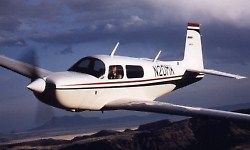 |
Mooney’s Encore |
Every year, Mooniacs return to the Mooney Homeland in Kerrville, Texas, much like theswallows to Capistrano, pigeons to statues, lemmings to the sea … well, you get mydrift. For the last several Homecomings, I have been among the faithful, learning aboutthe history of the breed, swapping Mooney lore, debating whether the tail was made like itwas because it looked better or flew faster. Get a bunch of Mooney owners together and beprepared to defend why YOUR tail is on backwards, not ours.
I also hung out with other owners of the older (classic, we call em) A, B, C, D,E and F models who probably wont be buying a new plane but that didnt stop usfrom getting smudgy fingerprints on the windows and dreaming what it must be like. It waswith that as a backdrop that AVweb gave me an assignment I couldnt refuse.They told me to go fly a new Mooney and report back on what it was like. What a way tomake a girls day!
Youve got to figure that on an assignment this good someone else is going to tryto horn in on the action. The interloper in my particular case was AVwebPublisher Carl Marbach, a good and saintly man who also happens to be my boss. Did Imention how clever he is? Actually, Carl is a fine sort who is a former M20-E ownerhimself, and couldnt pass up the chance to see what flying a Mooney would be like 20years later.
Carl and I were ushered around the factory by Tom Bowen, Mooney’s Vice President ofEngineering. Although Tom can relate to engineering cartoon hero Dilbert, you wontcatch this guy carrying a bunch of pens in his pocket protector. They might put his eyeout as he flips inverted in his pride and joy, the Mooney “Predator.” Mooneycreated the M20T to compete for the Air Force’s Primary Trainer contract in 1989-1990, butthe Predator lost to the T-3 Slingsby. Ultimately, the same fate befell both of them. TheSlingsby was grounded by the Air Force because of safety issues, and the Predator, afterfailing to win the contract, was pushed to the back of a hangar and left for dead. From1991 until 1996, the little plane sat, moldering away, stripped of its engine, its canopy,its cowling. Then came Tom.
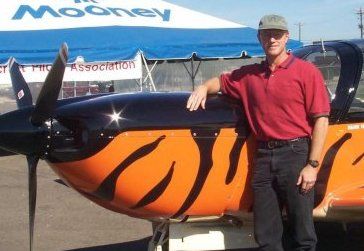 |
Tom Bowen and the Mooney Predator take a break. |
Bowen looked at the flight test data and saw the maneuverability, the ability to spin,the energy the plane carried, and decided to rebuild it. Mooneys CEO at the time wasBing Lantis, who told Tom he could do what he wanted as long as the project didntcost Mooney any money. That was all right by Tom, who assembled a small cadre oflike-minded buddies and set about making the Predator fly. “To get it from the pointof where it was, no engine, no cowl, no prop, cost the company exactly two thousanddollars. Eight hundred for the paint and twelve hundred for the decals. So what you see istwo thousand dollars worth of airplane sitting there.” Bowen wanted to rebuild theplane to fly it, but he also hoped to make it viable to the company.
The airplane isnt certified and to get it to that point would likely take threeyears and cost about $5 million. To make that worth Mooneys while, they need a blockorder for 100 or more. Bowen realizes thats a tall order to fill, and he continuesto ponder the possibilities of kitting out the plane. You can hear the wheels turning ashe considers it… “its a comfortable two-place cross-country 175-knotairplane. You can load tons of baggage and full fuel, but you can also take it out on theweekend and turn it over, go get a $100 hamburger….”
The Predator is a one-of-a-kind and very few people have ever been able to fly it. AVwebsCarl Marbach did and loved it.
Carl
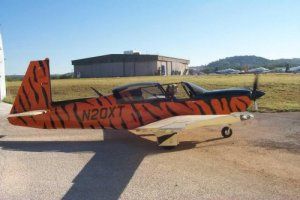 |
AVweb’s Liz Swaine and Mooney’s Tom Bowen pause on the ramp at Kerrville before putting the Predator through its paces. |
The Predator is a patchwork of Mooney models, some new design and a big ContinentalIO-550 craking out 300 hp mounted up front. Its made up of a short body from theM20C and M20E, but shortened even more, a tail from the M22 (the pressurized MooneyMustang from the 1960s) and – believe it or not – a standard 201 wing. The door has beenreplaced by a sliding canopy and the regular controls have been replaced by … whatelse? Sticks! All in all, its still a Mooney but definitely in wolf’s clothing!
The Predator is bare bones with a spartan interior and no insulation, so shesloud, like a race car. Starting and getting the big bore Continental to run requires adeft ability with the mixture, but Tom Bowen has the perfect touch. When taxiing,its evident that the short body makes the Predator nimble … but its whathappens in the air that counts!
Rotate at about 70 KIAS, then climb at 100 KIAS and youll get good rate of climband some over-the-nose visibility. With only a moderate amount of right rudder, I smoothlyapplied full power and in almost no time we were climbing at a steep angle, somewhereabove 1,000 fpm at 100 KIAS. As tricky as the engine was on the ground, thats howgood it sounds and feels in the air; sometimes when an airplane has the “right”engine it just feels good. Couple the feel with the canopys visibility and hold ontoyour hat!
Level off and the speed builds. Two things become immediately obvious: First, this is afast Mooney. Considering that all Mooneys are fast to begin with, that says something.Second, the stick feels like its stuck in cement. “We know the stick forces aretoo high,” Tom told me, “and we know how to fix that.” Even with stickforces like these, the Predator seems light and nimble while still maintaining the famousMooney stability. But the design and the look say, “lets rock and roll” sowe did.
Liz
While Carl and Tom were up in the air cavorting about, I was on the ground going overthe instrumentation of a new Mooney Ovation. The M20R is Mooneys equivalent of aBMW-Seven series – its got it all and it knows it. Rick Pitner, Mooney’s Directorof Sales and Marketing, was showing me the different bells and whistles and I was tryingto quickly make the leap from the panel of my 20-year old plane to one that seemed to haveevery single pilot gadget currently on the market. The only thing I couldnt find wasa cappuccino maker, but I probably just wasnt looking hard enough.
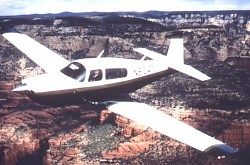 |
Mooney’s Ovation |
I sunk back into the fine Corinthian leather and taxied to the end of the runway assomewhere in the distance I heard Rick talking about “V” speeds and the like.Heck with that stuff. I knew this pretty baby would fly when she wanted to and look sleekdoing it. And thats exactly what happened. After the engine purred at run-up, wetook off down the runway with power to spare. At about 70 KIAS, I pulled ever so slightlyback on the yoke and the Ovation headed for the sky. Im not going to tell you whatshe climbed at and what we cruised at because you can get all that in a sales brochure andbesides, I wasnt paying any attention to it. What I WAS doing was having a blast ina plane that flew with a light touch, settled down as if it was on rails, and turnedelegantly into each and every maneuver. I was in love.
After just a few minutes at typical Mooney speed, we had managed to fly near atop-secret military restricted area and when Rick started looking nervous, I turned thebird and headed for home. But oh, the best was yet to come. If youve ever flown aMooney you know they hate to go down and slow down. Mooneys think “hot” is theirmiddle name, but if you try to land one that way, youll discover what”float” means, too. As long as you come in over the numbers at about 70 mph,youre OK. Thats why I was sweating when we flew into the pattern and weresmoking right along at 150 KIAS on downwind. When Rick popped the speed brakes, though, Ilearned a new lesson in Speed Management 101. Throwing those little pieces of metal outallowed me to keep my manifold pressure and RPM up, yet tidy up the Ovation for landing.She settled onto the runway just like a typical Mooney – so low as to make you feel likeyour fanny is going to come into contact with the pavement and make you check the gearlights several times. She was a sweet ride and a fine bird, and I will continue to getsmudgy fingerprints on one whenever I see it.
Carl
While Liz was smudging up the Ovation, I asked to fly Mooney’s newest airplane: theM20S Eagle. The Eagle is meant to be the more affordable of the two non-turbochargedairplanes. The Eagle will have a de-rated Continental IO-550 producing about 240 hp (downfrom the Ovations 270), use a new two-bladed prop, carry about 20 fewer gallons of100LL in the wings, use fabric instead of leather inside and lack a few other options,including the speedbrakes Liz loves so much. All of these features should allow Mooney tocreate a sizeable gap in pricing between the popular Ovation and the new lower-cost Eagle.
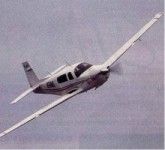 |
Mooney’s Eagle |
The Eagle has new-style power and engine gauges. Each is about 1.5 inches square anddisplays both analog dials and digital numbers. Leaning the Eagle in cruise means screwingout the vernier mixture control until the analog gauge peaks, then using the digitalnumbers you increase by 50 degrees. Easy. Exact.
At 7,500 ft/msl, setting up 2370 RPM and 24.1 inches of manifold pressure tell you thatthe Eagle is no slouch in the speed category. While it will be a bit slower than theOvation, it will also burn less fuel. My first airplane was a Mooney and they have a feelthat was like putting an old glove on again – it fit just right. Stalls, steep turns anda stable cruise make for a great flying experience.
Back in the pattern, the Eagle reminded me that in a Mooney, speed control is veryimportant. I came over the numbers about 10 knots too fast and floated a long way down therunway (OK, Liz, OK) before the Eagle decided to land once, twice, well, alright, threetimes. At least my Mooney time prevented me from releasing any back pressure and riskingthe wheelbarrow effect that has been known to ruin props, nosegear and egos. Here it wasjust the ego that was bruised a bit.
The Eagle has a new two-bladed prop that seemed normal in climb, but extraordinarilysmooth in cruise. McCauley and Mooney have been working on improving prop efficiency andthey seem to have a winner here. More blades are not necessarily better – they just havemore blades. I recently saw a Malibu with four blades and someone is offering them forAerostars as well.
Maybe it is because the Mooney was my first airplane, but I still love them. They flywith a grace and style that is hard to beat. The push/pull tubes that connect the controlsgive the plane a solid feel that cant be duplicated by other designs’ cables thathave to have some slop. The control harmony is perfect and honed to a fine edge since theMooney brothers did their thing here in Kerrville almost 50 years ago.
Coming to Kerrville is more than a homecoming, its a pilgrimage a pay tribute toa design that has survived the ages and still flies the modern skies. When all was quietbetween flights and I looked around at the old hangars and buildings, I was back in the1950s, when the Mooneys wood wing and clean lines were showing what you could dowith 150 hp. Then the Ovation came rumbling in, longer and all metal now with a big engineup front and cool electronics inside and it makes you wish those who came before could seewhere we have gone.
Liz
Of course, Im going to get the last word on this. I told you Carl was a good guy,didnt I? Anyone who had so much fun flying Mooneys cant be all bad. Wheneveryou happen to see one of the birds with its distinctive tail (its on right, youknow), walk up, put a nose print on it and say its from me.
You can request more information online on any of these aircraft, or check the Mooney web site for photos, prices and specifications. |
