




























Avoiding Aviation Gridlock: A Consensus for Change
National Civil Aviation
Review Commission
Preliminary Funding Task
Force Report
Norman Y. Mineta, Chair
September 10, 1997
NOTE: A PDF version of this report is also available.
Table of Contents
 I. COMMISSION FINDINGS AND RECOMMENDATIONS
B.Commission Recommends an Integrated and Comprehensive Package
II. INTRODUCTION: WASHINGTON, WE HAVE A PROBLEM
A. Without Change, Delays and Congestion Will Become Overwhelming
B. Without Change, Anticipated Growth in Aviation Will Stop and Economic Growth Will Be Constrained
C. Without Change, Air Traffic Control Will Live Increasingly Hand-To-Mouth
D. Without Change, Federally-Authorized Investment in Airport Infrastructure Will Remain Inadequate
E. Without Change, FAA Will Remain Disconnected from Its Customers’ Needs
G. Without Change, the U.S. Global Competitive Posture Will Be Harmed
H. Without Change, Maintaining Safety Standards Will Become a Real Challenge
III. FAA’S BUDGET TREATMENT MUST CHANGE
A. Recommendation
C. The FAA’s Revenues and Spending Should Be Linked and Spending Shielded from Budget Caps
Current Situation
Commission Recommendations
Budget Scoring
IV. FAA MANAGEMENT MUST BECOME PERFORMANCE BASED
B. Performance Based Organization for the Air Traffic System
Performance Based Organization Board
Creation of the Position of the Chief Operating Officer
First Steps in Establishing the PBO
Establishing Specific Measures for FAA Operational and Financial Performance
Structural Recommendations to Achieve Effective FAA Financial Reform
V. FAA’S REVENUE STREAM MUST BECOME COST-BASED
B. Present Method of Financing the FAA
D. Future Method of Funding the FAA
Future User Charge System
Air Carriers Should Pay Cost-Based User Charges
General Aviation Should Continue to Pay a Fuel Tax
There Should Continue To Be a General Fund Contribution
Process for Getting to Cost-Based User Charges
VI. FAA MUST BETTER MANAGE AIR TRAFFIC CONTROL OPERATING COSTS AND INCREASE CAPITAL INVESTMENTS
B. The FAA’s Requirements Estimates
Operations
Facilities and Equipment
Research. Engineering & DevelopmentC. Potential Budget Savings from the FAA Requirements Baseline
VII. AIRPORT CAPITAL FINANCING REQUIREMENTS MUST BE MET
IX. APPENDIX 1: BACKGROUND ON THE COMMISSION
X. APPENDIX 2: GENERAL BUDGET INFORMATION
I. COMMISSION FINDINGS AND RECOMMENDATIONS
The aviation system of the United States is at a critical crossroads. Aviation activity is growing, the technology of aviation is changing rapidly, and the business of aviation is becoming more complex.
Yet, a critical piece of aviation’s future is in doubt. The Federal Aviation Administration (FAA) currently lacks the organizational, management, and financial wherewithal to keep pace with the dynamic aviation community. Unless the FAA and various aviation stakeholders — the Congress, the Executive Branch, and the aviation community — change the status quo, internal and external to the FAA, our nation’s aviation system will succumb to gridlock. Delays will skyrocket while we reminisce about the “reliable” flight schedules of the past. This current course will impair our domestic economy, reduce our standing in the global marketplace, and result in a long-term deterioration of aviation safety. In this regard, the Commission has made several critical findings:
A. Commission Findings
Gridlock is near and will be expensive: Traffic data and trends indicate that adding just a few minutes of delay to each airline flight in the United States will bring the aviation system to gridlock with dramatic negative impacts on the economy. The airline industry’s complicated schedules are based on precise and efficient air traffic control technology and management. Rapidly growing demand combined with a reduction in capacity, as the result of outdated equipment, will bring our nation’s aviation system to gridlock soon after the turn of the century. Gridlock could also have safety implications as pressures to meet flight schedules grow just at a time when capacity is increasingly being constrained.
Budget rules are crippling: The present system of federal budget regulation is inappropriate for a system controlling commercial operations that needs to be driven by demand for services. Budget rules that govern the federal aviation system must be revised. The money problem that faces the FAA is an inability to access the revenues collected for its use.
Too many cooks: Authority and accountability are too diffused to run a 24 hour-a-day, high technology, rapidly changing operating system for a major commercial industry. Everyone responsible for the current ATC system — the FAA, the DOT, the aviation industry, the Administration and the Congress — want to make the system work. But there are too many people in charge. The problems are systemic and require basic changes in command and control.
FAA is nearsighted: While the vast majority of FAA employees remain dedicated and professional, the FAA itself impedes needed modernization by not focusing enough on determining and meeting its external users’ needs for high quality and modern services at reasonable costs. Modern business tools such as a cost accounting system that tie specific costs to services and measurement tools to assess how well services are provided are not yet available. Incentives are needed to change the FAA culture to be more externally focused on users and services and more businesslike and responsive.
Increasing operational costs overshadow capital investments: The funding system forces trade-offs which substitute operational costs for capital investments. The system is in a downward spiral where increasing operation and maintenance costs, driven by outdated equipment, are “freezing out” new investments under current federal budget cap assumptions. Future system capacity will be reduced in real terms from today’s capacity.
Airport needs are not being met: Airport related congestion will increase in the future without a strong, federal commitment of resources. Airport capital investments must be hand-in-hand with ATC investment to maintain system capacity.
International competitive stature will be hurt: Historically, the U.S. has been the leader in air traffic management and technology. However, other countries are moving ahead of the United States in making improvements to their aviation infrastructure. Falling behind other countries in making critical capital investments will certainly affect our international competitive position
The National Civil Aviation Review Commission believes these problems can be rectified, but it will take dramatic changes in the way that the air traffic system and airport development are managed and financed. Institutional relations within the FAA and among the various stakeholders must be altered if we are to increase accountability at the agency, improve management performance, and ensure sufficient resources are used effectively.
The Commission notes that the identification of these problems is not new, and that previous Commissions and analyses have pointed to them. Among these are The National Commission for a Strong Competitive Airline Industry (1993), The Clinton Administration Air Traffic Control Corporation Study (1994), The White House Commission on Safety and Security (early 1997), and the Coopers & Lybrand FAA Independent Financial Assessment (early 1997). While these problems are not new, there is now a realization and a consensus as to their seriousness and implications.
B. Commission Recommends an Integrated and Comprehensive Package
Meeting the demands of a growing, complex aviation system is no small task. In this report, the Commission recommends broad and sweeping changes in the ways the FAA is managed, sets its priorities, assesses and achieves performance outcomes, and is financed. As a package, these reforms put the FAA and aviation stakeholders in position to take advantage of industry growth and technological change.
The Commission has agreed on a set of five broad recommendations that stem from their findings. The recommendations are viewed as a comprehensive package and strongly supported by all Commissioners. Any alternative to the Commission’s proposal must demonstrate singular consensus to be credible. It must be recognized that the strong consensus within the Commission for these recommendations exists because they are viewed as a comprehensive package. Moving forward on implementing some elements of the package without the others being addressed would result in a loss of this consensus. The importance of this consensus is demonstrated by the shortfall of previous efforts which lacked full industry support to reform the FAA. The Commission’s recommendations are included in the proposed legislation in Attachment I and are summarized below.
The FAA’s Budget Treatment Must Change: The Commission recommends that the FAA’s funding and financing system receive a federal budget treatment ensuring that revenues from aviation users and spending on aviation services are directly linked, and shielded from discretionary budget caps. This will ensure that FAA expenditures will be driven by aviation demand.
FAA’s Management Must Become Performance Based: The Commission recommends that the air traffic control services be placed in a performance based organization (PBO) which is managed by a Chief Operating Officer, and overseen by a board of public interest directors. In addition, the FAA should have a cost accounting system and be given authority to implement innovative programs involving leasing and borrowing authority. The Commission further recommends that the safety and security functions of the FAA that are separate from the PBO should also adopt a performance based management philosophy so that the quality of these programs can be improved.
FAA’s Revenue Stream Must Become More Cost Based: The Commission recommends that the FAA adopt a cost-based revenue stream to support its air traffic system activities including capital investments. At the same time, funding for aviation security, safety, and government use of the air traffic system should be provided by the federal government general fund.
The FAA Must Control Its Operating Costs and Increase Capital Investments: The Commission has reviewed the FAA’s forecast budget needs and assumes the agency’s own budget projections to be reasonable in a status quo environment. However, the Commission recommends that FAA operating costs could be better managed and controlled and that investments in air traffic control modernization should be increased.
Airport Capital Needs Must Be Met: The federal requirements of airport capital development currently exceed the amount of revenue presently available to finance these requirements. The Airport Improvement Program (AIP) is the linchpin of airport financial planning and the Commission believes AIP should be funded at a minimum of $2 billion annually over the next five years.
These recommendations are strongly interconnected. Without budget treatment that links aviation revenues and spending together, key capital investments will not be made despite industry’s willingness to pay. Without movement to a cost-based system, FAA’s improved performance will be limited, because the agency will lack critical data to judge performance and appropriate market signals to make sound investment decisions. Without management and organizational changes, there will be no guarantee that any dollar that goes into the FAA is used wisely and efficiently.
These connections are the basis for why the Commission’s recommendations are comprehensive and sweeping. It is the belief of the Commission that without these changes, the aviation system infrastructure of this country will become an impediment to economic growth. Critics of these proposals, or defenders of the status quo, must provide a compelling alternative, for the current system is headed down a path toward economic disaster and reduced safety. Since this is unacceptable, the Commission offers its report as a clarion call to action and innovation.
II. INTRODUCTION: WASHINGTON, WE HAVE A PROBLEM
Without prompt action, the United States’ aviation system is headed toward gridlock shortly after the turn of the century. If this gridlock is allowed to happen, it will result in a deterioration of aviation safety, harm the efficiency and growth of our domestic economy, and hurt our position in the global marketplace. Lives may be endangered; the profitability and strength of the aviation sector could disappear; and jobs and business opportunities far beyond aviation could be foregone.
Currently, the aviation sector of our economy is vibrant and growing. At its core are technological innovation and managerial success. U.S. aircraft manufacturing leads the global market, and U.S. airline operations are the most competitive and efficient in the world. Our airports are recognized as professionally managed enterprises that are the engines of local and regional economies. The system is a true “public-private partnership,” as air transport services, carrying passengers and freight, are produced by a combination of private firms and public agencies.
The private firms, passenger and cargo carriers, provide the equipment and crews that actually move people and goods, as well as the required support services-reservations and booking, ticketing, and baggage handling. The public agencies, the FAA, to a limited extent DoD, and airport authorities, provide the infrastructure of facilities, technology and services necessary for the safe and efficient operation of a large number of commercial aircraft, frequently in heavy-traffic conditions. The FAA provides the civilian air traffic control (ATC) system, including facilities, personnel, hardware and software. The airport authorities provide runways, terminal buildings (often in partnership with air carriers) and extensive support facilities.
In just the past several decades, this partnership has moved aviation from a minor industrial sector to being 6% of the Gross Domestic Product (GDP). U.S. airline and aerospace industries directly employ approximately 1.5 million people, mostly in highly skilled, high-wage jobs that generate more than $100 billion a year in wages.
According to the 1997 World Development Survey, the world’s air travelers are expected to double from one billion to more than two billion over the next twenty years. The total economic impact of air transport on the world economy was $1.14 trillion in 1994. This is expected to increase to $1.7 trillion by the year 2010. Presently, over $1.5 trillion worth of freight is moved through the air around the globe annually.
The aviation system offers one of the most significant engines for national economic growth. If managed well, this economic advantage will become ever more important as there is continued movement toward a global economy dominated by services and lighter, high-value manufacturing.
There are dark storm clouds on the horizon, however. Our ability, as a nation, to provide the financial and management resources needed to support the underlying infrastructure (that is, our air traffic system and airports) and keep the aviation system vibrant and growing is slowly, but steadily, evaporating. The present process by which the air traffic control system and federally-related airport development is financed and managed will not meet the future needs of the national economy and the traveling public.
The effects are already being felt, but our current problems pale in comparison to what is anticipated to come in a few short years. What happens in the aviation sector of our economy will have an enormous impact beyond that 6% of the GDP. The problems that this country faces could be wide ranging because the rest of the GDP and its productivity have become inextricably linked to our aviation system. Try to picture our economy with a gridlocked aviation system and what could and could not be produced.
The problem is difficult to solve because it is multifaceted and the solution requires dramatic changes in the way the business of air traffic control and federally related airport development is conducted. The Congress, the Executive Branch, the FAA, and the aviation community will all have to be part of the changes. The solution is all the more difficult to achieve because long-standing institutional relationships must be dramatically altered if our nation is to avoid the problem that is about to be delivered on its doorstep.
The U.S. air traffic control system does not have enough capital resources to overhaul its technological components as quickly as needed and to continue operating on a day-in-and-day-out basis at a tempo that the public expects and that economic activity and growth require. Similarly, our airports need more federally-related resources to meet the future capital requirements that growth in air transportation will demand.
Just focusing on financial resources, however, would dramatically understate the problem confronting our country. How we organize, manage, make plans for, and execute critical decisions about the future of this basic building block of our economy is just as significant. Sweeping organizational, institutional, and management changes are also required. Money alone is not the answer.
Every day that passes without financial and management reforms means the coming gridlock will be here sooner and last longer than if the country steps up to the problems now. The U.S. air transportation system is falling into a hole that will take a great deal of money and time to climb out of. We, as a nation, still have a grip on the edge of that hole, but significant steps need to be taken very soon or that grip will be lost. Not just aviation will be pulled into the pit. Because aviation has become such a normal and ubiquitous part of our economic way of life, nearly every other sector of our economy will find itself dragged into it in one degree or another.
A. Without Change, Delays and Congestion Will BecomeOverwhelming
As stated above, the problems with the financing and management of our air traffic control system are already becoming manifest. In 1995, the FAA estimated that airline delays cost the industry approximately $2.5 billion per year in higher operating expenses. That cost is clearly higher today and will grow. Recent data indicate the delay problem is getting worse. The number of daily aircraft delays of 15 minutes or longer was 18.9% higher in 1996 than in 1995. As illustrated in figure 1, American Airlines data shows that delays are likely to grow at ever-increasing rates unless some action is taken soon. American Airlines has estimated that by 2014 it expects delays to increase by a factor of three, bringing its hub and spoke system to its knees.
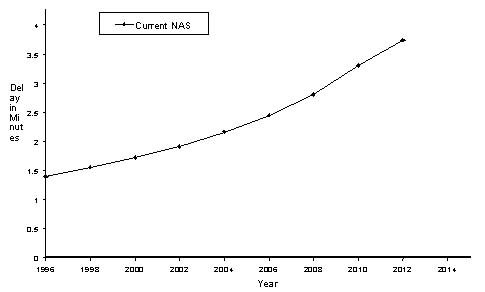
Figure 1.
Projected Average Industry Air Delay Per Flight
Study by American Airlines
Moreover, delays appear to be lengthening. The Air Transport Association reports that the amount of time per delay rose 10% between 1995 and 1996. However, this figure masks the problem, because delay has become such a normal operational feature of the air traffic control system, airlines have simply built additional time into their flight schedules to accommodate it.
While extremely costly, delays in the air traffic and airport system will soon move beyond a cost and an inconvenience to be borne to a major breakdown of our air transportation system. Most major airlines operate with a hub and spoke route system or require quick turnaround times at gates. The efficiency and efficacy of these approaches are entirely dependent on the ability to reliably and dependably schedule flights to arrive at and leave airports in relatively narrow windows of time. The uncertainty these delays create are occurring at the same time that today’s economy requires better reliability and predictability. There are at least three significant and rising costs from a system which is approaching gridlock:
Direct costs to operate and maintain aircraft — paid by the airlines, but passed onto travelers in the form of higher fares.
The cost to travelers of delays caused by increased travel time.
Broader economic losses due to uncertainty in the delivery of goods and people.
For example, air traffic inefficiencies cost Delta Air Lines approximately $300 million per year. Delta Air Lines estimates that if just four more minutes are added to the average time of each flight, it will not be able to reliably operate its hubs. The foundation of Southwest Airlines’ low-fare operation is a 20-minute turnaround between flights. If just five minutes are added to its turnaround time, Southwest would be forced to fly each of its aircraft one less flight per day, jeopardizing its ability to continue to offer low-fares. A recent MITRE Corporation analysis confirms these projections and estimates. As airlines strive to maintain the reliability of their operations, the result will inevitably be reductions in air service with the attendant negative economic impact.
B. Without Change, Anticipated Growth in Aviation Will Stop and Economic Growth Will Be Constrained
Given the delay and congestion problems that already exist, anticipated growth, without needed expansion of capacity in the air and on the ground, will simply reach a point at which it cannot be accommodated. Historically, the growth of aviation has outpaced overall economic growth. For example, in 1996, the strong U.S. economy (growing, at approximately 3%) spurred domestic airline traffic to grow 6.6%.
Many will recall that in the 1980s growth in aviation was constrained by the failure to rebuild the air traffic control workforce after the 1981 strike. The air transportation system was widely viewed as hitting a ceiling in terms of moving people and shipments smoothly, effectively, and efficiently. A similar situation awaits us, albeit for different reasons, but the result will be the same and likely worse.
Every forecast of aviation activity predicts steady growth well into the next century. U.S. domestic and international passenger enplanements are expected to increase by 52% between 1996 and 2006 (from 606 million to 920 million). For the next ten years the FAA forecasts that annual growth in revenue passengers miles will average 4.2%. Aircraft movements are also expected to dramatically rise. In 2008, there are forecast to be nearly 10 million more annual aircraft operations than the 63 million operations expected by the end of this year. While aviation activity is growing. the FAA’s capital investments are decreasing. Between 1992 and 1997, the effective buying power of the FAA’s capital budget has decreased nearly 40%.
In short, growth, without significant capacity improvements, is already posing a serious challenge to the efficiency of our air transportation system, and hence the economy at large. Continued steady growth, without adequate investment in the air traffic control and airport system, will make this challenge even more daunting with each passing day. At some point, the challenge will become completely unmanageable, and growth in aviation will stop. The effect of this will ripple throughout the economy affecting, other sectors’ ability to grow.
As mentioned above, the aviation system has become integral to the national and global economics. Virtually all sectors of the economy are now dependent on air transportation for the movement of goods and people. Approximately half of air travel is undertaken in the course of conducting business. Even in the face of new and improved electronic and telephonic means of communication, air travel continues to grow indicating that face-to-face communication remains a necessity for business transactions. In short, the aviation system has become a basic element of the infrastructure of the nation’s and the world’s economic way of life. Significant problems that cause inefficiency in the air transportation system will hinder the ability of businesses to open new markets and create new opportunities to expand and grow.
C. Without Change, Air Traffic Control Will Live Increasingly Hand To-Mouth
The FAA has both large capital requirements and large day-to-day operating needs. The FAA is unique for a government agency in that it provides around-the-clock, 365-days-a-year air traffic control services — a linchpin of our nation’s economic well being. However, the FAA is funded and budgeted like other government agencies, most of which do not have this type of operating responsibility.
Being subject to the increasingly stringent federal budgetary caps , the agency is placed in the unsustainable position of having to forego capital development programs in order to keep the day-to-day operations adequately staffed. The FAA’s capital investments have decreased by approximately 20% since FY 1992, while funding for operations has increased by more than 10% over the same period.
In recent years, this predicament has forced the FAA to cut back on airport grants and forego full investment in modernizing air traffic control equipment. A process that forces the agency to be shortsighted will inevitably harm the entire aviation system in the long term. Unfortunately, the long-term consequences are actually just around the comer.
Unless the budgeting and funding picture is dramatically altered so that aviation revenues can be directly linked to the programs they ostensibly support, rising operating expenses will outstrip the FAA’s ability to make capital investments in air traffic control and airports. When faced with limited resources. operating and maintaining the present system prevails over the need to modernize.
Operating expenses are climbing because of traffic growth in the system and the rising costs of maintaining a large inventory of antiquated equipment. Because much of the equipment is old, its failure rates and outage intervals are resulting in ever-increasing maintenance costs as FAA strives to keep the. equipment up and running. Just between 1992 and 1996, the number of hours of unscheduled outages more than doubled. When budget constraints guide policy choices in this kind of operating environment, the inevitable result is a downward spiral of disinvestment and increased operating costs. This is painfully ironic since one of the principal reasons for capital investment is to reduce the growth in the operations budget.
The problems of the current budget predicament were brought home to the aviation community when the recent 5-year federal budget agreement was enacted into law. It raises an extra $4 billion from the aviation community (including passengers and shippers), all of which will be deposited into the Airport and Airway Trust Fund. Although the aviation users will pay significantly more in taxes, there are no guarantees that the funds will be spent on aviation purposes. The current budget caps and rules will likely result in the extra revenue only being locked up in the Trust Fund, unavailable to be used to develop and operate the system. Virtually all of the new revenue will be used to off-set spending on non-aviation programs, setting a very damaging precedent for the future.
The likely effect of the recent budget agreement on the near-term funding of these programs makes change imperative. The case becomes even stronger if the longer term effects of the budget agreement lead to the federal deficit beginning to climb after 2002. If that happens, the FAA’s programs will come under even greater pressure just as the congestion and delay crises described above are beginning to strangle the national air transportation system and the overall economy.
D. Without Change, Federally-Authorized Investment in Airport infrastructure Will Remain Inadequate.
In the face of growing demands on airport infrastructure because of the passenger and traffic growth described above, safety and environmental requirements, and the continual need to refurbish existing infrastructure so as not to lose it, the federal government’s role in providing airport capital investment has actually slackened in recent years. Between 1992 and 1996 the annual program was reduced by nearly $500 million, or 23%. For FY 1998 it appears the Congress will fund AIP at $1.7 billion, but this is well below the authorized amount.
While the congressional appropriations process may well provide a greater amount than that requested by the President for next year, the uncertainty and instability that pervades the airport funding picture has reached such a level that local planning is virtually impossible to accomplish in some circumstances. This has resulted in the delay or deferral of capacity-critical projects.
The budgeting and funding process has become so flawed that the aviation community finds itself standing up and cheering when an extra $250 million in airport grants are available, even though that restores the program to $200 million shy of its highest level of $1.9 billion, and $500 million below where most believe it should be to support 3,400 airports.
Such underinvestment will certainly lead to further congestion in the aviation system. In 1995, 25 of the largest U.S. airports were characterized as “severely congested” by the FAA. Without adequate capacity enhancements, this number will climb to 29 by 2005. Among those airports that would newly achieve this dubious distinction are Baltimore-Washington, San Diego, and Memphis. Each of the nation’s ten most congested airports averaged more than 3,000 hours of delay per month for the first four months of this year. This will continue and only get worse if adequate infrastructure is not developed.
In 1990, a new source of airport development funds was created, known as passenger facility charges (PFCs). These are locally levied charges of up to $3 per passenger for specific airport capital improvement projects. While the FAA has no role in collecting these funds, it does approve specific projects before a PFC can be levied. When PFCs were established, it was for the purpose of creating a whole new funding stream on top of the AIP. In some respects, with the AIP falling off in recent years because of the overall budget situation, the PFC program has come to act largely as a replacement for AIP funds in the minds of aviation policy makers in the Executive and Legislative Branches. This mind set is hurting both of these vitally important programs.
The Commission believes that underinvestment in airport infrastructure undermines the benefits that can be expected through modernization of the air traffic control system. If airport and air traffic investments do not keep pace with one another, capacity gained on the air traffic side cannot be fully realized. Whether an aircraft is delayed because of a lack of runway, taxiway, or terminal constraints, or if it is because of inadequate air traffic control equipment, the effect on the traveling public and the broader economy is the same: higher costs, lost productivity, and poorer economic performance.
E. Without Change, FAA Will Remain Disconnected from Its Customers’ Needs
Aviation users perceive a lack of connection between, the FAA’s management of the air traffic control system, and the agency’s ability to reduce the cost of operating in the system. The aviation community has lost faith that the FAA can meet their needs for lower operational costs. This has manifested itself in significant ways and at great cost.
Fifteen years ago, the FAA embarked on a program to modernize the air traffic control system. Unfortunately, the agency looked at itself as the “customer” of the system, rather than those who pay to use it. This approach led to a collection of overly ambitious, out-of-scope, too expensive, and undermanaged projects that have fallen years behind schedule with cost overruns in multiples of their original projections. For the most part, when these projects are finally delivered, there will be no additional system performance or capability from the users’ perspective, no reduction in costs to use the system, and few improvements in safety. The follow-on programs to the Advanced Automation system (AAS), for example, will provide the same basic functionality of today’s systems on modern hardware. While system outages and breakdowns are expected to decrease, without a change in acquisition philosophy, new tools designed to enhance controllers’ productivity will not be implemented for a least another 5 years.
Another recent example of how this approach continues is seen in the Wide Area Augmentation System (WAAS) program, which makes satellite navigation signals accurate and reliable enough to be used in commercial aviation. The airline industry, which WAAS is supposed to benefit, was never fully supportive of the FAA’s approach to the problem this program was intended to solve. The program is perceived to be troubled with costs and schedules under review. These difficulties, coupled with an industry skeptical of the FAA’s approach even if it was working properly, undermine aviation stakeholders’ confidence in the FAA’s ability to meet their needs at a reasonable price.
If there is any hope in the near term of making improvements that provide significant benefits to air travelers, shippers, and other users of the system, the air traffic control system (including its capital investment) must become managed from a perspective that enables its performance to be continually assessed and improved. Without this change, critical safety and operational problems loom in the immediate future.
F. Without Change, the Economics of Air Traffic Services Will Be Poorly Understood and, Hence, Poorly Managed
Part of the disconnect between the FAA’s management of the air traffic control system and the user community resides in the inability of both the FAA and its users to assess and act upon the true costs of their plans and actions. This approach has led new projects and procedures to be launched and ongoing projects and procedures to be continued without proper and crucial management knowledge and user input and support.
Better data on the costs of specific air traffic control services and pricing mechanisms related to that data will send better economic and market-type signals to both FAA managers and the industry. This would improve decision-making by forcing both to examine whether there were better, less expensive ways to provide the service, or whether the service was really worth the costs from the users’ perspective.
Because system delays and congestion are related to the most heavily used components of the aviation system, additional resources (capital or operational) in particular places will undoubtedly yield system-wide benefits. A better allocation of existing funds for needed investments or operational changes could make a real difference in solving these problems. Currently, however, such information about system needs is incomplete at best.
In a free market, businesses can look at the revenues and costs of services and product lines and learn a great deal about how customers value products relative to their costs, where cost savings can be found, where to make improvements, and the most attractive opportunities to invest new capital. At present, there is a dearth of this kind of information flowing in either direction between the FAA and its customers. An approach is required that mimics the information and resources that market price signaling provides the private sector, so that best business practices and management can be brought to bear on a system that is so important to the nation’s economic well being. A move toward a system that is able to convey market-like financial and economic-like signals would help FAA better manage the day-to-day air traffic control operation and develop an investment strategy for the future that is more sophisticated than “more is better.”
The Commission believes that without a fundamental change in management practices and perspective, coupled with cost-based accounting and financing mechanisms, the management of the ATC system will be largely focused on evolving day-to-day operations, without the foresight to implement long term improvement strategies. The costs of continuing in this fashion are enormous and not sustainable.
G. Without Change, the U.S. Global Competitive Posture Will Be Harmed
Since the dawn of aviation, it has been said that the U.S. air traffic control system is second to none. There are already indications that this may no longer be the case. Numerous other countries are taking steps to improve airport facilities dramatically and modernize air traffic control systems with state-of-the-art technology. The irony is that, more often than not, these countries are procuring advanced technology from U.S. companies that have been unable to sell their wares to the FAA. The irony is compounded by the U.S. exporting advanced air traffic equipment, while the FAA imports vacuum tubes to run some of its antiquated equipment. This predicament is due in part to cumbersome procurement rules (from which the FAA was recently freed), lack of good management approaches and practices, the absence of a steady and reliable funding source, and a budgeting process that tilts away from taking the long view.
Because of the FAA’s lack of modern ATC equipment, there have been suggestions in International Civil Aviation Organization forums about redelegating oceanic ATC responsibilities that now rest with the United States. Canada, Germany, Norway, the United Kingdom, and some Asian, Latin American, and Eastern European countries are installing and, in some cases, are now using state-of-the-art equipment. Although 19 out of 20 of the busiest airports in the world are in the U.S., the United States can no longer claim that it has the world’s most modern air traffic control system.
This was further underscored in an Aviation Week article from January 27, 1997 describing a variety of satellite navigation developments that have been initiated by the island nation of Fiji. The article stated: “The United States is being left behind in the implementation of satellite navigation and digital data communication for air traffic management in the Asian/Pacific areas.”
Other countries are also making multi-billion dollar investments to upgrade and build new airports. As examples, whole new airports representing investments of billions of dollars are being built in Asia. Existing ones are being refurbished and given new capacity. Osaka and Munich recently opened new airports. These investments are being made because there is a recognition that to compete well in the global economic system markets need to be served with strong airport infrastructure. While the U.S. recognizes this need as well, the present funding system forces the country to invest less than it should on capital investment at airports.
For the United States to compete well in the global marketplace this picture must change dramatically. If it does not, the U.S. simply should not expect to have an aviation system that provides competitive benefits.
H. Without Change, Maintaining Safety Standards Will Become a Real Challenge
Outdated technology and ever increasing capacity demands placed on our airports and air traffic control system can have an impact on safety. As the pace of activity quickens and greater demands are placed on our aging communication, navigation and surveillance equipment, failures are bound to occur. Antiquated backup systems cannot be expected to provide needed safety assurance as communication and radar failures become a more frequent occurrence.
Maintaining old equipment and responding to capacity demands are not, therefore, simply economic efficiency issues. Like old bridges and congested highways, congested airports and airways supported by outdated equipment can be less safe. A system straining at the seams of capacity is one that is also straining to be safe. Even aside from congestion posing risks, sheer growth is going to result in more accidents if nothing is done to dramatically reduce the accident rate. A Boeing Company analysis (as shown below) found that when today’s accident rate is applied to the traffic forecast for 2015, the result would be an airliner crashing somewhere in the world almost weekly. If the problems caused by congestion and failing equipment are laid over this, it presents a safety problem which the public will find intolerable.
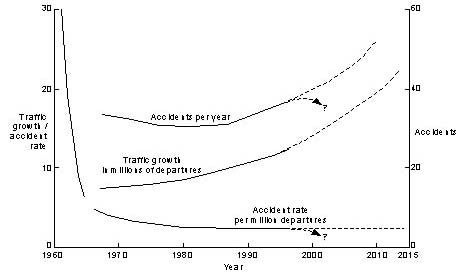
Figure 2.
Potential Aviation Accident Levels
To summarize, this report will set out a path to steer us away from the looming disaster. Those who are prepared to argue that this path should not be followed, must be ready to offer a viable alternative, because staying on the present path is untenable. The American public deserves better than gridlock in the sky and congestion on the ground. The Commission’s recommendations will change the current course and lead to a stronger aviation system in the future. The nation will be more prosperous and the traveling public will be safer if the recommendations of the National Civil Aviation Review Commission are adopted.
III. FAA’S BUDGET TREATMENT MUST CHANGE
A. Recommendation
The Commission believes that if users of FAA services are expected to pay special aviation charges, every dollar raised should be directly linked to supporting FAA programs. The Commission recommends that the FAA’s funding and financing system should receive a budget treatment ensuring that revenues from aviation users and spending on aviation services are directly linked, and shielded from discretionary budget caps. In general, funds raised for aviation purposes should be available for aviation purposes. In the same manner, services provided to the users should be supported by them financially. However, the services that are of a general public benefit should be supported by the general taxpayers.
This was the first recommendation made by the Commission and acts as the foundation for the other recommendations. Commission Chairman Mineta, on behalf of all the Commissioners, wrote the following to the House of Representatives and Senate leadership in early June:
“Without providing the type of budget treatment recommended…. the Commission cannot achieve the objectives of the enabling legislation. This failure will only lead to a crisis in the future of safety, delays, bottlenecks and air traffic gridlock. At that point, it will take more time and resources (measured in years and billions of dollars) to fix than if we succeed with our mandate now.”
(See Attachment 8.)
B. Background
Because the FAA is part of the federal government, the treatment of its budget and spending, currently follows federal budget rules. Like most federal agencies, the FAA’s budget must be annually passed by the Congress and signed into law by the President. However, unlike many agencies in the federal government, users of FAA facilities and services must pay special aviation excise taxes (including the aviation ticket tax, the flight segment tax, the cargo waybill tax, the international departure and arrival fee, and certain fuel taxes) ostensibly levied to support the FAA’s programs. These excise taxes are deposited into the Airport and Airway Trust Fund.
The Aviation Trust Fund was established in 1970 with the purpose of financing the FAA’s capital investment in the airport and airway system. Over the years, Trust Fund monies have also been increasingly used to support the FAA’s operations. Statutory language limits the amount of Trust Fund money allowed to support FAA’s operations.
The law is intended to encourage more capital investment; if more Trust Fund money is appropriated for capital needs, then more Trust Fund money can be spent on the FAA’s operations.
But, with the FAA’s total budget limited due to federal deficit concerns, the immediate needs of the FAA’s operations must take priority over capital investment needs. Since not all of the Trust Fund money is spent annually, the balance grows. Every year that there is an aviation Trust Fund surplus, some fees are not being spent on the intended aviation purposes. With the new taxes the Congress has levied and the limits placed on spending due to federal deficit concerns, Trust Fund balances are expected to dramatically increase. There are some estimates that, with the new aviation taxes, projections of FAA requirements, and statutory limits on Trust Fund spending, the uncommitted balance (surplus) of the Trust Fund could grow in excess of $9 billion by 2002. This buildup in the Trust Fund clearly reflects that annual tax revenues extracted from aviation users soon will exceed annual spending on aviation allowed by current budget constraints.
The ATC function of the FAA is unique in our federal government. The government is charged with running the “production line” of a major commercial industry; every unit of production — in this case every flight — needs the FAA’s input to make it a deliverable product. If that operation is to become performance-based and financed by the users and beneficiaries of the system, it must have its revenues driven by demand, which in turn drives expenditures. If the ATC system remains part of a budget process driven by external forces, such as reducing total federal domestic discretionary spending, it will never be performance based, no matter what label anyone might wish to hang on it.
The lack of any direct linkage between revenues and spending was crystallized by the tax-writing committees in the Congress during consideration of this year’s budget reconciliation bill. Taxes will be dramatically increased on airline passengers and air carriers without assuring that the additional revenue raised will be dedicated to aviation safety and capacity improvements. As we move toward and past the turn of the century, the revenues from this increased aviation consumer and carrier tax will not be invested in additional modernization of the aging air traffic control infrastructure unless the budget treatment is changed. Without change, passengers will pay more and receive less efficient ATC service in the form of more delays and less safety.
C. The FAA’s Revenues and Spending Should Be Linked and Spending Shielded from Budget Caps
1. Current Situation
The FAA is funded through the appropriations process and must compete for funding, with other modes of transportation (and other government programs like education or health programs), even though the FAA is primarily supported with money from the Airport and Airway Trust Fund. The Trust Fund is fully supported with revenues from aviation users. Under existing budget process rules, the budget cap that applies to the Department of Transportation and related agencies does not take into consideration the seemingly dedicated revenue stream derived from its aviation users.
In the simplest form, there are two types of federal government revenues and spending: mandatory and discretionary. The rules for spending and controlling mandatory versus discretionary funds are completely different. While the FAA’s spending is considered discretionary, the revenue supporting the Trust Fund is considered mandatory. Decisions made regarding the FAA’s mandatory revenues are made with little consideration of the FAA’s discretionary spending, and vice versa. Therefore, there is very little relationship between the revenues flowing into the Trust Fund and the level of the FAA funding. For instance, in FY 1995, there was a $5 billion uncommitted balance (surplus) in the Trust Fund; however, the FAA’s appropriations were reduced 4 percent from the FY 1994 level (see Appendix 2 for additional information on budget issues).
The FAA’s budget classification also means that, if the FAA proposes a program that would significantly reduce its costs, there would be no reason for the tax committees to implement a corresponding reduction in aviation taxes. Since the FAA’s spending is discretionary, any cost savings could only benefit other discretionary programs. In fact, there is little incentive for cost savings by the FAA because any savings usually translate into lower funding the next year rather than rewards for productive employees or additional investments in capital programs.
2. Commission Recommendations
The Commission believes that this lack of linkage between the FAA’s revenues and spending is inappropriate and unnecessarily causes very difficult consequences for the FAA and the aviation industry. The FAA and the industry should be able to benefit from the user revenues that are collected. The FAA should also be able to reduce charges on aviation users if the FAA’s needs are below the level of funds raised by the current charges. In other words, the FAA should have the flexibility to alter the user charges relative to aviation system demands. Under the current system these options are not available to the FAA.
The Commission believes that since the FAA is largely funded by its own revenue sources supported by users, the agency’s spending of user charges should be controlled by its revenues, not by the budget caps. The budget caps are to reduce the federal deficit. If the level of FAA spending was limited to its means, then it would have the same overall impact as the budget caps. Therefore, the Commission believes the FAA’s user supported budget should be able to function outside the federal budget caps so long as that does not increase the deficit. This change will also alter the terms of overall FAA spending decisions. Currently, the funding trade-offs are between FAA spending relative to other government programs. Instead, the focus needs to be the appropriate level of spending within the FAA, prioritized by the anticipated economic efficiencies and benefits. The Commission’s recommended budget treatment will achieve this result.
The Commission recommends a change that would, in its simplest form, allow aviation user revenues to be spent on FAA programs. The Commission understands that the federal government must function under strong budget rules to control spending. In addition, the Commission believes that certain budget controls for the FAA are necessary. For example, the FAA should not be allowed to spend beyond its means. However, the budget rules regarding aviation revenues currently lead to some inappropriate or unwise policy choices, needless delay in implementing programs, and decreased employee efficiency and morale.
In a recent case, the FAA attempted to use internal reprogramming authority (established by Congress) to address a commissioning backlog of Automated Surface Observation System (ASOS) weather measurement equipment. The backlog was a result of congressional direction on purchasing the systems, although there were already many ASOS in the FAA inventory. Funds appropriated by Congress for ASOS covered the acquisition of new systems and did not cover the commissioning costs for new and previously procured systems. FAA attempted to reprogram internally in FY 1997 to address a portion of the backlog but that was met with a significant resistance from congressional staff, resulting in the need for a formal and time consuming reprogramming request. The FAA had other important shortfalls at the time, and after the initial feedback from congressional staff, chose not to pursue a formal ASOS reprogramming request at that time to concentrate on other priorities.
The budgetary treatment of the collection and spending of aviation user charges will, in all likelihood, depend upon the precise nature of the user charges. Therefore, the Commission’s decision to move toward a more cost-based funding system (which is discussed in detail in Section V of this report) has an impact on how future collection and spending would be scored in the budget, unless changes or exceptions are made to the existing budget rules. In general, cost-based funding should be scored consistent with the budget treatment advocated in this report.
3. Budget Scoring
The Commission recommends that the FAA revenues and spending, should be on the same side of the budget. This would allow any increases in need to be compensated with increases in revenues and spending. This would also allow any reduction in spending to be countered with a reduction in revenues. The Commission’s recommended budget treatment for the FAA should not increase the federal deficit estimates through FY 2002.
As discussed later in Section IV appropriate budget scoring of borrowing activity would enable the agency to utilize financial resources available to it in a business like manner. The changes in budget treatment should recognize that borrowing by a day-to-day operating organization, such as the air traffic system, is a necessary flexibility to achieve the safety and efficiency benefits the public demands.
Regardless of the nuances of the current budget system, the Commission recommends that the majority of the FAA’s funding be placed on the mandatory side of the federal budget so that spending would be limited to the monies raised through dedicated user charges. This would be similar to the “permanent appropriations” treatment the United States Postal Service (USPS) receives, whereby all revenues generated from USPS services (i.e., first class stamps) are automatically appropriated (see U.S.C. Title 39, Section 2401) and transferred to USPS accounts for their use (U.S.C. Title 39, Section 2003). Under such a plan, the statutory budget caps on overall federal discretionary spending would be lowered and used as a one-time offset for the increase in mandatory spending that would occur.
The remainder of the FAA’s programs (safety, security and the governmental usage of the ATC system) would continue to be discretionary in nature since the Commission is also recommending that those programs be funded through an appropriated general fund contribution (discussed in Section V). The Commission believes that such appropriations (approximately $1.4 billion in 1995) should be made on a multiyear basis so that there would be funding stability for those important safety and security activities.
Although not the preferred course of action, it would be acceptable to move the collection of user charges to the discretionary side of the budget (as offsetting collections) with spending on the majority of the FAA’s programs being placed in its own budgetary category much as has been done with the Violent Crime Reduction Trust Fund (which is not subject to many of the usual budget pressures). This would require a one-time budget scoring exemption (a pay-as-you-go offset) if the current mandatory aviation taxes were replaced by an equal amount (through FY 2002) of aviation user charges on the discretionary side of the budget.
If Congress should decide that the budget process for aviation programs should not be changed as the Commission recommends, then taxes must be reduced subsequent to when appropriations fall below the authorized amount or there will be a buildup in the Trust Fund balance. Simple fairness requires that the taxes to fund aviation programs be in line with the programs funded by those taxes, otherwise the American traveling public is being misled and overcharged.
The FAA is providing services to aviation travelers, the aviation industry, and the general public. The beneficiaries of the aviation system should pay for those services that relate to them — services provided to the aviation community should be funded by the users, and services to the general public should be funded by the general tax revenues.
IV. FAA MANAGEMENT MUST BECOME PERFORMANCE BASED
A. Recommendation
The Commission recommends that the FAA move to a Performance Based Organization (PBO), with a management board, and strong financial management in order to effectively provide the air traffic services and related capital investment required in the next century. Establishment of such a PBO would enable the FAA to reap the full benefits of personnel and procurement reforms already enacted by the Administration and the Congress. Through those previous actions the Administration and Congress demonstrated recognition of the FAA’s unique management needs.
The Commission also recommends that the FAA’s Management Advisory Council (MAC) be put in place as quickly as possible to provide guidance to the FAA on operating in a new, performance-based environment for both air traffic services and for airport, safety, and security concerns.
There have been numerous organizational shifts at the FAA over the past decade, all intending to improve FAA management. The structure of the FAA’s air traffic services organization evolves almost continually, the FAA’s Research and Acquisition organization has begun to implement Integrated Product Teams, and other changes associated with personnel and procurement reform have been instituted.
Despite these organizational shifts, there has been no fundamental change in the results attained by the FAA. The Commission notes that the existing structure is ill suited to making the fundamental shift required to attain substantially improved results focused on the needs of the FAA’s customers. Existing rules and regulations, coupled with existing cultural norms, make it very difficult for the FAA to move from its old management by a control structure to a new management organization focused on providing continually improved services to users of the National Airspace System (NAS).
The Commission believes that establishment of a PBO within the FAA for the development, management, and provision of air traffic services would help bring about such a change in the FAA’s management, ensuring that the FAA’s performance will be continually measured and improved, that service costs will be reduced, and that efficiencies will be maximized. The provision of air traffic services is the function performed by the FAA that is most similar to a commercial enterprise. The Vice President’s National Performance Review designed the PBO structure specifically to allow specific, more business-like, parts of government organizations greater institutional flexibility to meet the business performance requirements of their clients. Air traffic services are an almost perfect model of the types of services envisioned by the Vice President in proposing the PBO structure.
The Commission also recommends that the law establishing the MAC be amended. Currently, the law requires Presidential appointment with Senate confirmation of the appointees to the MAC. Since the MAC’s role is advisory, the Commission believes that the process of appointment and confirmation is disproportionate to their role. A more appropriate process for the MAC, particularly in the light of moving to a performance-based organization governed by a Presidentially appointed/Senate confirmed Board, would be to have the FAA Administrator appoint the MAC, much in the same way other advisory organizations to Federal agencies are appointed.
The following sections detail a number of approaches, focused on a PBO for the air traffic system and higher performance standards for the remaining more governmental safety and security organizations of the FAA. The Commission believes these changes will help improve the overall efficiency of the FAA and ensure that aviation users and the general public get more value for their money.
B. Performance Based Organization for the Air Traffic System
The Congress and the Administration have introduced various approaches in recent years to make federal agencies more results-oriented and federal managers more accountable for results. For example, the Government Performance and Results Act of 1993 (GPRA) requires agencies to set goals, measure results and report on their accomplishments. More recently, the Clinton Administration has proposed the formation of PBOs for certain agencies within the federal government.
A PBO is a distinct management unit within a government agency with strong incentives to manage for results. It would commit to specific measurable goals with targets for improved performance. In exchange, it is granted managerial flexibilities and accountability to achieve these targets. In order to become a PBO, an organization must have a clear mission with measurable services and a measurement system in place or in development. The organization should have a focus on external customers and its operation should be separate from policymaking. There must be a clear line of accountability to an agency head who would have policy responsibility. Finally, there must be funding levels that correspond to the organization’s business operations.
Because the FAA’s Air Traffic Services organization, including the research, development and acquisition of equipment used by the air traffic controllers, fits this description of the PBO extraordinarily well, and because the Commission believes that the operation of air traffic services in a more business like manner is crucial, the Commission recommends that the existing Air Traffic Services and Research and Acquisition Organizations be formed into a PBO.
Being more governmental in nature, the remaining parts of the FAA (safety, security, the airports office, and FAA administration functions) would remain as a traditional government agency, but one that also should become more performance oriented. The PBO for the Air Traffic System would still be part of the FAA and would still be subject to the safety, security, certification, and broad policymaking responsibilities of the FAA. It would contribute its share to support the Administrators staff offices and the Administration line of business. However, the PBO will have the flexibility to use the services of the FAA’s administrative line of business or to contract out for these services as required by a Chief Operating Officer (COO). The degree of cooperation and coordination between the PBO and the rest of the FAA would need to be strong, given the critical role the safety organization plays in National Airspace Modernization through its certification of aviation-related technology.
The Commission also believes that the PBO can improve coordination between airport development programs of the agency and air traffic services. Too often in the past, airport infrastructure has been put in place without sufficient coordination between the air traffic services, research and acquisitions, and airports organizations in the FAA.
1. Performance Based Organization Board
The Commission believes that an a management/oversight board for the PBO for the Air Traffic System should be established. If government and industry are going to provide the PBO with full authority over revenues, expenditures, and operations, a board is needed. Vesting complete authority in one individual would place too much power in that individual. To be successful, a board over the PBO for the Air Traffic System needs to bring different perspectives and expertise to the governance of the organization. The PBO Board will help provide stability and continuity of leadership. In addition, management direction and leadership of most business entities is provided by a Governance structure within which a board hires and evaluates a COO who is responsible for day-to-day operations. The PBO Board provides that type of structure.
As a board with full authority over the Performance Based Organization, its duties and responsibilities would include: hiring, firing, and setting compensation for the Chief Operating Officer of the PBO; setting and adjusting charges for services provided by the PBO, providing direction to the total affairs of the PBO to ensure its development and growth in services and financial results; overseeing total performance of the PBO; approving all financing programs and policies; and, reviewing and approving major capital investment programs. Specific responsibilities would include preparation of a business plan, an annual financial plan, an annual budget, annual financial and performance targets, details of performance-based pay systems, and other incentives for PBO employees. In fulfilling these duties the Board members would not represent any specific segment of the aviation industry, but would manage the PBO in the best public interest.
The PBO Board should be made up of seven members. Members would include the FAA Administrator and six public interest members with no direct pecuniary ties to the aviation industry but who are generally knowledgeable of best business and management practices. The legislation the Commission recommends would require three Board members (half of the Board) other than the Administrator, to be knowledgeable in the aviation field. This would ensure that aviation experience could be brought to bear on the issues considered by the Board. The Administrator of the FAA would chair the Board. The board members would have fiduciary responsibilities appropriate to the board’s responsibilities. The public interest members of the Board would be appointed by the President and confirmed by the Senate for five-year staggered terms.
2. Creation of the Position of the Chief Operating Officer
A key function of the board is the appointment of the Chief Operating Officer (COO) for the PBO. The ultimate goal is to create an executive structure where broad policy issues are determined by policy officials and operational and financial issues are managed by the COO, who would be hired by the board based on her or his managerial experience and qualifications.
The Chief Operating Officer would sign with the board, an incentive based contract with appropriate compensation that defines the parameters for the business expected of the COO. If the COO does not perform appropriately, s/he could be dismissed; likewise, if the COO succeeds in an outstanding manner, s/he could be rewarded.
The contract would run for a fixed term (three to five years) and be based on the COO’s performance. At the end of the contract, the existing contract could be extended. A career Government employee would have to surrender his or her career status to take the position as Chief Operating Officer.
The performance agreement establishes the basis for measuring the results and achievements against clearly defined, measurable, and meaningful performance indicators (discussed in more detail below). The agreement would also include specific financial management indicators. Other performance indicators might include productivity, efficiency, effectiveness, quality, timeliness, delivery of end user benefits within specified cost targets, cost-reduction, innovative service delivery techniques, and customer satisfaction. The agreement may stipulate important benchmarking initiatives designed to identify and promulgate “best practices” throughout the PBO for the Air Traffic System. The COO would also have the flexibility in coordination with the Board to provide or contract for administrative services for the PBO, including the budget and personnel management services. In general terms, the Chief Operating Officer would be responsible for reporting to the board on all matters concerning the operational and financial management of the air traffic system PBO.
The performance agreement establishing organizational targets for the year would cascade downward throughout the organization. The Chief Operating Officer would be responsible for hiring and firing of senior managers within the PBO, and would assign individual performance goals to the PBO, senior management and subordinate departments. Success of the organization and the tenure of its officers and employees could be defined and measured by the achievement of these goals.
3. First Steps in Establishing the PBO
The Commission recognizes that in moving to a Performance Based Organization in the FAA, it may be useful to first transition to the PBO by designating a subset of FAA operations for PBO designation. Oceanic air traffic control provides a segment of operations that is large enough to include all of the areas of FAA business, but appropriate for the first step in the complete PBO transition recommended by the Commission.
In the opinion of the Commission, the oceanic model could potentially allow the FAA to move more rapidly to institute a complete PBO for the air traffic system by allowing the agency to work each step of the process for the oceanic system while moving to implementing those steps for the larger system.
4. Establishing Specific Measures for FAA Operational and Financial Performance
The Commission believes that specific measures must be established for identifying the performance of the FAA in terms of the provision of air traffic services, financial management, and the maintenance of system safety and security.
These measures should encompass all aspects of the FAA, including the PBO and the operations of the airports, safety and security functions that would remain under the more Governmental structure of the remainder of the FAA. The MAC could play a critical role in establishing performance measures for the new PBO as well as for the remainder of the FAA.
a. Quantifying System Performance
The Commission believes that a fundamental truth about the FAA’s Air Traffic Services organization, or about any organization, is that one cannot improve what one cannot measure. The FAA has begun a number of initiatives to quantify and measure the agency’s performance, but these are in their infancy and need to be expanded. Therefore, the Commission recommends that the FAA adopt a more comprehensive set of system performance measures as a first and critical step to forming a Performance Based Organization for the entire air traffic control system. This building block will be a critical management tool for the new PBO board. Similarly, concrete measures of performance are needed to effectively manage the airport, safety, and security organizations within the FAA.
The Commission recognizes that the FAA currently measures aggregate delay within the system, and accounts for the causes of that delay. However, this measure does not fully address the economic interests of the users of the National Airspace System (NAS), and masks many of the inefficiencies of the system. For example, measuring aggregate delay does not take into account delays “accepted” by the system as a result of schedule padding to ensure that favorable “delay by airline” statistics are reported to the DOT. The Commission recommends that the FAA quickly complete its current investigations of the type of measures of performance noted below, and implement reporting of such measures as soon as possible.
User impacts can be defined in terms of four classes of performance indicators: Flexibility, Predictability, Access. and Delay. Diminished. performance in any of these categories carries a cost to users. Some examples of measures the FAA is reviewing that could measure system flexibility include: reducing the number of procedural restrictions in the system, reducing the deviation between the route requested and the route flown, increasing the peak acceptance rate of airports and airspace; and, increasing the number of decisions involving pilot-controller collaboration.
The FAA could measure system predictability by measuring: reductions in the variation in system performance associated with changes in weather, reductions in the impact of system outages; and, increases in the number of delay allocation decisions made with direct user input. With regard to system access, or the ability of users to enter the system and obtain services on demand, examples of measures the FAA could use might include: increases in the number of airports with precision approach capability; increases in civilian utilization of Special Use Airspace; increases in the availability and quality of VFR inflight services; and, increases in the coverage of air traffic control surveillance and communication.
Measures by which the FAA could measure improvements in system delay include: reductions in ground movement times at key airports during peak operations; reductions in the difference between estimated and average en route time; and, reductions in the number, duration, and impact of ground delays imposed by the Air Traffic Command Center.
Other measures of performance include process performance measures that motivate people within that process to help anticipate and prevent problems. Examples include measures of cycle times, number of process steps, number of process departures, etc. In addition, output performance measures report the results of a process to management and are used to control resources. Such measures are both financial and operational, with examples being cost per unit of service, earnings per share, etc. All the measures discussed above will be needed to support continuous process improvement, innovation, and mission-critical objectives.
b. Implementation of a Cost Accounting System
The Commission supports the congressional mandate contained in the Federal Aviation Reauthorization Act of 1996 for the FAA to move immediately to implement an effective, reliable, and comprehensive cost accounting system to accurately determine agency costs. This will allow the agency to understand the costs associated with providing ATC and other services and programs, as well as provide needed management tools as the FAA seeks to become increasingly performance based.
Without an effective cost accounting system it will not be possible for the FAA to manage its resources in a business like manner, nor will the PBO board be able to allocate its costs correctly and fairly to users as the basis for a cost-based user charge. The PBO board also will be hampered in recommending the appropriate fuel tax rate for general aviation aircraft if there is not a more complete understanding of the costs associated with providing services to the general aviation community that a cost accounting system would provide. The Commission believes that only with this effective management tool can a substantial improvement in cost accuracy and service be obtained by the FAA.
Specifically, under existing accounting and cost-benefit analysis practices, and because of budget pressures, the FAA tends to focus its investments on items that will improve the ability of the agency to reduce its costs. While significant, it understates the importance of programs, especially automation programs, that would allow controllers to provide more and better services to users of the system. This tendency is linked by most observers to the simple fact that the FAA may not charge users for services provided, thus being unable to recoup the costs of fielding new systems that would provide better service. As a result, performance of the FAA, insofar as it would apply to providing better performance to users, is not always effectively considered in making agency investment decisions.
The work that the FAA has undertaken with regard to implementing a cost accounting system must be a top priority of the new FAA Administrator; preliminary and limited performance data should be delivered to the Congress and senior FAA managers be-inning in October 1997. The system should be operational by October 1998. The Commission believes that it is essential that the FAA senior managers be fully involved and supportive of this effort if full implementation is to be achieved. In addition, the FAA must implement adequate training for appropriate personnel so that the resulting data from the cost accounting system can be used most effectively. The Commission cannot overstate the importance of the implementation of a cost-based accounting system with reliable and meaningful information so that the full benefits of the recommendations in this report can be realized.
5. Structural Recommendations to Achieve Effective FAA Financial Reform
This Section contains specific recommendations from the Commission on how the FAA can generally improve its performance. Many of these recommendations are not new. some of them are contained in the recommendations of previous commissions established to examine the operating practices of the FAA. The recommendations in this Section are fairly specific, and are intended to provide operating guidance to the Congress and the FAA as to measures that would improve the service provided to the aviation industry and the flying public by the FAA.
a. Enhance Financial Flexibility and Focus on Core Mission
The FAA at present is responsible for many activities that in the private sector would not be considered part of its core business activity. For example, today much of the FAA’s ATC communications infrastructure is owned and operated by the agency.
In order to have an ATC system that is responsive to the growing and changing demands of airspace users, the Commission recommends that more services that FAA currently provides itself could be leased from private vendors saving development and maintenance costs. From our discussions With private industry, it appears that industry could “tailor” their documentation and testing processes more efficiently than the FAA bureaucracy. The FAA has already initiated steps in this direction. For example, the new technology that further automates the flight service stations will be procured by the FAA through a lease. This approach should be further examined and expanded in order to reduce up-front capital costs and recurring maintenance costs. In addition. many such leased services can more easily incorporate new technology, enhancing overall system efficiency.
As a specific example, the Commission recommends that the FAA explore the establishment of a “consortium” to modernize and maintain the Communications, Navigation. and Surveillance (CNS) infrastructure. This consortium would operate as a business and lease services back to the FAA. A starting point for this concept could be augmentation of the satellite navigation system at the local level in order to make it reliable and accurate enough for precision approaches to airports. Such a consortium could also help integrate FAA investment decisions with industry equipage decisions. This integration is critical to the success of “Free Flight” and other modernization decisions.
b. Define and Develop Innovative Financial Options
Innovative management, financial, and operational reforms of the FAA are also critically needed. Numerous commentators have suggested changes to the FAA’s management approach and evolution of FAA’s culture. A lack of accountability is often cited as one of the foremost problems of FAA management. Organizational changes and changes in management practices, including use of innovative financial practices, could go much further to increase accountability and foster improvement in management and FAA culture.
In fact, the current budget process for the Agency reduces accountability because there is so much dispersed power and authority in making budget decisions that FAA managers, industry, and the Congress can always point fingers when something goes awry. Financial reform will help establish clear lines of accountability.
The need for financial innovation is illustrated by the FAA’s need to coordinate modernization of the ATC system with industry’s modernization of aircraft navigation systems. Such coordination would maximize the benefits of these investments to both industry and the FAA. In many cases, industry is waiting for the FAA to field systems before modernizing their aircraft fleets. The FAA needs to have a steady and flexible funding sources (sic) for capital investments to make commitments to the aviation industry. The Commission believes that funding for the FAA’s modernization must be predictable and flexible; it should not be limited by arbitrary budget scoring rules. In the private sector, this predictability and flexibility is obtained by capital budgeting, which allows for sale of bonds and other debt instruments to rationalize capital flow. The rest of this Section suggests methods by which the FAA could rationalize its capital flow.
The Commission recommends adoption of financial reform initiatives, such as those discussed below, as absolutely critical to the success of all other reforms recommended in this report.
Borrowing Authority. FAA should be given authority for long-term borrowing from the U.S. Treasury or from private capital markets. To finance air traffic control investments of the PBO for the Air Traffic System it may be necessary to increase the total investment level from the currently constrained levels of about $2 billion per year to as much as $3 billion per year, exclusive of the air traffic services modernization requirements in the White House Commission on Aviation Safety and Security Report. Borrowing is not an option but a necessity for capital intensive enterprises, especially in technology transitions. Furthermore, the Safety Task Force of this Commission may recommend additional funding needs requiring borrowing authority.
Borrowing authority permits a federal agency to incur obligations and to make outlays against those obligations. Borrowing authority is usually authorized for businesslike activities where the activity being financed is expected to produce income or has a dedicated revenue stream over time with which to repay the borrowed principal with interest. This is a perfect fit for a cost-based funding structure and the FAA’s need for a large capital program for system replacement and modernization.
Borrowing allows leveraging of resources by enabling key long-term investments to be made while repayments are made over time. Such investments.could help reduce costs to the FAA or benefit system users. Borrowing for such investments would allow the cost to be repaid as the benefits of the investment are received. The ability to borrow would give the FAA greater flexibility to take advantage of capital investment opportunities as technology changes. A cap on borrowing could be established based on the size of the FAA capital program and the ability of user charges to support debt. The Secretary of the Treasury could be consulted on borrowing from the private sector ensuring that doing so would represent a sound business decision.
Borrowing for needed ATC investments should be viewed in the broader context of the PBO for the Air Traffic System managed by a professional board. Users and the PBO will have the same objective of providing a level of service quality at the lowest reasonable cost. Users would have greater input into capital decisions, capital budgets, and annual business plans. Borrowing for needed capital investment is a tool that can be used to expedite the introduction of new equipment. Users accept borrowing for their own investment programs and will send the proper market signals to ensure that needed investments are made by the Air Traffic Services organization with the lowest overall financing cost.
Borrowing for air traffic control modernization would result in outlays that would have to be scored under the rules of the Budget Enforcement Act. The current rules on Government scoring may stand in the way of the flexibility needed for the FAA to realize the full potential of borrowing authority. Current scoring rules could require the FAA to match any outlay from the use of borrowed funds with the same level of receipts. While this would give the FAA some needed flexibility in capital acquisition compared to the present system it would fall short of the “best business practices” and would have relatively limited value.
The Commission recommends that in addition to the authority to borrow, the FAA also be given special scoring treatment to allow only the annual current FAA outlays to repay debt service to be scored. This authority would only be effective when the FAA has established dedicated user charges for air traffic control services. This exception will promote efficiency in that it allows the FAA to borrow efficiently, behave in a more traditional businesslike mode and still provide protection for debt repayment to the Treasury or private capital markets.
Capital Leasing. Similarly, the Commission recommends that instead of outright purchase of capital equipment, a variety of leasing options exist that should be considered by the FAA in its capital decisions. Simply stated, a lease can allow full use of specified capital equipment, facilities, or systems for a stated period at a stated price per month. The lease, given appropriate budget scoring treatment, (For purposes of the federal budget, it would be necessary for the lease to be counted in terms of the annual expenditures for the lease rather than for the total value of the lease to be counted in the first year of the lease) avoids the up-front capital costs of purchasing the equipment and potential obsolescence. The risk of owning the equipment are not taken on directly by the government, rather by the equipment owner. Leases can be customized to guarantee specific performance levels of equipment or systems allowing/encouraging periodic technology update by the owner of the capital good to meet or exceed performance levels at lower costs. The FAA has made minimal use of leasing in the past, but seems more receptive to considering this option at present.
Leveraging New ATC System Development Abroad. For some of its future modernization, the FAA could reduce costs by engaging, to a greater extent in joint development efforts with foreign countries. Additionally, the FAA could take advantage of ATC systems and standards developed by other countries. To some degree, the FAA is attempting to take advantage of foreign development efforts by promoting commercial off-the-shelf (COTS) acquisitions. Other opportunities might include some cost sharing on future navigation technologies or recovery of FAA investment by selling FAA navigation technologies abroad.
Some would argue that the FAA’s mission is far more complex than any foreign country’s ATC environment. While this may be true in the aggregate, there are busy terminal and en route airspace areas abroad that are comparable to the US and that are fielding new equipment. The FAA will need to change its requirements generation process to capitalize on foreign developments. The FAA culture would also need to become more accepting to outside solutions.
C. Institute Management Reforms in All Components of the FAA
Much of the discussion above focuses on reforms associated with the PBO that the Commission recommends be established for the management of the FAA’s air traffic system. The Commission also recommends that the airports, safety, security, and administrative components of the FAA undertake substantive management and financial reform.
Good Government Reforms. The Commission recommends a series of FAA reforms including the use of Line Of Business budgeting enabling greater certainty and accountability among FAA’s lines of business for airports, safety and security. In addition, the Commission recommends the adoption of multi-year appropriations. This will promote better overall business planning and will provide greater stability for the FAA Safety, Security and Public Use functions that would be governed by the Authorization/Appropriation process.
Cultural Change Incentives. The Commission believes that the PBO structure and management will provide adequate incentives to the air traffic services portion of the FAA. The Commission notes that the incentives confronting FAA government managers in the remainder of the Agency often do not promote efficiency. New incentives need to be implemented to influence management and agency behavior. For example, the FAA needs to be more businesslike by benchmarking against best practices in the private sector. This concept should be extended to compare like facilities or functions within the FAA (benchmark against the best in your company). The FAA should give the incentive for managers, organizations, or facilities to be high performance in terms of potential awards or gainsharing and then determine why other facilities cannot measure up to the best. Aggressive FAA reform involving greater focus on proper use of Incentives would work especially well if coupled with a new cost accounting system, cost-based charges, Performance Based Organizations, and other financial reforms, because the cost data would enable rapid, timely cost tracking and post-implementation evaluation of different strategies at different facilities.
D. Summary
Overall, the Commission believes that a PBO structure would greatly facilitate the FAA’s movement to a customer-oriented agency. Despite existing performance improvement initiatives, to date little service performance has been measured and few results are being reported, and improvements in service performance are not being achieved. From an aviation system user’s perspective, several productivity benefits could result if the FAA transitions to a performance-based philosophy that would complement the cost-based financing system that is being recommended.
By adopting this structure for managing the air traffic control system, the Commission believes that the system will be run in a more productive and cost effective manner. Given the fact that labor costs at the FAA are rising 6 percent annually, a PBO governance structure should lead to appropriate and effective capital investments leading to an increase in productivity, thereby reducing labor costs and freeing additional capital for needed investments. This will ultimately reduce the day-to-day costs of operating aircraft. When coupled with the concept of free flight, in which aircraft will be able to take relatively unhindered, direct routings, a PBO will likely result in significantly lower ATC operating expenses for users of the system. Adoption of such an operating philosophy also might facilitate user insight into what drives FAA service performance and increase the FAA’s willingness to respond to users’ service improvement suggestions. Absent such a move to a PBO, the Commission sees no alternative but to revisit the concept of establishing a government corporation to run the air traffic system.
The Commission strongly believes that the management reforms outlined in this Section of the report are essential for the FAA to move effectively into the next century and avoid the impending gridlock of the nation’s air traffic system. The Commission also notes that these management reforms can not be fully achieved unless the agency receives the special budget treatment recommended in this report and moves to be financed under a cost-based system. Further, the Commission believes that the establishment of a performance-based culture in all parts of the FAA will make it possible to better establish the future capital and operational requirements of the agency.
V. FAA’S REVENUE STREAM MUST BECOME COST-BASED
A. Recommendation
The Commission recommends that the FAA be primarily funded through cost-based user charges for commercial passenger and cargo air carriers and a fuel tax for general aviation aircraft. The Commission also recommends that a continuing U.S. Treasury general fund contribution pays for safety, security and the governmental use of the air traffic control system. These charges must be treated consistently with the budget treatment advocated by the Commission.
A cost-based system of charges will change the way the government, as the provider of ATC services, and the aviation industry, as the user of ATC services develop their respective policy and management decisions. Using such a system, in and of itself, will bring about a very significant management improvement. The questions that could be answered in a cost-based environment cannot be answered today. Using a system based on costs borne by users will enable the safety, efficiency, and cost reduction performance of the organization to be measured and adjusted. All of these indicators are paramount in an effective cost-based environment.
B. Present Method of Financing the FAA
Based on a statutory formula, ATC system users at present pay approximately 70% of the FAA’s annual costs from taxes deposited into the Airport and Airway Trust Fund. In addition to user payments, the U.S. Treasury general fund contributes, on average, the remaining 30% of the FAA’s annual costs2. As of October 1, 1997, ATC users will pay into the Airport and Airway Trust Fund through the following means:
Commercial:
Ticket tax of 9% in FY 1998, 8% in FY 1999, 7.5% in FY 2000 through FY 2002;
Segment charges per passenger of $1.00 in FY 1998, $2.00 in FY 1999, $2.25 in FY 2000, $2.75 in FY 2001, $3.00 in FY 2002,
International departure and arrival taxes of $12;
Frequent flyer award tax;
$0.043 commercial user fuel tax (formerly the deficit reduction tax);
6.25% cargo waybill tax;
- The FAA is currently authorized to collect $100 million in overflight fees for FY 1997 which will be paid directly to the FAA ($550 million of which will go to support the Essential Air Service program).
Non-Commercial:
$0. 193 aviation gasoline tax ($0.15 + $0.043);
$0.218 aviation jet fuel tax ($.175+$0.043).
Initial estimates of the revenue to be collected from users through these taxes are shown in figure 3.
| FY1998 | FY1999 | FY2000 | FY2001 | FY2002 | |
| Ticket Tax | $5,567 | $5,277 | $5,171 | $5,413 | $5,759 |
| Segment Charge | $598 | $1,239 | $1,600 | $1,827 | $ 2,072 |
| Cargo Waybill Tax | $426 | $462 | $501 | $543 | $590 |
| Commercial Fuel Tax | $595 | $621 | $648 | $672 | $696 |
| GA Fuel Tax | $182 | $195 | $199 | $203 | $207 |
| International Departure/Arrival Tax | $884 | $1,055 | $1,121 | $1,186 | $1,258 |
| Frequent Flyer Tax | $135 | $139 | $143 | $147 | $151 |
| sub total: | $8,387 | $8,988 | $9,383 | $9,991 | $10,733 |
| Trust Fund Interest4 | $499 | $604 | $740 | $826 | $941 |
| Total Trust Fund Revenue | $8,886 | $9,592 | $10,123 | $10,817 | $11,674 |
Figure 3.
Preliminary Estimates of Airport and Airways Trust Fund Revenue Collection,
FY 1998-2002 based on current FAA funding policy
[in millions]3
Prior to the 1997 agreement to balance the federal budget, aviation taxes deposited into the Airport and Airway Trust Fund were limited to a 10% ticket tax, a 6.25% cargo waybill tax, a $6 international departure tax, a 17.5 cents per gallon general aviation jet fuel tax, and a 15 cents per gallon general aviation gasoline tax. These taxes and fees levied on the aviation community (including passengers and shippers) have been increased to help reduce the federal budget deficit or to pay for cuts in other areas. As such, once these additional revenues are collected, they will likely remain unavailable for FAA funding unless the FAA receives the budget treatment sought by the Commission.
Preliminary estimates. Ongoing refinements needed for ticket tax in rural areas, impact of Alaska and Hawaii on international departure taxes, and frequent flier taxes.
Interest calculation assumes Trust Fund continues to fund the FAA at current rates.
C. Why Change Is Needed
The Commission believes that there are compelling reasons to move to a cost-based system of charges for ATC-related services which include the FAA’s operational and capital investment programs in airport grants, facilities and equipment, and research, engineering and development.
As manager of the aviation system, the FAA provides its customers with a variety of facilities and services. The customers pay for the system, but current payments bear little relationship to the particular facilities and services they actually use and whether they use them at busy or slack times.
By contrast, a private sector firm can look at the revenues and costs of its services and product lines and learn a lot about how customers, including passengers, value products relative to their costs, where the firm should try to reduce costs, what product lines to improve or develop, the most attractive opportunities to invest new capital, and so forth. The FAA does not get that kind of detailed information from its customers, nor do its customers receive detailed information on the costs of providing the services they use.
Changing to a cost-based system is essential to develop a more independent, more commercial and more efficient air traffic system. If charges for services have little or no relationship to real costs, there is neither the means nor the opportunity for service providers to enter into realistic consultations with customers as to what services are providers to enter into realistic consultations with customers as to what services are needed, how they should be provided and what the charges should be.
In order to provide more efficient services, the FAA must distinguish between the buyers of air transport services, the users of the system, and the beneficiaries of the air transportation industry. The buyers — largely travelers and shippers — pay market prices for the services they receive. On the other hand, none of the direct users of the public infrastructure — including airlines and owners of general aircraft — pay market prices for air traffic control services. Rather, they collect ticket or waybill taxes from buyers, or they pay fuel taxes. These taxes, however, are not directly related to the FAA’s costs in providing the specific services used. Moreover, beneficiaries of the air transport sport system, including the general public and all businesses, have little insight concerning the infrastructure that makes up the public component of the aviation system, and little or no idea about how the public component of the system is financed.
The Commission’s approach has been to develop alternatives to provide system managers with useful information as well as the power and resources to act on that information. This approach mimics the information and resources that the market system provides to the private portions of the aviation system and will provide valuable tools to decision makers in the aviation system. Revenue streams will serve as signals to providers within the system — including the FAA, airports, airlines — as to where improvement is needed or demand is not being met. This approach also ensures that these revenue streams provide the financial resources needed to act on those signals and provide the means to increase capacity (or decrease it, if less capacity is needed).
The Commission believes that better spending decisions will come from better information. It is not hard to make a strong general case for the gains from imposing user charges that reflect the costs of providing air traffic control services. This is a basic tenet of a free-market economy. The FAA, the aviation system in general, and the individuals and businesses who depend on air travel would all benefit from a move to charges that reflect FAA’s actual costs to provide specific services. Similarly, the FAA needs more information from its customers on their costs of specific operations, including operations of particular aircraft types, time of day differentials, etc., in order to evaluate its operations, investments, and pricing. Better information on revenues and costs would have several important impacts:
First, the FAA, and its customers, would be able to plan more effectively. Better information allows better analysis and better decisions. The FAA would be able to see more clearly where more spending, faster development or deployment of new technologies, and new investment are required. Such analysis could point to greater emphasis on particular improvements or technologies applicable to many elements of the system or to solutions of problems at particular locations, as appropriate.
Similarly, the FAA would have access to realistic information about its performance. Public availability of data on revenues and costs of system elements will encourage FAA managers to focus their efforts. Such data would also be helpful in the development of a system of performance measures which customers, the Congress, and the general public could use to judge how well FAA does its Job.
Further, there will be revenue and pricing effects to the extent that customers and the FAA adjust their behavior. Some carriers may decide to avoid times and places with higher prices. Other carriers may decide that the cost of air traffic services is not a critical component of their operations decisions, and will be undeterred by such prices. Behavioral changes of this kind could reduce system costs while helping to expand system capacity. At the same time, the FAA will be able to focus its revenues on particular costs sectors or locations, speeding needed deployment of new air traffic technologies, personnel, or even helping to finance needed system runway expansion.
In addition to these economic performance based reasons for moving to a cost-based user charge, there are other, institutional benefits from such a system. Revenue raised through a cost-based system normally receives more favorable treatment in the budget process. A cost-based system is more likely to receive the budget treatment recommended by the Commission, allowing all of the revenues from the system to fund relevant programs. In addition, the current excise taxes have been challenged as not being appropriately tied to the ATC services provided to a particular flight and therefore does not fairly distribute costs among users. A cost-based system — based upon a cost accounting system — would finally clarify whether this perceived lack of connection is real. Finally, a cost-based system could be more readily adjusted in order to take into account new aviation system priorities, new programs, and/or FAA cost reductions.
D. Future Method of Funding the FAA
1. Future User Charge System
The Commission recommends that the future cost-based funding system for the FAA should have the following features:
Have accurate costs as its foundation,
Be easy to administer;
Be readily adjustable;
Ensure that the FAA has a stable and adequate funding source;
Ensure that the nation’s airports and airways are safe and are used as efficiently as possible;
Encourage a strong, competitive aviation industry; and
Make the FAA more accountable to its customers.
2. Air Carriers Should Pay Cost-Based User Charges
The Commission recommends that the cost-based user charges required of air carriers fully recover the FAA’s operating costs and capital needs (other than those recovered by general aviation fuel taxes and the proposed general fund contribution for public use of the system). When developing a cost-based system, the FAA should first rely on the new cost accounting system to best determine where and how system costs are generated. The FAA may also consider guidelines such as those established by the International Civil Aviation Organization (ICAO). ICAO approved formulas are typically based on separate en-route/in-flight and terminal/approach charges, taking into account aircraft weight and distance flown. However, there are many other factors which are not part of the ICAO formula that would be critical to the development of a true cost-based system, and therefore should also be taken into consideration when developing user charges (i.e., time of day when the flight occurs and the level of congestion in the airports and airspace utilized). In addition, when establishing this new system, the competitive balance among industry segments must be taken into consideration.
3. General Aviation Should Continue to Pay a Fuel Tax
The Commission recommends a continuation of the fuel tax for general aviation. A fuel tax is an efficient, easy to administer revenue collection mechanism. Any fuel excise tax must receive the same special budget treatment as the Commission seeks for all aviation user charges, and these taxes should be used to support the air traffic and airport development activities of the FAA. In addition, the Commission believes the Congress should allow air taxis (air carriers operating non-scheduled air transportation under 14 CFR Part 135) to pay general aviation fuel tax instead of the air transportation taxes that their customers currently pay.
Notwithstanding this recommendation it is clear from existing aviation cost allocation studies that the current level of tax payments does not cover the costs general aviation imposes on the FAA. The Commission believes that fuel taxes imposed on general aviation should be re-evaluated based on an accurate analysis of the costs of providing ATC and related services to them. It must also be recognized that general aviation is a unique user of our nation’s aviation system and consideration should be given to its unique status and the benefits it provides.
The Commission anticipates that general aviation users and the FAA will work together to allow the FAA to provide more cost-effective services to general aviation in order to reduce the costs they impose on the aviation system. For example, a cost effective DUATS (Direct User Access Terminal. which provides automated flight service information via computer link) could be used more often in place of automated on-site flight service facilities.
4. There Should Continue To Be a General Fund Contribution
The Commission recommends that the FAA should continue to receive a portion of its funding, from the U.S. Treasury general fund. This contribution should be made to cover the FAA programs which are clearly of public benefit, such as the costs of the military/government use of the ATC system and the costs of the safety and security lines of business at the FAA which benefits the nation as a whole.
Some people argue that the general fund contribution is not needed and that the FAA should be 100 percent supported by the aviation system users. However, the Commission believes that the FAA should be partially funded by general tax revenues, in part because aviation system benefits all of society, not just system users. Non-aviation users benefit economically and socially from a safe, efficient, and effective air transportation system.
Examples of this public benefit include: increased property values and employment levels in areas which have good access to air transportation; people who benefit directly from the air transportation system without getting on a plane include cab drivers, hotel employees, and shop workers who manufacture goods destined for the global economy; and all members of our society benefit from a safe aviation system that prevents fatal aircraft accidents involving family, friends, and coworkers.
This public benefit is not readily susceptible to quantification in terms of the FAA’s annual budget. So the Commission’s recommendation on the portion of the FAA budget to be supported by the general fund is based on a quantification of those portions of the budget which are most directly of general benefit. The cost of safety regulation and certification should be borne by a general fund contribution as these activities are consistent with the government’s traditional role of providing for the general welfare of the citizens and are clearly in the broad public.interest. Safety is fundamental to public confidence in the transportation system. That confidence is necessary for transportation to serve the country and the economy as a whole.
The Commissioners concur with the conclusion of the White House Commission on Aviation Safety and Security that “. . . terrorist attacks on civil aviation are directed at the United States, and that there should be an ongoing federal commitment to reducing the threats that they pose.” Therefore, the Commission recommends that the security functions of the FAA be paid for through a general fund contribution.
Using FY 1995 as an illustrative example, the total cost to the general fund of public use, regulation and certification (including administrative and research, engineering and development costs), and security (including administrative and research, engineering and development costs) would have been:
| Military and Other Government Uses: | $558.7 million |
| Certification and Regulation: | $695.7 million |
| Security: | $115.7 million |
| Total: | $1,370 million |
It must be noted that events that have occurred since FY 1995 have placed pressure on the need for the FAA to make additional investments in the safety and security areas. Therefore, the general fund contribution for these functions is expected to increase accordingly above the FY 1995 levels. This dollar amount is intended to be illustrative of the scope of a general fund contribution, not an exact recommended amount.
The Commissioners recognize that this subjects these programs to the pressures of the federal budget process. However, by limiting the general fund contribution to public use, safety, and security, the Commissioners believe this is a fair and appropriate decision. The Congress and the Administration should strongly support and — as they have in the past — provide adequate funding for these critical safety and security programs.
With regard to the FAA’s functions funded by the general fund, the Commission recommends a multiyear appropriation which would greatly improve the planning and management of these programs. Presently, the FAA Safety and Security Office finds itself concerned with three budget cycles at one time — the current budget, next years budget being considered by the Congress, and the budget two years out being developed by the agency. This type of budget planning is distracting, not productive. A multiyear appropriation will allow the FAA to focus on its job, not its budgetary plans and strategies.
5. Process for Getting to Cost-Based User Charges
Listed below is the process recommended by the Commission to develop and implement cost-based user charges:
The FAA Administrator should be empowered and directed to develop and implement, after approval of the new Performance Based Organization Board, a schedule of charges for all users of the ATC system. The charges for ATC services should differentiate between the provision of services (including capital investment) related to the landing and takeoff of aircraft and the provision of services related to handling aircraft in flight, and must reflect a reasonable allocation of the costs of providing those services using the best available cost accounting data.
The Administrator and the Board would consider, when establishing the charges for ATC services, the cost of services provided at different size terminals to different size aircraft and at different times of day. Ease of administration and the competitive balance among industry segments must be taken into consideration as well as the unique circumstances associated with inter-island air carrier service in Hawaii and rural air service in Alaska.
The Administrator and the Board could formulate charges for some users that would not be solely cost-based if s/he determined that the public interest would be better served to do so (such as small regional air carriers, if it was determined that certain changes would result in a significant loss of air service) or safety concerns.
The initial schedule of charges would be developed in consultation with the FAA’s Management Advisory Council and the Congress.
The FAA Administrator would publish the schedule of charges as a Notice of Proposed Rulemaking by July 1, 1999. The schedule published by the Administrator must be accompanied by the cost allocation data forming the basis of the charges.
A Final Rule on charges for ATC would be issued after public comment and hearing by March 1, 2000 and would take effect on July 1, 2000. During this four-month period, the Congress can review the Final Rule to determine if the charges promulgated by the Administrator sufficiently relate user charges to allocated costs. Existing user charges, except on general aviation fuel, would be repealed at that time, when duplicative.
The Administrator would have the authority to adjust charges based on improved cost accounting data and the need to fund new or accelerated programs after approval by the Performance Based Organization Board and public hearings and comment through the Notice of Proposed Rulemaking process.
The Commissioners believe this process will help gain credibility and support for a new financing system, provided that the cost information used as the foundation for pricing is highly specific and sophisticated. Commissioners and the aviation industry have expressed concern over the high percentage of fixed costs in past cost allocation studies. Only through more reliable cost allocation data can a system based on costs help improve the FAA’s performance and cause the aviation industry users to become more sensitive to the costs of services provided by the agency. The Commissioners hope that the positive example set by the Food and Drug Administration of improvement in performance linked to cost-based charges will also be true of the FAA. Finally, the combination of more accurate costs and the performance improvements suggested in this report should serve as a solid funding foundation for the FAA and the industry to meet the aviation challenges of the 21st century.
The law establishing the Commission directed it to analyze and determine the effect of a new financing system on a variety of aspects of the nation’s air transportation system, such as the effect on Alaska, Hawaii, rural areas and small communities. Since the Commission is not making a specific financing formula or proposal, it is unable to provide this analysis or determination. However, the legislation accompanying this report includes them as factors to consider in the development of a cost-based system.
VI. FAA MUST BETTER MANAGE AIR TRAFFIC CONTROL OPERATING COSTS AND INCREASE CAPITAL INVESTMENTS
A. Recommendation
As required by the Federal Aviation Reauthorization Act of 1996, the Commission has analyzed the FAA’s budgetary requirements through FY 2002 and assumes the agency’s own budget predictions to be reasonable in a status quo environment. However, the Commission also believes that the status quo cannot be maintained and that total system costs can only be completely determined when the FAA establishes a credible cost accounting system. Moreover, the Commission recommends management efficiencies and productivity enhancements aimed at reducing the FAA’s operating costs, but recognizes the FAA’s need for increased capital investments. Below are the Findings of the Commission regarding the FAA’s future requirements, including a discussion of cost saving opportunities.
B. The FAA’s Requirements Estimates
The validity of the FAA’s future financial requirements have been debated vigorously in the aviation community over the past few years. Despite staffing reductions, the FAA’s operating costs have continued to increase. Outside critics argue that the FAA should be able to reduce cost through management efficiencies and productivity enhancements. The FAA responds that workload is increasing as the aviation industry continues to grow and new services are provided. Additionally, the FAA has stated that transitioning to modern air traffic control equipment often requires maintaining dual FAA systems until all aircraft have corresponding avionics upgrades.
In June 1995 the FAA projected its financial requirements to be $12 billion above allocated budget targets for the period from FY 1997 to FY 2002. The Congress and the aviation industry questioned the FAA’s estimates resulting in the Federal Aviation Reauthorization Act of 1996 requiring an independent financial assessment of the FAA’s budget requirements from FY 1997 to FY 2002. Coopers & Lybrand conducted the independent financial assessment and determined that the FAA’s calculation of requirements was reasonable within a status quo environment.
Coopers & Lybrand argued that this status quo was unsustainable and suggested a number of cost-saving opportunities. (They also recognized the difficulty of achieving agreement on reductions because of industry or congressional opposition.) Most cost saving recommendations are associated with the FAA’s increasing operating costs. In terms of capital investments, Coopers & Lybrand pointed out potential cost increases the FAA may face, such as:
White House Commission on Aviation Safety and Security (Gore Commission) recommendations;
Problems with FAA computers approaching the year 2000; and
Flight 2000 initiative which provides satellite navigation infrastructure and equipment for a test program for aviation users in Alaska and Hawaii.
As stated above, the Commission agrees with Coopers & Lybrand’s findings regarding both the general validity of FAA’s future requirements and the unacceptability of a status quo environment. The Commission’s recommendation for a Performance Based Organization discussed in Section IV should provide a catalyst for cost savings. The Commission strongly urges the FAA to look at improving cost management through a new cost accounting system designed to identify “best practices” and efficiently allocate resources. Additional recommendations for cost savings are discussed at the end of this Section.
The Commission recognizes that under the proposed structure where the FAA is able to borrow and function like a capital intensive business, annual financial requirements may change significantly. Any additional funds made available from financing capital investments or operational cost efficiencies, may be needed to fund new capital requirements in both the FAA’s air traffic control facilities and equipment modernization program, and the airport grant program. The commission recognizes, however, that funds are scarce with many competing demands, and providers of capital will resist additional funding for the national airspace system unless they are confident the funds will be invested effectively.
Most capital investments in air traffic control (ATC) modernization do not generate immediate reductions in operations and maintenance costs. In addition, for many equipment modernization programs, existing systems must be phased out to minimize the impact on aviation users. In some cases, this means overall operating costs can increase since two systems may provide the same function during the phase-out process. The transition from a ground-based to a space-based navigation system is an excellent example of where the FAA will be required to maintain dual systems until the aviation community is properly equipped. The Commission believes that improved coordination between FAA planning and industry equipage can help minimize these costs.
While some investments will lead to efficiencies and reductions in FAA operations and maintenance costs, other investments will lead to new sites, new functions and new support staff. The integrated terminal weather system (ITWS), for example, will provide controllers more accurate and timely weather information. ITWS will save the airlines significant operating costs by reducing delays. When deployed, however, ITWS will increase the FAA’s operating cost. This helps explain the FAA’s dilemma in prioritizing programs within budget constraints that are in no way connected to the benefits to the aviation industry. These nuances account for why a decrease in the FAA’s operating costs is not seen either during or right after modernization. Most FAA savings for capital investments in the FY 1998 to FY 2002 time period will not be realized until after FY 2002. However, airline operating costs during this time period should be reduced as a result of the FAA’s capital investments.
Another factor contributing to the difficulty of cost reductions is the more than 15% decrease in effective buying power of the budget since FY 1992. This decrease has occurred over a period where aviation activity increased by nearly 15%.
The FAA’s budget is divided into four accounts: (1) Operations, which supports FAA air traffic controllers, aircraft and airline inspectors, security specialists, and headquarters staff; (2) Facilities and Equipment (F&E), which supports capital equipment expenses such as new radar equipment, air traffic control towers, and air traffic controller equipment; (3) Airport Improvement Program (AIP) grants, which supports capital needs at airports such as new runways and taxiways; and (4) Research, Engineering, and Development (RE&D), which supports various research projects including development of new air traffic control automation tools, improved explosive detection equipment and lighter and stronger material for aircraft manufacturing. The following discussion focuses on the FAA’s funding requirements for the Operations, F&E, and RE&D budget accounts followed by a discussion of specific cost saving recommendations. The AIP budget is discussed in a separate section on airport needs.
Much of the FAA’s funding erosion has resulted from budget targets set by both the Administration and Congress aimed at reducing the deficit. Through FY 1997, the budget decline has been heavily skewed to the F&E and AIP capital accounts, which have been reduced by 19% and 23%, respectively, since FY 1992. The Operations account actually has grown by about 12% largely in response to increased labor costs (6% per year) and relatively small staffing growth for aviation safety and security (although reductions have occurred in the FAA’s administrative staffing). In summary, growth in FAA operating costs and reductions in the FAA’s overall funding have resulted in significant decreases in FAA capital investments.
The FAA is at a juncture similar to the one faced 12 years ago by two airports which serve the Washington, DC area. These two airports, which at the time were run by the federal government, had gone for years without significant capital improvement because of federal budget constraints. The capital plant was deteriorating and there was concern that the hundreds of millions of dollars needed would not be made available. Congress decided to create a new organization with budgetary and management options and flexibilities to undertake the development and renewal that was required, and the Metropolitan Washington Airports Authority was established. The new terminals and associated work are widely viewed as showcase airport development projects. A similar “breakout” approval is needed for the national air traffic control system.
1. Operations
The Operations account finances the personnel and support costs required to operate and maintain the ATC system, and to ensure the safety and security of its operation. It is the FAA’s largest account, comprising 58% of the agency’s FY 1997 appropriations, and it pays for 17,300 controllers, 8,410 maintenance technicians, 3,247 safety inspectors, 962 security agents, 3,333 flight service personnel, 578 flight inspection personnel, and 12,858 technical and support personnel. Figure 4, below, illustrates the breakdown of expenditures within this category.
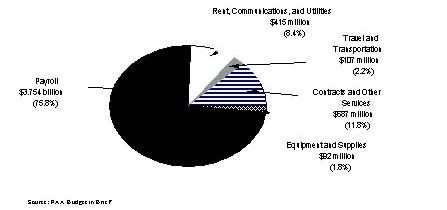
Figure 4. Spending Distribution by Major Object Class
within the Operations Appropriation, FY 1997
The Operations portion of the $61.9 billion requirements estimate from FY 1997 to FY 2002 is $36 billion. The Operations requirement estimate provides resources (with inflation) to continue existing services through the six-year period along with the following additional expenses: growth in the controller work force to accommodate anticipated growth in aviation activity, minimal growth in the maintenance technician work force (25 employees per year); and increases of $70 million to $90 million per year for the operation and maintenance of new air traffic control systems going on-line. This Operations estimate also includes growth in safety inspector and security work forces as recommended by the Gore Commission and internal FAA safety studies.
As stated previously, the Commission believes significant, long-term opportunities for cost savings and efficiencies exist within the Operations budget and these are discussed later in this Section. One such positive example has been the contract tower program for Level One towers.
2. Facilities and Equipment
Until 1993, the FAA had premised its F&E capital investment planning on a sustained $2.9 billion annual funding level. In FY 1997, the F&E budget decreased to $1.937 billion which represents a cut of 38% in real annual capital funding compared to FY 1992 actual appropriations and a 45% real cut in F&E funding planning levels since FY 1993. Figure 5, below, illustrates the reduction in F&E funding levels in actual and inflation adjusted values from FY 1992 through FY 1997.
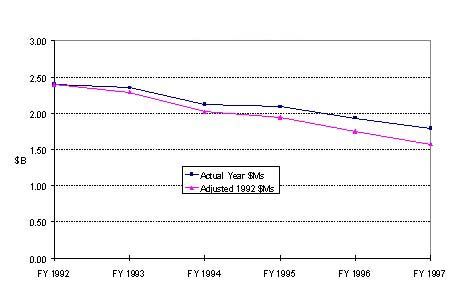
Figure 5.
Facilities & Equipment (F&E) Funding Levels
FY 1992-FY 1997
The FAA capital inventory includes over 24,000 facilities or equipment sites. These include 591 major air traffic control facilities, 396 radars, 1,027 navigational aids, 1,197 landing systems, and 2,427 communication sites. Most of these facilities and systems are being modernized. Many of the FAA’s essential ATC systems have been in service well beyond their intended life. Some of the controllers’ data displays, for example, have been in operation for more than twice as long as originally expected. Figure 6 illustrates a part of the FAA’s aging infrastructure in need of modernization.
| Systems | Average Age (Years) | Quantity | Planned Years for Replacement* |
| ARTS Data Displays | 24 | 100 | 1998-2004 |
| ARTS Radar Displays | 13 | 200 | 1998-2004 |
| Direct Radar Access Channel | 11 | 20 | 2002-2005 |
| Host Computer | 9 | 20 | 2002-2005 |
| Remote Center Air/Ground Communications | 23 | 701 | 2004-2012 |
| Remote Transmitter/Receiver | 18 | 1265 | 2004-2012 |
| Air Traffic Control Beacon interrogator – 4 | 26 | 81 | 1999-2003 |
| Air Traffic Control Beacon interrogator – 5 | 21 | 162 | 1999-2003 |
| Airport Surveillance Radar – 7 | 19 | 35 | 1998-2002 |
| Airport Surveillance Radar – 8 | 16 | 70 | 1999-2002 |
| Air Route Surveillance Radar – 3 | 16 | 22 | 2001-2004 |
Figure 6.
The National Airspace System (NAS) is Aging
NAS Systems Essential for Providing Air Traffic Control Services
* Constrained by Budget Projections
The F&E account contains the FAA’s funding for all capital investments (except airport infrastructure), including development, implementation, and the first year’s support costs. Currently, the F&E account is made up of nearly 200 separate projects, which are individually justified in the budget request the President submits to the Congress. For planning, purposes, the FAA groups these projects into the following categories: automation, communication, mission support, navigation and landing facilities, weather, and Surveillance.
Figure 7, below, illustrates the percentage of F&E funds allocated to these investment areas.
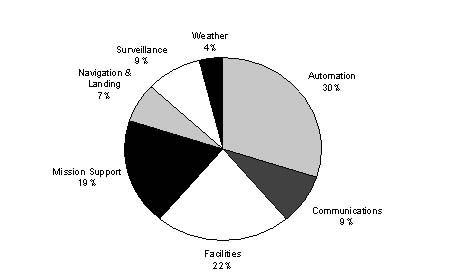
Figure 7.
FY 1997 to FY 2002 Facilities and Equipment (F&E) Budget Authority by
In the FAA’s revised requirements estimate of $61.9 billion, the F&E portion is $13.6 billion. From FY 1999 to FY 2002, the average annual F&E investment would be approximately $2.4 billion (excluding $150 million per year for airport security systems). The $2.4 billion annual level allows the FAA to cost-effectively modernize aging infrastructure and implement new air traffic control (ATC) tools designed to improve air space management and reduce aircraft operating costs. Modernization includes a new space-based navigation system, new communications with automatic data link between controllers and the aircraft flight deck, and new controller automation equipment in ATC facilities. Also included in the FAA’s estimates are support contractors, facility leases, support equipment, and the modernization and/or replacement of many of the 591 ATC facilities.
Many of the new ATC tools, which provide cost savings to airway system users, are now in prototype form. These software intensive systems will help maximize the capacity of congested airspace and airports, reduce delays, and increase direct routing of aircraft. As the FAA’s controllers begin to rely on these tools and aircraft separation is reduced, it becomes extremely important that these systems are highly accurate and reliable. These tools represent the building blocks for future “Free Flight” which will allow aircraft to fly the most efficient routes of their choice. Full-scale-development of these systems and implementation across numerous sites with unique requirements is both time consuming and costly.
The FAA’s revised requirement estimate also includes an additional $600 million for aviation security based on Gore Commission recommendations. It is an initial estimate inserted for explosives detection equipment at airports, similar to equipment acquired in the FY 1997 supplemental appropriation which included sophisticated baggage checking equipment for installation at the FAA’s top 30 airports.
One area in the “navigation and landing” category of the Facilities and Equipment budget has caused concern for members of the Commission. In a recent version of FAA’s “NAS Architecture” plan, the agency suggested that certain navigation and landing aids should be the financial responsibility of non-federal parties such as airport authorities. The Commission believes that the FAA has the responsibility to provide a nationwide system of air traffic control services and equipment and that proposals to shift a subset of these responsibilities are inappropriate and could negatively impact on aviation safety.
If F&E investments are not increased, the FAA will have to make tradeoffs between providing improved services and sustaining current services. Reductions in funding to sustain current services will impact the availability and predictability of the air traffic control (ATC) services, due to more frequent and longer lasting equipment failures associated with aging equipment. Because safety will always be paramount, ground delay programs may be used to ensure that NAS safety is not jeopardized. The users of the ATC system would experience increased system delays, mostly on the ground, due to equipment outages and more airports and sectors reaching critical capacity. The users also would experience decreased system flexibility due to the system being operated near its capacity limit for longer periods of time. In essence, without these increased investments, the air traffic control system will approach gridlock shortly after the turn of the century.
3. Research, Engineering & Development
Although the RE&D budget is a relatively small portion (about 2%) of the total FAA budget, RE&D is viewed as having a central role in helping the FAA accomplish its missions. The FAA’s RE&D budget normally is not used for full scale development of air traffic control systems which is funded under the F&E account. RE&D includes programs in the following areas: air traffic management (ATM) (including Flight 2000 and Free Flight), digital air-ground communications, weather research, surveillance (runway incursions), airway facilities maintenance technology, airport technology (pavement research), aircraft safety, human factors and aviation medicine, and environment and energy.
The FAA’s Requirements Estimate recommended more than doubling the RE&D funding to a level of $420 million in FY 2002 from $208 million in FY 1997. This level of requirements was based on an intensive 30 day zero-base review accomplished jointly with the National Aeronautics and Space Administration (NASA) , and that review resulted in a program report in November 1996. The program report shows funding, levels year-by-year of between $400 million to $450 million, peaking in FY 1999. Examples of RE&D efforts that would be increased under the requirements estimate include:
Human factors;
Aircraft safety;
Wake vortex detection/prediction.
Full-scale validation and demo installation of new ATM technologies;
ATM operations concept development and system design;
Aviation weather research;
Safety and security of ATM software and communications;
More cost-effective aircraft and system certification methods;
Air-ground digital communications;
System maintenance technology;
Surveillance, including mitigation of runway incursions;
The Flight 2000 initiatives have not yet been factored into this requirements base. Nonetheless, the requirements estimated (sic) noted above is considered a satisfactory level of funding, assuming cooperative leveraging of NASA, DoD and industry research (NASA currently is proposing to spend approximately $500 million over the next five years on aviation safety research). The Commission supports NASA’s role to develop breakthrough safety technologies while the FAA works to improve safety today.
At the current RE&D funding level (approximately $200 million annually), the FAA would be unable to expand its RE&D efforts, especially in emerging areas such as human factors, considered key to improving aviation safety and reducing accidents. Moreover, since some RE&D is intended in part to “create” commercial products/nondevelopmental items (COTS/NDI) that FAA could then acquire cheaply and quickly, the net effect of not making investments would be to increase the cost and time required to acquire new systems through the F&E process. Such a result would unravel the gains of FAA acquisition reform and defer the ultimate cost savings that would be otherwise available through greater productivity in FAA/NAS operations. Finally, there would be a harmful effect on ATM equipment exports, a surplus area for U.S. trade, since these same products are proven first in the FAA environment and then become the commercial leaders in markets overseas
The Commission supports increased RE&D funding but recommends phasing, in an increase over a four-year period. The Commission is skeptical that increasing RE&D funding from $200 million to more than $400 million over a one-year period would be effective. However, if there are new programs, like Flight 2000, which could be implemented independently, specific increases may be justifiable.
C. Potential Budget Savings from the FAA Requirements Baseline
The Commission believes that opportunities for cost savings exist within the FAA requirements baseline. These savings may be needed to fund additional capital investments requirements, such as improved radios, not currently included in the budget. To achieve savings, the FAA needs the mandate to operate like a business and provide services in the most efficient and cost-effective manner. The Commission’s proposed Performance Based Organization for ATC would help establish a business-like framework for implementing cost saving initiatives. Below are the Commissions cost saving recommendations to be accomplished across the FAA, both within and outside of the PBO for the Air Traffic System. The Commission would expect the PBO to continually look for cost saving opportunities and productivity increases.
Organizational and geographic consolidation of major FAA functions and facilities is one area where the FAA’s cost of service can be reduced. Such consolidations can create economies of scale for the FAA, thereby reducing costs, with little or no decrease in quality, timeliness, or other measures of service effectiveness and delivery, and with no decrease in customer satisfaction. In the FAA, regional office consolidation has been discussed repeatedly, but changes have not been made. FAA efforts at facility consolidation have not been successful, and its successes have been needlessly delayed based on political resistance to closing facilities. Clearly the FAA needs to reverse this process and close/consolidate facilities as needed over time for efficiency and cost savings. The Commission recommends that a regional office consolidation take place reducing from nine to three regions. Studies have shown this consolidation could reduce the FAA’s operating costs by nearly $100 million per year while improving or standardizing services.
Additionally, the following specific actions should be considered:
Streamline FAA controller training.
This would reduce both the direct and the overhead costs associated with controller training using any of several measures, including building on the civilian university controller training programs or consolidation of FAA and DoD controller training programsImprove the efficiency of the FAA logistics function (spare parts management and delivery).
Based on existing corporate practices, allow the FAA to contract out its logistics functions, currently managed out of the Oklahoma City Center, to a private vendor specializing in parts inventory management and delivery to remote sites. The FAA needs to take advantage of the private sector’s improvements in spare parts management and delivery. FAA should work with private entities to possibly locate where they could take advantage of just-in-time inventory practices and better transportation of parts. This should have no impact on field maintenance staffingFurther consolidate Flight Service Stations and rely more heavily on personal computers for pilot contacts and flight plan filing.
Consolidation of Flight Service Stations and relying on an expanded Direct User Access Terminal (DUATS) program to provide preflight briefings, weather briefings and flight plan filings could save the FAA over $1 billion over the next five years while maintaining or improving safety and existing services to the general aviation community.Accelerate the transition to a space-based navigation system.
The FAA will have to bear the full costs of maintaining both the existing navigation system and the new space-based system until the old system is decommissioned. Accelerating the decommissioning process, possibly in stages beginning with long-range radars and moving to VORs and nondirectional beacons, and concluding with instrument landing systems could save the FAA over $100 million per year.Leased or contract services.
In the short term, a potential savings vehicle would be for corporations to capitalize development and lease back equipment/services. Allowing private companies to have more control over development costs may reduce overruns often blamed on additional features added by the FAA which were not originally planned.
The savings considerations above could cause significant discomfort within both the FAA and the Congress. The FAA’s new Performance Based Organization (PBO) for the Air Traffic System will provide the organizational structure to support these cost saving recommendations. A PBO coupled with the proper budget treatment which allows the FAA financial flexibility, will lead to an improved aviation system for all customers and stakeholders.
VII. AIRPORT CAPITAL FINANCING REQUIREMENTS MUST BE MET
A. Recommendations
Airport Improvement Program (AIP) funding serves as the linchpin of airport financial planning and therefore, must be funded adequately on a reliable basis. The Commission recommends that AIP contributions to airport capital requirements should be funded at $2 billion annually over the next five years assuming growth adjustments through this period. Further, AIP should-be provided requisite budget treatment to ensure a stable and predictable Federal funding source for airport capital development.
The Commission recommends that Congress look to AIP and Passenger Facility Charges (PFCS) as sources of additional revenues to finance future airport capital needs. This recommendation is made reiterating the Commission’s very strong belief that all elements of this report on aviation financing are viewed as a comprehensive package and not as individual parts to be implemented piecemeal.
The Commission also recommends that smaller airports receive funding at a higher level, so that their capital development needs can be met and thereby allowing them to continue serving as a critical element of the air transportation system. The Airport Improvement Program is essential for capital development at smaller airports as they have less capability to draw in a meaningful way from other sources of capital funds.
B. Background
The Commission was encouraged by its enacting legislation to consider airport infrastructure needs for airports of all sizes, and to provide recommendations on funding alternatives for airport capacity development. To assist the Commission in this effort, the Federal Aviation Reauthorization Act of 1996 requested that the General Accounting Office (GAO-Airport Development Needs, April 1997) and an independent entity (Coopers & Lybrand LLP-Independent Financial Assessment, February 1997) provide independent assessments of future airport development capital needs. The Commission reviewed and considered these studies and notes that both entities reviewed previous airport capital requirement studies, which contained different underlying assumptions and hence conclusions as to the total estimated needs over the next five years.
The Commission agrees with GAO and Coopers & Lybrand that there are several key reasons for the differing assessments of airport capital requirements: incompatibility and purpose of collected data, availability of data, and the underlying premise of the data collection process. There are also significant differences in terms of time periods, AIP eligibility, and data sources. In its report, Coopers & Lybrand estimated that the average annual capital requirements total for 1997-2002 will be $7-8 billion per year in constant 1997 dollars. In its report, GAO created four separate models to create an estimated range of $1.4 billion to $10.1 billion per year from 1997-2001. While not resulting in a single agreed upon estimate of needs, the Commission notes that these reports all confirm that airport needs are significant and are expected to increase due to emerging new requirements and forecast growth in airport operations. Current airport revenue sources have not provided the funding to meet the needs identified in the Coopers & Lybrand and GAO reports.
| Funding Source | 1990 | 1991 | 1992 | 1993 | 1994 | 1995 | 1996 |
| Airport Revenue Bonds | 54.600 | $3.200 | $4.800 | $1.600 | $3.000 | $3.200 | $4.000 |
| AIP | $1.425 | $1.800 | $1.900 | $1.800 | $1.690 | $1.450 | $1.450 |
| State/Local Grants | $0.500 | $0.500 | $0.500 | $0.500 | $0.500 | $0.500 | $0.500 |
| PFC’s | N/A | N/A | $0.085 | $0.485 | $0.849 | $1.046 | $1.113 |
| Total | $6.525 | $5.500 | $7.285 | $4.485 | $6.039 | $6.196 | $7.063 |
Figure 8.
Sources of Airport Capital Financing*
(in $ billions)
* Does not include General Obligation bonds or airport operating revenue.
The Commission examined the FAA’s AIP requirement level of $1.7 billion, an estimate derived from historic appropriation levels and budget constraints. While the FAA states that at this level, it is able to fund most safety, security, rehabilitation, standards and capacity projects, the Commission does not agree. At such a level of annual funding the FAA has not provided single-year AIP grants for all high priority capacity projects and noise mitigation projects that were ready for construction. The FAA acknowledges that at less than a $2 billion level it cannot satisfy all requests for worthy noise mitigation projects and multiyear letters of intent (LOI) that have been requested for capacity projects important to the national system of airports.
The Commission believes that a $2 billion annual AIP should serve as the minimal Federal investment level in airport infrastructure, and that this amount should be made available on a reliable and predictable basis. Funding at the $2 billion level would accomplish the following:
There would be increased preservation of airport infrastructure at smaller airports that are dependent on federal aid. This is especially important at general aviation airports which largely use funds to improve safety and bring existing infrastructure up to standards. There would also be more funding for capacity projects at reliever airports
More safety and security projects could be funded at airports of all types and sizes. Legislation enacted last year requires smaller airports served by commuter type operations to meet higher safety standards consistent with those that airports serving larger aircraft meet. AIP will be the principal source of funds to meet these standards. Security expectations of the public can also be expect to drive further standards in this area. Higher AIP will be a primary source to meet any new objectives for security.
While there have been tremendous achievements in noise mitigation near airports, millions of people living in areas near airports still experience noise levels that are incompatible with residential usage. The noise funding set aside was cut last year based on lower funding assumptions. If a higher funding level were achieved, noise mitigation through AIP could achieve much more environmental benefit and timely results.
More AIP funding will result in more system capacity being developed. With higher AIP, substantial progress can be made at meeting these needs. For large airports, further commitments in the form of Letters of Intent (LOI — a multi-year commitment or promise by the FAA to fund a large project at a particular airport) could be made. These commitments are typically for projects that will have a significant system-wide impact. There are over $2 billion in pending LOI applications. With a higher AIP funding level, a more significant improvement in overall airport capacity could be achieved.
The Commission notes that this $2 billion AIP level is less than the current authorized level for AIP in existing law. This recommendation is based on the requirement to balance capital spending, of federally collected taxes and fees between air traffic control and airport needs, and the recognition that airport capital funding has a second federally-authorized revenue source in PFCS.
In addition to considering needs assessments, the Commission also examined actual airport capital spending from all known sources of airport capital financing: airport revenue bonds, AIP, State and local grants, and Passenger Facility Charges (PFCS) (but not including other potential revenue sources more difficult to quantify, such as that portion of an airport’s operating budget which may finance small capital projects). In examining these revenue sources, the Commission makes the following observations and conclusions:
From 1990-1996, total airport capital spending from “known” sources ranged between $4.5 billion and $7 billion and averaged approximately $6 billion per year.
Of this total, the principal source of capital for airport development at large and medium hub airports was airport revenue bonds. On average, the Commission notes that airport revenue bonds accounted for $3.5 billion a year in “new money”, and an additional $1.6 billion a year in “refunding” or debt restructuring designed to enable future borrowing or to reduce airport related costs to users. Further, the Commission additional (sic) $1.6 billion a year in “refunding” or debt restructuring designed to enable future borrowing or to reduce airport related costs to users. Further, the Commission notes that this level of bond financing has persisted, on average, even with the advent and expanded use of PFC revenue.
Between 1992 and 1996, the AIP program has been reduced from $1.9 billion to $1.45 billion, a 23% drop-off. This has tremendously eroded the effectiveness of this program to meet airport infrastructure requirements. Looked at another way, the proportion of the FAA’s budget that goes for airports has declined precipitously. The following chart illustrates the relative decline in the airport program compared to the rest of the FAA’s activities and programs. Aside from fiscal impact on airport development, this is a very strong policy statement about priorities. It is one that the Commission strongly opposes and believes should be reversed.
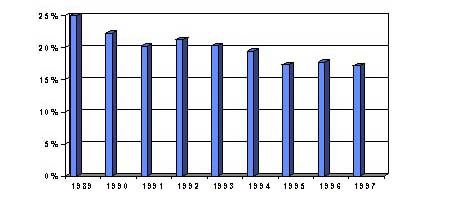
Figure 9.
AIP as Percent of FAA
Appropriations
Since 1992, PFCs have provided an important new financing option for airport capital development, generating over $1.1 billion annually. Airports and airlines have generally agreed with the majority of proposed PFC financed projects. In those cases in which airlines register disagreement, most often landside related development has been proposed. The Commission recognizes that untapped, annual PFC authority of approximately $500 million exists at certain large and medium hub airports, as well as an additional revenue potential of $60 million per year at certain small commercial service airports. However, untapped PFCs represent potential local resources which may not presently align with where the capital needs are in the airport system. Even if fully utilized, current PFCs are insufficient to satisfy unmet infrastructure requirements.
In 1990, Congress, when considering all sources of airport revenue, determined that airport infrastructure requirements could best be met by granting airports PFC authority of up to $3 per passenger, and by increasing AIP spending to $2 billion a year or higher. Yet, since 1993, AIP funding has steadily declined, to the extent that in 1997, a gap of over of $800 million exists between AIP authorized and appropriated levels.
C. Other Recommendations and Findings
Airport revenue bonds are the single most important financing tool available to large and medium airports. These airports boast an unbroken record of creditworthy financial performance, earning the status of premium-grade investments in the exempt municipal bond market. Preservation and potential enhancement of the tax exempt status of this financing tool is essential to meeting the capital demands of large and medium hub airports.
Considering the Commission’s recommendations for higher AIP funding, it recognizes that Letters of Intent (LOIs) are an effective innovative financing technique and recommends that the use of LOIs should be continued and concentrated on projects which increase airfield capacity. Further, the FAA should maintain and strictly enforce existing requirements that LOI proposals be subject to rigorous cost benefit analysis, as well as an affirmative determination of system benefits.
In addition to LOIs, the Commission examined other innovative financing techniques and alternatives. The Commission concludes that innovative financing options, such as revolving loan programs, loan Guarantees, and various credit enhancements, offer, at best, marginal and limited opportunities to leverage Federal funds or to increase total airport capital development spending. This is because the essential elements of innovative finance have long been institutionalized at large, medium and small airports capable of borrowing. Airports not capable of borrowing generally rely on local subsidies to meet operating expenses and Federal support to meet capital requirements. With regards to airport privatization, the Commission believes that the results of the current congressionally mandated pilot program should be analyzed before any conclusions are reached on the additional statutory or policy changes.
In order to meet the needs for airport infrastructure investment, the Commission recommends that, in the future, the current $3 ceiling on PFCs will need to be raised. As an alternative, AIP levels would need to be funded at a level substantially above the $2 billion annual level recommended in this report. If Congress decides to increase the PFC, the Commission recommends that there be a process established that places a strong emphasis on negotiation between local airports and tenant airlines when a higher-than-$3 PFC is being proposed. When a higher-than-$3 PFC is proposed, the Commission recommends that when there is written agreement between an airport and its tenant airlines for the airport to levy a PFC higher than $3, there should be no statutory PFC dollar limit, and the FAA’s approval process should be ministerial. The Commission recognizes the fact that the airport and airline industry groups have very strongly held and, at times, differing views on the matters of when and how such an increase should take place. Those matters will still require resolution in the context of comprehensive airport funding legislation. Therefore, the Commission’s legislative proposal only includes a “findings” statement on the need for a general PFC or AIP increase to meet significant airport capital needs to accommodate growth. Again, this recommendation is made in the context of the overall financing report of the Commission being treated as a total package and not as elements to be separately implemented.
The Commission stresses the need for treatment in the federal budget process of the AIP so that it can be a steady, dependable and reliable source of airport capital development funding.
VIII. CONCLUSION
The Commission believes that tremendous industry growth, new industry practices and rapid technological change will dramatically change the aviation system over the next ten years. These changes offer great promise for aviation but only if there is a strong FAA able to meet the challenges such change brings.
The Commission’s recommendations — appropriate budget treatment which links revenue and spending together, a cost-based revenue system, better FAA performance, control of the FAA’s operating costs, and increased capital investment — are designed to ensure that our nation’s aviation system remains preeminent and that the FAA is up to the challenge. The recommendations complement and reinforce each other to make certain that the FAA is a well-managed organization, meeting the highest standards of performance, responsive to customer needs, and has adequate resources to make critical investments.
Again, the Commission stresses the recommendations are part of an integrated, comprehensive package. The consensus the Commission developed rests in large part on the recommendations being, adopted in whole, not piece meal.
Without adoption of these recommendations, delays and congestion will become overwhelming; the current excellent safety record will be Jeopardized; anticipated growth in the aviation industry will stop: air traffic control services and investments will be, at the same time, inadequately funded, disconnected from users needs, and poorly managed; and the global competitive position of the United States will be threatened.
As with all significant changes, these recommendations are not without controversy. They will require the major stakeholders in aviation — the FAA, the Congress. the Executive Branch, and the aviation community — to assume new or changed roles. This is not taken lightly by the Commission. It is only because we believe the air traffic system is facing gridlock with potential safety consequences that we propose such action. It is increasingly impossible to effectively run an agency every day and hour of the year within the constraints of the current federal budget process and the current organizational and management structure of the agency. These problems will become more pronounced as the FAA tries to keep up with technological changes and industry growth at a time of increasingly scarce federal resources.
It is the hope of the Commissioners that this report and its accompanying legislative proposal will help build consensus for these needed and necessary changes. All sectors of the industry have been included in the Commission’s deliberations, and we believe there will be widespread support for the recommendations. The Commissioners stand ready to work with anyone to explain and help implement this proposal as the Commission’s recommendations are read, discussed and acted upon.
This is a unique opportunity for change. Members of Congress, the Administration, the aviation community, and the FAA have all expressed a willingness to end business-as-usual. It is our hope that the Commission’s recommendations serve as a catalyst for delivering significant reform to an essential part of our aviation system.
IX. APPENDIX 1: BACKGROUND ON THE COMMISSION
The Congress created the Commission after congressional and industry debates on several aviation issues for which there was no consensus. The FAA argued that its needs would not be met if federal budget trends continued. Most of the aviation industry argued that the aviation taxes should be dedicated for FAA programs. Some airlines argued that a new revenue system should be developed to better reflect the costs imposed on the aviation system by its users. Other airlines felt that the ticket tax was fair, easy to implement, and thus should not be altered. It was clear that the industry would not come to a consensus on these issues on their own. The Congress created this Commission, which includes representatives from the various segments the aviation community, as well as individuals outside of aviation, to discuss and identify problems in the aviation system and to provide recommendations on improving the current situation.
The Federal Aviation Reauthorization Act of 1996 created the Commission with two task forces: the Aviation Funding Task Force and the Safety Task Force. This report covers the findings and recommendations of the Commission’s funding task force. In general, the Commission’s funding task force was created to make recommendations on the FAA’s needs, the revenues needed to support the FAA, potential cost savings, and ways to improve the FAA’s attempts to modernize its equipment. The legislation specifically states that the Commission’s report shall include a draft bill containing the changes in law necessary to implement its recommendations.
The Commission is comprised of 21 members: 13 appointed by the Secretary of Transportation, 2 appointed by the Speaker of the House of Representatives, 2 appointed by the Minority Leader of the House of Representatives, 2 appointed by the Majority Leader of the Senate, and 2 by the Minority Leader of the Senate. Commission members are experts in a variety of subjects including aircraft manufacturing, airline operations, airport management, financial management, general aviation services, and overall aviation industry issues. All Commission members are part of the funding task force. In addition to the 21 Commissioners, the Executive Branch provided representatives from relevant departments and agencies to attend and, in some cases, participate in the Commission meetings.
Former U.S. Representative Norman Y. Mineta was appointed the Chair of the Commission and convened the first meeting on April 28, 1997. This meeting was the first in a series of Commission briefings. Over the course of several meetings, the Commissioners were briefed by the Department of Transportation (DOT), the FAA, industry officials, and others on a variety of topics, including: the FAA’s budget process, concerns of various congressional committees, the FAA’s needs, airline concerns, airport needs, general aviation needs and concerns, the views of air traffic controllers, reviews by the General Accounting Office, concerns of the U.S. military, the experience of NavCanada (the recently privatized air traffic control system in Canada), and the implementation of performance fees by the Food and Drug Administration. The Commission also held a public hearing on May 28, 1997 which included witnesses from many aviation interest groups. (A complete list of the witnesses is in Attachment 5). In addition to the briefings, the Commissioners met at length to discuss various aviation issues and to discuss potential recommendations.
As the Commission debated various aviation financial issues, the Congress also debated and acted upon aviation revenue issues as part of a larger multi-year budget agreement. The congressional debate and action underscored for the Commission the very serious flaws in the budget process for aviation.
X. APPENDIX 2: GENERAL BUDGET INFORMATION
This is not an attempt to explain and discuss all basic federal budget concepts. Instead, this is an attempt to highlight only those budget issues that relate to the Commission’s recommendations.
There are two types of federal government funding and spending: mandatory and discretionary. Mandatory spending (e.g., Social Security, Medicare, and food stamps), accounts for approximately 68 percent of all federal government spending. Mandatory spending is controlled by the authorizing committees (primarily the House Ways and Means Committee and the Senate Finance Committee) and does not need an annual appropriation.
The FAA’s budget is primarily discretionary and must be authorized, and then annually appropriated. The Congress appropriates money for the FAA’s budget as part of the Department of Transportation’s (DOT’s) appropriations bill. The DOT’s appropriations bill is one of the 13 major appropriations bills. Every year, each of the 13 bills must eventually pass the House and the Senate in an identical form and be signed by the President.
In an effort to reduce the annual budget deficit, the Administration and the Congress try to control spending and revenue raising. There are two different budget rules to control the two types of spending: mandatory spending is controlled by “pay as you go” restrictions, and discretionary spending is controlled by spending (budget) caps.
Mandatory spending is usually included in bills authorizing various federal programs. Once in place, a typical mandatory program receives annual funding sufficient to provide the benefits specified in law without any additional congressional action. Laws providing mandatory spending often do not include expiration dates. Therefore, to stop, lower, or increase the funding level of a mandatory program, the Congress must pass, and the President must sign, another bill. (This is in contrast to discretionary spending, which is usually limited to one year.)
As already mentioned, to control mandatory spending, the Congress must abide by the “pay as you go” (or PAYGO) rules. In its simplest form, PAYGO means that any new mandatory spending must be offset by increases in mandatory revenues (i.e., virtually all taxes) or decreases in other mandatory spending. For instance, if the Congress decided that the FAA’s spending should become a mandatory program, the Congress would have to increase mandatory revenues (taxes), or cut mandatory spending, in an amount equal to the proposed mandatory FAA spending. However, the FAA currently is a discretionary spending program, so a bill that included a reduction in aviation taxes could not offer a reduction in FAA spending as a PAYGO offset because the taxes are mandatory and the FAA’s spending is classified as discretionary. If a bill including new mandatory spending is considered for passage and there is no PAYGO offset (i.e., mandatory revenue increase or mandatory spending decrease), the bill can be struck down in the House or Senate by a parliamentary point of order because it would increase the federal deficit; however, budget points of order can be waived in the Senate, usually by a three-fifths majority vote, and in the House usually by protective parliamentary procedures.
Discretionary spending is controlled with budget caps. The budget resolution develops overall federal spending levels which are allocated to each committee (with virtually all discretionary spending allocated to the appropriations committees). Each appropriations committee then decides how much each of its subcommittees will be allowed to spend for a fiscal year without going above the budget caps.
The FAA receives funding from both the Airport and Airway Trust Fund and the general revenue fund. The Airport and Airway Trust Fund receives its revenues from aviation user charges and taxes. The general fund receives revenue from general government sources, primarily taxes. The Commission believes the special budget treatment should only apply to those funds collected from aviation users. The Commission is recommending that the general fund contribution continue. It is assumed that the general fund contribution will continue to be allocated under typical budget rules or a multi year appropriation..
The Airport Improvement Program (AIP) is funded with contract authority, which is a mandatory program. However, traditionally the DOT annual appropriations bill has an obligation limitation on AIP funds. For scoring purposes, AIP’s contract authority is mandatory and its outlays are discretionary.