


































|  | Listen to the entire "Meet the Boss" session as if you had been there via AVweb’s RealAudio feed . |
 | Get the FREE RealAudio player. | |

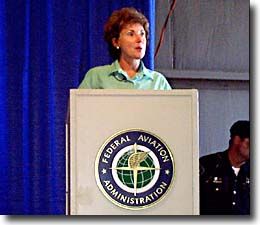
 FAAAdministrator Jane Garvey appeared before a standing-room-only crowd in the FAA pavillionauditorium at EAA AirVenture in Oshkosh Sunday at 11:30 am for the traditional "MeetThe Boss" session. Prior to the session, AVweb had heard rumors that Garveywas cancelling her Oshkosh appearance, and other rumors that she planned to take up mostof the hour with a lengthy prepared statement that would leave little or no time left forquestions from the. Both proved completely false. In fact, the Administrator began herremarks by saying that she was going to keep her opening remarks brief to leave as muchtime as possible for Q&A.
Garvey was joined on stage by key top management from the FAA:
Monte Belger, Acting Deputy Administrator
Jim Washington, Acting Director of Air Traffic
James Whitlow, Deputy Chief Counsel
Jon Jordan, Federal Air Surgeon, Office of Aviation Medicine
Cecilia Hunseker, Regional Administrator, Great Lakes Region
Tom McSweeney, Director of Aircraft Certification
Peggy Gilligan, Deputy Associate Administrator for Regulation and Certification
Steve Brown, Deputy Associate Administrator for Air Traffic
Stan Rivers, Director of Airway Facilities
Garvey started by reminding the audience that her first "Meet The Boss"session at EAA ’97, she was brand new on the job and in fact had not even yet been swornin as Administrator. She said that coming to Oshkosh, she was particularly touched byseeing the family involvement in grass-roots aviation at EAA, and the involvement of youngpeople and young instructors as typified by the Young Eagles program.
Cites importance of FAA/industry partnerships
 The Administrator talked about the importance ofproblem-solving partnerships in aviation, saying that it was clear that most of theproblems facing aviation could not be solved either by industry or the public sectoralone, and that collaborative partnerships were essential. She spoke of the "SaferSkies" initiative, announced on April 4th by Vice President Gore, which set the FAA’ssafety agenda for the coming years. The initiative has three key components: generalaviation, commercial aviation, and cabin safety. "It was very, very important to usgoing into shaping that agenda to involve the General Aviation community — to make surethey were a key part as we thought what that agenda would be," Garvey said, "andso we’ve really ended up with something I think reflects initiative and reflectspriorities that are important not only to the commercial aviation world, but to theGeneral Aviation world as well."
Speaking of General Aviation’s future, Garvey said that she meets frequently with NASAAdministrator Dan Goldin to make sure that the R&D agendas of NASA and the FAA are insync. She pointed out that the Agency worked very hard over the Fourth of July weekend toprocess certification for Lancair’s Columbia 300, and that it is also working intenselywith Cirrus Design on certification of the Cirrus SR20. "Those kinds of certificationare critically important not only to the General Aviation world, but to the entireaviation world as well." She praised the GAMA’s GA Team 2000 initiative, calling"a terrific example of encouraging young people to get involved in aviation."
Garvey stated that in any partnership effort, occasional differences of opinion areinevitable, and as an example, she specifically cited the FAA’s new controversial"ticketing" program. "I know a number of you have been very concerned aboutthat…did I hear a yes?" She explained that the program grew from a post-ValuJetstudy and a GAO report, both of which indicated that the FAA was not capturing manyadministrative actions in its safety database, and that those that were being capturedtook an average of 145 days to get into the database due to the bureaucratic proceduresinvolved in processing such actions. The ticket program came out of the Agency’s desire tostreamline the procedures and eliminate the delays, lost data, and unnecessary paperwork."However, we’ve heard a lot from people in this room as well as people in commercialaviation that have given us pause. We had a wonderful…I thought a very good meetinglast week where industry came in…and identified both concerns they had with theprograms and suggestions to get at the two issues that were raised in terms ofstreamlining and in terms of capturing the right information," said Garvey. "Allof the comments were in by last Friday, the 31st…we’re going to be looking at thoseover the next couple of weeks, and I can promise you we’re taking those issues very, veryseriously. We’re looking at what actions we should take either to modify the program orjust to re-think it."
Cites AVweb’s influence on FAA’s ticketing program decision
Garvey singled out the ticketing program editorial written by AVwebeditor-in-chief Mike Busch for special mention. "I want to point out one item…Iread in AVweb, Mike Busch I think wrote a terrific…that was a great column, agreat couple of pages on both the perspective of what the ticket program…both why wewere trying to do it and then some real concerns, and I thought what was terrific aboutthat article is that you had some very specific suggestions for improvement, so I reallyappreciate that." She said her staff would be examining those suggestions and othersover the next ten days or two weeks. "I heard you…we heard you…and Ipromise you we’ll take those issues very, very seriously and thank you again for gettingall of that in."
Finally, Garvey said that perhaps the biggest challenge faced by the FAA and byaviation in general is the incredible rate at which technology is changing. She said thatit was vital for the FAA to keep asking itself "are we doing business in the rightway? What do we need to do to keep up with the technology and challenges?" Shereiterated that none of these problems were insurmountable, but that none of them could bedealt with by the FAA alone, and once again stressed the importance of "constructivecollaboration" between government and industry.
The Q&A Session
The Administrator then opened the session to questions from the audience.
Ed Sweeney, a pilot and A&P mechanic from Colorado Springs, asked whether or not apilot was required to report undergoing "lasix" laser surgery to correct visionanomalies. Dr. Jordan said that the FAA wants a report from the treating physician toensure that there are no complications, side-effects or problems associated with thesurgery, and that a pilot who undergoes such surgery should not use his medicalcertificate until receiving clearance from the Agency.
AVweb editor-in-chief Mike Busch asked the Administrator whether she had read AVweb’seditorial on the FAA Chief Counsel’s decision that the FAA would stop making airmanaddresses available to industry, and whether there was any chance that the FAA wouldreverse or modify its decision to withhold such addresses. Garvey said she hadn’t readthat particular AVweb editorial (but promised to do so), but exhibited considerablefamiliarity with the issue. "We’ve had two categories of comments on that…thosefolks who say ‘this is a mistake, you’ve always done it, keep doing it.’ We’ve also had agroup of folks saying ‘you know, we’re not really comfortable with our names going out’and so forth, so it’s been mixed. There’s been a suggestion made — and this by the way isin legislation now before congress — that we set up some sort of a voluntary process.We’re watching that legislation and very well aware of it, and will continue to watch it.We’d have to do a lot of administrative work to handle something like that, but certainlyif that’s our direction, that’s certainly how we will go."
Roger Manning of Portland, Michigan, asked about the latest info on the future of MeigsField. Garvey seemed unprepared for this question and deferred to her deputy Monte Belger."As a fundamental policy, we’re going to oppose the closure of airports," saidBelger, drawing applause from the audience. "However, it real boils down to a localcommunity decision. When the decision comes up again after the five-year moratorium, we’regoing to weigh-in strongly. It’s a critical asset to the aviation system," Belgercontinued. Garvey added, "Because the five-year moratorium is still in place, there’snot been an opportunity to weigh-in again, but we will."
Don Hollingsworth from Camarillo, California, talked about residential encroachment onthe clearzones surrounding certain small General Aviation airports. "When you go tothe FAA — and the famous quote from Western Region is ‘no objection’ — the lawyers forthe developers turn this around that the FAA actually endorses these projects." Thequestioner suggested that the FAA have a knowledgeable person come testify before localgovernment bodies to persuade them not to approve such real estate developments thatthreaten airports. Garvey promised to look at it.
Ed Kirkpatrick from Incline Village, Nevada, asked why the FAA refuses to follow thelead of Australia and Japan to permit airline pilots over 60 to continue working. Garveypassed the question to Peggy Gilligan, who said "we have looked at this carefully. Wehave been requested by many pilot groups to look at it repeatedly. At this point, we’vemade the determination that the medical evidence is not sufficient for us to determinewhat an appropriate other age would be. It is an issue that we will continue I think toreexamine, because you will continue to request that we do, and I think that’s appropriateas the science is improved. But at this point we’ve made the determination that the age 60cutoff is the appropriate one to maintain a level of safety."
Dr. Jon Jordan briefly reviewed the history of the age 60 rule, saying that afterextensive research the FAA "came to the conclusion that age 60 was about as close aswe could come to an appropriate age [beyond] which a person should not be permitted to flyas a pilot with an air carrier operation. Now it is true that some of the foreigncountries have relaxed the age limitation. ICAO still persists with the age 60 limitationfor the pilot-in-command, and a recommended practice that the first officer also be underage 60. The Europeans, on the other hand, have come to the conclusion that one pilot couldgo to age 65 so long as the other pilot on board is age 60. Admittedly, it’s a somewhatarbitrary rule, I don’t know that age 60 is any better or any worse than age 62 or 65, andsome folks believe it should be age 55. But it’s about the best we can do." Dr.Jordan added that "one of the major problems in being able to distinguish who shouldbe able to fly beyond a certain age and who should not relates to cognitive function andperformance, and that’s a very, very difficult thing to measure with any individual, andit eludes us so far…that’s the problem."
Alan Hanks, President of NARCO Avionics praised the FAA’s "Task Force 4"working on streamlining certification procedures, but complained about an almost totallack of up-to-date information regarding the capabilities of WAAS (the Wide-AreaAugmentation System for GPS) and how it affects the retention of terrestrial navigationfacilities already in place. He asked the Administrator whether the FAA would be willingto conduct an industry forum where industry — manufacturers of avionics in particular —could work with the FAA to develop precise direction about what can be done with GPS andwhat cannot. Garvey responded that she thought it was a terrific idea and would definitelyfollow up on it. She said that WAAS Phase I would be in place by March 1999, and that ATAand RTCA were currently involved in a study of the impact of GPS on General Aviation.
Bob Hill of UPS in Louisville, Kentucky, talked about the FAA/industry partnership todevelop ADS-B (automatic dependent surveillance, broadcast), said it was a great exampleof how industry and the Agency could work together, and invited Garvey to visit the Flight2000 booth to see the ADS-B equipment that UPS will be putting on an aircraft this week.Garvey said she would.
Fireworks over the Bill Bainbrige fiasco
 Bill Bainbridge ofB&C Specialty Products in Kansas complained bitterly about the FAA’s year-long delayin resolving enforcement action taken against his company by a rogue inspector in Alaska.He had been promised by top FAA representatives 15 weeks ago at Sun ‘n Fun that the falsecharges against him would be dropped, but still had received no relief. "Because ofthese false charges that have been brought against me," Bainbridge told Garvey,"you have helped to weaken the trust that must exist between the FAA and the aviationcommunity. This is totally inexcusable." He spoke of "reprisals" and"Gestapo tactics" by the Agency against, including FAA people threatening to taphis phone and threatening to bring him up on additional charges. "It’s adisgrace," Bainbridge concluded in obviously emotional tones as the audience brokeinto applause.
Garvey conferred with Deputy Chief Counsel James Whitlow. "James, I thought he gotthe letter." "No," replied Whitlow, "he’s not gotten the letter."Garvey then asked Bainbridge to remain after the public session so that she and Whitlowcould talk to him, but several angry members of the audience stood up and hollered,"we want to hear this publically, please! This is a big issue!"
"Okay," said Garvey, "there is a letter that we thought…that Ithought had been delivered…"
"It had to go to your attorney," Whitlow interjected, speaking to Bainbridge."We found out last week that you had not gotten the letter, so we brought a copydown. We have a copy of the letter for you. But it [the enforcement action againstBainbridge] was withdrawn. One of the problems that I had was that I had to deal with yourcounsel on this, which is why I sent the letter withdrawing it to him. Let me talk to youafterwards. I think the reasons why it was withdrawn are in the letter, but we have a copyfor you here, it was sent to you attorney. The action has been withdrawn."
"I do not have counsel, sir!" cried Bainbridge.
"Let me talk to you afterwards," said Whitlow, "because you still have acounsel-of-record. I’ll give you a copy of the letter after this discussion."
"A year ago, you put me off until after the meeting," Bainbridge complainedbitterly, "and you’re doing the same thing again this year. I want the letter sayingthe charges were dropped, and I want a letter of apology. Mrs. Garvey, I would like you toinstruct James Whitlow to do this at this time. Will you do it? Yes or no?"
"You’ll receive the letter today," replied Garvey.
"And the letter of apology?" asked Bainbridge.
"That I have not had a chance to talk to James about," said Garvey.
"Let’s talk after this," said Whitlow.
"I don’t want ‘after this,’" said an agitated Bainbridge. "Neither doesanybody else in this audience. We’re tired of that." More applause.
| | Listen to Bainbridge and Garvey as if you had been there via AVweb’s RealAudio feed. |
| Get the FREE RealAudio player. | |
Zoom keeps the heat on
 Jim "Zoom" Campbell of U.S. Aviatorwas the next questioner. Campbell talked about due process for pilots who were targets ofFAA enforcement actions, and the need for a "Pilot’s Bill of Rights" to protectairmen against overzealous FAA inspectors. How can you have partnerships, asked Campbell,when you have storm troopers and Gestapo tactics? "You’ve heard from Mr. Bainbridge,you’ve heard from Mr. Peshak, you’ve certainly heard from Mr. Hoover. I’ve got about 300case histories now I’m assembling and trying to whittle down to about 30 for a book fornext year. What it comes down to is why, in a constitutional democracy — the UnitedStates of America — can the FAA do to pilots what you cannot do to any otherquasi-minority in this country?"
Garvey invited Campbell to bring specific cases in which due process was not followedto her attention. She said that a big part of the FAA’s reconsideration of the"ticketing" program was to ensure that fairness and due process were notcompromised. "We haven’t implemented the program yet."
"But it would have happened if someone hadn’t spoken up," Campbellcomplained. "Congratulations to AVweb for being first on this, by the way. Ifsomebody hadn’t come up and made a big stink about it, this thing would have been slippedinto place. You were already teaching it to your inspectors. It was already on theschedule."
"I think what’s important," replied Garvey, "is that we’ve taken a stepback, we’re taking a look at it, we’ve given the industry an opportunity to comment on it,and we’re taking those comments very seriously."
"I would just dearly love to have this conversation next year," saidCampbell, "and be talking about the changes that have been made, and the fact that apilot has as much right to justice in this country as some guy caught selling smack toschoolchildren. We don’t! We really don’t. It’s unbelievable!"
| | Listen to Zoom Campbell and Garvey as if you had been there via AVweb’s RealAudio feed. |
| Get the FREE RealAudio player. | |
But, there are happy campers the audience
Tom Fahey from St. Paul, Minn., manager of meteorology for an "unnamedairline," discussed the cooperative FAA, airline and G.A. experiments in thunderstormforecasting. Fahey said the outcome of the experiments were expected to benefit commercialand General Aviation alike, thanked the Administrator for FAA’s support of the program,and encouraged the Agency to continue that support.
Mrs. Amelia Reid, California aviation matriarch and 56,000-hour flight instructor, toldGarvey that San Jose’s Reid-Hillview Airport was in a similar situation to Meigs Field,under assault by a local Board of Supervisors that has been trying to close down theairport for ten years now. Local pilots, with the help of AOPA, has been successful so farin fighting the closure, but in the meantime the Board has not requested (and so the FAAhas not funded) any improvements to the airport, which after a decade is badly in needrepaving and other projects. She appealed to the FAA to take a more activist stanceagainst local governments who try to close airports and refuse to keep airports in animproved state. Garvey promised to look at the RHV situation to see if the FAA could bemore helpful.
Victor Boyce of Fort Lauderdale, Florida, complained that the FAA maintenance manual AC43.13-1A is terribly out-of-date, and the new manual AC 43.13-1B has been written andreviewed, but remains hung up with the FAA lawyers in Washington, and asked whetheranything could be done to expedite its issuance. Garvey promised to follow up on this.
Keith Peshak of Texas gave the Administrator a file of materials relating to anincident in which an FAA inspector forcibly broke into Peshak’s Cessna 152 and confiscatedsome experimental equipment, and admitted to doing so in court testimony. Peshak includedsome pages from FAA orders that he says the Inspector violated, and some pages from theTexas penal code that he says shows the Inspector was guilty of felony criminalviolations. "My question to you is very simple," Peshak said. "Given theway your Agency has behaved toward us, why should any of us follow any of yourrules?" Garvey declined to answer that clearly-rhetorical question.
Martha King on the FAA privacy decision
Martha King of King Schools in San Diego, California, once again raised the issue ofthe FAA’s sudden decision to start withholding airman address information after makingthat information available to industry for decades. "I do want to compliment you onthe ‘Safer Skies’ initiative, and the partnership with industry to prevent accidents.We’re very eager to be involved in that. However, this withdrawal of the pilot list fromindustry has put a big crimp in industry’s ability to uphold our part of that partnership.
For instance, the company that my husband and I own, in the past seven years, hasmailed out free aviation safety videos to about 700,000 student pilots, and our ability todo that in the future is going to be very severely compromised by this inability tocommunicate with pilots that we’ve had in the past. I would like to suggest that this isnot strictly a legal issue, as it has been framed by some people, but more of a policyissue. I would like to encourage you to talk to the Federal Communications Commission. Wedo work with them also, and it is their very strong feeling that their licensees listneeds to be available to the public for safety reasons, and they very strongly promotethat and work aggressively with industry to get that out. So it appears that it’s notstrictly a legal issue." Garvey responded that she thought it was an excellentsuggestion for the FAA to compare notes with the FCC on this matter, and promised to doso.
| | Listen to Martha King as if you had been there via AVweb’s RealAudio feed. |
| Get the FREE RealAudio player. | |
Final Questions
Doug Meyers, director of safety for a regional airline in Milwaukee, Wisconsin,discussed a petition to the FAA Air Traffic Division calling for FAA recognition of aninitiative to allow local government agencies to implement airport advisory services akinto FSS-provided AAS or Canada’s CARS. Meyers said that it has been six months since thepetition was submitted, and no response had been received from the FAA. Acting Director ofAir Traffic Jim Washington said the FAA "fully supports the concept" andpromised to reply.
Darryl Phillips of Salisaw, Oklahoma, asked the Administrator why, in today’selectronic age, the airman community does not have access to the more than 1400 active FAAOders which provide policy guidance for FAA inspectors and other employees. An FAA stafferreplied, "all our handbooks are on-line, including the Orders…all 1400 on CDROMand on the Internet." Phillips insisted it wasn’t so. [Garvey later checked,discovered Phillips was indeed correct, and promised to follow up on the matter.]
 Phillips also complained that some FAA Orders directlycontradicted other FAA orders, leaving field inspectors free to pick and choose which onesthey wanted to follow. Peggy Gilligan, Deputy Associate Administrator for Regulation andCertification, said that the FAA had a "very active program underway to make surethat the Orders are brought in line, to make sure that in fact over years we haven’t mademistakes and have conflicting advice out there as well, and all of that will also beavailable on the Internet. … The key is for us to get consistent guidance and we aredoing that, that’s part of the automated database that inspectors will be getting accessto shortly as well."
Bob Sigfried of Downers Grove, Illinois, commended the FAA on its very rapid action toapprove the use of an IFR-certified GPS as a substitute for ADF and DME, and urgedsimilarly rapid action to streamline the certification process for new STCs, such as thealternators produced by B&C Specialty Products, and dozens of other similar products."Good comment," said Garvey. Tom McSweeney, Director of Aircraft Certification,assur Sigfried that his department was working hard "to try to get some of this stuffonline and to get some of these approvals moving along." Garvey added that Task Force4, referred to earlier, was working on streamlining of the certification process."I’m counting on that…terrific people from both outside and inside the FAA andfrom industry that are really focused on this. … If we are not more streamlined,we’re not going to be able to keep up with it."
Phil Reed from Boise, Idaho, asked the final "Meet The Boss" question. Heinquired about the status of the Sport Pilot Certificate program, and asked whether theFAA would support the Aviation Rulemaking Advisory Committee recommendations in front ofthe Secretary of DOT. Garvey responded that the FAA had just received the ARACrecommendation and that none of the staff had yet had time to read the recommendation,much less decide the Agency’s position on it. "It is complicated. It is a tough onefor us. … We will look at it very carefully. I know it’s an important issue foryou."
As Tom Poberezny made some closing remarks, Garvey was heard to turn Deputy ChiefCounsel to James Whitlow and tell him that she wanted the two of them to meet with BillBainbridge of B&C Specialty Products in a small room at the back of the auditorium.For the results of that meeting, see the related article on Bill Bainbridge.
| | Listen to the entire Meet The Boss session as if you had been there via AVweb’s RealAudio feed . |
| Get the FREE RealAudio player. | |