




















Warbirds Collide
Corsair Pilot Critical
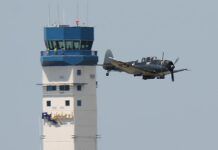
EAA AirVenture officials do what they can to make their event safe, thencross their fingers and pray for luck. That luck ran low Thursday afternoon asthe warbirds were taking to the air for the daily airshow. As a formation ofBearcats and Corsairs started their takeoff roll, something went terribly wrong.Thousands of airshow fans watched in horror as one of the F-4U Corsairs, pilotedby 56-year-old Laird Doctor of Dallas, Texas, collided with a Bearcat fighterflown by Howard Pardue, of Breckinridge, Texas.
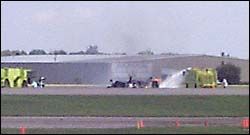 Two World War II-era F-8 Bearcats and two F-4U Corsairs had been cleared fortakeoff by the airboss … that we know. What happened next is not yet clear.The Bearcats may have started their takeoff roll, or may have been completingtheir runups when the Corsair pilots behind them added throttle for takeoff. Thepilot of one of the Corsairs saw something that made him realize there was aproblem and managed to swerve to avoid a Bearcat. Doctor was not able to reactin time and slammed into Pardue’s plane, ripping off the Bearcat’s right wing.The Corsair turned into a cartwheeling, fiery tumble, breaking into severalburning pieces. The cockpit, with Doctor still inside, came to rest upside down.Rescue crews were on the scene within seconds and transported the pilot to MercyMedical Center in Oshkosh, and later, to Froedtert Memorial Hospital inMilwaukee, a hospital known for its trauma unit. As this went to press, Doctorwas in extremely critical condition with severe internal injuries.
At the time of the accident, the warbird pilots were taking off on runway 18,which had a crosswind today, but those familiar with the warbirds say the stiffcrosswind should not have been more than the planes and their pilots couldhandle. The plane Doctor was piloting was one of the few flying Corsairs leftand was on loan from the Cavanaugh Museum in Addison, Texas, a suburb of Dallas.The plane is not known as being difficult to fly, but it is tricky on takeoffsand landings because of poor forward visibility. In fact, a large number ofcrashes during WWII happened during takeoffs and landings and were attributed tolack of forward visibility. Had Doctor been able to see what was ahead of him,he would have been much better able to avoid it. The NTSB investigation into theaccident continues.
Let Us Entertain You
Aerobatics Go Public
If you had the chance to travel to an airshow featuring the Navy’s BlueAngels Flight Demonstration Team or Wayne Handley, which would you choose? You,being the GA-savvy AVweb reader that you are, might choose Handley. Joeand Jane Q. Public, though, would likely respond with something on the order of"Blues, great! Wayne who?" The Championship Air Show PilotsAssociation (CASPA) is working to meet that challenge with one of their own,called the NAVplus Challenge Series. The NAVplus Challenge is very simply that:several of the best general aviation airshow pilots giving it the best they’vegot in a competition in which the public decides who is best.
 Over the course of several different airshows, pilots Matt Chapman, IanGroom, Gene Soucy, Mike Goulian, Rocky Hill, and Sean Tucker will compete forpoints. Come Labor Day and the Cleveland National Airshow, the point totalwinner will be awarded a big new trophy, bragging rights, and $150,000. To winthose lucrative points, the pilots must complete three segments at fourdifferent airshows. Just like in figure skating, each competitor will berequired to fly pre-determined maneuvers in a compulsory round, a freestyleroutine that will give them a chance to show what they’ve got, and finally, ahead-to-head challenge that will put two of the pilots in the air at the sametime in an all-out bid to wow the crowd.
Wowing the crowd is what it’s all about, says CASPA’s Chuck Newcombe.Newcombe told reporters at EAA AirVenture Oshkosh Thursday that the organizationis always looking for something new and exciting to increase interest in GAflying, and this could be it. Straight aerobatic competition is not generallyconsidered terribly exciting or audience-friendly. The competitors fly high andconcentrate on keeping their lines straight instead of entertaining the crowd.This will be something completely different. "Let’s play to an audience.That will be the driving force," says Newcombe, who stresses thatentertainment is the name of the game. To make certain the pilots are doing whatthe crowd wants to see, members of the crowd will be judging them. Earlier thisyear, EAA and CASPA ran a contest, and the winners — no experience necessary —will be official judges at Oshkosh. CASPA Chief Steward Clint McHenry says thepilots can use smoke, music, pyrotechnics, ribbon-cuttings — whatever theythink will impress the judges — and the only instructions he will give thosejudges is, "You like the routine, grade the pilot high." Thecompetition starts with six pilots. By Saturday, the number will be cut to four;on Sunday, the best two will compete head-on.
The pilots enjoy the competition, and none of them want to "lose,"although CASPA is loathe to use that word. With standing and money on the line,the NAVplus Challenge promises to be a hot one.
SAMA Pushes Partners For Progress
But FAA Resource Bottlenecks Slow Progress
When the FAA was forced to take a chunk of its budget to pay a big newcontrollers’ contract, FAA Administrator Jane Garvey told AVweb it would notaffect other FAA missions. That may have been what she thought at the time, butit’s not what is actually happening, according to Small Aircraft ManufacturersAssociation (SAMA) President Paul Fiduccia. Fiduccia says the FAA is so strappedfor cash that 200 positions that have come vacant in the agency in this fiscalyear have gone unfilled.
The attrition is random, and because the FAA was caught unprepared for allthe retirements, medical problems and pregnancies, several areas areexperiencing serious staff shortages. One Aircraft Certification Office (ACO) inChicago, Fiduccia said, is down to just one systems worker, from three. Becauseof the lack of bodies, certification of everything from new airplanes to newavionics is taking much longer than it should, increasing GA manufacturers’"burn rate." The burn rate is the rate at which money goes out thedoor, which happens even when a manufacturer is awaiting certification. Everyday that goes by, those companies have a payroll that must be met, no matterwhat.
There are several ways the FAA could address the problem. They could somehowfind enough money to hire the people they need, get some relief from theoutside, or be more open to entering into partnerships with manufacturers.Fiduccia doubts the FAA will "find" large amounts of money, but saysthe latter two options are easily doable.
One option that the agency is already exploring would allow manufacturers touse Designated Engineering Representatives (DERs) to do test reports. Thosereports contain data to show an aircraft complies with airworthiness standards.The DERs aren’t free — manufacturers pay for their time and expertise. Lately,though, the FAA has begun to question the DER reports and re-review the data,leading to just what SAMA wants to avoid: added costs and delays. Fidducia isurging the feds to find a way to identify and qualify the DERs so they feelcomfortable with their reports and some of the load is taken off the agency.
Another way to speed the certification process is with a program called theFAA Partnership for Safety. Under the proposed program, the company in need ofcertification and the FAA would enter into a written agreement that lays out aschedule for the entire process. The beauty of the program is that the Feds haveto do what they say they will do on the day they say they will do it. Thecompany needs to stick to a schedule, too. According to Fiduccia, "Somewant to do it, others think it puts the FAA on the spot. I think it makes boththe FAA and industry more accountable. It’s time to go forward with it. Everyonelikes the idea as a concept, it’s just a question of how fast the FAA is willingto put it into play." The FAA is allowing one case per ACO, but at the endof a one-year test period, SAMA wants the program put into widespread use. Willeither happen? The wheels of the FAA machinery grind slowly, but SAMA and PaulFidducia will be pushing.
Finally, FADEC?
TCM, Aerosance Bring Electronic Piston Engine Controls A Step Closer
Want to get into a spirited argument at your nexthangar-flying session? Start a discussion about piston engine power management.Throw in subjects like what to do with the mixture for takeoff and lean-of-peakoperation, plus things like cycling the propeller during the run-up, and you’llbe tied up for hours. In fact, understanding engine management can be one of themost frustrating things for new pilots and old flight instructors alike. [Note:to help start the hangar flying arguments, be sure to check out JohnDeakin’s columns. — Ed.] For years, the promise of applying the revolutionin electronics to the challenge of engine management has eluded manymanufacturers, even though turbine- and jet-powered aircraft have employed thesystems, known as FADEC, or Full Authority Digital Electronic Control, foryears.
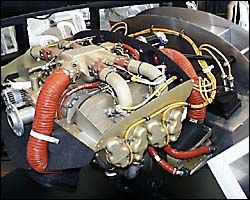 Enter Teledyne Continental Motors (TCM) and its subsidiaryAerosance Inc. The two companiesare displaying a Diamond Katana C1 and a Cessna 172K at this year’s EAAAirVenture, both with engines sporting — and operated by — preproduction FADECsystems. Designed specifically for piston engines and engineered in a modularfashion, TCM/Aerosance’s FADEC units replace both magnetos and eliminatecarburetor heat (there is no carburetor), mixture controls and priming. Bothaircraft are being used as flying test beds for the technology, currently beingdeployed on four-cylinder engines only. Some 40 hours of operational testing hasincluded taxi tests, service-ceiling operation, in-flight engine shutdowns andrestarts, plus limited aerobatics and simulated failure of the aircraft’sprimary power. According to test pilot Pat Moe of Starflight Consultants, theC-172’s engine installation now starts like a "modern automobile,"while the FADEC also helps "prevent overspeed for these fixed propellerinstallations" in the Skyhawk. TCM says that testing of a six-cylinderversion is planned for later this year with additions to the modular system.Turbocharged versions will follow as well.
Air & Space Ready For Wide Open Spaces
But No Decision On Engen Naming
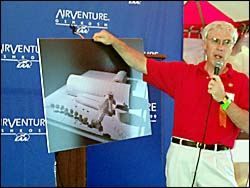 If you’ve been to the National Air & Space Museum, inWashington, D.C., and found it more than you could absorb in a day, just waituntil the annex is built on a 185-acre tract adjacent to Dulles InternationalAirport. The new facility, set to open in 2003, will provide room to exhibit thespace shuttle Enterprise, an SR-71 Blackbird, the only surviving B-17D — TheSwoose, the B-29 Enola Gay and the Dash 80 prototype of the Boeing 707, and lotsmore, said John Fay, the museum’s director of development, at a press conferenceat AirVenture on Thursday. Fay showed off drawings for the planned facility,which will house displays of more than 180 aircraft and 100 spacecraft. Therestoration operations now at NASM’s Garber Center, at Silver Hill, Md., willmove to the new facility. Fay estimated that at the current rate, it would take400 years to finish restoring the museum inventory of historic and noteworthyaircraft.
He was not prepared, though, to state the NASM’s positionon naming the facility for former director Donald Engen, who died in a glideraccident earlier this month. Fay said that decision would depend on the family’swishes. Fay remembered Engen as "gentleman of greatest integrity … [whohad] a stellar background in aviation." He said that the annex had beenEngen’s primary focus, particularly raising the funds to build the facility,which will be completed without federal funding. Plans call for groundbreakingin the spring of 2001, with completion and a "soft" opening in thespring of 2003. A formal dedication will be made in conjunction with the 100thanniversary of the Wrights’ first flight, in December 2003.
BRS Floats "Initial Pilot Offering" For 172 Recovery System
Owners of Cessna 172 Skyhawks could soon have a safetysystem on par with the newest emergency system in general aviations newestairplane: the Cirrus SR20. Parachute maker Ballistic Recovery Systems isexamining the prospect of its third whole-plan recovery system for certificatedaircraft by adapting the SR20 system for the Skyhawk. And BRS has simultaneouslylaunched an "initial pilot offering" directly to Skyhawk owners, inhopes of landing a base of 25 to 40 commitments for the BRS-172 system. BRSasked interested owners to deposit $2,500 in an interest-bearing escrow accountwith the promise that these "investors" will receive a de factodividend of $1,500 toward the final $14,995 price of the system. At that point,BRS would launch engineering development of the project.
Once a cost analysis iscomplete, the company will decide whether to proceed, and refund the deposits ifthe decision is a no-go. If it’s a go, those who made deposits will owe $10,995when their 172 BRS parachute system is ready for delivery, sometime within thenext two years.During more than 20 years in business, BRS has deliveredmore than 15,000 emergency parachute systems to its hang-glider, ultralight andlight-plane customers; more than 130 of those systems have been deployed to savethe lives of the people flying. In 1993, the company certificated its firstgeneral-aviation recovery device when the FAA awarded an STC for the GeneralAviation Recovery Device, or GARD, a parachute installation for Cessna 150 and152 aircraft. In the summer 1998, the FAA approved the BRS system for the SR20 afterseven live deployment tests.
Aviat Flies 110 Special
Expects Oshkosh Debut Friday
Aviat Aircraft successfully started test-flying theresurrected Monocoupe 110 Special on July 25, and when results exceededexpectations, it was started off to Oshkosh for its EAA AirVenture debut thisweek, according to company staff. And after waiting through two days of Oshkoshfor the ferry flight of his new baby, company owner Stuart Horne was strainingat the bit. "We’re ready to have it here," Horne said earlier thisweek. Finished in a unique paint scheme, with a birds-eye maple panel andleather upholstery, Horne sees the resurrected 1930s air racer as the aerialequivalent of a 1950s hot rod. "Its going to blow the socks offeverybody who sees it," he said. "Everything about the 110 Special isworking out better than anticipated."Early flights revealed the speed potential of the200-horse, aerobatic two-seater. "Flying at 10,000 feet on a hot day, itturned in more than 190 miles an hour," Horne told AVweb. "Imagine what she’ll do at a density altitude where theengine can make 75 percent power."
The original 1932 Monocoupe was a racerpowered by 145- and 185-hp radial engines; Aviat’s 1999 incarnation flies behindLycoming’s AEIO-360 200-hp aerobatic engine turning a 78-inch constant-speedHartzell prop. Beyond the powerplant differences, the old and new 110 Specialsare virtually identical in size and construction, from the cloth-coveredwood-spar wing to the steel-tube fuselage. Horne has priced the 110 Special at$159,000, with an IFR panel and complete avionics. With an optionalall-electronic EFIS-style panel, the price goes up about $50,000. Since Aviat isworking with the original 1932 CAR 3 type certificate, Horne expects Aviat’stest crew to complete certification by around the end of the year, with firstdeliveries by early next year.
Jeppesen’s New Products
For Airborne And Armchair Pilots
 Jeppesen Sanderson of Englewood, Colo., announced severalnew and upgraded products at AirVenture ’99 that should make navigation andflight planning easier and cheaper for pilots and nonpilots alike. Foremost isJeppesen’s release of an upgrade to its FlightStar flight-planning software, nowknown as FlightStar 8.0. Some of the enhanced features of version 8.0 are bettergraphics, integrated low- and high-altitude en route charts, and a worldwideterrain database that can be viewed in planview and profile. The new profileview gives the pilot a better picture of airspace and terrain conditions alongthe planned flight route. Jeppesen has also increased the capability of itsFliteMap moving map software with version 8.0, featuring a new interface, whichmakes it easier to calculate and execute route changes while flying. The latestversions of FliteMap and FlightStar require a 133 MHz Pentium, 32 megs of RAM,and 60 to 100 megs of hard disk space.
 In an effort to reduce the cost and complexity of upgrading the ever-popularpanel-mount GPS units with nav databases, Jeppesen also revealed that it isturning to the power of the Internet to disseminate timely aircraft navigationdata to pilots. Starting September 1, pilots can order the new SkyboundDatawriter hardware/software package, which allows them to download currentnavigation data directly from the Jeppesen Web site. After download, the pilotinserts the GPS data card into the Datawriter to complete the update. Jeppesenis claiming Datawriter support for all the major GPS manufacturers, includingGarmin, Trimble, Northstar, Magellan, and ARNAV. Jeppesen is shooting for aprice of around $350 for the Datawriter package, including North Americancoverage and monthly updates. For VFR pilots who don’t need frequent updates,the Datawriter will sell for $295, with $95 for individual updates. If you andyour buddies are thinking of buying one Datawriter and sharing your databaseupgrades with each other, forget it — Jeppesen has cleverly written theDatawriter software to ensure that only one GPS nav card can be updated peraccount. Jeppesen made it clear that using the Internet to update nav data isthe future, with the goal eventually to get out of the data-card businesscompletely.
Finally, for the armchair pilot who flys nothing more complicated than aswiveling La-Z-Boy, Jeppesen announced SIMCharts for use with the popular PCflight simulation programs. Each SIMCharts CD allows the "pilot" tosort, view, and print thousands of terminal charts for 12 different regionscovering the entire planet. The CDs only cost $20 each, so practicing yourwhite-knuckle approach into JFK on a stormy night is within reach of PC pilotseverywhere.
Briefs…
First You Walk, Then You Fly
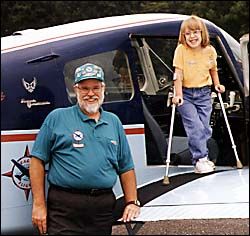 Dennis Carney, 55, of Boiling Springs, Pa., was born with spina bifida, anddoctors told his parents he never would walk. But Thursday at EAA AirVenture, hewalked proudly up to the dais — with a little help from a cane and a boost fromfriends to make a big step up — and accepted the 1999 Aviation LeadershipAward, sponsored by Phillips 66. Carney has flown more than 300 children in theYoung Eagles program, and also flies children from the Spina Bifida Associationand the Make A Wish Foundation. Ray Stits, 77, of Riverside, Calif., alsoreceived the award this year. A founder of EAA’s first chapter, Stits hasdesigned and built 15 aircraft since he earned his pilot’s license, in 1945.He’s flown more than 715 Young Eagles in his 1975 Cessna 182, and subsidizesflight lessons for seven young pilots who impressed him with their enthusiasm.The two were honored by Mark Wagner, of Phillips 66, as aviation standouts."Both men have selflessly shared their love of flight with young people whowill become pilots in the next century," he said.
Cash,Check, Long-Term Financing?
Folks can buy anything from logbooks to decorative wall clocks at Sporty’sPilot Shop, and in the not-too-distant future, you might be able to purchase ahome and hangar at Sporty’s new airpark. Sporty’s President Hal Shevers has hiseyes on a 100-acre parcel of undeveloped land at Sporty’s home field, theClaremont County (Ohio) Airport. A divorce might be in Shever’s future, though,if he moves into the airpark himself. "I don’t think my wife will stand forme moving any closer to the airport," he told reporters Thursday morning,"even though I would want to." In addition to hopes for an airpark,Shevers is also working to keep Claremont County Airport out of Cincinnati’sClass B airspace, butting heads with the FAA over airplane rides — "Ithink people should be able to offer $20 airplane sightseeing flights withoutgoing full-blown Part 135" — and fighting in federal court to use Sporty’strademark as a domain name.
Phillips and EAA, Partners-A-Plenty
Phillips 66 is expanding its commitment to get more young people intoaviation. The company has agreed to sponsor a number of exhibits in the EAAAirVenture Museum, including a re-creation of a fixed-base operator. Phillipsand EAA want the kid-friendly FBO to promote flying while showing therelationship between pilots, airports, and aviation service businesses. Includedin the FBO will be the "World’s Largest Logbook," which will list thename of the more than 500,000 Young Eagles; a map with time-zone clocks notingthe number of Young Eagles and pilot volunteers by state; and an electronic"current count" sign that will reflect the 300-odd Young Eaglesregistered each day. The EAA Aviation Foundation is obviously pleased withPhillips’ increased donation, as is J. Mark Wagner, Phillips 66 aviationmanager. "It is natural for Phillips 66 to support these efforts that willcontinue to welcome new aviators, with their energy and promise." And AVwebwould be remiss if we didn’t point out: future fuel consumers.
AlliedSignal Wins First Two ACAS II TSOs
Two new aircraft collision-avoidance systems won their TSOapproval from the FAA July 27 — the AlliedSignal Aerospace CAS 81A and CAS 67A— company sources said Thursday. The new ACAS II systems are the first to meetstringent new Joint Aviation Authority requirements for use in Europe and thefirst that target both commercial and private aircraft. According to thecompany, the new ACAS II system uses enhanced software language that reducesnuisance alerts while cutting frequency congestion by requiring fewertransmissions. AlliedSignal accomplished this by replacing current TCAS softwarewith Change 7.0 software. European business-aircraft operators are required toinstall ACAS by 2005, while commercial airlines have until the end of 2000 tofit the system to all aircraft weighing more than 33,000 pounds or seating 30 ormore.
Buchanan To Receive Bill Barber Award At Theater In The Woods
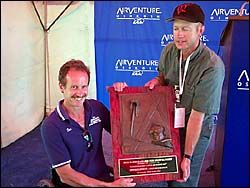 A unique airshow pilot will be recognized Sunday eveningfor his extraordinary flying exhibitions over a career spanning 10 years, but hewon’t be walking across the Theater In The Woods Sunday night, he’ll be rolling.Dan Buchanan will be receiving the Bill Barber Award for Showmanship at an 8:30p.m. presentation to honor his courage and innovation as the worlds onlyprofessional hang-glider airshow pilot. Buchanan, 42, has been a paraplegicsince a 1981 hang-gliding accident. "Dan is not only a showman, he is aninspiration to people who wish to live their dreams," said Dave Weiman,publisher of World Airshow News, which offers the award to recognize excellencein airshow flying and honor the people who perform. The award is named in honorof the late, legendary Bill Barber, who awed crowds by flying any of sixroutines in up to five different aircraft. Prior to Buchanan’s ceremony at theTheater In The Woods Sunday night at 8:30, a new exhibit will be dedicated inthe EAA AirVenture Museum, devoted to past recipients of the Barber awards. Thededication will be at 10 a.m.
A Word To The Wise
Caesar Heyne, a pilot from Holland, has a warning he wants to share withpilots in America: Be careful, or what’s happening to pilots now in Europe couldsoon happen to you. He took the dais Thursday morning in the AirVenture presstent to celebrate the virtues of the Young Eagles program, but he took theopportunity to also sound a caution: More and more restrictions make it harderand harder for European pilots to find airspace to fly in and airports to takeoff from. Pilots in Holland have only recently banded together in the DutchAviation Forum to advocate for their rights. Already they have flown 1,200 YoungEagles — including Heyne’s nine-year-old son Floris — and Heyne is hopefulthat the future of Dutch general aviation will look more like what we have inAmerica — and not the other way around.
Fly Market Offers Something For Everybody
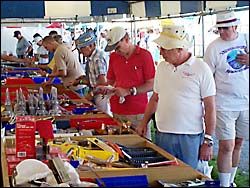 WhenAirVenturers tire of things that fly and feel a desire to replenish their supplyof nuts and bolts — or need a camp chair or sun hat — the Fly Market is theplace to go. The Market is a collection of open-air booths off in one corner ofthe convention grounds, where a hodgepodge of vendors sell books, aviation art,T-shirts, jewelry, tools, and small fittings and fasteners. And if aviationisn’t enough of a religious experience for you, you can check out the booth forthe Praise and Prayer Fly-In.
Some of the vendors said on Thursday afternoon that sales were off from lastyear’s first two days. The intense heat — it was 98 degrees at 3:15 p.m. —seemed to be keeping down the traffic. Brad Kay, at the Billy Carr Tool Manbooth, said that business was off "a good bit" from previous years.Dane Heckendorn, of Walkabout Hats, also reported slower sales than last year,which he attributed partly to the heat and partly to increased competition.Other vendors agreed the crowd was lighter, and said they were doing morebusiness in the mornings, when the air was a bit cooler. But Elinor Howell, ofHowell Press, a book vendor, said that Wednesday was one of her better openingdays at Oshkosh. Some of her customers, though, asked her to hold theirpurchases for later pickup — trying to keep their loads light as they baked inthe sun.