




























 Staringinto all that blue sky during a week at Oshkosh can give people ideas. Theairplanes exude an aura of romance, the breezes blow from far horizons, theglamorous flying boats and biplanes raise visions of exotic lands and highadventure. And for those who suffer from that itch to set out and explore thisbig round world, somewhere there’s an aircraft ready to fly to the ends of theearth. And this being AirVenture ’99, those aircraft are right here on WittmanField.
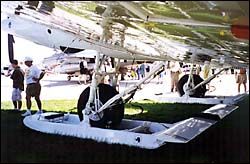
Attracting attention near the West Ramp is a beautifully restored DC-3 onskis, ready to fly to the South Pole with any intrepid tourist who can pay thefreight. The big twin has been completely stripped down and refitted by BaslerTurbo Conversions, based here at OSH. Contracted by Adventure Network, which hasbeen operating Antarctic tours for about 15 years, the spanking-new turboconversion is equipped with long-range tanks, all-new avionics, and a wide-opencabin with lots of room for cargo along with up to 22 pax. The nose wasstretched out about 40 inches to compensate for the heavy new engines, and it’sa long, steep walk up to the cockpit from the rear cargo door.
Doug Wenzel, of Basler Turbo Conversions, says the company has restored 35old DC-3s over the last 12 years. They now live all over the world — flying inthe air forces of Bolivia, Mali, Guatemala and elsewhere; surveying geophysicalfeatures in Johannesburg; hauling smoke jumpers for the U.S. Forest Service; andseeding clouds in Thailand. Not one seems in danger of dying of boredom.
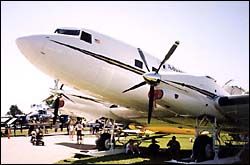 Thelatest Basler baby will fly to Antarctica in October and stay there throughApril, says Bernie Elms, an Englishman who coordinates the trips. Tourists comefrom all over the world and fly across the Southern Ocean in a stretched C-130.The new DC-3, operating from blue-ice runways, will cart them around to thegarden spots of the ice pack: the pole itself; Mount Vinson, the highestAntarctic mountain peak — a mecca to climbers determined to bag the SevenSummits — and other isolated spots where tourists can soak up the naturalbeauty, watch the wildlife, rock-climb, skydive, ski and snowboard.
Antarctica is a hotel-free continent, but tour operators find ways to offerluxury to their guests. Travelers may stay in tents, but they get real meals,library and video tents, medical support, and guided trips onto the ice to learnsurvival techniques, rock-climbing, and other outdoor skills. The millennium isa big draw, Elms said: He expects about 100 people will travel to the South Polefor December 31, nearly twice the number usually found there at any one time.Some clients plan to ski across the continent, which takes about two months;others will be dropped off closer in and ski to the pole for New Year’s Eve;others plan to skydive in. Elms said his own preference is to "fly straightthere and have tea and crumpets."
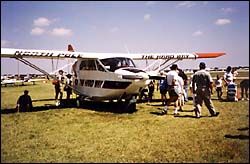
 If Antarcticathe pampered way doesn’t appeal to you, maybe the North Pole the hard way willcapture your imagination. French aviator Hubert de Chevigny arrived atAirVenture Thursday, where his unique "flying Winnebago," the PrivateExplorer, is resting on the Experimental flight line. De Chevigny, who flew tothe Pole in 1987 in an Avid Flyer ultralight, is planning to reach the poleagain next spring in the Explorer — and to land there, navigating only by thesun.
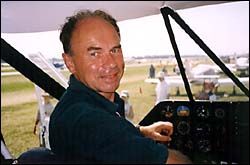 De Chevignysaid the motivation for the flight is to research the accuracy of the navigationused by early aerial polar explorers, in the 1920s. "We want to navigateexactly as Byrd and Amundsen did," he said. To do that, he will have tomake several landings on the ice and take a sextant sight on the sun, then waitfour hours and do it again. And hope that the weather cooperates and the icedoesn’t shift in the meantime. "If you can land on safe ice, you can wait.It can be four hours or four days. But you are on the sea there," deChevigny said. The movements of the ice, like the whims of the Arctic weather,can be unpredictable.
De Chevigny’s base team at Resolute Bay will track the entire flight bysatellite, but the flight crew won’t have access to that data. After the flightthe two tracks will be compared — what the satellites showed, and where theflight crew thought they were. "Then we can understand how difficult oreasy it is to navigate with astronomical methods," de Chevigny said."We hope to bring new insight to old questions about the North Poleconquest." Since the early explorers never landed at the pole, de Chevignysaid, questions about the accuracy of their fixes have never been settled. Hehopes historians can use the data from his flight in their research.
 Since he’s beento the Arctic before, de Chevigny has no illusions about what he will facethere. He plans to be at Resolute Bay next April, and wait for a weather windowthat will let him start out on the 7- to 10-day flight. He may not get one, andwill wait to try again the following year. If he’s very lucky, he said, he’llget good weather with a moon to help in navigation, and make the flight to thepole and back with no delays. But he’ll be prepared to wait out the weather onthe ice if he has to, and even to abandon the airplane and travel on skis if itcomes to that.
The airplane itself is a wonder. It’s not pretty, but it sure looks ready togo anywhere. The cabin is tall enough to stand up in, broad enough to stretchboth arms wide. The kit was designed by Dean Wilson, who also designed the AvidFlyer. In the rear is a platform for a full-size bed — that’s right, you cansleep in this airplane. The floor is mahogany, and the cockpit has dual stickcontrols. The wood-and-fabric wings are 47 feet long, and they’re wide enoughfor two airshow-watchers to sit side-by-side in the shade. It cruises at 112 mphand takes off in just over 800 feet.
Take your pick, north or south, east or west, near or far — if you canimagine it, you can find an airplane to take you there. So dream on, and here atAirVenture, you might find those dreams can come true.
