




























Let’s take a shot some of the common aviation myths and “Old Wives’ Tales” (OWTs) so common in this wacky business, some of which I intend to make the main subject of future columns.
Many people equate a gift of gab, gray hair, hours aloft, or years in the business with pilot quality. High-time, or old pilots are often given far more respect than they deserve, and there are many of these types around most airports, and some in airline cockpits, too. General Aviation airports usually have a few of them sitting around, basking in the admiration of the student pilots, who themselves vie for a position in the pecking order by measuring their accomplishments and hours against others. Reminds me of the cartoon of two kids, about five years old, leaning against the “Fly me for a quarter” airplane in front of the drugstore, one nonchalantly saying “Oh, about 3 hours, how about you?” First thing students learn is to never ask this question unless they are sure they are on top, going into that conversation!
I recall well one little old blue-haired lady who raved about “What a wonderful pilot he is,” in reference to another corporate pilot. I politely said “Yes, he’s a very nice guy,” and she said, “No, no, I mean he’s a wonderful pilot!” I let it go, for she was the mother of my boss, but I wondered just what basis she had for that judgment, for he was widely known as a hamburger, with little more than a gift of gab, and she had no aviation knowledge at all.
Or the retired USAF bird colonel who showed up in Saigon, bringing with him considerable fame as a very high-time B-52 pilot in the Strategic Air Command. I flew with him in the Twin Beech during his “line training” for a few days and rejected him as unfit for any cockpit duty – in anything. Not only could he not fly, but his head-work was non-existent. Another instructor came to the same conclusion. In one of his less stellar moves, the chief pilot rode around the pattern with “The Colonel” once and signed him off. He wrecked a Twin Beech his first day, first takeoff, and then quietly went home.
Let’s Dissect (and Decimate) My Bio
Sure, hours and years aloft can mean something, but other things need to be considered. Take a peek at the embarrassing bio at the end of this column; there are a few things there I’d like to dissect here. I’ve been getting a good deal of teasing about that from some, and a few have warned me that some may attach more credence to what I say than they should because of my apparent credentials. I hope that’s not true, I hope they pay attention because what I say makes sense. If it doesn’t make sense, then I want to hear about it.
“Over 32,000 hours.” Well, yeah, I’ve watched in fascination over 40 years of professional flying, as that total has grown to a number that surprises even me, particularly in light of some of the dumb things I’ve done. But, consider; 747 time accounts for well over half of it, and since the 747 is almost exclusively a very long range aircraft with supplemented or double crews, several thousand of those hours were spent sleeping in the crew bunk, and more than a few in the seat, peacefully snoozing on duty (which I encourage on long flights, preferably one at a time!) Many thousands more were spent in the cockpit, boring along (and bored) at FL370, on 12- and 14-hour flights, above most of the weather. More to the point, since there are so few takeoffs and landings, by the time the other pilots get their share, I’m lucky to get 2 takeoffs, and 2 landings per month. That’s 24 per year, for 25 years, for about 300, total. Okay, maybe 500, because some of that time was on short-range flights of nine hours, or less, with a “normal” crew. Folks, this is not a lot of experience, relative to the total time!
My hat is off to commuter pilots, operating killer schedules through long winter nights, often down in the clag and in high-density areas, or short-haul pilots, “freight dogs,” often operating shabby equipment, and many others who get more genuine experience in a few months than I have in the last 25 years. Give me credit for patience, not demanding flying experience.
How about this business of being a 747 captain, some of whom would like to wear five stripes? With rare exceptions, the only difference (other than waistline) between a 737 captain and a 747 captain is union seniority, which is all well and good, and probably fair enough, but that has nothing to do with skill, talent, knowledge, or ability. Oh, the pay is better, too, but that’s also a union function, because way back in the beginning, ALPA somehow got pay tied to productivity, which sounds fair enough, but that ended up somehow connected to aircraft weight. In reality, the 747 is a pussycat, the easiest of all the transports to fly, genuinely an “old man’s airplane.” It is really hard to make a bad landing, though I seem to succeed in that far too often. Note also that transport certification rules constantly emphasize something like “No more than average piloting skill must be needed” on the various criteria.
Now, what about the “instructor” thing? Did you ever stop to think that 300-hour pilots form the bulk of those getting this certificate? Can it really be so hard? It probably took me longer, and I had to study harder, though, because I hadn’t been exposed to the basics in many years, and these days there are a lot more “basics!” Reminds me of the old saying, “He’s forgotten more about flying than (someone else) ever knew.” Think about that, a moment? It’s often literally true, and it does not reflect favorably on the old coot who has forgotten so much. I don’t consider it a compliment.
Respect My Examiner Designation?
Surely, though, I deserve respect as an Examiner? Well, maybe, but note that my privileges are restricted to the Curtiss-Wright C-46 “Commando,” a 55-year-old military transport, of which only a few flying examples remain. The FAA Inspectors not only don’t want to get into these relics to conduct check rides, they don’t want anything to do with them, and they don’t want to know anything about them. Are you kidding me? Fly an ancient, 48,000-pound taildragger? Or worse, climb into the jumpseat of one, while strangers are up front, yanking engines, and simulating emergencies now done only in simulators? Do you have any idea what a helpless feeling that is? Very, very few FAA people think is any part of their job description! (I am grateful to Karla Towe, of the VNY FSDO, for her can-do attitude, and willingness to occupy that jumpseat, with me up front!)
There are only a few pilots left interested in flying these old beasts, and with most “modern pilots” having learned to fly in jets (the military-trained ones, anyway), there aren’t many who would take a PAYING job flying a C-46, much less do it as a labor of love. Of that small number of nuts, very, very few happen to have an instructor’s certificate, an absolute requirement to be an Examiner. So, when I came along and joined the SoCal (Southern California) Wing of the Confederate Air Force in Camarillo, Calif., it suddenly got really easy to get to be a C-46 Examiner. In fact, I wonder if the FAA Examiner’s school in OKC would have allowed me to fail! It seemed that everyone in the FAA was on my side, warmly supportive and encouraging (no, I’m not joking). Hmm, have I missed something, here?
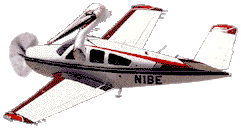
Yes, I fly a Bonanza, though not as much as I would like. You would be amazed at how hard I had to work when I bought that machine in 1992. I thought I was current, but for some months I was “VFR ONLY,” until I worked up the courage to start a little light IFR, after some re-training and practice. That was the first time I realized how much help I’d been getting in the 747 cockpit all these years. With 500 hours and some training, I’m a little better, now, I hope.
Now that I hope I’ve stripped away some of the illusions, allow me to say that I am indeed proud to have served with Air America, and it sure wasn’t the outfit portrayed in that dreadful movie. It was the most interesting, demanding, and challenging flying I’ve ever done, or ever will do. I am deeply honored and privileged to have the opportunity to once again fly my beloved C-46, my favorite airplane of all time. I do try to study, I read a lot, I think I’ve paid attention to the aviation business for a lot of years, and so I hope I can pass along some of that here.
Think for Yourself
Please, don’t take my word for anything because of my so-called credentials. If you read what I write, consider the content, and think for yourself. Consult with others for their opinions, and make them (and me) back them up with logic and data, not “credentials,” or inappropriate claims.
I have listened to an “Airport Big-Mouth” (ABM) proclaim, “You can’t log PIC time unless you are the PIC!” A quiet, professional, young CFI attempted to point out the FAR that clearly DOES permit just that, but got shouted down by the ABM, who pointed out that “I’ve been flying for fifty years, and that’s ridiculous!” What does fifty years of experience mean, when he’s so wrong? In fact, the FARs permit more than one person to log PIC at the same time, and with very good reason! The ABM shouted this down, too.
Or, take the senior editor of a well-known aviation publication who beat on the OWT, the downwind turn, where the demonstrably false theory is that when turning downwind in a constant wind, the airplane must accelerate – or stall! Rubbish! This one is laughable, except he claims to be a test pilot! He should know better, but I know of several “letters to the Editor” about that article that drew no response, and the article has gone uncorrected, to confuse students forever. A CFI and columnist for a training magazine also fell into this old trap some months back. How can a lowly CFI argue against people like them?
The fact is, of course, that you can fly a constant circle at 100 knots indicated, in a 200-knot stable wind, and never know the difference in the cockpit, never see a change in your instruments from the wind. It would be a sight to see from low altitude, if you did it while watching the ground, though! This is not to be confused with flying from one wind condition into another wind condition, which is “wind shear,” an entirely different thing.
Another example was one of the Lycoming Field Reps, with whom I got into a discussion over GAMIjectors. These devices allow almost any fuel-injected General Aviation engine to run smoothly lean of peak, where it runs cooler and cleaner. This old “fount of knowledge” all but screamed, “I wouldn’t recommend lean of peak to my worst enemy!” “Gee,” said I, “there are several hundred million hours of experience running well lean of peak on the big old radials, why is it harmful to a big-bore flat six? “Gas is cheap, engines are expensive!” he said, not exactly addressing the issue.
“Well, yes, but if running lean of peak will extend engine life and thereby also improve safety, isn’t that even better?” “I wouldn’t recommend lean of peak to my worst enemy!” he repeated (about five times, in all). His other justification was “I’ve been giving depositions for Lycoming for 25 years now, and (you guessed it) I wouldn’t recommend…” He never did answer my question or support his adamant opinion with facts.
Pay Attention to Content
My point in all this is that if you learn nothing else from me or from my column, learn to pay very little attention to credentials, or a loud voice, or age, or time in the air, the color of hair, or gender, or race, or anything but the content of advice and instruction, here and elsewhere, whether from a grizzled old pilot, or a young student pilot, some of whom can have astonishing insight, and a new, fresh way of looking at things. Think about what you hear, and what you read, no matter how authoritative the material seems. Treat new information like a raccoon treats his food. He washes it, and examines it, turning it over and over, washing it some more, looking, sniffing, poking, prodding, washing, and only after a long and careful examination does he finally swallow it. If something does not “fit” with your previous “knowledge,” then either the new information is wrong, or the old is, or you’re missing something. Track it down – before it kills you.
Be careful up there!