

























You know you’re in trouble when a memo from the chief pilots starts out “It has come to the attention of this office…”
Well, the FAA may be in trouble with me, because it has come to my attention that it may be official policy at (at least) one FSDO that simple failure to time a full ILS approach on a checkride is an automatic bust.
That’s a BAD BUST, in my opinion, and I’d squawk like a Pelican with a leaky beak, if it happened to me.
For the full ILS approach, the missed approach point is defined ONLY by arrival at DH. That’s exactly why they call it “Decision Height,” because that’s where the decision (land or miss) is made. DH may be determined by the barometric altimeter, or in some cases by the radio altimeter. Either way, the proper procedure is to simply descend to that point and execute the missed approach-unless you just happen to discover a runway during the process.
Timing Doesn’t Enter into It
Timing does not enter into it. You follow the LOC (Localizer) for lateral guidance, you follow the GS (Glide Slope) for vertical guidance, and when you hit DH, that’s your limit horizontally. In reality, you should be planning to execute the miss at DH, with a landing becoming a pleasant surprise – and sometimes a welcome relief!
Key point: if the Glide Slope fails during an ILS, EXECUTE THE MISS, get things sorted out, and come back to shoot the Localizer approach, if that’s what you decide is appropriate and safe under the circumstances.
The current popular concept in instrument training seems to favor switching from the ILS to the LOC approach right in the middle of the approach, if the GS fails, and that seems to be the driving force behind timing an ILS. Is this legal? Perhaps. Is it safe? Often, it is not.
Two for the Price of One?
I know of no airline that favors this, and with good reason. Sure, with practice it may work, in many locations, and in light, slow aircraft, it may even be fairly graceful. If you wish to do this for training, then BOTH approaches must be carefully studied and understood ahead of time.
The ILS and the LOC-only procedures sometimes appear on the same chart only to save paper. In reality, they are two entirely different approach procedures, with different FAFs (Final Approach Fixes), different MAPs (Missed Approach Points), and entirely different descent profiles and altitudes.
I don’t know about you, but I find having to memorize that level of critically important data a formidable task, and it is not one I care to use in day-to-day operations, particularly in high-performance aircraft. As a certain Far East airline discovered recently in Guam, even the LOC-only approach can be a challenge. In instrument training, I think even mentioning the possibility of a changeover in mid-approach is a very bad idea, one that should be avoided during the course of normal instruction. Mentioning it, or doing it on a checkride is well outside my limits, and is not in accordance with any PTS (FAA Practical Test Standards) of which I am aware.
If the airlines don’t do it with a cockpit full of highly trained pros and megabucks worth of equipment, should we be doing it in GA aircraft?
Quick! Where Are You?
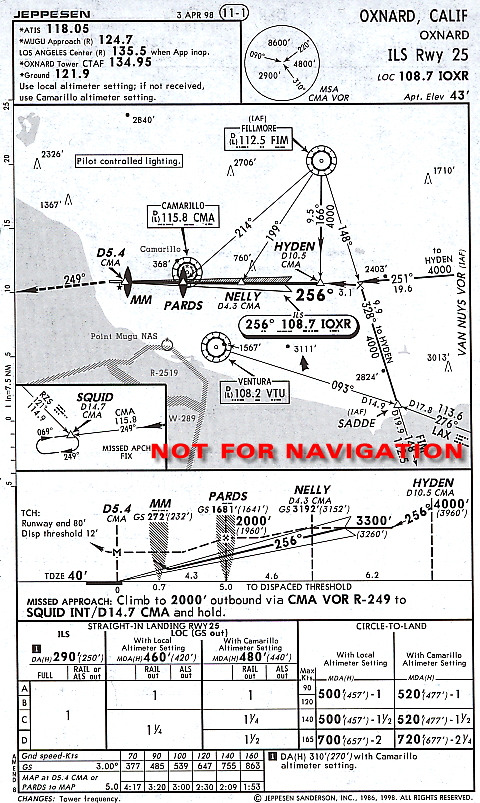
Consider. You are shooting the ILS to Oxnard, Calif. [PLATE], you’re out of 1,000′ AGL,and the GS flag pops up. Quick, where are you in relation to where you would be, if you’d been shooting the LOC-only? You are most likely already well below the proper altitude you should be holding or descending to on the LOC-only approach. So long as you remain on the LOC, you’re okay with regard to the trees, but now you have the task of changing your thinking over to a considerably more complex operation. Where are you in relation to those fixes that determine the step-down points on the LOC-only approach? Have you been faithfully tracking them as you take that long slide down the GS? Should you climb back up to, and level off at, the desired altitude?
It’s not wrong, but you’re adding difficulty to the procedure, and adding a task that is not required by the PTS. Should you stay at the altitude where you lost the GS? Oops, what if that perfectly legal altitude with the GS working is now below the MDA for the LOC-only approach? This would require an immediate missed approach, but would you be legal and safe to climb to the MDA, level off, and continue? This reversion mode is not a requirement of the FAA for the practical test, nor should it be, in my opinion, and it should not be considered for normal day-to-day operations, except for an emergency.
If you are going to plan on continuing with the LOC-only when the GS fails, then you must crank your brain into some kind of a dual mode. One part of your brain must keep track of a precision ILS approach, while the other part of your mind is keeping very close track of where you are in relation to the non-precision LOC-only approach. You must be continuously saying to yourself, “Okay, self, I just passed DUMMY intersection, so the minimum altitude here is 1200′, and I’m out of 1,000′, so I must level off, or climb to 1200′ until I pass STUPID.” Or, “Okay, self, the MDA for the LOC-only here is 876′, and I’m now below that, so I MUST pull up to 876′ (plus or minus 50′), and level off.”
And you think this is a good idea? I think it’s damned stupid, myself. We have enough accidents, already.
What about radio settings? When I’m on a full ILS, if I’ve got two receivers, I’d prefer them both tuned to the ILS during the final (when following the GS). Or, more commonly in GA aircraft, one on the ILS, the other on the corresponding LOC, so that I can cross-check them. What if the LOC-only approach requires tuning a separate VOR off to the side for the fixes? Do I get to have my redundant LOC indications, or must I tune the other facility, for the rare case where I might lose the GS, and have to revert to the non-precision approach? Surely, no one would suggest tuning both to the ILS frequency for the approach, then changing frequencies if the GS fails?Decisions, decisions, decisions…and I have trouble deciding when to turn the seat belt sign on.
Should We Train for This?

Should we train for this? Sure, why not, you might be in an emergency situation one day…perhaps low on fuel, weather getting worse, airplane on fire, and your wife (or girlfriend) giving birth in the seat next to you. Hey, why be half-hearted about this? You might HAVE to switch from the full ILS to the LOC-only, or even to some other non-precision approach that is “close.” Anything goes, in an emergency, when you have to get down. It’s always a good idea to train for things well outside the PTS, but it is NOT PERMISSIBLE for anyone, FAA or not, to ask for anything outside the PTS on a checkride!
Is it a good habit to hit the timer button over the FAF? Of course it is. After all, it’s one of the items on the “Five Ts” reminder, right? I think it is, I can usually only name four of them, most of the time.
All joking aside, if you start a NON-precision approach (including a LOC-only) and fail to start the timer (or note the time), it’s a major boo-boo. Your only recourse is to immediately go missed and start it over. If you perform an approach where timing is required, and you do not time it, it’s a good bust on a checkride, for that is compounding an error with stupidity.
If you start a full ILS, and start the timer over the FAF, you have performed an unnecessary action, possibly distracting you from something more important, while, on the other hand, possibly helping to develop a good habit for other types of approaches. But frankly, I don’t care if someone times an ILS, and the FAA shouldn’t care, either.
Be careful up there!