












 The 747 was nearing the end of the trans-Pacific flight from Tokyo to Anchorage, Alaska, and had begun a descent from Flight Level 370 about 120nm from the runway. The triple Inertial Navigation Systems (INS) had functioned perfectly, and the autopilot in INS mode still held the big bird on a flawless and perfectly straight Great Circle course from the Newenham VOR on the west coast of Alaska to the ANC VOR.
Early in the descent, still on autopilot, still tracking the Great Circle with INS, the crew noticed a bank angle of several degrees developing. Even small bank angles are quite noticeable in the 747, as the attitude indicator is very large, with precise markings, and it is driven by an inertial platform. Unlike lesser instruments, when that attitude indicator shows a half-degree of bank, there really is a half-degree of bank, with never any precession or visible error. The bank angle during this descent varied from barely perceptible to about three degrees; then at the lower altitudes, the bank angle dropped off until the indicator again showed a perfectly level attitude.
All this was quite normal.
Can you think of a reason for that bank?
Another time, a 747 was departing Anchorage on runway 24L, headed for Tokyo. The surface wind was dead calm, and the skies were clear with no visible weather. These flights are considered short range for the 747, so with fuel tanks about half full, the airplane was not very heavy. 747 performance is excellent, and pilots would expect to see the vertical speed indicator show about 2,000 feet per minute right after liftoff. This day, liftoff was perfectly normal, the gear was retracted, and the aircraft started the usual pitch to the climb attitude that would hold about V2+10 or a bit more. (V2 is the desired speed for the initial climb if an engine is lost on the runway at V1, the refusal speed. With all engines operating, we usually climb at V2 plus ten knots or a bit more until obstructions are not a factor.)
At about 200 feet above the runway, without a ripple of turbulence and for no apparent reason, the airspeed suddenly began dropping, and so did the nose. The speed stabilized at V2 minus about 10 knots, while the altimeter slowly unwound. The vertical speed swiftly and smoothly dropped through zero to about 200 feet per minute – down.
In seeming slow motion, the 200 feet gained since liftoff plus a bit more was lost, putting the aircraft below the elevation of the runway. Mercifully, there is a 100-foot-high bluff at the west end of the airport that drops to the surface of Cook Inlet. The crew got a nice up close and personal look at the water that day! At that point, the vertical speed improved to zero, held there for a few seconds, then slowly began showing a positive rate again, after which it quickly returned to the normal 2,000 feet per minute. The entire episode took no more than 60 seconds from start to finish.
Knowledgeable readers will note that this pilot should have pitched up a bit more to stick shaker speed, but that technique had not been invented at the time. I can only wonder what might have happened if the weather had not been clear, or the aircraft more heavily loaded.
A few days later, the same captain, having returned to ANC on another trip, realized the same conditions existed, and elected to use 6L for takeoff instead of the active 24R. Again, the surface wind was dead calm. On this takeoff, at an altitude of less than 200 feet above the runway, the nose pitched sharply up, the airspeed increased by about 80 knots (exceeding the flap limit slightly), and the vertical speed indicator pegged at 6,000 FPM up, with strong turbulence. At about 2,500 feet, the wild indications all returned to normal, and within 60 seconds from liftoff, the adventure was over.
I was the captain on all the above “experiences,” but I’m not the only pilot who has ever gotten into such pickles. Some did not survive to tell the tale, and only the flight recorders preserved the evidence for those.
Many years later, those same conditions at Anchorage would create the same problems, but in addition, they would rip an engine off an Evergreen 747, leaving the crew with massive multiple emergencies. Thanks to a lot of skill and a little bit of luck, they did a superb job of getting the airplane back on the ground safely.
Jet Upsets
In the early days of the jet age, there were several incidents and accidents that were at first very mysterious. Contrary to popular belief, not all of them were at high altitudes. Few if any had anything to do with the so-called “coffin corner” (a vastly overrated theory unless you fly a U-2). Early flight recorders were primitive devices at best, with tinfoil moving past four styli that enscribed four traces in the foil, corresponding to airspeed, altitude, heading, and g-force. Time was determined by the movement of the foil.
Here are the plots of two such early events from 1963, superimposed on each other to show the similarity. As you can see, one crashed. The other didn’t, recovering at a very low altitude.

Author’s Note: Many thanks to Paul Soderlind for the beautiful plots you’ll see here. Paul is the legendary Northwest Airlines pilot who served as Director, Flight Operations – Technical for them for 26 years. He (with Dan Sowa) developed the now-famous TP (Turbulence Plot) system that has given NWA the best record in the world for avoiding turbulence, and he also developed many other techniques in wide use throughout the industry.
The airspeed and g traces are missing, so only the altitude is plotted against time. The similarity between these two and the next two below is due to the fact that all were from exactly the same cause.
In Case A, the altitude is plotted on the scale at the left. The aircraft started at just above 17,000 feet, climbed to just over 19,000 feet, then in only 24 seconds, descended to impact. That’s an average rate of descent of 48,000 feet per minute!
In Case B, the altitude is plotted on the scale at the right, the event peaked at about 35,000 feet, recovered at about 12,000 feet, for a total change of 23,000 feet in 53 seconds, or about 23,000 feet per minute.

707 departing Hong Kong
A 707 departed Hong Kong and followed the profile shown above. The initial climb was absolutely smooth, not a hint of trouble. Just before reaching 4,000 feet, the nose pitched up violently – the crew would later claim “near vertical,” but pilots not accustomed to aerobatics will often call 30 or 40 degrees “vertical” – and the airspeed rose, all within a very few seconds.
Think about that. Right out of the blue, so to speak, the nose pitches UP, and the airspeed increases. As the old advertisement goes, “What would you do … what WOULD you do?” Remember, this was more than 20 years ago, perhaps 30, long before this problem was well understood.
Going through about 6,000 feet, the airspeed began dropping again, returning to the initial value. The wild climb stopped at 8,000 feet, the nose pitched down sharply, and a very steep descent began, with rapidly increasing airspeed. The airplane dove steeply, losing 7,400 feet in about 30 seconds, with the airspeed going some 40 knots beyond the redline (barber pole). Yes, you did the math right – the recovery bottomed out only 600 feet above the water, pulling 4.75g, indicating 480 knots! There would be one more wild climb to 4,000 feet with the speed returning to normal, then another much smaller excursion, mild by comparison.

727 departing Detroit
Finally, this 727 departed Detroit, and followed almost exactly the same pattern as the 707 leaving Hong Kong. Both of these happened within six minutes of takeoff.
These plots are typical of a number of such incidents, and several did not make the recovery at all, with the loss of the aircraft and all aboard. These were chilling scenarios to those flying these magnificent new machines with so much promise.
Of course, the culprit in all these events was wind shear. We’ll come back to them a little later.
Who, Me? Lie?
Wind shear was not well understood until fairly recently, though some old-timers claim they understood it much earlier. Perhaps, perhaps not. Some old pilots are like some lawyers: You know they’re lying when their lips are moving. On the other hand, even the NTSB has learned about it only in recent years. Pan American dumped a 707 in Pago Pago some years back, and it was called “pilot error.” Only after vigorous lobbying was the case reopened years later, and wind shear was found to be a contributing factor, although it had never been mentioned before.
The beginning is often a good place to start, so let’s go back to the basics for a quick review. Take the classic Piper Cub, flying at a constant airspeed of 60 knots, making circles at a constant bank angle. Let us further assume the Cub has a smoke system installed for an airshow act of some sort.
We are going to fly this Cub in calm conditions, then with 10 knots of wind, then 30, and finally 60. Take a look at the patterns this will produce as seen from the ground.
 |  |
On the left, of course, we have the no-wind pattern the airplane will make over the ground and in the air – a perfect circle, with the pilot coughing in his own smoke. An observer on the ground can lie down and relax; the airplane will just come around in the same place each time.
On the right is the ground path made good with only 10 knots of wind, making two circles. Even in the time it takes to get around the circle once, the center of the circle has moved across the ground a significant distance, and our ground observer would have to run along with the wind at a speed of 10 knots to stay in the apparent center of the circle, as the circle itself drifts along with the wind. The running observer would feel no wind at all, of course.

As the wind gets stronger, the patterns on the ground become ever more bizarre, as we see from the 30-knot-wind plot above.
If our hero the pilot is dumb enough to take off with a 60-knot wind blowing, and still makes the same old boring turn, he’ll still be coughing in his own smoke all the way around. He’ll still be making the same perfect circles – in the air. But now the best he can do is make the pattern depicted below over the ground, because with only 60 knots of airspeed into a 60-knot wind, he cannot possibly make any forward progress. He’ll come to a full stop relative to the ground each time he turns directly into the wind, and begin losing ground the instant he starts the turn.

But make no mistake, the pilot will still be flying a perfect circle, still maintaining 60 knots, still the same old bank angle, and blissfully unaware of the wind effect, unless he’s looking at landmarks, or using his navigation radios.
Author’s Note: My thanks to Ed Williams for providing the formulas to plot those winds, using the wonderful graphing capabilities of Microsoft Excel.
From the Ground
An observer standing on the ground in the 60-knot wind would rapidly lose sight of the aircraft. But if he drove straight downwind at 60 knots, the airplane would again be making perfect circles around him, and he’d feel no wind if he stuck his hand out the car window.
If the pilot cannot see the ground and cannot use navigation radios to plot his positions, he will not have the faintest idea of what the wind is doing – or indeed if there is any wind at all.
Finally, if the pilot CAN see the ground, he will see the airplane come to a complete stop relative to the ground each time his heading is into the wind. He’ll see a wild drift angle as he turns away from the wind, and will see the ground whipping by at 120 knots at the 180-degree point, headed downwind. Talk about instant vertigo! A crop duster sees this very clearly, and must learn to allow for it. (Ever notice that you don’t see much crop dusting done in 60-knot winds?)
The “Deadly Downwind Turn”
Since a crop duster pilot rarely (if ever) looks at the airspeed indicator, he will rely on his “feel” for the airplane and the ever-changing visual picture. He must do this to maintain his spacing on each row, so that no spray is wasted, and no part of the field is missed. It is very easy to see the relative motion when dusting into the wind, and to fix that motion-sight picture as “normal.” When turning downwind, looking at the ground up close and personal, the increase in groundspeed will fake the pilot into thinking he’s going too fast, and the temptation will be to reduce power. This will override his “feel” for the machine. But reducing power will reduce his airspeed, and if he’s close to a stall (as crop dusters often are) that may well put him into a stall and a crash. This is the sole reason, the only “truth” for the “deadly downwind turn.” It is purely a VISUAL effect, but don’t discount it. Those who have walked down a stairway with a new pair of glasses will understand just how powerful a purely visual effect can be. Since the early pilots flew only at very low altitudes, this visual effect killed many of them, and this was the genesis of this OWT (Old Wives’ Tale).
On the other hand, when turning into the wind at low altitude, the crop duster will appear (to the pilot) to slow down, and the temptation will be to get the nose down, decrease the bank, and increase power, but this is not dangerous.
A couple years ago, a man with test-pilot credentials wrote an article on this subject for the second-tier aviation magazine for which he was the editor. In that article he maintained vigorously that the airplane had to accelerate and decelerate while flying circles in a steady wind, demonstrating that even experienced pilots can get hung up in OWTs.
Poppycock!
If you find someone who still believes this, have him fly constant-speed, constant-bank circles under the hood on a day with a strong wind blowing, and no view of the ground. Ask him to tell you which way the wind is blowing by “feeling” the acceleration and deceleration. Be sure to make a hefty bet – you might as well make a little profit from this.
Also visualize a boy (or a man, same thing) with a plumb bob at the end of a three-foot string. He holds the free end over his head, and swings the weight around in a gentle circle around himself. Once stable, is the weight speeding up and slowing down? No, of course not. This, in spite of the fact that the whole universe is speeding off in one direction at some incredible speed, the galaxy another, our own solar system is doing its own thing, and our world is spinning at 1,000 MPH while rotating about the sun. The kid’s plumb bob will quietly make a circle as perfect as the kid can turn it evenly. (But picture the actual track of that weight relative to the universe!)
Put that kid on a 747 in cruise at 500 knots – does his plumb bob speed up and slow down each time around? Not as far as he’s concerned. This proves every man is the center of the universe. That’s my story, and I’m stickin’ to it.
We can now make a hard and fast rule: “Airspeed and aircraft handling are not affected by any steady wind, no matter how strong.”
Changing Winds
Things get a bit more complicated if the wind changes, however. As a thought experiment, picture a giant fan with shutters that can be opened and closed instantaneously. We fire this fan up with the shutters open and run it up until it is producing 60 knots of wind. Now mentally picture our Piper Cub flying into that wind (never mind how it gets there) at 60 knots and whatever cruise power setting it takes to hold that airspeed. As part of the thought experiment, picture the throttle as fixed (welded) at that cruise power setting for the remainder of this exercise. The groundspeed, of course, will be zero and let’s give it an altitude of, oh, say, 10 feet.
Note that airspeed (60) plus wind (-60) equals groundspeed (0).
Now, picture what happens if we instantly shut the wind off. Mother nature does this, too, thus proving that women …er, nevermind, let’s not go there. The mass of the Cub cannot possibly accelerate instantly, so the airspeed drops to zero.
Again, airspeed (0) plus wind (0) equals groundspeed (0).
The moment the wind stops, the power we have set will tend to accelerate the aircraft, but since the Cub has mass and limited power (VERY limited power), it cannot accelerate from zero to 60 knots very quickly with just cruise power set. As a result, the Cub will simply stall at the zero airspeed and fall to the ground – rather hard, too! With the same cruise power set, no big fan, it will start rolling, will eventually fly, and then will get back to 60 knots airspeed (and groundspeed, with no wind). Just how we get the fan out of the way while the Cub takes off on its own is left as an exercise for the reader, of course.
In fact, that Cub will take just as long to accelerate back to 60 knots as it would if you did a deliberate takeoff by setting only cruise power.
Prop aircraft are generally “speed-stable” in that if you disturb them from the stable condition, they will tend to return to the original speed. If we shut that wind off very slowly, the natural speed stability of most prop airplanes will automatically correct things for us. If we drop the wind speed by 1 knot, the airspeed of the airplane will drop exactly one knot right along with that, but then the natural speed stability of the prop airplane will kick in, and will regain the loss, albeit slowly.
Remember the power-required curves, where it takes more power to maintain a higher speed, and less power to maintain a slower speed. When the Cub drops a knot of airspeed, the power doesn’t change much, so it tends to return to the original speed.
So, the rule now is: “If the wind (headwind or tailwind) component changes more quickly than the aircraft can accelerate (or decelerate), then the airspeed must change to make up the difference.”
Or put another way: “An instantaneous change in the headwind/tailwind component will produce an equal and instantaneous change in the airspeed.”
Finally, an increasing headwind (or decreasing tailwind) will cause an equal increase in airspeed. A decreasing headwind (or increasing tailwind) will cause an equal decrease in airspeed.
Now let’s go back to the fan and reset the condition of a 60 knot wind, 60 knot airspeed, and zero groundspeed. Let us suddenly increase the wind to 120 knots. The mass of the Cub cannot instantly accelerate backwards by 60 knots; it will take some finite time to do that. During that time, the airspeed must rise to make up the difference. If the wind changes instantly, the airspeed changes instantly, and by exactly the same amount.
Airspeed (120) plus wind (-120) equals groundspeed (0).
From the new speed of 120 knots, but no change in power, the airspeed will fall off at the same rate that it would if you dove to 120 knots, with the power set for 60 knots, and leveled out. After some time, the airplane would end up moving backwards at 60 knots, back at 60 knots of airspeed.
Airspeed (60) plus wind (-120) equals groundspeed (-60).
This effect can actually be seen very well in an aircraft equipped with inertial navigation systems if the airspeed indicator has a small enough resolution. The 747 has the conventional airspeed indicator with a needle, but within that instrument there is a Mach indicator window with three digits behind the decimal point. At a normal cruise, it might be showing 0.860 (for 86% of the speed of sound). If the headwind at altitude increases by only 1 knot, that digital indicator will instantly jump to just under 0.862. That Mach indicator is actually a very sensitive indicator of changes in headwind/tailwind!
The thrust from a jet engine increases with speed, so when a jet’s speed is disturbed by outside forces, the airspeed will tend to remain at the new value. For any significant wind change, the thrust must be reset to regain the speed, then reset back to the original value to maintain it. This used to be a royal pain in the early 747s, until we got auto throttles that do that little chore for us.
Big Wind Changes
Just how fast can the wind change? Have you ever felt the sudden outrush of cold air from an approaching thunderstorm? Look at this plot of a microburst on the ground at Andrews Air Force Base, near Washington DC.

Coincidentally, it occurred just a few minutes after Air Force One landed with then-President Reagan on board. The wind increased by 98 knots in less than two minutes, dropped off about as quickly, then peaked again at over 60 knots as the cell passed overhead! BOTH bursts were in operation within two miles of each other! The president sure dodged a bullet that day!
Also, think of the eye of a himacane (that’s a heracane with a male name … and no, my spell checker doesn’t think it’s funny either). Just yards inside the wall, the wind can be calm, but at and outside the wall, it can be blowing 200 knots! Now, THAT is wind shear! There are many, many situations where the wind can change in seconds, dramatically so. It can change during climb or descent, or with just horizontal flight. If you fly through the division between the winds, the effect on the airplane can be quite dramatic, equal to the change in wind.
A change in wind direction can be just as catastrophic as a change in speed. A change in direction from a direct headwind to a direct crosswind, for example, will have the same effect on airspeed as a drop in wind speed to zero.
For reasons I don’t fully understand, several times a year at Narita’s New Tokyo International Airport, there will be 60 knot winds only 1,500 feet above the airport (generally across the runway), and very light winds at the surface. That’s a bit disconcerting, and you’ll hear pilots passing the outer marker and watching the horrendous drift angle ask the tower, “Confirm the wind?” There are really no topographical features anywhere near that airport to cause this, so I’m content to consider that one of the mysteries of life, along with nuclear fission, the stock market and women.
But there is another less-understood effect from a sudden wind change, and this lies at the heart of most, if not all the early jet “upsets.”
Picture yourself flying into a strong increasing headwind as that 707 did, after taking off from Hong Kong. They are in a stable climb in a tailwind of 21 knots when they suddenly pass through some sort of layer into a headwind of 25 knots – a 46 knot change in just a few seconds. All of a sudden, the indicated airspeed has jumped 46 knots with nothing to tell the crew what is happening. What many do not realize is that at this point, if the aircraft was in trim before the wind shear, it is now 46 knots above that trim speed. This will cause the nose to pitch up, and even strong pressure forward on the yoke will not feel like it’s doing enough to hold the nose down, much less get it back down. What would be the natural thing to do? Most pilots will instinctively hit the trim switch on the yoke or activate the trim levers to help get that nose down. During the 30 seconds it took for that shear to occur, they were probably trimming the whole time. That’s more than enough time to drive the trim to the full nose down position.
Just as the airplane completed the transition from one air mass to the other, natural stability and the pilot’s efforts finally brought the nose down. The momentary relief they must have felt must have turned to sheer terror, because as the nose dropped through level, they were back at the original climb speed and original in-trim speed, but now with the airplane trimmed full nose down! The pilots would have been frantically pulling back on the yoke, and they probably hit the good old trim switch again, this time the other way.
Now at this point, there may be a couple of unknowns. With full nose-down trim at high speed, the hydraulic (or electric) motors that drive the leading edge of the horizontal stabilizer up and down (see “Pelican’s Perch” #27) MAY not have been strong enough to drive it against the rapidly building airflow. Additionally, since the elevators were being partially blanked by the abnormal position of the stabilizer, they may not have had much effect. Obviously, this 707 out of Hong Kong did have powerful enough trim actuators, because it recovered. Several others may have stalled, or even just slowed the trim motors a bit, and crashed before the crew could regain control. While it is extremely difficult and counterintuitive, the best recovery technique in this case is to relax the back force on the yoke, relieving the load on the stabilizer trim jackscrew, allowing full-speed trimming. Pretty tough to do, though, in a near-vertical dive!
The two events at ANC above should now be a little clearer. In the first, we encountered an increasing tailwind shear of close to 80 knots. I can see some of you shaking your heads now, saying that with a calm wind at the surface, there is NO WAY we are going to get 80 knots only 300 feet above the surface. Just another old pilot with his lips moving, right?
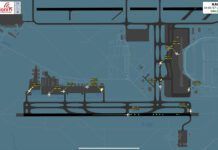
No. It’s a phenomenon rather well known to local pilots, there’s even a name for it, which I do not recall. It doesn’t occur often – I’ve only seen it four or five times in 30 years – but when it does, it’s “really interesting,” in the Chinese sense. Note the chart of the local area, please:

If an intense low pressure area forms southwest of Anchorage, the counterclockwise circulation will sometimes be just right to blow from the east at just the right angle, straight west through Turnagain Arm, funneling through the gap between significant mountains, gaining speed, and blowing right past the southern edge of the ANC airport. There is a low hill along the coast there, which tends to shelter the airport, possibly by deflecting any wind up and over the airport. But when this condition exists, there is literally the core of a jet stream, on the surface, blasting down that arm as depicted, leaving the ANC airport in a very small protected area.
Had we flown directly from the calm wind at the airport, into the 80-knot tailwind, we would have very suddenly been well below the stalling speed, and a crash would have been unavoidable. You would not be subjected to my writing efforts today. However, by penetrating the shear line horizontally at a slight angle (pure luck!) it took longer to get into the full 80-knot tailwind, giving us enough time to accelerate at almost the same rate as the effective tailwind was increasing. Additionally, by descending (not on purpose!) we may have avoided flying into even stronger winds above us.
On the second takeoff from ANC a week or so later, while standing on the ramp, I observed some low clouds just streaming across the airport, while the wind on the surface was calm. With the previous takeoff in mind, I insisted on taking off to the east, and was ready for the rapidly increasing shear. Knowing it was there made it fun – we just took the E-ticket ride, let the nose come up a bit, and went our merry way. I should have let the nose come up even more, but as I recall, we had more than 30 degrees, and that felt like “enough” to me in a 747.
Wind shear ALWAYS affects the airplane, but it may not affect the speed. The opening story of the bank angle illustrates this. When we started that descent, there was a very strong jet stream blowing across our track at a right angle, or nearly so. We had about 20 degrees of drift or more when we left cruise altitude, as I recall. At some point during the descent at 3,000 feet per minute or more, that wind started dropping off, and within a couple of minutes, there was no longer much crosswind at all. How did the airplane react to this? Since the autopilot was coupled to the INS, it was maintaining a perfect Great Circle track across the ground. If we started out with 20 degrees of wind correction angle, and ended with none, the only way the two-axis autopilot has to correct the heading is to bank for the turn. (Virtually all modern autopilots are only two-axis, never three. Some may have a yaw damper installed, but that is not part of the autopilot system, and will not correct for this situation.)
So all the time the crosswind was changing, the airplane HAD to bank to maintain the track.
Something similar happens in simple heading mode, although it’s less noticeable. The change in crosswind will tend to weathervane the airplane into the wind, and the pilot or autopilot will have to bank away from that to maintain the heading. If you have trouble with this concept, remember the airplane flying through the eye of the himacane, and plunging into the wall. According to Newton, the airplane will try to continue in a straight line, but very suddenly, it will have a 200-knot crosswind component that must be accounted for. That will actually weathervane the airplane around into the wind, while the heading mode can only correct that by banking.
Please note that I have not even mentioned vertical winds, yet! All the above incidents were pure horizontal wind shear.
For one final example of what Mama Nature can do to the unwary (or unalert) pilot, take a look at this oddball plot.

The altitude trace at the top of the plot shows FL 350, probably with a crew that was “out to lunch.” In a 14-minute time span, the OAT rose by 15 degrees Celsius, or 25 degrees Fahrenheit. Big deal, you say? Yes, it is, because the rise in temperature caused the jet engines to produce less thrust at the same thrust lever setting, and the speed fell off gradually until entering stall buffet. At that point, the crew properly got the nose down and dived about 4,000 feet while picking up speed again. This is called a rude awakening! It’s also a good argument for auto-throttles.
Bad Air
Finally, I’ve always remembered a discussion I overheard about 50 years ago among the “airport bums” at the Sarasota-Bradenton airport, where I was a hangar rat from age nine. The discussion was over “The Deadly Downwind Turn,” a subject still debated today (see above). When it was all over, a local old grizzled former crop duster wagged his finger at me and said, “John, you just remember, there is sometimes BAD AIR out there.” I did not realize at the time just how profound that remark was. He had been arguing that the downwind turn was hazardous (and he was right), and the others had been arguing that wind did not affect airplanes in flight (they were right, too). Different perspectives.
Watch out for those “bad air days.” (Oooooh, Deakin, you’re BAD.)
Be careful up there!