





























I‘m a little nervous writing stuff like this, because I am acutely aware that not all readers are the same. Some will read this column by itself, without reading the material in previous columns that has led up to this point. Some don’t care about the dirty details, and simply want to know what to push or pull and when to do it, without any desire to understand what they’re doing, and why. Some may skim the material, figuring they know most of it already, and some may use a procedure “out of context.”
I can only ask you to be careful when using this material. That’s true of anything in aviation (or life itself!), but a bit more so in this area. A thinking pilot is always the best safety device in any airplane, and if a thinking pilot also has the practical knowledge to go with it, so much the better. In many ways, these engines are far more rugged than many believe, but ignorance or a few moments of carelessness can easily do major damage to an engine, with potential catastrophic results to the airplane. The potential for damage is even greater with supercharged engines of any type.
Finally, this information is heavily slanted towards the engines built by Teledyne-Continental Motors (TCM). The basic principles of combustion are the same for all spark-fired, gasoline-powered, four-stroke engines, from your garden tractor to the monstrous Pratt & Whitney R-4360 of bygone days. However, some of the details differ, with some slightly different limitations. It is impossible to cover them all, and since all recent development work that I’m familiar with has been on TCM engines, those are the ones we’ll talk about.
If you are not prepared to study and understand the underlying principles, I do not believe you can safely and economically operate these fire-breathers, and frankly, I wish you wouldn’t read this stuff at all. I’m not trying to be elitist here, just trying to warn the unwary. As someone said, “A little knowledge is a dangerous thing.”
Come to think of it, this may be one reason there is so very little material of this kind “out there.” Maybe no one wants to stick his or her neck out!
Review Material
For your information, I have listed previous related columns. If you have not read them, this would be an excellent time to do so. They are the foundation for this current column, which has a lot of “advanced material” in it.
- PP #15: Manifold Pressure Sucks!
- PP #16: Those Marvelous Props
- PP #18: Mixture Magic
- PP #19: Putting It All Together
- PP #31: Those Fire-Breathing Turbos (Part 1)
- PP #32: Those Fire-Breathing Turbos (Part 2)
I am hoping to incorporate all those and a good deal more into a book soon.
For those who do not understand this material, I strongly suggest you simply follow the advice in your POH, or that published by the STC holder, and do not adopt any other “special” techniques until you fully understand why you are doing something differently.
There is also no need to change your whole lifestyle, here! Set up your usual power setting in cruise, somewhere around 65%, and play with the ideas here. At that power setting, you cannot hurt your engine by playing with the mixture, RPM or MP. This will allow you to validate these concepts on your own, and become comfortable with them.
Old Books
I try to keep a ready stock of some of the old books I’ve reprinted and that I’ve mentioned here before. I do this at no profit, mostly for the warbird groundschool classes I do. By reprinting them in larger quantities and selling them to anyone interested, I can sell them to all at lower prices. The information in them is timeless, as valid today as it was in the days of the big recips – or a garden tractor. For complete (and updated) information, please see:
Pelican’s Perch — Old Books & Publications
All come with a no-questions-asked, money-back guarantee, although I’m pleased to say no one has been that unhappy yet!
Modern “Instruction”
I really, truly wish I could say “Go get some instruction on these techniques from a good CFI.” I really do. But the sad fact is that you are far more likely to get bad information – even dangerously bad information – than good information in the areas discussed here. Most of the current crop of CFIs are a terribly inexperienced lot, and since most modern “flight instruction” is nothing more than teaching the trainee how to pass FAA multiple-choice knowledge tests and “canned” practical tests, there is little to no real teaching getting done, and none at all beyond the basics. Even if you find a very experienced instructor at your local airport, the chances are he (or she…I’m an equal opportunity insulter) has been doing the same old instruction for many years. At the criminally low rates we pay our CFIs, they don’t have the time or the inclination for advanced study themselves. Once a new instructor gets the CFI tickets, he or she will probably not see any serious advanced instruction until he gets that “real job”…flying turbine equipment.
The same comments apply to most of the manufacturer’s “tech reps” you will find available to you. Some of these guys have been around for years, parroting the same old “Old Wives’ Tales” (OWTs), born of hearing some other old-timer telling them what he thought…also with no data. For example, there are still a few tech reps out there that will mumble something about warranties becoming invalid when an engine is run lean of peak (LOP) EGT, but the real folks at the factory don’t say this, and there are no known records of warranties ever being denied for this reason. Indeed, some of the engines are required to be run LOP, and both TCM and Lycoming have stated publicly that running LOP will not invalidate the engine warranty. In spite of this, one Lycoming tech rep bellowed several times within a few minutes at me, “I wouldn’t recommend lean of peak to my worst enemy!” Tech reps are often too busy passing out old advice to read the company line, or like many people, they will never change their opinions, no matter how incorrect they may be.
That’s not to condemn all CFIs, or all tech reps. But the really good ones are few and far between, and I suspect most of the good ones will agree with my comments about the bad ones.
Sadly, each user must determine for himself or herself who is putting out the straight scoop, and who isn’t. Be skeptical, always. Including when reading my stuff, for I’ve been wrong, too. I’ve rather gotten to enjoy eating crow!
What Happens When You Move That Knob
I’d like to very briefly review a couple of key things, here. This is mostly because I have a few dynamite charts just fresh in – a couple from GAMI, and several from my own data. Much of this information is in the charts and text published in previous columns. However, in this column I would like to present it a bit differently, more the way I think you should mentally picture it during actual operation. For example, we could (and did) talk about the numeric ratios of fuel and air for various power settings. But in flight, I don’t think of them in that way, I look for the reactions I see on the instruments, and the effect on the machinery.
Throttle, from Open to Closed
The first “action, reaction” I’d like to cover is what happens when you pull the throttle from fully open to fully closed. Obviously, the throttle plate (“butterfly”) moves from a position “edge on” to the airflow to a position where it almost fully blocks the flow. At first there is almost no change in the MP…then as you continue to retard the control, it starts dropping faster and faster. This is due to the geometry of the closing valve.
You need to understand that when you open the throttle, you are simply allowing the engine (and supercharger, if installed) to pull in more air, and in general, produce more power. When you close the throttle, you are depriving the engine of air. That’s why they call it a “throttle.”
It is also important to realize that with throttle movement, you are probably also changing the mixture ratio, even though you’re not touching the mixture control. On these high-performance engines, full throttle gives a richer mixture than partial throttle. The relationship between the throttle position and mixture may not even be linear outside that high-power range. In other words, suppose you have a part-throttle power setting of 60% power with a “best power” mixture, and you pull the throttle back to some lower setting. You will probably not have a “best power” mixture setting at this new throttle position, and may need to adjust the mixture for the fuel/air ratio you want if you’re going to stay at that setting for some time. The most important example of this “mixture change with throttle” is the common power reduction right after takeoff from full throttle (and quite rich) to 25 inches of MP (much leaner), which has been “sort of standard” for so long. Making this power reduction is almost universally a “bad thing” to do, but if you’ve been taught that way, and have always done it that way, it’s really hard to accept that.
Think about it. Has anyone ever told you why you should (not!) pull the MP back to 25 inches after takeoff? Have they told you what happens inside the engine when you do that? In my personal opinion, this very old power setting (“25 squared”) is a carry-over from the big radials where we have a “Maximum” power (usually limited to something between one and five minutes) and a “METO” power setting (which is “good forever.”) My guess is that the “old hands” coming off the big radials onto the flat engines just felt terrible about running them wide open, and just had to make up some sort of “lesser power.” Just a guess, but it has always been a bad idea on the high-performance flat engines.
Moving the throttle does not normally affect the RPM, since we are talking mostly about constant-speed props. But the converse is not true: Changing the RPM can have a major effect on the manifold pressure (MP). Depending on the circumstances, and whether you have a supercharger or not, an RPM change can move the MP either way, and you should understand why. Changing RPM can have an effect on the mixture, too (fuel pump turns faster/slower, for one thing), as well as the effective timing.
You need to have a good idea of what is happening in the combustion chamber when you change any engine control in flight. The normal mixture control is, of course, the mixture knob, but with the above in mind, you must realize that the mixture can be changed in many ways, and all these changes can have a major effect on the combustion event.
Mixture, from Rich to Lean
If the mixture is full rich and you begin to lean it, a number of things begin to happen. Most obvious to you in the cockpit, and the fastest indication of all, is exhaust gas temperature (EGT). As the mixture is manually leaned from full rich to “too lean to run” with everything else staying the same, EGT will first rise, peak, and then fall…with a very abrupt transition, a very sharp peak. This rise and fall is fairly symmetrical with fuel flow. That is, if you construct a chart with fuel flow across the bottom, and EGT up the left side, then plot actual EGT for an engine at a constant power setting as you change the mixture, you’ll find a very tidy picture with the outline of a nice, symmetrical mountain, fairly straight slopes, and a fairly sharp peak. Because the EGT responds so quickly to the smallest inputs, we depend on it for changes and trends, but generally speaking, we should not pay much attention to the absolute numbers. EGT is a somewhat phony measurement to start with, because it is averaging the temperature of a series of “pulses,” often right outside the exhaust port of a single cylinder.
Many turbocharged engines have a turbine inlet temperature (TIT) indicator, which shows the temperature of the exhaust flow after the exhaust from all cylinders has been combined, and just before it enters the turbine. This is a much more meaningful indication of the actual temperature of the exhaust gas, because this sensor “sees” all six pulses after they have mostly been damped out by distance. This very real temperature is important for long turbo life, so it must be monitored, and the limits should never be exceeded.
Moving only the mixture knob, you will change the power produced. From full rich at sea level, power will increase very slightly as you lean, it peaks around 80F ROP, then starts falling off very slightly. (For the remainder of this article, all temperatures cited will be expressed in degrees Fahrenheit.) But once leaning goes beyond peak EGT, power falls off in direct proportion to the change in fuel flow.
Moving only the mixture knob, you will change the cylinder head temperature (CHT), albeit much more slowly than EGT. CHT will peak at a mixture setting of about 35 rich of peak EGT, give or take a few degrees. The “slope” of the CHT curve on the rich side will be a bit shallower than the slope for the EGT curve, but that is not important to this discussion of pilot operating technique. We’ve picked some of this stuff to death in previous columns; this one is for practical use, in the airplane.
In summary, as you pull the mixture knob out, first the power peaks and falls, then CHT peaks and falls, and finally, the EGT peaks and falls. Run through this in your mind until it is firmly fixed, it’s very important.
“Fire in the Hole!” – The Combustion Event
Very few people understand that the combustion event is a variable and controllable process, and that a pilot can have a very large effect on it – well beyond simply “more fire” or “less fire.” Even though combustion appears to be nothing more than a rapid series of explosions, most of us realize that it is actually a process that takes a finite amount of time (measured in milliseconds). Fuel and air is introduced, compressed to about 300 PSI, and fired with a spark well before the piston reaches the limit of its stroke at top dead center (TDC). In most of our engines, that spark is set to fire somewhere around 20 of crankshaft rotation before TDC. The resulting fire takes a little time to get organized and spread from the spark point throughout the combustion chamber, while the piston finishes its upstroke. The fire should start burning pretty seriously right after the piston hits the top of its stroke, and the longer it can burn, the better, at least until just before the exhaust valve opens.
Any burning that takes place before TDC is not only not productive but counterproductive, since it resists the turning crankshaft, and represents a net power loss. I’ll call it “negative power” here.
In a perfect world, for a perfect power stroke, we’d like as little pressure in the combustion chamber as possible before TDC, then we’d like a very steady maximum pressure of about 800 PSI from TDC to the point where the exhaust valve pops open. (Think of 850 to 1,050 PSI as a very rough long-term structural limit on the cylinder heads and pistons, and all associated moving parts.)
Alas, physics intrudes. First, as the next picture shows, the mechanical motion of the crank and connecting rod dictate that the piston motion in the cylinder is very slow at the top and bottom of its stroke when the crank throw and connecting rod are aligned with each other. The piston motion accelerates to “very fast” at mid-stroke, as the crank throw passes 90 to the connecting rod. This mechanical advantage can be seen clearly in this illustration:
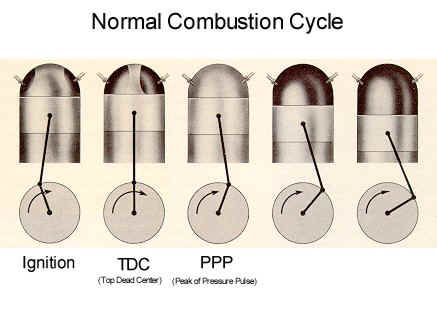
My primary purpose in showing this picture (again) is to emphasize the geometry of the moving piston, the crankshaft “throw” and the connecting rod between them.
In the first picture, the piston is approaching TDC, and is located roughly where the spark fires. Due to geometry, compression is almost complete, because the piston has just about reached the limit of its travel, even if the crankshaft has another 20 degrees to go to TDC. This means the combustion chamber is very, very small, and it doesn’t take much to drive the pressure up to very high levels. Any buildup from combustion at this point is “negative power,” for it resists the crankshaft motion.
The second picture shows TDC. Any pressure in the combustion chamber produces no power at all on the crankshaft, just very high forces on the cylinder head, cylinder hold-down bolts, piston, wrist pin, con-rod, crankshaft, and engine case. Hmm, seems like I just mentioned the whole engine! Excessive force in the combustion chamber at this point is very harmful to the entire engine.
In the third picture, as the piston falls away from TDC (very slowly at first) the combustion event pressure builds very rapidly, and produces real, useful power. As the fuel and air burns off, and the piston starts falling away more rapidly (again, due to geometry) the pressure drops off again, as quickly as it rose. The longer we can prolong that pressure, the better.
With a little math, confirmed by actual measurement on a test stand, we know that no matter what the power setting, the very best point for maximum pressure (“Peak Pressure Pulse” or “PPP” or “theta”) to occur is about 15 to 18 after TDC. This is “best” in the sense that it transfers the most possible power from the burning fuel and air to the crankshaft and prop. However, it may not be “optimal” given other considerations, such as the structural strength of the cylinder and variations in fuel octane ratings.
For now, let’s simplify it and just call it 18 past top dead center. That’s important. There will be a quiz, later. Seriously, there’s no way you can read this in the cockpit, so I hesitate to suggest this as a “memory item.” But it is so central to the whole issue of engine management, we need some sort of working number to talk about it. This value of 18 is not optimum for all conditions, but for as long as we have to put up with fixed timing, it’s an excellent working average. In the future…well, we’ll talk about that another time.
It’s All About Pressure
If we plot that pressure on a chart, with degrees of crank angle across the bottom, and pressure up the left side, it looks like this:
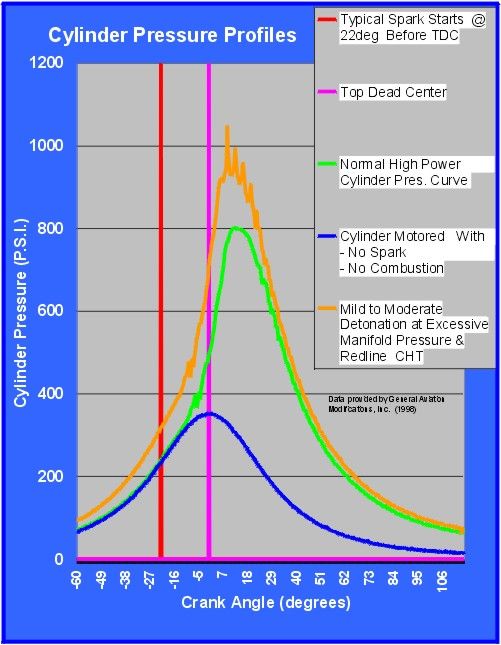
The vertical red line is the spark, the pink is TDC. The blue curve is the pressure you might see with “no fire,” the green is the pressure pulse with normal high power, and the orange is detonation, about which, more later.
The real key point here is that any change in mixture (by any cause) or any change in RPM will change not only the total pressure attained, but the location of the peak pressure point past TDC. It also changes the shape of that pressure pulse.
Follow me through here, this is really important. Just as EGT and CHT will rise, peak, and then fall as the mixture is leaned, the speed of the flame front will be “slow” at full rich, it will speed up as you lean, reach a maximum at about the same point the CHT peaks, then it will slow down again as the mixture goes leaner.
Click for a higher-resolution graphic.
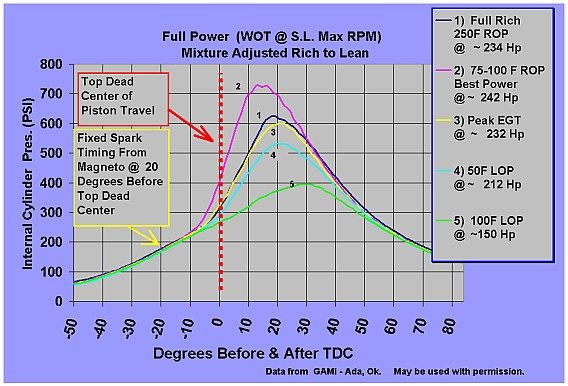
Here is a spectacular graph, with data from a real, running engine. Please don’t skip over this picture! Understanding what this is showing you is central to this whole issue of engine management! Take the time to stop, follow me through on this chart, and understand it. If you won’t, or can’t, then please forget all that you read here, and just operate your engine as the manufacturer, the tech reps, or your 300-hour-total-time instructor taught you. I don’t want you blaming me for a destroyed engine!
The GAMI folks have an IO-470 heavily instrumented on what is probably the most sophisticated test stand in the world. I can sit in a hotel room anywhere in the world, and have full control over that engine, and record the data from it in real time, over an Internet connection. Magic, pure magic.
This data was from one run, starting with (1) full power, full rich, then changing to (2) 50 ROP, then on to (3) peak EGT, (4) 50 LOP, and finally, (5) 100 LOP. Nothing but the mixture knob was changed. LET ME SAY THAT AGAIN: NOTHING BUT THE MIXTURE WAS CHANGED.
I could do a whole column on this picture alone, and it is the prime reason why I have chosen to do this “review.”
The points of interest on all these traces are:
- Horsepower (listed in the text box to the right),
- Peak pressure height (read from the left side of the chart),
- Peak pressure location (read along the bottom of the chart),
- Spark timing (-20 – i.e., 20 before TDC),
- Pressure rise from compression, then additional rise from combustion, and where it occurs,
- Overall shape of the pressure event.
Please look carefully at each trace in turn, noting these points.
Please look at the black (or dark blue) trace, also labeled “1.” This is the starting point, at wide-open throttle (WOT), full RPM, and full rich mixture, as on a normal takeoff. Note the text at the right side of the chart shows the actual horsepower output is 234 HP (100%, for this engine, this day). This a very tired, terribly abused test engine, and it just won’t make the full rated 260 HP. Note the peak of the pressure pulse is about 625 PSI, and it occurs at about 18 after TDC. Note the pressure rise doesn’t really change much when the spark fires, it takes a significant amount of time and crankshaft rotation to get going, finally showing some effect from combustion at about 2 or 3 BTDC (before TDC). That little rise is a net loss, but it is probably not really significant.
Now, compare the other traces one by one, point by point. The purple trace (2), the highest one, is leaner than 1. Of course, you should never see this condition at high power. We have leaned the mixture without changing anything else, to about 50 rich of peak EGT (ROP). This is a terrible thing to do to an engine!
Still looking at (2), we have increased the HP output and peak pressure to about 245 HP (105%) and 725 PSI, respectively. Remember when we lean from full rich towards peak CHT, we increase the speed of combustion, i.e., the flame front moves faster. The evidence of this is plain to see in this trace, the fire gets organized faster, and the pressure starts to rise much sooner before TDC, rises much more steeply, and peaks much sooner, at only about 12 or 14 ATDC (after TDC). It is striking the top of that poor piston like the hammer of Thor. Note how much pressure is exerted BEFORE TDC – all of it “negative power” which must be made up with pressure ATDC. We are making this poor engine work a lot harder than the 10 measly NET HP we’re getting! The ugly little wiggles at the peak of this trace are probably the early stages of detonation.
The yellow trace (3) shows a far more benign picture at peak EGT (and how many of you always thought peak EGT was “worse” than 50 ROP?) HP is back down to about 2 HP less than the HP at full rich, and the peak pressure is only about 600 PSI. The peak pressure occurs at about 22 ATDC, which is not a bad place for it. Not the best point for maximum horsepower (which is probably between 16 and 18 ATDC), but on the whole, a heck of a lot better than the purple trace (50 ROP), above.
The blue trace (4) is 50 LOP, and is nearly perfect from an efficiency point of view. We’re only getting 212 HP (90%), and the peak pressure is down to about 530 PSI. Note there is little or no “negative power” being produced, as the pressure from combustion does not start to increase until very close to TDC. Remember the geometry: Any pressure in the combustion chamber within a very few degrees of TDC is translated into internal forces in the engine, and is neither “negative” or “positive” power. That purple line is producing a lot of “negative” power, though!
Finally, the green trace (5) should be self-evident by now. 100 LOP, 150 HP (65%), peak pressure is way down to 400 PSI, and the pressure peaks at a whopping 30 ATDC! There is minimal “negative power” in the area just before TDC at this very lean setting.
In summary, at full throttle and full RPM, changing nothing but mixture, we can easily vary the actual power setting between 245 HP (105%), and 150 HP (65%)!
Now, consider for a moment. Remember these lines are showing pressure in PSI within the combustion chamber, NOT the HP. (For the techies, HP can be calculated by numerical integration of the areas below each line, as well as measured directly on the test stand.) Compare the black line (250 ROP) at 234 HP, and the yellow line at 232 HP (peak EGT). Both are producing just about equal amounts of power, right? The lean setting produces about 35 lower CHT (that’s not a typo).
That’s where we’re running when we suggest LOP operations, folks. Leaner, cleaner, and cooler.
The Perils of Throttling Back to “25 Squared”
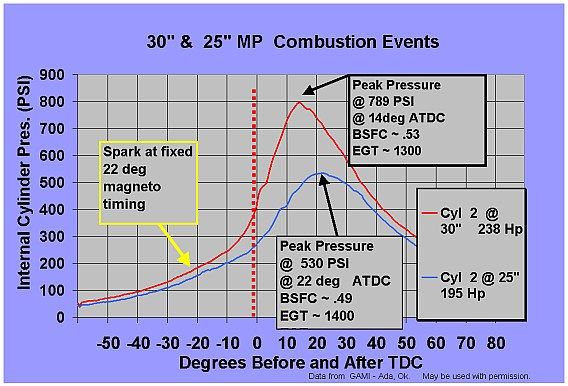
The mixture control is not the only control that affects the mixture. Here’s a picture of what happens to that power pulse if you take off with full power (as you should), and simply reduce to 25″ MP (as so many of us did for so long, and shouldn’t have).
Click for a higher-resolution graphic.
The red trace is full normal takeoff power, full rich, 238 HP on this tired IO-470 engine. The blue is after pulling back the throttle to about 25 inches MP and 195 HP, with no other changes by the pilot. The peak pressure drops, and moves to a “better” angle. That sure looks good at first glance, right? But note the EGT, which translates into a big increase in CHT as well. EGT at the lower power setting is 100 hotter! On many of these engines, leaving it there will often run the CHT far over 400, possibly leading to what we’re calling “thermal runaway.” We believe only a short-duration severe “thermal runaway” – just once – can destroy an engine and probably lead to failure on that same flight. Repeated “mild” thermal runaways will almost certainly do long-term damage. Yes, many got away with this initial power reduction for many years, but the overhaul statistics aren’t very good, either.
Reducing RPM
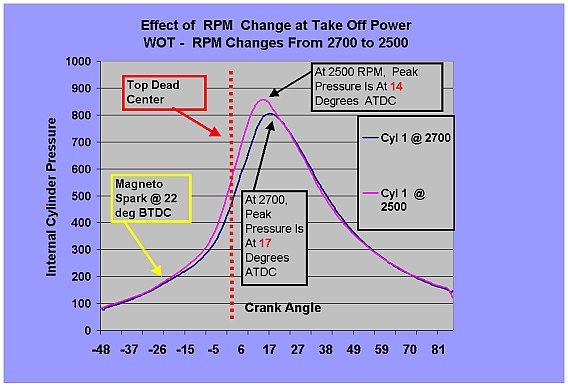
Finally, RPM may change the mixture a bit, but it has an even greater effect on the power pulse. Here’s a series of pictures showing what happens to the power pulse when you reduce RPM only.
Click for a higher-resolution graphic.
Only the RPM is changed, the throttle and mixture control settings remain the same.
Why does the power pulse change so much? By changing the RPM, we are changing two things: the effective timing and the effective mixture.
First, effective timing. The spark lights the fuel-air mixture off at the same physical point of crank rotation (20 BTDC), and the flame front moves at the same speed (in feet per second) throughout the combustion chamber. However, the piston is not moving at the same speed (in feet per second). At reduced RPM, the crankshaft is turning more slowly, and it takes a longer period of time for the piston to rise to the top and fall again, while the combustion is taking place at the same high speed. Net effect, the peak pressure occurs at an earlier angle. Note also that the peak pressure is higher, but the HP is lower. This power loss is from the additional “negative power” produced before TDC, and the change in the angle of the crankshaft (less mechanical advantage) at peak pressure.
Second, reducing the RPM also leans the mixture a bit, which also accelerates the burn time of the mixture, having an effect similar to advancing the timing slightly.
This chart shows the classic reason for the rule-of-thumb, “Always reduce MP before reducing RPM.” It’s really only critical at very high power settings, but over the years, it has become a mantra for all settings. There are a few exceptions to the “rule,” where the engine manufacturer has gone to the trouble of certifying the engine for an RPM reduction first. The old IGSO-540 on the Twin Bonanzas and Queen Airs were like this, and the modern IO-550 is certified for the Germans at 2500 RPM (285 HP) instead of 2700 (300 HP). Reduce RPM first at takeoff power on engines that have not been tested for it, and you’re a test pilot again.
In summary, it’s probably best to just leave your engine at full takeoff power, period. In my personal opinion, noise is such a major issue these days, I consider it worthwhile to pull the RPM back 200, and risk slightly greater wear and tear on my engine. Your mileage may vary. But please quit pulling the MP back to 25 inches!
Detonation
It is now becoming evident that we did not know as much about detonation as we thought. (I am at least speaking for myself, here!) The classic explanation of detonation involves the entire contents of the combustion chamber rising to a temperature where it all “explodes” at once. That simply doesn’t happen. Even some of the old literature refers to “light, medium and heavy” detonation. If the mixture all blows up at once, how can there be such a variation? There is much more to the story, but that will have to wait for another day, and another column, perhaps. For now, I’ll say only that a little detonation now and then is not only not harmful, but probably beneficial.
I’m out of time and space this month, to be continued next. Patience!
Be careful up there!

Can you please fix the images in these articles? Every single image is broken, probably because they’re still hosted in their old “http” location as opposed to “https.” This requires a great deal of imagination and assumptions by the reader when reading descriptions that refer to various charts and images. This is invaluable content and I’d like to make sure I fully understand this before I start operating my PA32RT-300T LOP and over square with the help of my GAMIjectors and JPI EDM-700.
I’m experiencing the same issue as mentioned in the previous comment in all the “Pelican’s Perch” articles (#31 through #36).
Is the issue related to retrieving content from an older database and has some information been lost in the transfer to your newer setup?
Or, do I perhaps need to change some settings on my iPad?