





 It suddenly occurred to me that I’ve never done a column on my all-time favorite airplane! How could I have so neglected my old sweetheart? My logbook reveals that I have 1,864.08 hours in this old classic, second only to the 747 time, which we won’t count because it’s a nosedragger, it burns that stinky kerosene, and it screeches, instead of rumbling like a real airplane.
Why, I remember the old C-46 like it was only yesterday.
Waitaminnit. Deakin, you fool, it WAS only yesterday, and you were training in it all last week! Oh well, I guess short-term memory is the first to go. One good thing about this Halfsheimer’s, I’m getting to the point I can now hide my own Easter eggs.
Anytime I talk or write about old “Dumbo,” it is very personal. I cannot explain it, but then again, I’ve never understood why some men love some women.
First Memories
 Click on photo for higher resolution. Photo John Dibbs |
My first memories of the Curtiss-Wright C-46 “Commando” are from 1949, when I was about nine years old. Dad had gone bankrupt in New Jersey, and we moved to Florida for a new start. The only place he could afford was an abandoned Army barracks on the far southeast corner of the Sarasota-Bradenton Airport (SRQ). It had been a military training base during WWII, and like so many such airports, had been declared surplus and turned over to the local authorities, in this case the two counties (Sarasota and Manatee), and the two cities after which it was named (much to the disgust of Bradentonians, who felt they should have come first, and who persisted in calling it “Bradenton-Sarasota,” probably to this day).
I loved the place, primarily because it was less than a mile from the flight line, and my old red bike made that a quick trip after school every day. By day SRQ was a fairly busy little general aviation airport. The FBO was J&J Aviation, run out of another converted Army barracks next to a huge hangar that could hold more than 50 small aircraft (when I stacked them, anyway).
I can still hear in memory three distinct sounds from my bed in that barracks building. The Florida rain on the tin roof of the carport outside my window, the lonely late-night moan of the train whistles as they passed a half-mile east of us crossing Desoto Road, and a strange, groaning, screaming sound that I imagined to be a Tyrannosaurus Rex, or something even larger. I wasn’t far wrong, either, but I didn’t get to see what made that sound for many months. It was the squealing brakes of a C-46 belonging to a South American airline named Aerovias Sud Americanas, or “ASA” for short. ASA was a cargo line, and had a schedule that often brought them through SRQ. Legitimate cargo, I might add, no one had ever heard of marijuana in those simpler days, much less the harder drugs.
One day, I arrived at the airport as usual, and was awed by quite the biggest airplane I’d ever seen. I knew this was the T-Rex I’d been hearing all those nights. It had broken down the night before, and had to wait for parts to come from the main base in St. Petersburg. I never dreamed that I might one day fly one, and was content to just hang around and listen to the people working on it that day. I still remember some discussion of the pilot, one Lou Lehman, as one fellow related that he had observed a check ride with Lehman flying, and he spoke in reverence of his having “split the runway” on an ADF approach. I didn’t even know what an ADF was, but it was obvious that Captain Lehman was a true sky god. I never even met him, but I still remember that name, more than fifty years later.
Growing up in Florida, and learning to fly there, I saw other C-46s, but most of them gravitated to boneyards, most notably “Corrosion Corner” at Miami. They always drew my eye, but I never thought I’d fly one, for they were dying fast and I was still at the Cessna 310 and Twin Beech level, longing to fly anything bigger.
Air America
In 1963, age 23, I joined Air America with a brand-new DC-3 type rating, with NO idea what I was doing, and absolutely no inkling that Air America was “The CIA’s Secret Airline.” All I knew was it was overseas, and it was a flying job. My tickets were on Northwest Orient Airlines, and I rode the cockpit of the Boeing 707-320 the entire trip to Tokyo. I must have been a terrible pest, that night.
From Tokyo, I rode “The Golden Worm,” the magnificent Convair 880 belonging to Civil Air Transport (CAT). I didn’t know it at the time, but CAT was a secret sister company of Air America. All I knew was that the stewardesses were the most gorgeous women I’d ever seen, all from high-class mainland Chinese families, and all wearing tight-fitting Cheongsams, the silken Chinese dress with the slit up the side to the hip. I was in love, three times over. But they were a very standoffish lot, and very few of our guys ever got to know them.
After “indoctrination” in Taipei (the headquarters base for the spooky airlines run by the CIA), I was off to Bangkok on the Golden Worm again (so named because of the ornate Chinese dragon stretching from the nose to the tail, on a background of gold. It was the most beautiful paint job I’ve ever seen on any airplane). By this time I knew that CAT and Air America were somehow related, and I tore myself away from the visions in the cabin to spend most of the flight in the cockpit, talking to the “Old China Hands” flying it. I think Felix Smith was the captain that day, and he recently wrote a wonderful book, “China Pilot.”
After an overnight in Bangkok, I proceeded to the Don Muang Airport to catch a lift to my new duty station in Vientiane, Laos. Lo and behold, my ride was to be a shiny, immaculate (but stripped out inside) C-46! At last, I would actually ride in one! At the time, the C-46 was the ultimate airplane in Southeast Asia, although “The Company” also operated DC-4s and DC-6s out of Tachikawa, Japan. I dreamed of flying it, but only the most senior pilots could do that, most of them “Old China Hands.” The C-47 (DC-3) was the next most senior, and I was relegated to the right seat of that airplane for the next three months.
In one of my many lucky strokes of fate, a captain’s slot on the Twin Beech opened up in Saigon, then the most undesirable station Air America had (no overtime, no hazard pay). But it was a checkout as captain, so I grabbed it. There were other good reasons to get out of Vientiane, but we won’t go into those here. This was late 1963, and little did anyone realize that Saigon would soon be “in the news.” It wasn’t long before C-46s and C-47s were moved into Saigon to support the growing conflict, and “The Company” went on a huge hiring spree to fill the seats. This created opportunities for me, and after brief tours in other airplanes, I got to fly the C-47 as captain for a year or so, and finally got the seat of my dreams in a C-46, checking out as captain on June 10, 1965. The first time I sat down in the left seat and pulled it forward, I was at home, for the 1,000 hours of Twin Beech time, and another 1,000 of C-47 time were excellent preparation.
Many Missions
 Click on photo for higher resolution.
|


The C-46s in Vietnam served several major tasks, and many minor ones.
One was picking up supplies in the port cities and large airports (Saigon and Danang mostly), and flying them to Hue, Qui Nhon, Quang Ngai, Ban Me Thuot, Kontum, Pleiku, Dalat, and many others. These supplies were food, medical supplies, clothing, animals for food and breeding stock, concrete and perforated steel planking (PSP) for airport runways and ramps. One common food was bulgur wheat, a very nutritious food. But the indigenous people wouldn’t eat the stuff, would rather starve to death, so most of that was wasted, or fed to animals.
Another common mission was to evacuate villagers from one area, and relocate them to another. The press of the day made a huge deal of this, crying about the mean old USA uprooting folks from their homes, but the reality was that those folks were fighting to get on the airplanes, and more than once we had to resort to violence to stem the human tide fighting their way up the ladder. The C-46 was usually fitted to haul about 40 people in a normal passenger configuration in the USA, but all of us had well over 100, in real panic evacuations. Most of the evacuees knew they wouldn’t survive the night if they didn’t get out.
All the up-country strips were considered “hot,” and we had several standard techniques to minimize the risk of friendly and enemy fire. Friendly? Sure, many of the kids carrying guns were straight out of the jungle, and had NO idea what those things were that were flying around, and it was great sport to shoot at them. There were often US Army Special Forces “A Teams” at these airports, and more than once one of them would meet the airplane and apologize for the friendly fire.
We would arrive at 3,000 feet agl over the strips (which were almost always 3,600 feet long, and 3,600 feet above sea level, 100 degrees, and often wet from recent rain) and spiral down in very tight turns with about 45 degrees bank, just a few knots above the stall. Time it just right on a very close, tight base and final, and plop the airplane in the first 50 feet of the runway, fully stalled, three point, and often slip and slide right to the end of the runway. With a nice dry runway, and good braking, the C-46 would stop in about 1,200 feet, but we didn’t get those very often, with morning dew, or tropical rain in the afternoons. Very hot asphalt can be pretty slickery, too!
Takeoff almost always involved a steep turn right at liftoff, and a tight circle while gaining altitude to about 3,000 feet before proceeding on course. A few didn’t believe in doing that, and some of them didn’t survive.
The grand old C-46 took all that in stride, and treated me very well. With no weather reporting, few navaids (the airplanes had ADF, but there were very few ground stations), and no brains, we cheerfully flew through any type of weather, including the big wet thunderstorms so common there. Since the C-46 is not pressurized, and has many leaky cockpit windows, there was usually more rain inside than out, and ponchos draped over the crew and the console were normal.
By my final C-46 flight on December 6, 1966, I had 1,548 happy hours on old Dumbo, and thought I had left her behind forever as I left Saigon to move to Tachikawa, Japan, and the larger four-engine DC-4.
30 Years Later
 Click on photo for higher resolution image. |
Now we fast-forward to late 1995, and early 1996. I’ve long been a regular on Compuserve’s AVSIG Forum, and during that time frame, a fellow named Randy Sohn joined the forum. It quickly became apparent that we had crossed paths in Tachikawa, as he’d flown KC-97s through there in the late sixties, and had seen the immaculate, polished aluminum, often unmarked DC-4s and C-46s there. It quickly came out that I had flown and instructed in C-46s, and still thought of them as my all-time favorite airplane. Randy is a longtime member of the Confederate Air Force, and served as Chief Check Pilot for many decades. He sorta mentioned that I just might be interested in visiting the Southern California Wing of the CAF in Camarillo CA (CMA), where they seemed to be a mite short of pilots for a flying C-46! In 1996! Good grief!
I was there in short order, drooling all over the airplane. On March 10, 1996, almost 30 years after last flying one, I took to the air again in my beloved old steed, with the legendary Noel Merrill Wien in the right seat as instructor. It was as if I’d never been out of the seat, and the memories just came flooding back. One of the highest compliments I’ve ever had in my life was right after the first takeoff, when Merrill turned to the guy in the jumpseat and said, “I think we got us a C-46 captain, here!”
Within a few months I was back in the saddle again, flying, instructing, and giving check rides in “Old Dumbo,” just as before. It was like falling in love with an old school sweetheart all over again. We’re both a lot older, a lot creakier, and we don’t do any of the wild and wooly things we used to do together. Don’t tell anyone, but there’s a lot of silly sentimentality I try to hide. One of my first trips was to the Watsonville show, and on the way back I flew down the relatively unpopulated valleys inland from Santa Barbara. It looked JUST like Vietnam there for a short time, but perhaps I didn’t see it too well, there was something in my eyes.
At airshows, I’ll often have the privilege of watching an old gent climb into the cockpit, and somehow I’ll just know that he flew them, long ago. I try to leave these men alone with their memories, good and bad.
Folks, I apologize for running on and on about myself, this is about the C-46. But there is a long and very personal history here, and I guess my fingers ran away with that.
China Doll
 Click on photos for higher resolution images. Photo John Dibbs
|


N53594 is now known as “China Doll” (renamed from “Humpty-Dumpty.”. The nickname refers to the nose art, a scantily-clad young oriental lady painted by one of the Wing’s wives.
That painting gets a lot of favorable attention from the men at shows, and fairly frequent pot-shots from some of the modern females who are quite offended. It’s odd, but the ones who seem to be the loudest and most offended are usually the fattest and ugliest ones. Human nature, I guess.
Alas, political correctness raises its head everywhere, and we take heat on two major issues. The first is the name, “Confederate Air Force.” This started forty years ago, when a couple of good old boys in Texas acquired a couple of surplus fighters, and someone spray-painted those words on one as a joke. The name stuck, and the organization grew into one of the premier aviation museums in the world, with over 140 airplanes from WWII, about 120 of them flying. But the name has negative connotations to some, and has cost the CAF a lot of money that might have been donated. Most of us have grown very weary of explaining to potential members and donors that the name has nothing to do with race, slavery, segregation, or bigotry. Very few are convinced, so it will finally be changed later this year. I’m deeply sorry to see the name go, but go it must if we are to survive.
The other issue is the lady on the nose of our C-46, and as far as I’m concerned, may she live forever. We all get a kick out of the occasional outrage at airshows.
My sweetie (no, the airplane, silly!) is a 1945 model C-46F that never got outside the USA, except for a brief time in the Caribbean. Like all C-46s, it was delivered to the military, for no civilian C-46 was ever built.
The aircraft was rushed into production for the war effort, without being properly tested, leaving 20-year-old fledgling pilots to do the real test flying. The results were not pretty, and many were lost, gaining the airplane a somewhat undeserved evil reputation. Many made the mistake of thinking it was nothing more than a big C-47, until they tried to fly it. There were early problems with the heaters, which had an unfortunate tendency to blow up, and with the Curtiss Electric props, which were not well understood. Today, the FAA will not allow Curtiss Electric props on anything, unless it is the only possible configuration, and then only with an Experimental Certificate.
Later, N53594 was sold as surplus, later passing through a number of rinky-dink airlines and operators, ending up as a bug sprayer, with huge tanks in the cabin, holes chopped in the sides, and wingtip-to-wingtip spray booms underneath (we can still smell the malathion when we open the door after she’s been closed up for awhile). After that, it sat derelict for a time, and the CAF bought it in 1981.
The Southern California Wing volunteers have been restoring it ever since, and it just keeps getting better. I get to work on it once in while when no one is looking, but generally, they just let me fly it. I don’t even to get to do that much, for we now have a great roster of pilots, and I mostly instruct and check in it. As Randy might say, “I cain’t fly it worth a hoot, but I shore can recover!”
It is powered by two of the ubiquitous Pratt & Whitney R-2800 engines, with this model of the famous engine producing 2,000 HP (more than 120 models of the R-2800 were built). During production, it was the largest twin-engine airplane ever produced, with a wingspan of 108 feet (four feet larger than a B-17), and a civilian gross weight of up to 48,000 pounds (there is data in the military manuals for 66,000 pounds). It literally towers over a B-17 on the ramp. It will haul 15,000 pounds of cargo into and out of 2,500-foot unimproved runways, a job it is still doing today for Everts Air Fuel out of Fairbanks. They’ve found no other airplane that will do the job as well. There are less than a dozen of them left flying in the whole world, out of a production run of about 3,500. More than 700 were lost on “The Hump,” the terrible supply route from India and Burma into China, over the Himalayan Mountains. Wreckage is still being discovered, high in those hills, and families get the final word on what happened to Granddad.
On the show circuit, the C-46 is often mistaken for a C-47/DC-3, which it vaguely resembles. (Well, it does have a tailwheel and two engines!) It is, however, twice the airplane. I joke about it being twice the weight, hauls twice the load, holds (and burns) twice the fuel – and the pilots are twice as good. That’s more than a little true, for while the DC-3 is known as an easy airplane to fly, the C-46 is widely feared for its ground handling characteristics. But for those who have significant time in both, almost all prefer the C-46 by a wide margin. Then again, pilots almost always like the airplanes they fly a lot, even the DC-10.
Airshow FAQs
Airshow visitors have several common questions.
“Does this thing fly?” “Yes,” (patiently), “it flies very well, we do about 30 shows a year with it, a lot of training, and numerous photo missions as a camera ship.”
 Click on photos for higher resolution images.
|

We also get to do some fun things under waivers, like the recent dedication of Crissy Field near the foot of the Golden Gate, where we airdropped over 5,000 chrysanthemums at the appropriate time. We had reports later that everyone at the ceremony left with a mum, so I guess we hit the target well enough. These pictures are not faked in any way; one was taken from the left over wing exit on one pass, the other from the right on the second pass. (We often fly with those hatches removed, for cooling.)
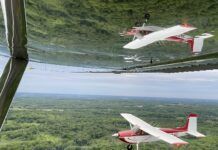
China Doll is also getting more and more popular as a camera ship at big warbird events, especially at the big annual Confederate Air Force event in October, at Midland Texas. We fly in the show, and also do several photo flights. With the jump door and the waist hatches removed, the man door open, and cargo nets over the openings, we can handle about 12 photographers per flight. We normally rendezvous at some prominent local landmark and set up a big left-hand circle with a fixed bank angle. The angle isn’t too important, but maintaining it certainly is, for when a number of aircraft are in a formation, the tiniest change has a “crack-the-whip” effect. As the aircraft arrive, they form up on our left, where the photographers in the man door can take pictures with the ground for a background. Then I’ll call ’em to move to the right side in the order needed, where the photographers can shoot them against the sky, the favored shot. Someone in the cabin will have a handheld with a headset, so the photographers can call for “three feet down,” “two feet out,” etc., or for a different formation entirely. It’s very intense, sweaty business for everyone, but the pictures are wonderful. More and more, as I open up the magazines and calendars with warbird pictures, I recognize shots that were taken from Dumbo.
China Doll went along with the recent reenactment of the famed Doolittle Raid on Tokyo. Twelve B-25s in formation closed down both San Fransicso and Oakland airports while doing a low flyby over the old Hornet, the carrier from which the original raid on Japan was launched. We went along as the camera ship for that flight, and most of the pictures you’ll see of that event were taken from China Doll.
We’re also getting into dropping parachute teams to open airshows. Under CAF rules, we’re only allowed to drop pro or military teams, so we have to turn down the requests we get for sport jumpers.
Just as in the original airplanes, we have a heavy-duty cable running from the front of the cabin to the rear, and two large, bright lights in the rear that we control from the cockpit. We put 500 MPH tape all around the jump door so that no one can get hung up or scratched on the way out, load ’em up, and go, often climbing to 13,000 feet or so for the jump. There are a multitude of FAA and CAF rules we must follow, of course, and extensive briefings so that everyone knows exactly what will happen.
We dropped a really neat group from Fort Bragg, a Special Forces demo team. When it came time to jump, we could hear the screamed commands all the way up in the cockpit. I’ve tried, and I can’t yell loud enough to be heard from anywhere in back, even with the door in! They go through a regular drill, screaming out commands and responses, and when that stops, we know they’re ready. The jumpmaster will usually hang his head out the door, look forward under the wing and give us heading commands if we are dropping from high altitude, but on the low altitude (1,500 feet) simulated combat jumps, they jump on our command. On the final run-in, we turn on the red light, and when we want them to go (or they are going to call their own) we hit the green, and out they go, yelling all the way. There is almost no change in pitch as they leave, it’s a big airplane, and their leaving has very little effect.
On the other hand, one of the favorite tricks with a new pilot flying is to get about four or five heavyweights together in back, and have all of them run from the front of the cabin to the extreme aft end, into the “orchestra pit.” Now THAT will change the CG! (The orchestra pit is so named because the floor level is about 18 inches lower than the main floor, for about the last eight feet of the cabin, like the orchestra pit at a musical.)
The airshow questions continue:
 Click on photo for higher resolution image. |
“Is this a DC-3?” “No, it’s a much larger airplane, it’s a C-46.”
“Why is the floor sloped?” “Because that’s the way they made the old airplanes, with tailwheels, as God intended airplanes to be made.”
(Just think of a 747 with a tailwheel! Now, THAT would be an AIRPLANE!)
“What’s THAT?” (Pointing to the right front corner of the cabin.) “That’s a gasoline-powered generator, original equipment on this airplane, also 56 years old. It still runs, too, producing electrical power to charge the batteries, and to help start the engines. It was originally located in the belly, but too many airplanes were lost from fires, so we put it up here to keep an eye on it when it’s running.”
A Quirky Old Bird
Just taxiing the old bird is a challenge. One recent trainee didn’t make it 100 feet, hollered, “You’ve got it,” and fled the cockpit before it stopped. To his everlasting credit, he watched, and learned, thought about it for a few weeks, then came back and did a fine job on his second try. He’s not the first, and he won’t be the last.
There are several problems that make ground operations difficult.
The center of each pilot’s seat sits well outboard of the rudder pedals, so the pilots sit cattyslanchwise, feet pointing in at an angle. The long, sloping (glass) windshield has a bit of distortion, and the visibility over the nose with the tail down is none too good. In fact, not running into anything on the ground becomes a full-time job for both pilots, and some trust is required. The power brakes are very powerful (except when hot, when they fade badly) but very delayed. When they do take effect, they’re grabby, so applying them smoothly is an art. Finally, the rudder is totally ineffective below about 60 knots. Need I mention there is no tailwheel steering, and the airplane has a mind of its own?
With all this, the new C-46 pilot will see the nose start to swing, and will apply a little rudder to correct. Old Dumbo smiles to herself, and swings a little faster, ignoring the rudder like it never existed. He adds more rudder, but the airplane has the bit in her teeth now, and is swinging rapidly, perhaps with one wheel already off the pavement. The rudder hits the stop, and the he finds out why I told him to set the rudder pedals WAY back, uncomfortably close when neutral, because now he has full rudder and can’t reach the brake on that distant pedal over there in the next county. (The C-46 rudder pedals have the largest “throw” I’ve ever seen.)
It’s not really that difficult, it’s just “different,” and when properly done, the old beast trundles docilely right down the middle of the taxiway with the distinctive C-46 gallop. It feels like flat spots on a tire that have taken a “set,” but the airplane will “gallop” right after multiple touch and gos, too, so that isn’t it. It helps to split the power a bit to counter any turning tendency, and the brake hydraulics will emit a soft hissing from time to time, with just the smallest touch to keep it straight. Oddly enough, China Doll’s brakes don’t squeal like those old ASA airplanes did. I’ve always wondered why they made such a noise. Perhaps they were made from different material in those days. I’ve heard the same noise from the C-97 and C-124, but not many others.
Primary directional control on takeoff is with differential power, a really new concept to the jet-jockey airline pilots trained on nosedraggers. You simply cannot keep the throttles together while you advance the power, and stay on the runway. In a strong crosswind, the throttles will be separated by as much as six inches, and you might not get full throttle on the upwind side until long after the tail is up, and passing 60 knots or more. Brakes are absolutely prohibited on takeoff, it’s too easy to flat-spot and ruin a $2,500 tire, so we require heels on the floor during takeoff and landing (that’s true of most of the old airplanes). The remaining aid for directional control is aileron. That’s right, aileron, those big old 24-foot things fifty feet out there on the back end of the wings. Partner, you ain’t seen adverse yaw until you’ve flown some of the old airplanes like the C-46. Remember when your first flight instructor demonstrated that if you input roll alone, the nose swings the other way at first? That’s why God invented feet, to use the rudder and control that yaw.
The old-timers used to teach steering the airplane on the ground with aileron, but it’s highly counterintuitive, for you must learn to steer it “backwards.” That is, if you want the nose to go right, you must apply left aileron. With a little practice, anyone can learn to do that, but when things really go to hell, the instinct from driving cars for years will come to the fore, and you’ll input the wrong aileron, with disastrous results.
It’s far better to just roll aileron into the wind as needed, and hold it there. The control wheel is very large (for better leverage) and roughly semicircular like most airplanes. It is also located very close to the pedestal, with not enough room for a knee. That’s no problem with the ailerons and rudder neutral, but the only time either is neutral on the ground is passing through it. Rotating the wheel towards the pedestal opens up room for the knee when that rudder pedal is back, but with the wheel rotated away from the pedestal, the wheel blocks the space needed for the knee.
While I’m at it, let me rail against those who want a “wind check” from the tower on final, and then fly the airplane accordingly. I’ve had trainees try to land the airplane crabbed the wrong way, based on what they think the tower said! Towers can misstate the wind, people can mis-hear it, and the wind can be very different in both power and direction from where the tower measures it! The wise pilot will ignore the “reported wind,” and apply control as needed to make the airplane do what it should.
It is far better to just crab down the final, look at what the airplane is doing coming into the flare, and input control as needed to align with the runway and stop the drift at touchdown. If you do that (in any airplane) you’ll have the control inputs correct, and all you’ll need is “more” for the rest of the landing roll as the speed drops, and controls become less effective. Note this does not mean I recommend a final with the wing down, and crossed controls! That’s a dreadful technique for normal operations, although it does have good training value for new students. Just for completeness, this technique won’t do with airplanes with pod-mounted jet engines (747), or minimal prop clearance (B-29). In those airplanes, pilots must “kick the crab out,” timing it just right to align with the runway as touchdown occurs, and before the airplane can begin a drift.
Adverse Yaw 101
We use the “adverse aileron effect” to good advantage for directional control, usually cranking in full aileron into the wind before we begin the takeoff, and again as we slow after landing. Think of a crosswind from the left, for example. We rotate the wheel fully left, which lifts the left aileron, and drops the right, right? The raised left aileron rides in the lee of the wing, reducing lift and drag, but the drooping right aileron is down in the airflow, creating more effective wing camber, more lift, and more drag. The left crosswind tends to hit the tail and weathervane the nose left, but that dragging aileron pulls the right wingtip back, partially offsetting the wind. So the takeoff in a left crosswind begins with full right rudder, full left aileron, and leading left throttle. As the airspeed picks up, and the tail comes up, the aileron is allowed to blow back towards neutral (or a wheel will lift off), the trailing throttle can be slowly equalized, and last, the rudder can be relaxed. In reality, it’s a lot “busier” than that, but that’s the idea.
On a crosswind landing, the process is reversed. Touchdown is made on the main gear, tail-low, power off. Then the real work begins, as rudder effect is lost. Very quickly, new C-46 pilots learn that those little wussy rudder movements they usually use in other aircraft just won’t do the job in this one! They have to immediately shift into a “BIG RUDDER MODE.” Usually, when rudder is needed, you’d best just slam that pedal to the stop, and hope it’s enough. As the speed drops, more aileron is applied into the wind, and if necessary, a touch of power is added on the upwind side. Easy, it just takes a little getting used to. Okay, okay, a lot of getting used to.
The new C-46 pilot really has a problem on landings because he’s sitting so crooked, and there’s nothing to align with the runway. Things tend to happen rather fast in the flare, so I brief, “If you hear me say, ‘more right rudder,’ it means that you still have some drift, and you really, really need to get more rudder in, and also correct with some left aileron.”
If you touch down with anything more than a slight crab in a C-46, you’re going to get a very violent swerve, in the worst possible direction, into the wind. Picture that left crosswind again, which will mean you’re crabbing to the right down final, nose left, to stay aligned with the runway (the center of the runway, please). The main gear touches down, and instantly tries to carry the airplane to the left, while the mass of the airplane wants to prove Newton’s laws of motion, and go straight. The crosswind only adds to that, and it doesn’t take a lot of crab at touchdown to simply lose the airplane. Sod or dirt runways make all this a LOT easier as the tires slide a little, but we rarely see one, all are hard-surface, sadly.
Contrast this with a jet transport, which can be landed in a full crab with impunity. Old Isaac’s rules apply again, but this time, with the center of mass forward of the main gear, the nose swings nicely into alignment, entirely by itself (not good airmanship, of course, but it does work). Why, with the little rudder they need, I’m surprised the boys and girls who fly those kerosene stinkpots have the strength in their legs to walk! I’ve even heard that Airbus Industries is trying to adopt the Ercoupe controls to the Airbii line, hoping to do away with rudder pedals entirely. Maybe just one big brake pedal, “stomp for stop.” You’ll see this as soon as the authorities declare the inventor of the Ercoupe was French.
The C-46 three-points wonderfully, and it’s very impressive to see this big machine do that. But none of us get enough practice to do it well, so we cheat and touch down on the main gear, as policy. A botched three-point is much harder on the airplane than a botched wheel landing. The guys at Everts will laugh, for they do nothing but three-points – a dozen times a day, or more, so all this stuff comes naturally to them without even thinking about it.
Inflight, the C-46 becomes quite the normal airplane, if a bit heavy on the controls. Early models had hydraulic boost on some of the control surfaces, but those systems were complex for their time, failure-prone, and oddly enough, the controls were even heavier with hydraulics normal. With the boost off, the controls felt like they were set in concrete. The F model was made with “spring tabs,” (aka “Flying tabs”) and is much lighter on the controls. Many of the earlier ones were converted at one time or another.
Clean stall, gross weight (48,000), power off, is around 79 knots, and full flap stall at max landing weight (46,800) is about 10 knots less. Our old rule was one knot per 2,000 pounds. Using some power dramatically reduces stalling speed, and while the airspeed indicator is probably not too accurate in that range, we’ll see 55 knots or less with a full-flap, lightweight, “some power on” stall. A full stall will produce a heavy buffet, and a straight nose drop, and recovery is very conventional. As in most airplanes, don’t use ailerons in the stall, due to the adverse yaw effects.
Since we usually fly with the overwing exits out for maximum crew cooling, there is another unintended but very effective stall warning system few folks have seen before. At the stall, the “bubble” of low pressure air above the wing rises to the level of the waist hatch, and creates a very strong suction, and all ears will pop from the sudden drop in pressure.
The Takeoff
Because ground handling is so difficult, we rarely get to do touch and gos, although the airplane certainly does them well. Pull the flaps up, set the trim, and go. But trainees need the practice at keeping the airplane on the runway during the takeoff roll, and even more so on the landing roll, so virtually all our landings are full-stop.
There were never any certified V-speeds on normal C-46s. No “blue line,” no Vmc, V1, V2, Vx, Vy, etc. Many chief pilots couldn’t live with this, so they conducted their own rough testing, and picked some speeds that worked well enough, and with which they could browbeat trainees and checkees. But anyone who uses them is kidding himself, and possibly developing a dangerous thought process. Having published “V-speeds” also means that a “V1 cut” is required on check rides, and I’ve had quite enough excitement in airplanes, thank you very much, we don’t do those, anymore. Without published V-speeds, the FAA does not allow even the simulated failure of an engine in flight below 500 feet on a check ride.
The old manuals usually call for a “minimum safe single engine speed,” and it’s generally around 95 knots, or “close enough,” and that’s what we use.
(Some C-46s were heavily modified, and certified under the old CAR 4b for transports (Everts has one working on a Part 121 operation, today!) Those do have true V1 and V2 speeds, along with appropriate charts. Those speeds are NOT good to use in the unmodified aircraft.)
Under CAF and FAA rules, we use full rated power (2,000 HP, 52″, 2700 RPM) on ALL takeoffs, regardless of weight, a very good idea in ALL piston-powered airplanes.
With just a little help with forward elevator, the tail wants to come up around 40 knots or so, and with a little experience, we learn and hold a fixed attitude, slightly tail-low.
Somewhere around 80 knots the airplane obviously wants to fly, and we let it do so, holding the attitude at which it lifts off. The moment the airplane is off, that 80 knots instantly becomes 88 knots, as there is a built-in error in the pitot system when in ground effect.
Still maintaining the liftoff attitude, we allow a gentle climb and a gentle airspeed increase, and we accelerate to 95 knots. With that, and only when positive there will not be ground contact, pull the gear. Pulling the gear is the signal to everyone in the cockpit that we will continue flying with an engine failure. Before that, we’ll probably put it back down. We continue to hold that same liftoff attitude and accelerate to about 105 knots, then pitch up gently (VERY gently) to hold that speed. Jet pilots have a LOT of trouble with this concept, and invariably they will haul the airplane off the ground and “rotate” to a nose high attitude as they do on the job. That is DISASTER in any old prop airplane, for the performance is simply not there.
(There is also NO SUCH THING as “Vr” or “Rotation” in a prop airplane! That is strictly a jet certification term, and has several very specific meanings that do NOT apply to props! I always get a chuckle out of the idea of “rotating” any prop airplane, especially something like a Cherokee.)
The Climb
As the gear comes up and the situation stabilizes at around 105 knots, we usually call for the first power reduction, to “METO” (Maximum Except Take Off) power, or 44″ and 2550. When heavy, we’ll delay that a few more seconds, to help gain altitude to protect from an engine failure.
At about 300 feet when light, or 500 feet (or more) when heavy, a second power reduction is usually used, to 36″ and 2300 RPM, or “Climb Power.”
105 knots makes an excellent pattern speed during the climb, and in level flight. The airplane seems to like that speed, using about 25 inches of manifold pressure and 1800 RPM on downwind, level. Any faster speed tends to overrun other VFR traffic in the pattern, and slower than 105 knots brings on problems with an engine failure. Trainees will almost always lose 10 knots while they struggle with the airplane, and while 95 is fine, getting slower will cause control problems with one engine at high power, and one windmilling.
The Approach
Trainees quickly learn that if they let the speed drop below 95 knots anywhere on downwind or base, or if they get below the glide slope, it is certain that I’ll cut one, and equally certain he won’t make the runway. They will not want a second demonstration!
The Landing
The best way to fly the airplane is to stay WELL above the electronic or visual glide slope, and keep 105 knots and NO flaps to somewhere within about a mile of touchdown. At that point, full flaps can be extended, and the power eased back a bit, allowing the airspeed to slowly drop off to about 75 or 80 knots over the fence. Somewhere in the flare, it is best to completely close the throttles, and land power off. There is a tendency for the nose to drop, but a little back pressure handles that, as on almost any airplane. There is plenty of time to “feel” for the runway, and land in a slightly tail-down attitude.
Under NO circumstances should C-46 pilots aim for a touchdown on the end of the runway. It’s too easy to misjudge and “stub your toe” on the runway lip, and I’ve seen that happen too many times. Aim for the numbers, or where the numbers should be, or beyond.
Depending on the vertical speed at the moment of touchdown, the airplane’s tail may drop. The tail is very heavy, and again old Isaac’s laws come into play. The gear stops the vertical speed of the gear, but the heavy tail wants to continue down. That may increase the angle of attack enough to make the airplane fly again, which is probably not a good idea. If the landing is a squeaker (a better term would be “squaller,” for the tires will emit a low-pitched yelp of some duration on a really good landing, while the tires come up to speed), there will be little tendency for the tail to continue down. With an “impact,” the tail wants to come down a lot, and that leads to the famed C-46 bounce.
The Bounce
The downside of doing wheel landings is that bounces happen. A lot. Handled properly, a bounce is no big deal, but most manage to snatch defeat from the jaws of victory, and make them worse. The worst possible solution is to try and “pin” the airplane by pushing the yoke well forward, raising the tail, and keeping the airplane on the ground. One person who used to instruct in China Doll before I arrived preferred this technique, and one day managed to nail both props. I understand he walked away, and was never seen again. No wonder they were short of instructors!
Now, there’s a difference between a slight forward pressure to keep the tail from continuing the descent when the main gear’s downward progress is halted by the ground, and stuffing the nose down to achieve a negative angle of attack while the airplane is still airborne. The first is done as touchdown occurs, the second is usually attempted with the airplane still in the air after a bounce.
I have seen many people get a bounce, try to land again, get another, and then continue the length of the runway, bouncing merrily away, each one about the same as the last. This is made worse by small shots of power, which do nothing but keep the forward speed up, allowing more bounces before running out of lift.
The easiest way is to note the attitude at or just before the first touchdown, and nail that attitude, letting the airplane bounce. It will quickly lose speed, the bounces will decrease in height and damp themselves out (he says), and by about the third touchdown, they’ll be all done. If the natural tendency to add power is avoided, there will be very little extra runway used.
Another technique is to simply add power, set up a new touchdown, and try to land it again. Of course, that often ends up with another bounce, much further down the runway.
No matter what technique is employed, the new C-46 pilot invariably gets so distracted by the bouncing, he forgets all about the rudder. Bad move, the airplane KNOWS. I don’t know how, but it just really does know. So swerves will begin, adding to the woes of the pilot. By this time, his hands will be so sweaty he’s slipping on the yoke and throttles, and the sweat is getting in his eyes so he can’t see the swerves, I guess.
In that case, we might as well just do a go-around and get it over with, mop up the sweat, and come back for another.
The Swerve
I’ve never run off a runway (or ground looped), but I’ve come closer than in any other airplane while instructing in the C-46. I’ve been from one edge of the runway to the other many times now, and it’s just not a fun maneuver. It is the classic problem faced by all instructors, just how far can you let a trainee go. You must allow mistakes, and allow the trainee to attempt the correction, but this one is so critical, and recovery is so difficult, it’s really hard.
It’s also hard to explain why I’ve just rammed in full rudder, and started reaching for the throttles (a primary recovery control). He thinks I’ve just reacted for no reason at all, because he probably didn’t even see the nose start to go.
It’s rarely the first swerve that’s the most difficult. What happens is that the airplane will swerve (for whatever reason), the trainee (or instructor) then stops the swing, leaving the nose pointed at the edge of the runway. It’s very easy to panic at that point, and actuate all available control to the other extreme, to keep it on the runway. Once the nose swings back towards the centerline, the trainee relaxes, and figures everything is all right, after all, we’re going to miss the edge of the runway. But what is happening is that the airplane is now in a violent and near-uncontrollable swerve that will go right through the runway heading, with an increasing yaw rate! This is the swerve that will put you right off in the boonies in short order, in a ground-looping swirl of dust.
The instant that nose stops on the first swerve, and just barely begins to swing back to the runway heading, THAT’S the time to start full attempts to stop the new swerve!
It is SUCH an interesting airplane, and I love it dearly.
Be careful up there!
