














 This column, and my next one, are a little different, and serve several purposes.
- A new name for an old flame,
- A new plea for pilots, mechanics and volunteers,
- A new airplane, and
- A new checklist.
A New Name for an Old Flame
First, it is an unabashed pitch for my favorite charity, hobby, and passion, the Commemorative Air Force.
Ok, what’s that? Why, it is the Confederate Air Force, under its new name, as of December 7, 2001!
It’s been a long road, and a controversial one, too, but the deed is done. Lloyd Nolen, the founder of the old CAF, very strongly stated decades ago that the “Confederate” in the name carried too much baggage with it, and was not politically correct long before the term “politically correct” was invented. Everyone who has ever tried to recruit a new member has had to spend an inordinate amount of time and energy explaining that we have nothing to dowith slavery, the war between the states, segregation, ordiscrimination. It seems to be a surprise to some that the Confederacydidn’t even have an air force. Even after hearing the explanation of howthe name came to be (a bunch of good ole Texas boys spray-painted it asa joke on a surplus Mustang, forty years ago), many still refused tohave anything to do with the organization, in spite of the fact it’s nowa world-renowned museum of flying WW-II aircraft (recently extended toKorean War aircraft). We also honor the history and service of those whoserved in any way, whether building the aircraft, maintaining them, orflying them.
World headquarters is in Midland, Texas, with morethan ninety units scattered all over the USA, and a few overseas. Thereare about 140 aircraft, with about 120 of them flying, at least oneexample of almost every type that served in WW-II, including the world’s onlyflying B-29.
Two years ago, a vote was taken to decide whether tochange the name at all. It was hotly discussed, and there are stillthose who rail against the affirmative decision, with strong wordsagainst “political correctness.” It seems futile to point outto them that we were losing millions in donations and financing, purelybecause of the name. A common comment by the rest of us is, “Verywell, if you’ll just write a check for a million or two, maybe we cankeep the name.” No takers, only talk.
The rest of us feelthe name is far less important than the mission. I’m a bit sad at theloss of a grand old name that is known around the world as a first-classflying museum, but hoping the the change will make it easier to recruitnew blood, and more donations.
Four names were selected, and thegeneral membership voted on them during AIRSHO 2001, at Midland, Texas.The vote is done, the name is official, let’s move on.
Volunteers Wanted!
Acouple years ago, I wrote a column here titled “WarbirdCrews Wanted.” In that column I bemoaned the difficulty we’rehaving finding volunteers to keep these old airplanes flying. Thesituation grows worse by the day, for the WW-II people are mostly gonenow, and the rest of the old prop pilots and mechanics are eitherretired, or have mostly been polluted, poisoned, and perverted by thosedreadful jets. I think there’s something about the stench of jet fuelthat kills brain cells, at least those relating to piston engines andprops. Why, just show me a jet that will raise the hair on the arm theway an old radial will, coughing to life!
(Yes, I am deliberatelyburying memories of flying recips in thunderstorms, ice, and foulweather with no radio aids, no met reports, and working on them onbitterly cold (or searing hot) ramps! And for this column, I amsubmerging treasonous thoughts that modern pressurized cabins arewonderfully temperature controlled, and the only leaks are out, not in.I am firmly in antique mode, here.)

I am privileged to workmostly with the Southern California Wing(SoCal, for short) of theConf… er, ah, the Commemorative Air Force located at the Camarillo, Ca.airport. In fact, I moved there from Seattle to be closer to it. In theopinion of many, it’s the finest unit in the entire organization. We’veput up and have mostly paid for two brand-new hangars, each capable ofholding a C-46 or B-17 comfortably, and will be putting two levels ofoffices around all three sides of each of them soon. One is the museumhangar, the other the maintenance and restoration facility. A collectionof books and artifacts gathered over more than 20 years is now ondisplay, and growing better by the day. We have a Curtiss-Wright C-46(“China Doll”), and a North American SNJ/AT-6 flying to showsregularly, and we do a lot of training on both. We have a beautifulGrumman F8F Bearcat that’s a favorite at shows, but since it has onlyone seat, we don’t do much training in it! We have a North American B-25well along in restoration (help wanted!), another AT-6 in pieces, butpretty complete (help wanted), a genuine Mitsubishi Zero needing majorrestoration to fly again (it flew in for an annual, and we discoveredsome real problems). We also have regular visitors that stay around alot, like the Grumman F6F Hellcat, the FM2 Wildcat, and others. Thereare rumors we’ll be restoring a P-38, we may acquire a Mig-17, andfinally, we have a brand-new airplane for us, a Convair C-131 (militaryversion of the Convair 340). More about that one later. We’ve also got”Tinker Belle,” the other C-46 belonging to the CommemorativeAir Force, here for some much-needed work and restoration over thewinter (help wanted!).
If you have any interest at all inaviation, old airplanes or history, it’s hard to imagine that youwouldn’t have a ball helping out in some way. Official workdays on theairplanes are Tuesdays, Thursdays and Saturdays, but increasingly, folksare showing up on other days, too. The museum is open 10 to 4, six daysa week (closed Monday), and is in need of docents, people to act asguides, and answer questions, or just simply greet visitors at theentrance, relieving others to take folks on tours. Most of the questionsare pretty easy, and very often one of the older visitors can answer themore difficult ones.
Visitors generally get a tour of the entirefacility, and get to enter some of the airplanes. Recently, the folksworking Sundays have had to call around to members, asking if they canPLEASE come out for a few hours, and help. I keep wondering if some ofthe retired folks in Camarillo and the surrounding areas wouldn’t makewonderful docents, and we’re trying to figure out how to reach them.Perhaps a few will stumble upon this column? Working around the oldairplanes has kept a number of oldsters young and alive, and we lovehaving them around!
Mechanics. Oy, do we need mechanics, evenunskilled ones who can work under supervision. Note that such time canbe credited towards the requirements for getting an A&P certificate.We need all types of expertise, in just about any field. Some of ourguys are doing the construction work on the offices that will go aroundthree sides of the hangar, some do plumbing, and one fellow isinstalling the entire phone system. Some days, there are enough peopleto work on some popular projects (B-25, for example), but others, theremay be only one, who can’t do much without some help.
We needjust plain volunteers, too. All the CAF airplanes are running short ofpeople to go along to airshows, to spend a couple hours a day collectingmoney, selling memorabilia, or just do crowd control around theairplane. We all pitch in and help wherever we’re needed most, but moreand more, we’re short-handed, and we go to shows with empty seats in theC-46, and probably in the C-131 (once the novelty wears off) nextseason. A few years ago, every seat was full.
Our New C-131
Severalweeks ago, a pleasant young stranger named Scott Holm walked in aroundlunchtime, and quietly asked about donating an airplane. Someone pointedhim at Steve Barber, who happened to be there that day. Steve is one ofthe main sparkplugs in the organization, and the fellow mostlyresponsible for raising the money for our new hangars. His enthusiasm,energy and positive attitude absolutely work wonders.
Turned outthat Scott and his father Barry (a businessman in Florida) had purchasedthe airplane as a derelict in Tucson some years ago, and had it restoredto mint condition by Western International Aviation there in Tucson. Itlater won “Best Transport” at Sun&Fun, a real tribute tothe immaculate restoration. It has been based for several years inStuart, Fla., flying to nearby airshows.


“What the heck is a C-131?” I had to thinkabout it myself! It’s the military version of the Convair 340, a popularairliner in the mid-’50s. Just over 100 of them were built for themilitary in various configurations, and this one was delivered as aC-131D in 1954. The civilian versions numbered many more, especially ifwe count the “relatives,” the Convair 240 and 440 (not tomention the turbine versions, the 540, 580 and 640). My references show176 240s, 209 340s and 186 440s. One check ride is good for all threeaircraft and three separate type ratings (CV-240 CV-340 CV-440)! What adeal for type rating collectors!
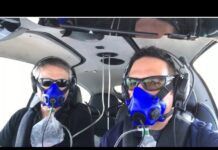
 Kerry Bean. | |
 Kelvin Rautiola. | |
 C-131 cabin, aft looking forward. |

The main concern of the Holms was keeping the airplanehangared and flying, and with some investigation, the SoCal Wing turnedout to be the only place they felt qualified to do that. Scott livesnearby, and we think he may “closely supervise” our treatmentof their “baby.” After a little discussion, they simply gaveit to us as a donation! What a magnificent gift! Along with countlessspares, tools, and support equipment! Most of the airplanes in the CAFwere donated, but few, if any, in such immaculate condition. This is thefirst “new” one I’ve been directly involved in, and thegenerosity overwhelms me. We were standing on the ramp in Florida, working ona minor mechanical problem, and Barry said, “Hey, I forgot, we’vegot a spare cabin compressor,” and off he went to wheel it out.Brand-new overhauled unit, worth about $40,000 on the market, if youhave to buy one!
The first order of business was togo get it. Our very own Kerry Bean, a current PIC on the C-46, wasselected to command that operation, as he is already type-rated (in thisvery airplane, in fact). However, he was not current under FAR 61.68(annual proficiency check), so he needed one to be legal. I can give theride, even though I’m not type-rated myself, so I got selected (Iresisted vigorously, of course) to go along and do his ride with ChuckClapper, the previous pilot, in the right seat as instructor. Theyswapped seats, and I gave Chuck a fresh 61.58, though he wasn’t due.Then I took the seat, and Chuck gave me my three circuits (one with asimulated engine failure), and made me legal as an SIC. We were hopingto get my training and type-rating ride done too, but we simply ran outof time, and there were no check pilots available (I can’t give myself aride, unfortunately). Kerry and I decided to fly the airplane toCamarillo, but a couple of mechanical delays made that impossible (Kerryhad to go back to work), so we had to leave the airplane, and come backlater.
Special thanks must go to Kelvin Rautiola,who made the trip (twice!) to serve as crew chief on the way home. Thisis a very important position on all these big airplanes, as we’ve provenmany times. The crew chief is not only a great help in-flight and on theground, but goes back and scans the wings and engines every few minutes,as we cannot see problems from the cockpit. That has saved us more thana few engines, and Kelvin is one of the best of a great bunch.
I had anticipated doing a column on the flight home,but there’s not really much to tell. On Saturday, December 1, welaunched from Stuart (KSUA) at about 0930 local, and had an absolutelyroutine, uneventful flight (7.1 hours) to Midland, Texas. The next day, welaunched at about 0930 Midland time, and had another uneventful flight(5.5 hours) to Camarillo, Calif. The beauty just quietly snored along at185 knots true, engines in perfect sync, everything working like factorynew (well, the left oil quantity gauge fizzled, but that’s easy to fix).There was a big storm blowing in from the north, but it held off longenough for us to land, even catching a big “sun break” just aswe landed, much to the photographer’s delight.
The next projectwill be to get some training done. We’ll probably get mine done first,along with the type rating (can’t you just feel the resistance, oozingfrom every pore?), then we need to do a ground school for a whole gangof people (at least three days, with Kerry and I sharing the duty), thenwe need to get some crews checked out, and soon!
Pilot Shortage
Butwhere do we get them? Due to moves and other factors, we’re now down toonly five qualified and active PICs on the C-46, and four SICs. Allpilots fly other show airplanes, too, with several being the only pilotson other airplanes. If we book an airshow that wants all aircraft, weneed all pilots to man them, and several have regular jobs, several arefrom out of town, and two live on the east coast!
Toto, thisain’t Kansas, and I think we have a problem here, we’re anticipating 30airshows next season! Sometime before that, we need to get several morePICs going on the C-131, a couple more on the C-46, and a whole slew ofSICs on both. Anyone out there interested? Email me (but see below,first).
No, there’s no pay, we’re all volunteers. In fact, it’llcost you some money, here and there. Put in a day as a volunteer, andyou still pay for your coffee, twenty-five cents a cup. Since it allgoes to the hangar fund, most of us chip in a buck or two per cup (only400,000 cups to go). Hotel rooms are often paid by airshows, butsometimes individuals have to cough up the price of a room. Littlethings like that. But no big money is required.
The old days arelong gone. In the past, there were long lists of QUALIFIED andexperienced people dying to fly and work on these old artifacts, notraining needed. The lists were so long and folks so eager, the CAF setup a program of “Sponsorship,” where members would donate$3,500 just to get on the “pilot, someday” list, with NOpromise of ever getting ANY seat. There’s no list, no mo’! Basically,anyone who shows up a few days a month, gets to know the gang, shows awillingness to participate, and wants a seat will pretty quickly get anevaluation ride, training, and a checkout, at least as SIC, withoutputting up any money (at least at SoCal, other units will have their ownrules). Several talented folks have moved very quickly to the left seatof the C-46, in a few cases within a few months. We’d much rather putsomeone in the right seat for some time, perhaps a season, but ouroptions are getting limited. If an individual can afford it, we ask fora donation towards training fuel, but even that seldom breaks even. Westill require sponsorship to check out as PIC, but we’re even startingto look hard at that.
What are we looking for, in pilots?Basically, a commercial certificate, with instrument and multiengineratings, 1,000 hours total time for SIC, and 1,500 hours for PIC. We’veeven had waivers for lower-time SICs, but I doubt we’ll ever checkanyone out in the C-46 or C-131 as PIC with only 1,500 hours, theairplanes are just too valuable.
Recent radial engine experienceis a major plus, but increasingly hard to find, so we’re doing a lot oftraining, formal and informal, in that area. To fly the C-46, it’salmost mandatory that a prospective pilot learned to fly in tailwheelaircraft, or be very, very quick to learn how to use their feet. If wecan check out a copilot in an hour or two, that’s fine, but if it’sgoing to take longer, we can’t afford the training time. The airplane isa wonderful, docile old girl in the air, but she’s a nightmare when therubber meets the runway. The systems are dirt-simple, so ground schoolis a two-day course, with short days, and only about a day of that is onsystems.
On the other hand, the Convair is a baby buggy to fly inall respects, but a VERY complicated aircraft, with many systems andprocedures, and will require a great deal of study for those not alreadyfamiliar with such machinery. We’re planning at least three days ofintensive ground school for people who already know a lot about theseold engines and aircraft, and that will have to be backed up with somevery serious self-study.
We do all the instructing and checkrides in-house, with Kerry volunteering to lead the C-131 trainingprogram (though he doesn’t know it, yet), and I’ll be helping withtraining and checking too. Kerry is a senior captain for a majorairline, and one of the training managers on an Airbus type, though wetry hard not to hold that against him. At least that’s partially offsetby the fact he got his start flying night cargo in Twin Beeches. Now,THERE is experience I like! He’s also a licensed undertaker with a senseof humor that drove him out of that business, so he’s a real kick to bearound. Hey, as I said, we need all types! We have not yet used hisundertaker talents.
All that said, let’s be honest, here. No oneis going to show up today, get a quickie ground school and training, aquick type rating, and be a PIC in a week or two. Even with the best ofpeople, new folks need to show up a few times, get to be knownpersonally, show that they can represent the Commemorative Air Force inhighly visible public appearances (TV interviews are fairly common),work with all volunteers, and above all, fly these priceless artifactssafely, PROFESSIONALLY. We may not come up to airline standards, but wedon’t miss ’em much, either.
The biggest problem is travel. Iknow a dozen people that would love to fly with us, but the distance andcost of regular travel from their homes to Camarillo just defeats them.Frankly, the best deal is for airline pilots, both active and retired,because they can travel free, or at very low cost, and many of theretired types do have the time to participate. The downside of that isthat once most active pros put in 85 hours on the job, there is littleenergy left to go fly other airplanes, and families often have needs,too.
Most of all, we’re looking for YOUNG people, defined asanyone under 60. Seriously, we’ve got to get more younger folks intothese airplanes, pilots in their thirties and forties, or there issimply no flying future for them. The expertise is rapidly being lost,and there’s very little training going on, except in those smellyjets.
I often hear people ask, “Why don’t you check oldso-and-so out in the C-46, he flew ’em, years ago?”
“Sure, how old is he?”
“Oh, I think he’s74.”
That’s our problem. Old so-and-so has forgotteneverything he ever knew about C-46s, and all the other old recips. Hemay even be able to check out, but is he going to teach? Will he giveaway 80% of the landings, as most of us do? If he doesn’t, he isoccupying a precious seat that someone else could be training in,developing experience that he can later pass on.
I wish I knewthe answers. If anyone out there can help me/us, email me, please!
Next month, I’ll go into the airplane a little bit, by putting up theexpanded normal checklist here, and some of the design philosophy thatwent into it.
Be careful up there!