





















I‘ve just had the rare opportunity to fly this very rare and remarkable warbird, and I’m just busting out all over to tell all. I am still amazed that I got the chance, and it appears that I’ll get to fly it on a continuing basis. To my knowledge, there are only two flying in the world, with the other one at Chino. We do have another Zero in two major parts, awaiting money and time for restoration. It was flown in a couple years ago for an annual inspection, but so many discrepancies were found, it has been grounded. The major requirement is for a new spar, a one-piece beam that runs from tip to tip. Best estimates are about $100,000 to fabricate one from drawings.
| (click photos for larger versions) | |
 | |
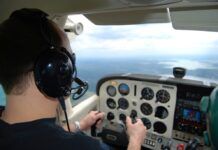
| The author, with engine running. Photo by Cathy Rezos | |
 | |
| Low pass at CMA. Photo by Cathy Rezos | |
How did all this come about? I wonder still!As some readers may remember, I’m rather involved (my wife would say “obsessed”) with the Southern California Wing of the Commemorative Air Force in Camarillo, Calif. This unit is the largest unit in the CAF, and in my opinion, the best of them all. We’ve got a very active membership, very little politics (too busy), a large, very impressive and fast-growing museum, a library that may be the best WWII library west of the Mississippi, and a highly dedicated group of volunteers that show up a lot, and who keep it all going. We’ve got two large new hangars, about a dozen airplanes, and we are now debt-free, thanks to donations from many, and with several very large recent donations (see the Web site for details). There are big plans for the future, including a gigantic hangar for the museum (which will leave both current ones available for maintenance and restoration), a row or two of T-hangars on each side of the ramp, and offices and shops inside all hangars.We remain in need of volunteer pilots, mechanics, docents, computer people, carpenters, plumbers, electricians, and anyone who can help in any way. See my column on Warbird Crews Wanted.David Price, the owner of the Santa Monica Museum of Flying, has been a long-time supporter and contributor to the Wing. He recently decided to scale back the size of his museum at the airport in what is locally known as “The People’s Republic of Santa Monica.” I don’t know what his reasons were, but I suspect a large part of his decision is the virulent hostility toward all aviation activities by that city’s residents and politicians. What they are doing is unspeakable, in my opinion, but that’s another story.Mr. Price wanted his precious airplanes close by so that he could continue to fly them himself, he wanted them well-kept, hangared and displayed, and he wanted them flown often enough that they would not decay into mere static displays. Our unit was a natural choice, and we are all delighted that we now have his Mark XIV Spitfire, Mark XII Hurricane, and A6M3 Zero. The CAF recently horse-traded for his Lockheed P-38, which is also now in our hangar and assigned to us. We are scheduled to get his Me-109 soon. In addition, he has donated many of the rare and priceless artifacts he has acquired over the years, and these are in the process of being set out for display in our museum, adding substantially to the scope and quality.All five of these airplanes are immaculate, pristine restorations, all with less than five hours on them since the full, professional restorations. In fact, it appears they’ve each had a single test flight, and maybe the flight to Camarillo, and that’s it. They are as authentic as time, love, and money can make them, with only a couple modern radios and a transponder to make them legal in today’s airspace. In short, they are gorgeous.This does have its downside when it comes to flying them, though. I can usually get into a strange cockpit, figure out what all the shiny things are (from thousands of sweaty hands and feet having pushed, pulled, and twisted them), and go fly. But there aren’t any “shiny staubs” in these airplanes — everything is in brand-new condition! That means I’ve got to figure out what everything is for, just in case it’s important. I know, you’re so sorry for me.To date, only two of us (the other is Steve Barber) have been approved to fly these aircraft. I’m not sure how I got here, but I have been instructing in the C-46 and AT-6 for some years without having scratched either, and have also flown the Mustang, F8F, and F6F without damaging them. Whatever the reason, I wasn’t asking any questions! I tried to act bashful, digging my toe into the ramp, and mumbling, “Aw, shucks, I guess I’d like to fly them,” but it was hard to hide the drool on my chin, and I don’t think my bashful act fooled anyone. I’m such a sucker for a new airplane, and everyone knows it.
A Bit Of History
I am indebted to Alan Gaynor for the sidebar (on the right) on the Zero. He is a T-6 pilot for us, and a budding historian. He has done a great deal of research on the Zero type, and this particular aircraft. I’m not much good at the history, I just want to know what I need to know to fly ’em.
Purpose-Built
The design intent was for a carrier-based fighter, very light in weight, very powerful, and very maneuverable. The Zero scores very high on all counts, and was the scourge of the Pacific until the Hellcat came along. The only way the P-38 enjoyed any success was to make one pass, take one shot, and get the hell away at high speed. The Zero is not good at speed, with a redline of only 300 knots. (Some Mustangs are redlined at 430 knots or so.)It is very light, weighing well under 6,000 pounds fully loaded with a Pratt & Whitney R1830-75, the same engine as in the DC-3. I think this model produces about 1100 HP at takeoff. By contrast, two of these engines haul the DC-3 around at up to 28,000 pounds in the cargo version. Check out our Weight & Balance sheet, available in Adobe’s Portable Document Format (PDF).Pratt & Whitney, you ask? What’s a good old American engine doing in a Japanese fighter? It’s not as non-authentic as you might think. One story has the USA giving or selling some 30 of these engines to the Japanese before the war, and the Japanese reverse-engineered them to produce the Sakae engine normally found in the Zero (to my knowledge, the Chino airplane is the only one left flying with the Sakae engine).There was no armor plate to protect the single pilot, no self-sealing fuel tanks, and none of the niceties found in Allied aircraft. Most of the airplane is built of T-7178 aluminum, a top-secret variety developed by the Japanese for the purpose. It is lighter and stronger than the normal aluminum we used at the time, but more brittle. If you push anywhere on the skin with your thumb (gently, please!), it feels like a heavy-duty tin foil. It has a fairly high-lift, low-speed wing with a very low wing-loading, giving it a very low stalling speed, well below 60 knots. This is the reason for the phenomenal turning ability of the airplane, letting it out-turn any Allied fighter at the time. Turning ability is very simply the ability to “pull harder,” and put more g-load on the wings before the accelerated stall occurs. If you have a Mustang with a stall speed of 80, and the Zero with a stall speed of 55, and the dogfight is at 140 knots, the Mustang can pull only 3g before stalling, and the Zero could pull 6.4g before the stall.Combine this very low stall speed with very brisk roll rates, and you have an airplane that is very difficult to keep in your sights, for you can’t roll with it, and you can’t follow it around the turns. In fact, if the faster fighter gets down and dirty in the low-speed range with the Zero, he’s dead meat, because the Zero will be on his tail very quickly.
Strange Devices
Roll rate is enhanced by “servo tabs” on the ailerons. These deflect opposite to the aileron, and make the control force much lighter. The disadvantage is that they reduce the maximum roll effect at full travel. | |
| Flap Aileron Tab Mechanism | |
In fact, the roll control forces were so light the designers felt it might be too sensitive on carrier approaches and landings, so they did a very clever thing, something I’ve never seen before. Through a series of small bellcranks and pushrods in between the outboard end of the flaps and the inboard end of the aileron, these servo tabs convert themselves to anti-servo tabs as the flaps extend!These are nowhere mentioned in any of the ship’s documents. I happened to discover this quite by accident, fumbling around in the cockpit during familiarization and practice drills. I moved the stick, and noted the tabs moving opposite to the ailerons, and thought to myself, “yup, servo tabs, makes sense.” Later, with the flaps down, I moved the stick again, and saw them move with the ailerons. After a double-take, I thought, “Hmm, those are ‘anti-servo’ tabs, and I could swear they were servo tabs a few minutes ago.” For a moment, I thought I was losing it. That little red warning light came on in my brain, and caused me to investigate further. There is no aileron trim in the cockpit at all, so it was natural for them to be one or the other, but not both!Then it got even more bizarre, because during flap extension, one moves UP first, the other doesn’t, then the first goes down, then they both go down, but one goes much more than the other. I didn’t think that could be right, and I made a mental note that it appeared the airplane would be very right-wing heavy with the flaps up and very left-wing heavy with them down. Sure enough, that turned out to be true. It would be quite a chore to fly this bird for more than 30 minutes, due to the heavy stick force required. We’ll get that little bit of rigging sorted out before the next flight.Rudder trim is the classic bendable tab, no rudder trim control in the cockpit at all. We need a bit of right rudder trim for cruise, and I’ve already made a slight adjustment for that.
 | |
| Trim Wheel | |
Pitch trim is a conventional geared tab, no servo action at all. It is controlled by a wheel on the left sidewall of the cockpit, and driven by cables and a bicycle chain. It’s nice to have, but pitch trim requirements are somewhat less than most fighters.Otherwise, the flight controls are driven by simple pushrods and bellcranks, and are quite conventional and well-harmonized.Boarding the aircraft is something of a chore, for there are only a few places to put your feet, without doing serious damage. There is no provision for getting up on the right wing, so I either step up on the main gear tire and crawl over the leading edge, or board on the left, step on the pilot’s seat (In the middle, please, not on the edges, it’s very fragile), and out onto the right wing, where all the rivets are, forward. Then I crawl on all fours right at the main spar to reach the fuel caps. I figure if the main spar breaks under my weight, I don’t want to fly it.
 | |
| Pullout Handle | |
 | |
| Pullout Step | |
To board over the left wing trailing edge, there are four pullout devices. There is a small step that pulls down out of the fuselage right behind the trailing edge, a popout handle above that, two popout steps in the side of the fuselage above the wing, and another popout handle closer to the cockpit. These are very simple, very fragile, and the whole assembly including mounting parts probably weighs only a few ounces. Once extended, they seem pretty sturdy, at least they have, so far, supported my 220 pounds. But they must be operated very gently, as the mechanism is very fragile. It’s best to hold one finger over the popout handle to keep it from slamming out against the slide stop, while gently pushing the release button.
 | |
| Left Wing Boarding Area | |
The entire aft portion of the wing is a “no step” (and “no push”) zone, with a couple of small spots to step, or to stand. Any attempt to stand anywhere outside these small areas is sure to do damage. More and more, I’m simply stepping on a tire, and crawling over the leading edge so as not to wear out the handles and steps. The wing is also very slippery, so one of our members has come up with a big no-slip pad, also marked with the few safe places to step.Walk-around is pretty conventional, just the usual “general condition,” mostly to make sure there is no hangar rash. But there are a few “special features” worthy of note.
Folding Tips
 | |
| Folded Wingtip | |
This model of the Zero has folding wingtips. Everyone giggles at them — for only about two feet on each tip fold — and the first thought is, “Why bother?” One story is that the elevators on Japanese aircraft carriers of the day were not quite big enough to handle the full span of this model, so they had to fold the tips. We’ve got enough airplanes in the hangar, so the folding tips help a lot!
 | |
| Wingtip Latching | |
The wingtip latch is a very simple device, and as with everything else on this airplane, very lightweight. The picture shows the folded tip. To extend it, the push-in door is pushed, which removes a little hood from the hole in the end of the lever. The lever is then pulled out, rotating the torque tube, which has cam-type locking devices fore and aft. Then the lower end of the uplatch is pushed in, allowing the tip to swing down into place. The locking lever is pushed back up flush with the wing, locking the tip in the extended position. But it also necessary to push the little door in to swing the hook back out of the way of the lever. Once the lever is flush, letting go of the door will allow the little hook to go through the hole in the end of the lever. Finally, barely visible in the photo, there is a little oval rocker latch that locks the door!
 | |
| Wingtip Lock Indicator | |
There is, as usual, a visual indicator for the pilot to show when the wingtips are secure, or not. It is a very good idea to glance at those! A small yellow tab showing will indicate “unlocked.” When everything is secure, the tab is flush.Only the right main gear has the ground safety mechanism, to prevent gear retraction on the ground.
 | |
| Right Main Landing Gear | |
This is a simple cable on the shock strut, so that when the strut extends, it pulls the cable, which pulls a pin out of the way of the gear lever. The wingtips and the gear safety are the only two really unusual exterior features on the airplane.
Checking Oil
Checking and servicing the oil is a bit of a hassle. To check the oil level, six Dzus fasteners must be released, and a foot-square panel just forward of the windshield is removed. Don’t let it blow away or it will surely be damaged. Best to put it on the pilot’s seat until done.If the oil level is found to be less than about 10 gallons (13-gallon tank), another cowling panel on the right side must be removed to get to the filler cap.
Fuel
 | |
| Inboard Fuel Placard | |
There are five fuel tanks in this model, one main in each wing (50 gallons), one outboard aux tank on each side (11 gallons), and a very small tank (16 gallons) just forward of the windshield (but aft of the panel for checking oil), for a total of 138 gallons. For a fighter, that’s an amazing amount of fuel, making it the longest-legged fighter in our collection.
Hydraulic Reservoir
Finally, there is a small hydraulic reservoir just behind the cockpit, on the right side, hidden by the usual flush panel with the small oval latch. The placard says to fill it to within 3-3/4″ of the top.
Remaining Preflight Items
The flush panels and the little locking devices found all over the aircraft deserve mention. They are very closely fitted, producing a very smooth surface. There was some very careful attention to these, both at the factory, and in restoration. They are a delight to the eye, and the touch. It’s a neat way to do it, and once again, very light. Air pressure in the main tires checked a little low, so we removed the small access panels, and rolled the airplane until the valve stem was properly located, and brought them up to 70 PSI. No problem with the tailwheel tire, it’s solid. It’s also very small, non-retracting, and very fragile; we have to be very careful when pushing the airplane over the tracks for the hangar door. It really looks and feels like a little bad angle or a deep spot would rip it right out by the roots.The airplane had been sitting for some time, so the battery voltage was low, down around 22 to 23 volts. I don’t like starting the big old radials or hot-water twelves without a fully-charged battery, because starting fires are not rare, and the only way to handle such a fire is to keep cranking, get the engine started, and let the fire get sucked in the intake, or blown out the exhaust. I’ve had to start on low batteries, and my heart is always in my throat when I do it. With low voltage, starts are not as easy, they often take a few extra tries, fire is more likely, and if you run out of battery at a crucial moment with a fire, you can lose the airplane.If at all possible, it’s just a better deal all around to use an external power source, even with a good battery.
Starting Fires
We also insist on having a fire guard with a large extinguisher right next to the airplane for all starts, too.In my mind, there are three danger spots for fire with these old airplanes. First is the exhaust outlet, where a fire is usually harmless. After all, the exhaust system is intended to conduct very hot gasses out of the engine, and the usual exhaust fire is not nearly that hot. There are usually stainless-steel panels around the exhaust, too. Usually, the worst that happens is that any passing breeze blows the flame onto the paint somewhere, and scorches it. The wise pilot will close the canopy during the start to avoid singed eyebrows, or worse. The cause of this “stack fire” is a botched start attempt, where too much fuel gets pumped through the combustion chambers without ever quite getting the mixture “right” for combustion. The excess fuel puddles in the low points of the system, then when a cylinder fires, it may be enough to light off the fumes from the excess fuel. This occurs rather often when the engine is hot, and it can produce a spectacular flame, sometimes 20 feet long. It’s usually a slow, lazy flame, very rich, and a bright orange, sure to catch the eye of the tower folks, who have been known to push the panic button.In spite of this, I brief the ground crews to not attempt to put this fire out unless they see the whites of my eyes, or an effort to flee the scene. Having seen the whites of a fire guard’s eyes a few times, and having seen them recoil in horror, I often wonder if they will be egressing the scene long before I can!The second — more serious and much more rare fire — is the intake fire. Generally speaking, this is caused by poor starting technique, most often the “mixture” start, where the engine is started with the mixture rich. If the engine starts, this fire will be sucked back into the intake, but if the start doesn’t happen, the fire guard needs to stuff the nozzle into the intake and let fly. This becomes problematic on the C-46, where the intake is 15 feet off the ground!Finally, there is the starting fire where excess fuel has either drained out of the exhaust, or out of the supercharger drain line, and puddles on the ground immediately below the engine. This is the one that scares me more than any of them, for I’ve had one myself, and I’ve seen an airplane burn to the ground for this. Engines can spit sparks to ignite this puddle, or there can be more than enough fuel vapor from the puddle, and from the exhaust to light it off. Any fire in this area should be extinguished immediately.By and large, a little skill and cunning will go a long way to prevent starting fires, and a little prior knowledge of the peccadilloes of the individual engine helps too. We insist on the “primer start” where the mixture is left in “idle cutoff” and the engine is started on the primer alone, provided the engine is equipped with a solenoid-operated “power primer” that squirts priming fuel into the induction manifold. This is enough fuel to accomplish the start, and operate the engine at about 1,000 RPM. Once the engine is running smoothly on the primer, and oil pressure is up, the mixture is advanced, still holding the primer on, until the engine floods and tries to quit. That’s the signal that fuel is available from the carburetor, and priming should stop.Next month we’ll explore the systems in this unique aircraft.Be careful, up there!