





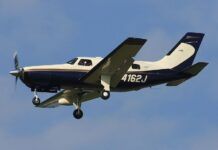







 It started with a bike ride. I was taking advantage of our unseasonably warm fall and riding through a subdivision near a local lake. As I approached a woman who was out for a walk, I heard an airplane. Being genetically unable to ignore any aircraft in the vicinity, I looked and saw it was a Bonanza, still a ways away, and low, maybe 500 feet AGL. The noise built rapidly even though the path of the airplane would not take it over me. It was obvious that the pilot felt the need to not only fly at an illegal altitude over the residential area, but that he or she also wanted to be sure the propeller was spinning fast enough to keep the pilot cool. That airplane was just plain LOUD. Having spent some time around Bonanzas, I figured the rpm to be at 2,500 or 2,600, way more than needed for level flight at low altitude.
At the closest point of approach, the Bonanza was maybe a quarter of a mile away. As the Doppler shift announced the passage of the airplane, I heard the woman clearly utter, “Those damned little airplanes.” As I rode by her and saw the anger on her face, I couldn’t help but think, “General Aviation, winning the public to its side, one person at a time.”
The episode lasted but seconds, yet it was disheartening. One inconsiderate pilot just hurt all of us. Then I thought about the contentious city council meetings I’d attended where airport issues were debated and I wondered whether I’d see the same woman at the next one, speaking out against the airport.
Lounge Talk – Public Perception
Later in the day, I found myself in the Pilot’s Lounge at the virtual airport, talking with other pilots about how the public sees General Aviation. The discussion was interesting to me, so I kept track of it.
There was the usual “to heck with ’em, we’ve got a right to fly” contingent, telling me that we pilots don’t need to be concerned about public perception. Laurie, one of the more thoughtful of the crowd, and a fairly new pilot, diplomatically put that philosophy into a real-world perspective. She pointed out that there are only about 600,000 pilots in the U.S., well under one percent of the population. With those kinds of odds, we need all the friends we can get. She reminded us that when a truck was used to kill hundreds in the federal building in Oklahoma, no one tried to restrict truck rentals. That would inconvenience millions of people. When airliners were used to murder thousands, General Aviation bore the brunt of the resulting knee-jerk reaction. She also reminded us that the populace applauded our national leadership when it shut General Aviation down. Many complained when we were later allowed to fly at all, even with severe restrictions. That is not the sort of thing that happens to an activity that is held in high esteem by the majority of a population.
 And the discussion continued, Laurie described conversations with her non-flying friends in which a certain percentage regularly say that General Aviation should simply be banned. Unfortunately, others in the Lounge said they had heard the same thing. Old Hack, our local curmudgeon looked at us and growled, “You know why don’t you? They’ve been somewhere and were pissed off by a jerk doing something stupid in a little airplane.”
As we talked about the experiences of non-pilots with General Aviation I thought about last night’s cocktail party where one guy made the comment I’m used to hearing to the effect that “all you hear on the news are stories about little airplanes crashing because those pilots just don’t know what they are doing.”
 How do we change the perception of the public about General Aviation? A few people, a tiny few, have been affected by the wonderful charitable organizations such as those doing medical mercy flights or LightHawk and its environmental work. Those people sing the praises of little airplanes and those who fly them. A few folks have friends who fly and say they wish they could use little airplanes to get around rather than driving. The problem is that it is much more common to hear from the person who went to the beach with his or her family. Suddenly a “damned little airplane” appeared, a couple hundred feet up (or lower) just off shore, or right over the people on the beach. The person describing the event was either scared that the airplane would crash on them (don’t knock fear, it may be irrational, but it’s real…and don’t deny that you’ve ever been scared in an airplane) or was angered by the noise it made in a location that didn’t have much background noise. One time, after an idiot in an Archer flew low along a packed beach on Lake Michigan, a witness asked me how I’d like it if an SUV with a bad muffler went blasting up the beach. He said that, to him, the level of intrusion was exactly the same.
 Another common refrain came from those who described a summer afternoon barbeque, some miles from the airport, when one of the approaching airplanes made a very loud growling noise as the prop control was shoved forward by a pilot mindlessly following a prelanding checklist. The majority of the time the homeowners don’t mind that airplanes fly over on a fairly regular basis. What turned them against the airplanes and the airport was the inconsiderate behavior of the little airplane pilots. After all, “the jets don’t make that kind of noise when they fly over.”
 A part of my legal practice involves dealing with airport noise issues. I’ve been at the public hearings where the bellicose anti-airport types make more noise than the airplanes they seek to restrict. I’ve interviewed innumerable people who live in areas affected by aircraft noise. I’ve learned that the reaction to it runs a spectrum from the small group at one end that loves airplanes and the noise they make, to the small group at the other end who get furious if they can either see or hear an airplane, no matter how far away or how quiet it is. Nevertheless, there is a common denominator: No one likes airplane noise where it isn’t expected and no one likes to see or hear an airplane flown in a manner that indicates the pilot is an insensitive dolt. When that happens, the overwhelming reaction is to get angry with the pilot. However, when the pilot cannot be identified, the anger spreads to all little airplanes. A certain percentage of those angry people become politically active and then each and every pilot pays for the actions of one cretin.
What Can We Do? We Have To Play Politics
 One of the nice things about hanging around the Lounge is that I get to hear a lot of different opinions. As the talk explored potential solutions to the problem, I listened. I tended to reject both extremes – boiling the guilty pilots in oil was as unworkable as figuring out where every noise complainer lived and then repeatedly buzzing those houses with the prop in high rpm.
It was generally agreed that all of us who enjoy flying have to remain as politically involved as we possibly can. No matter how carefully, considerately and quietly we fly, the combination of irrational haters of aviation and simple population pressure means that airports and general aviation will remain under attack. We have to be prepared to speak out, write letters and contribute to organizations such as AOPA that fight for pilots and aviation.
An underlying current in the discussion was that we also have to fight intelligently. We too often come across in public hearings or in front of the media as “aviation buffs.” The TV then shows an aging white guy with a beer belly, wearing a silly-looking jumpsuit covered with patches, who rambles on about flying being his life. He comes across as an airborne Gomer Pyle, and the battle is lost before it is joined. Those of us who have entered into the airport noise debates in the political arena have observed that pilots can be their own worst enemies if they do not do some planning prior to showing up and speaking publicly. The anti-aviation groups do their homework and have designated speakers who come across well. Pilots have to do the same. They have to get together beforehand and determine what is going to be said and who can most effectively say it in a way that is most likely to be persuasive. They also have to learn to leave the jumpsuits and hats at the airport.
What? You Mean That There Are Other People Around?
 The pilots who had watched the areas around their airports become more urbanized over the years were adamant about the issue of how we flew our airplanes. Their noses had been rubbed in the noise fight and they had seen how fiercely independent pilots can be their own worst enemies. They insisted that a huge part of getting the public on our side involved simply being considerate. They gave a little history lesson: Most airports were built on the cheapest land around. Many came about in the 1920s and early ’30s when having an airport meant the community was progressive, something intensely important at the time. Of course, the politicians bought the cheapest land for the city airport. Because the land was cheap and a road into town had been built, developers followed, with noise complaints a short distance behind. The battle of noise around airports is going to continue for years. In general, it’s been fought to a draw around airports. There is an acceptance that there is going to be noise within a certain distance. The seesaw battle revolves around the distance and the time of day. That’s a given and the only way we can deal with it is through political activism.
Where we in General Aviation shoot ourselves in the collective foot is by creating noise outside of the immediate airport area. We don’t do ourselves any favors when we fly low over groups of people or houses that aren’t near an airport. When we shove the prop control forward before getting well into the traffic pattern (actually, anywhere before short final), cause the engine to surge (and it mutters, “Gee, thanks a heap, Pilot”) and create all sorts of prop noise, we are not telling those around us that General Aviation is a good thing.
 Old Hack looked at us and said, “You know how powerful you feel when you go blasting down the shoreline at 200 feet over all those people on the beach, don’t you? You know you’re actually saying, ‘look at me; I’m extremely cool; I can control this flying machine.’ But if you really look at yourself what you see is some pencil-necked geek in a Michael Dukakis headset. You had to shell out hundreds of bucks to buy the headset because your airplane, that develops less power than your car, will wreck your hearing if you don’t protect your ears. So, there you are, laying all that noise down along the beach and you are dumb enough to think those people down there love you? Hey, Chump, they don’t. A lot of them are looking at you hoping to get your N number and turn your sorry carcass in to the FAA.”
Old Hack never was afraid to express himself. He went on, “You want to be envied? Fly down the beach at 2,000 feet AGL with the prop at 2,200 rpm. The ground-pounders who don’t like little airplanes won’t even notice. The ones who do like airplanes will look up and wish they could be where you are.”
It Sounded Reasonable To Me
I got to thinking about the problem of prop noise and the fact that most pilots seem not to take it into consideration. I recently got a call from pilot who went flying just after the restrictions were eased. It was a pretty evening, so he just cruised back and forth over his hometown in his big-bore Continental-powered machine. The public was still in hypersensitive mode and, as it turned out, the police switchboard lit up. The FAA came calling to the pilot. One of the many complaints was from a police officer that said the airplane was doing aerobatics at 200 feet. The reality was that the pilot was just cruising in circles over town (radar tapes show he was never below 1,500 AGL) but his practice was to leave the prop at 2,600 rpm, so the perception was that he was very low. He admitted to me that he always kept the prop at 2,600 rpm because he didn’t want to risk running the engine “oversquare” and damaging it. Because a guy didn’t know his airplane, he scared or angered a heck of a lot of people. That sort of behavior falls into the dumber than a bag of hammers department.
We’re All In Aviation Marketing
 I’m of the opinion that we have to sell aviation with everything we do. Most of us love it, so sharing with others is a part of our lives. However, selling it means being mature and considerate. It means turning the prop as slowly as possible when flying below about 2,000 feet AGL. It means not flying below 1,000 feet AGL over houses and groups of people – even small groups. It means keeping in mind that most of the people don’t particularly want to see your airplane up close and personal and that your buzz job over the lake or the baseball game is viewed by the majority as a stupid, childish stunt by someone who can’t be trusted with a device that could be used to hurt a lot of people. Those folks don’t see your airplane as a symbol of freedom and independence. What they really see in their mind’s eye is the video clip of the burning airplane crashing into the air show crowd in Germany.
A visitor to the Lounge told me that he lives on a shoreline about ten miles from a nuclear power plant that is also on the shore. Regularly, some idiot buzzes the municipal pier and then disappears down the beach, in the direction of the power plant, at low altitude. The pilot even did it during that temporary no-fly-near-nukes we had. What kind of message does that send to the hundreds who see that one little airplane? Do we want to suffer another series of flight restrictions because of that yahoo?
We Have To Reach Out To Transgressors
One of the pleasures I get out of aviation is that it attracts fiercely independent people. People who are capable of and used to making decisions on their own and taking action to accomplish what they want. The average person who feels the need for a committee consensus on all decisions tends not to do well as a pilot. Part of the joy of aviation is that pilots have a tendency to rebel against authority if it is perceived to be lacking in competence. That does lead to one nasty downside. A certain percentage of pilots will, when presented with concerns about noise, react simply by mentally thumbing their noses at the messenger and taking pains to make more noise in the area the next time. This three-year-old maturity level winds up making those on the receiving end of the noise or buzz job even less happy. The hero pilot flies away thinking he has shown the complainer a thing or two, only to find out that those same complainers are just as willing to fight back as the pilot was. The complainer does so by going to the county commission meeting to put noise restrictions on the airport, or vote to turn it into a subdivision.
As independent people, we are loathe to talk to other pilots about the way that they fly. However, I’ve written about that issue before (“ThePilot’s Lounge #13: An Instructor’s Obligation“). I feel there are times when we must speak to other pilots, or at least ask someone that pilot respects to speak to him. I believe that is the case with behavior that hurts all of us. We must do our best to get the word to those who feel it necessary to buzz people or generally fly inconsiderately. It may mean having a conversation with them or simply printing out this column and sticking it where it will be seen.
The Cost To Each Pilot
 As the afternoon wound down and folks started heading out of the Lounge, Walter said that every time a pilot does something stupid such as fly low over a bunch of people or run the prop control clear forward while still on downwind, that pilot had better figure that the cost to him or her will be someday having to write at least one letter to the editor or to speak out at a public hearing in support of aviation or to keep an airport open. Looking back over the years, that seemed to make sense to me.
As I headed home, I kept thinking about the day. We certainly can’t be invisible when we fly and aren’t going to win the hearts and minds of the public by trying to stay out of sight. We win them by effectively passing along the joys of flight and honestly addressing their fears. It is a slow, steady, fragile process. Irrational fear is intensely powerful. We saw what it did after September 11 when the panic and overreaction affected us so harshly. While we work to win over those who don’t fly, we have to recognize that we also cannot afford to condone the actions that work against us so effectively. We cannot allow those who don’t care to hurt the rest of us. We saw how fragile our privilege to fly (and yes, the unhappy truth is that it’s a privilege, not a right) is last September. In addition to flying considerately and staying involved politically, we must refuse to tolerate those among us who regularly do the buzz jobs or haven’t figured out that their airplane will run just fine at 2,300 rpm rather than 2,500. We have to talk to our friends and convince them that what they are doing is hurting all of us. If we can’t talk to them, then print this out and make sure they get a copy.
See you next month.
