












Originations
Jiggs Landing Fishing Camp, Braden River, Manatee County, Florida
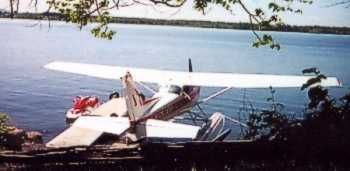
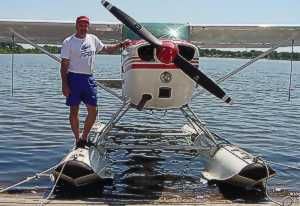
Last summer, I took one of the most fascinating, challenging and rewarding trips of my lifetime: a round-trip flight from Florida to Vermont and back in my 1973 Cessna 172M. "So what?" you ask; people do that all the time. Well, the difference is that the airplane isn’t on wheels; it’s on EDO 2000 straight (non-amphibious) floats. The 150-hp Lycoming O320-E2D had 1,790 hours and an auto-gas STC, enabling us to land at boat marinas for fuel and greatly increasing our options for landing areas.
My flying partner each way was my good friend Frank Edmonds, my neighbor in Vermont. We also own a 1946 Aeronca 7AC Champ together. After many hours of preflight planning, my first long-distance straight-float seaplane flight was set to begin. As my good friend Chris Urstadt told me, "It will be an adventure … it always is." He should know: Chris has been a bush pilot in Alaska for 20-plus years and we flew DC-3s in the Florida Keys together in a "previous life." Frank has ferried Twin Otters and Beavers on straight floats from Alaska to Florida, and beyond, several times. In fact, this Alaskan first introduced me to the freedom of dancing with wave and wind in a Beaver on floats many, many moons ago. So, I was prepared … or so I thought.
Our First Problem
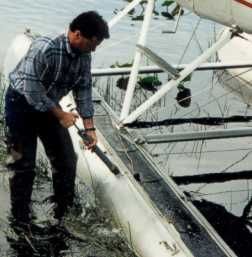
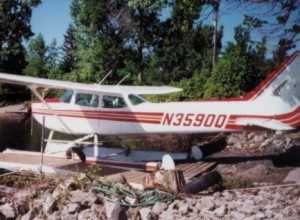
 Frank and I arrived at Jiggs Landing the evening before departure to find my floating dock … well, not floating. I had been busy flying for my day job the previous week and hadn’t thought much about the water level. It hadn’t rained in Florida for months and, when the Manatee County water management authority sold some water to neighboring counties in need, the water level really went down. I had topped off the fuel and had everything set the week before, so somehow we had to negotiate a loaded seaplane approximately 25 feet through muck, sludge and quicksand to alligator- and snake-infested shallow waters.
Fortunately, a group of "real" Florida boys and their buds were around. Leading the charge was "Wood" Chuck. At his side was "Hillbilly" Chuck, "Vietnam" John and someone simply named "Ed." Frank, myself and a few others completed a cast of characters with a mission in mind. It took four hours of pushing, pulling and shoving with rope, 4x4s, logs, shovels (for digging trenches so the floats would float) and advice from other "supervisors," but the 172 was finally floating in the water, unharmed. But it was dirty: There were muddy hand prints everywhere. Still, it was time to celebrate — the first of many on this trip.
The next morning, Frank and I met my business partner Norval Dawson at Jiggs. Norval was there to help in any way he could and establish communication procedures for each leg of our journey. The wind was dead calm, with water like glass and temperature in the 70s. It’s a small lake/river, affording me a little over a mile in length and a half mile in width to circle to get off. Calm winds and mild temperatures might be "just right" for a 172 on wheels, but not one on floats. To get the floats "unstuck" and get the 172 up on "the step" — that flat part of the float that comprises the aft half of its underside — would mean churning up the water. My technique involved accelerating to 52 mph, cranking in full left aileron — ready with the right rudder — and try to raise the right float out of the water. Along the way, don’t sink, etc. After the first three attempts, I still couldn’t get on-step. Of course, everyone was still watching.
I taxied out to the middle, picked up the water rudders, reduced RPM down below 1,000 … ahhh … yes … there seems to be about a 3-mph wind out of the east. I hadn’t tried that direction yet. Then I remembered what J.J. Frey taught me a few months back when we were flying my airplane together. I briefed Frank. We started the takeoff run flaps up. I had Frank lower the electric flaps when we finally got on step … and the rest is history. We were on our way to Vermont. Of course a fly-by of Jiggs was in order.
Our Second Problem
Somewhere over DisneyWorld, we lost the vacuum pump. We were planning to do the trip VFR anyway, so we just continued. What remained included an electric turn coordinator and a 1973-vintage magnetic compass that was … well … dancing, to put it positively. No problem, only 1,600 miles to go….
Fortunately, I had an old Apollo Loran, current sectionals and my son’s handheld Garmin 90 GPS he won in a "Private Pilot" magazine contest in association with Maule Aircraft to name the new Maule. I didn’t have the manual with me (a mistake I’ll explain shortly) but, thank you Garmin, for designing such user-friendly equipment. I never really used the Garmin 90 much before since the Loran worked fine for my needs and, besides, it was panel-mounted. Now, I never launch without the Garmin anymore. I’m hoping to get a GPSMAP 295 soon.
 Primarily using the Loran and "finger on the map" navigation, Frank and I proceeded to our first fuel stop in Jacksonville, Fla. I had called Gary’s Seaplane Base (SPB) days before and the morning of, to coordinate our arrival. The Seaplane Pilots Association (SPA) Water Landing Directory was my source of reference for the majority of our stops. Thanks SPA!
Our Third Problem
Gary told me over the phone to make certain I establish radio communication with the Jacksonville Naval Air Station prior to entering their airspace for landing on the St. Johns River. Upon doing so, and by testing later on, I found out that my only comm radio reception was failing. Basically, the remainder of our trip I was without a comm radio except for very close range. (It turned out to be a bad antenna that was later replaced.)
Gary has a wonderful facility. This is a private SPB, so prior approval is required. While there, Gary showed us his 180-hp Super Cub on floats in the hangar adjacent to his home on the water — some guys have it all. We refueled, bought some oil and off we went to Kirks Air Base in South Carolina with a bum radio and no vacuum pump. No problem … only 1,400 miles to go.
Our Fourth Problem
 The weather was getting "scuddy." Because of our equipment failures, Frank and I religiously kept our position updated and one of us flew while the other navigated. I’m here to tell you that sectionals are great. WAC charts are great. Loran is great. But cellphone towers are not charted and some aren’t even lighted. That’s not so great. At times, to remain VFR, we had to occasionally go below 1,000 AGL. It was during these times we were the most alert. Approaching Kirks SPB, we got a warning on the Loran. The weather was marginal; fuel about 10 gallons; visibility two miles (maybe). I turned on the Garmin GPS 90 and within five minutes I had a moving map, but I couldn’t figure out all the functions I wanted to display under the circumstances. Priorities: Fly the airplane, navigate, communicate (whoops, can’t do that.)
After a few minutes, we determined that the Loran seemed to be working okay with the warning light "on," but the distance displayed on the GPS 90 to Kirks SPB did not agree with the Loran — there was a three-mile difference. The courses were within a few degrees. I made a command decision to follow the Garmin 90. Poof … there was Kirks SPB, but we were a little too high and too fast. This is where your training instantly comes to mind. (Again, thanks J.J., and you too, Norval.) After a bit of maneuvering, we splashed down in a field of wet dreams, relieved to have another leg "under our belt." Jim Kirk was very pleasant and accommodating. It was a quick stop … then as Willy sings, we were "on the road again."
Our Fifth Problem
Our next fuel stop was at a boat marina in Clarksville, Va., on the John Kerr Reservoir. This was the quickest fuel stop we had. Everyone was excited to see a seaplane and we had all the help we needed. We were airborne about 20 minutes later.
I had made arrangements with one of my airline buddies to overnight in Harmony, Md., on the Choptank River. We now had to circumnavigate all the restricted airspace around the Virginia/Maryland border and cut across the Chesapeake Bay with a now-defunct Loran (operator error … I didn’t know how to change the grid and, oh yeah, that manual was in Florida, too). No radio, no attitude indicator, and did I mention the sun was about to set? The visibility was around three miles and the trusty Garmin and whisky compass got us to the vicinity of Harmony. Now, all that was left was to find a two-story white house with a yellow guest cottage on the east shoreline about a mile north of the bridge leading to Easton. We did have a Rand McNally road atlas (thank you, Chris Urstadt) and ultimately found our evening’s accommodations easily enough. We splashed down in front of Roger and Patty’s house as the sun was setting in a sea of haze. Frank and I congratulated each other on a successful first day without one word spoken. We knew what we had accomplished.
Our Sixth Problem
 We had a wonderful time with Roger and Patty — they could not have been better hosts — and the next morning departed early, headed for Goodspeed SPB in Connecticut. Landing at Goodspeed SPB was simple. A student receiving seaplane instruction helped us dock. There was no fuel at the dock, so we had to use cans to fuel. The folks were friendly and off we went.
The weather was getting worse. There were mountains to cross and temperatures at altitude were falling, presenting me with some concerns about carb ice. We were in light rain but still had three to four miles of visibility. I tried to get traffic advisories through the local approach control, but that proved to be worthless: My radio was not worth the aggravation. Fortunately, some other GA pilots relayed messages for me but it was back to squawking 1200 and staying clear of everything, including mountains and towers and planes … oh my.
Now here’s a big "atta boy" for my friend and partner Frank Edmonds. Every once in a while you run across an individual that is enormously talented, intellectually way ahead of most, and possesses wisdom beyond words. Frank is a master carpenter, flew in the Canadian military, speaks a few languages, and is a stick and rudder pilot all the way. We were now approaching Franks "part of the woods." We had a choice of trying to circle VFR to get on top, hoping to find a break in the clouds for a descent over northern Lake Champlain and using nothing but an electric turn coordinator as a last resort — and getting low on fuel. Or, we could, for lack of a better term, scud-run our way through the mountains. We discussed our options, which included returning to Goodspeed. We decided to go low, but always leave room for a way out. Frank said that once we got to a point on the map, he could get us to Alburg with restricted visibility, and that he knew all the valleys. The rest is history.
After 1,680 miles in a day and a half, five fuel stops, one overnight, mechanical problems, weather problems and enough excitement to last me for a while, two fortunate souls splashed down in front of my home in a blaze of glory! We knew we just completed a long-distance straight-float seaplane adventure that would forever be "frozen in time." I wonder what percentage of pilots can say that? Yeah … we were marveling in the thrill of adventure, and damn proud of it. We always had an out. We learned a thing or two. We’d do things a little different next time.
The Get-back
The summer of 2000 in Vermont was grand. I had all maintenance issued resolved in short order. Ol’ 90Q was purring like a kitten again and we had a wonderful summer exploring the surrounding area waters. The beauty of that part of North America is certainly worth a visit. but, it was now September. The family was back in Florida. My bird was still in Vermont. Frank and I looked forward to the return.
Our First Problem
I had flown to Vermont a week before, only to get weathered in. This time it looked okay. The FSS briefer was forecasting fog along the first leg until mid-morning, so we delayed our departure accordingly. Once airborne in clear skies, the familiar smile and sense of adventure returned. Everything was fine until we received weather updates: There was fog ahead. As we approached Albany from alongside the Hudson River, we tuned in the ATIS … ceiling indefinite, 1/4 mile. Soon, fuel became a "player." Frank and I discussed our options and we calculated a point by which we’d return to Lake Champlain if we couldn’t see the Hudson River.
 The only thing I was really concerned about was engine failure … what if? We decided to continue without any sight of the water with VFR flight following, albeit on top. At all times, we had the unobscured mountain tops surrounding us clearly in sight. I felt good about the Lycoming and always maintained and operated the engine like a woman. You treat her right … she’ll be there when you need her.
Well, as Mr Murphy would have it, we reached our point by which we’d return to Lake Champlain without the Hudson River in sight. I was about to advise approach control of our intentions when I queried him for any weather reports to the south. He was working two frequencies, and he asked a King Air that just departed a small airport 20 miles south of our position what the flight conditions were. The King Air pilots’ report was favorable — there were CAVU conditions on the horizon. As I pondered my existence, Frank said "there it is." Sure enough, that Garmin was "dead-on" again. We did some tight spirals down to 500 AGL over the middle of the Hudson River headed for Peekskill SPB. It was time for lunch and some sightseeing. The weather was improving by the mile, and we were full of smiles.
Windows On The World
Flying down the Hudson, we had spectacular views of West Point and all the incredible homes along the banks on our way to a fuel stop with Mr. Martin at the Peekskill SPB. He was prompt and friendly. The locals there told us he has been there operating that seaplane base for 60-plus years, and he brought his 1950 fuel truck to my bird and filled it up. I recommend any seaplane enthusiast to visit the Peekskill SPB.
Soon, we were headed to the Baltimore area, but within a few miles we began to see the New York City. Words alone cannot describe the views: Central Park, the Empire State Building, The Statue of Liberty, the World Trade Center, Ellis Island .. well, you have to see it from the air sometime.
We didn’t even have the radio on, instead we just aimed for the VFR corridor and enjoyed the scenery. The only other traffic we saw was a helicopter around the Statue. We continued across to Sandy Hook and paralleled the New Jersey shore on our way down to Cape May, then we hung a right to the Bay Bridge airport in the Baltimore area for fuel.
Our Second Problem
The weather was heading south and the forecast for the next leg was very marginal. Thundershowers, low ceilings, blah, blah, blah. After Frank and I consulted, we decided to at least give it a try and headed for Clarksville, Va. Shortly, we were crossing the Chesapeake Bay again in light rain headed for Clarksville. After successfully negotiating some military airspace, rain showers and Class B airspace with only a few hours to sunset, the visibility started to decrease. There were scattered thunderstorms — some level four and fives — and our navigation plans had changed twice. Suddenly, Frank said, "What’s with this?"
 We had just lost the vacuum pump! Again. Visibility two-to-three miles, unstable air, and the whiskey compass dancing. We had about 130 miles to go, so we sharpened up our scans, made joint decisions and crosschecked the chart. Thank you, again, Garmin. There were some tense moments circumnavigating the weather and airspace. We remained VFR, because we had to.
I was very happy to see the John Kerr Reservoir ahead. We stopped at the same marina as sunset approached and there was the Lake View Hotel, with a sandy spot to tie down the bird for the evening. I ordered two rooms … with a view. We proceeded to the bar after quickly freshening up and it was there that I learned it was Frank’s birthday. A salute to the captain, and another, and well … another … I love it when a plan comes together. The last thing I remembered to do was check the weather before I hit the bed. It was not promising at all. In fact, the briefer laughed … then asked if I had four more days to wait. I fell asleep listening to Mick and Keith singing, "You can’t always get what you want … but sometimes, you get what you need."
Our Third Problem
The weather! I stumbled out of bed and opened the curtains to a sea of fog. An hour later, rain, then distant thunder. Fortunately the fog lifted and the thunder was scattered in nature … yeah, right. Visibility was about five miles …. off we went, always with a plan for a way out. Today, I sensed we might have to improvise. It was more of the same … marginal VFR … dodging scattered level three, four and five storms. Still no vacuum pump … but we had a plan. You couldn’t buy any more excitement.
We made it to Lake Marion in South Carolina , searched for a marina and splashed down. We were now rock stars again, as the locals crowded around. The local AFSS said the National Weather Service just issued a severe thunderstorm watch on or abeam our route of flight. The longer we waited, the worse it would get. We quickly departed the dock, but we were full of fuel, it was 93 degrees F and there was not a breath of wind. This time I could not get it on the step after three attempts. Frank suggested we water taxi up one of the fingers where he saw a flag that had some wind. It took us about 20 minutes and it was HOT. The first attempt we almost made … the second one was the charm. Flagler Beach, here we come. It took us almost 50 minutes to reach the 8,500 feet necessary to top the haze and blow-off clouds from the nearby storms. Our radio worked great, and approach control helped us "thread the needle," barely maintaining VFR. At one point, I heard an airliner report moderate to severe chop in the descent at 6,000 feet.
 We finally hit the coast around Savannah and descended to 1,000 feet along the shoreline, heading for Florida, with most of the storms were behind us. All we had to contend with was the haze, but it was worse than expected. We remained about two miles offshore, paralleling the shoreline. Sometimes we got a little too far from shore, lost sight and once or twice Frank had to rely on the turn coordinator while I squinted to see the water/boats/shoreline/whatever to not lose my senses. After that, we decided to always remain near the shoreline and contact any airport towers for transition approval. It was more work but safer under the conditions.
"Do you see that F-18? He’s been following you for 15 miles."
"Negative, Cecil Tower."
Apparently a single-ship aggressor (probably a reserve weenie…) was "playing" with us. I had no idea a Hornet could fly slower than a 172 on floats — we were indicating only 105 mph at 1,000 MSL. The tower told us he was 7 o’clock low. Sure enough, he then went under us, sped up a tad, pulled up on our right side with a high angle of attack and gear and flaps/slats down … and then he saluted! Your and my tax dollars at work … you gotta love it.
Our Fourth Problem
More of the same. We arrived at the Flagler SPB and, in very short order, a fuel truck arrived. After some extremely good service, it was off to Jiggs Landing. Only one thing in our way … a report of a solid line of level five thunderstorms from Daytona to St. Petersburg. Well … we were now in "my neck of the woods" and simply kept a safe distance from the line. This time, though, I had serious doubts of arriving at Jiggs as planned. We identified a "sucker hole" and continued past it. Out of nowhere, a rainbow appeared. I tuned in Tampa Approach and listened. They were vectoring the airliners through a wide gap with smooth ride reports near Zephyrhills. I had Frank change course to go for a look/see. Indeed there was a large hole. We zigged and zagged, encountered some moments of brief, light rain but visibility remained good. All of a sudden … poof … we were on the other side with unrestricted views of the end of the rainbow . We splashed down at Jiggs after a 130-mph fly-by as my wife and son waved. It was three minutes after official sundown. We were "rock stars" again, this time with an added hero’s welcome.
I have logged over 17,000 hours total time in a variety of airplanes, large and small, but only about 400 in seaplanes. I am here to tell you that once you are bitten with the seaplane bug … there is no return to normal. It’s in your blood to stay. I can’t tell you how many people have said to me, "Yeah … I always wanted to get my rating." My response? Just do it — you’ll be amazed at how seaplane flying complements and actually helps you plan ahead in all types of flying. How many chances do most seaplane guys have at docking? One. You screw it up, you get wet or, worse, you damage the airplane.
I cannot tell you how wonderful it is touring the country at low altitude. I have over 12,000 hours of 737 time, most of it in the flight levels and, of course, I enjoy every bit of that type of flying, too. However, nothing compares to the "Rock Star" status one receives after water taxiing the only seaplane up to a dock surrounded by boats and folks.
I must close now with a huge thank you to my Florida friend and partner Norval Dawson. Without crossing his path, this seaplane bug would not have bitten. He is one of the Field Directors for the SPA in Florida and his enthusiasm for water flying is second to none. His is a true professional and one of the most decent human beings on this planet. Also, Jon Brown from Browns SPB and Tom Carracino, who maintains our bird, are people in the Florida seaplane community worthy of your time.
May you dance with wave and wind … and prosper.
