




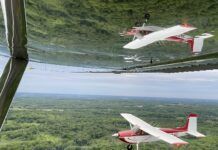
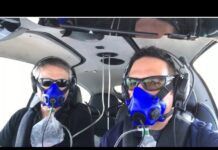
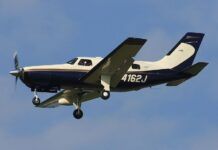



A couple of years ago one of my clients flew throughoutAustralia on something called the GOANA air safari andhas been raving about it ever since. So in April of the year 2000 when I got theopportunity to go on the same trip, I jumped at the chance. When I mentioned that I was goingto do this, one of my former students, Tim Dziuba, also signed on for the tour.Eight Cessna 172s with twopeople in each plus a tour director flying a Cherokee fly approximately 350 nm aday and cover as much of Australia as one could see inperhaps three months or so by car or bus. The organization of the itinerary issuperb.
GOANA
The tour is run by an organization called GOANA, which stands for the Great Outback AustralianNavigation Adventure.The name is a take on a native lizard, the goanna, an Australian iguana. GOANA is run by a delightful couple from Brisbane named Maland Marjorie Shipton. The pair have set up several air safaris, lasting fromfive days to a full month. The trip Tim and I took is their most popular —dubbed the Frontier Explorer — and lasts 15 days. I had met Mal a total ofthree times: first at Oshkosh in 1998, then at Sun ‘n Fun in 1999, and finallyat Oshkosh again in 1999 when he had Marjorie with him to run the GOANAbooth. I then corresponded with them by email.
By happenstance this year has been the wettest in Australia’s history. In theseveral years that the GOANA air safaris have been in existence, the weather hasnever caused more than a half-day delay and never so much as a single diversionfrom the scheduled itinerary. However, this year the tour preceding ours and theone on which we flew had to be changed almost daily due to the weather.Obviously, all our flying must be day VFR (in fact our Australian Pilot Licenseslimit us to this kind of flying). Even so, our wonderful tour director KeithFearnside managed to make the arrangements for our accommodations, groundtransport, meals, etc., changing each almost daily. The monumental task ofhandling all this while shepherding a group of 15 Americans from diversebackgrounds and widely differing ages was handled smoothly and efficiently. Aswell as being an excellent pilot, the bloke is also an engineer (Australianaircraft mechanic), so with his toolbox and spare parts he was ready for almostany minor emergency. We did in fact have one alternator failure in one of theairplanes, and Keith simply replaced the faulty alternator with a new one out ofhis spare parts supply (carried in the Cherokee which he flew).
Paperwork
|
We sent photocopies of our U.S. pilot certificates, medicals, and proof ofcurrent BFRs several months earlier, and when we arrived, Australian PilotLicenses were waiting for us to sign. The participants stay in the best hotels,eat at the finest restaurants, and fly aircraft that are well maintained, all ofwhich is included in the modest price. In fact the only flaw — the onlything I can find wrong with the GOANA organization — is that they don’t chargeenough. When you consider that you get 40 hours of Skyhawk rental, 15 nights in quality accommodations, excellent dining, and admission to all kinds ofmuseums, etc. it is a bargain. With U.S. $100 in your pocket, you’ll haveadequate funds to cover any and all incidentals you might require. Of course, ifyou wish to, you can spend a great deal more on gifts and souvenirs, but U.S.$100 is certainly adequate to cover the incidentals that mostpeople would require. At Coober Pedy several of the people on our trip boughtrather expensive opal jewelry, at far better prices than can be found anywhereelse in the entire world.
First Day
 The first day — or was it the first two days? — saw Tim and I leaving Detroit Metropolitan Airporton Saturday, April 8, for the first leg of our trip. After a brief layover while wechanged planes in St. Louis, we arrived in Los Angles, where, after another brieflayover, we boarded an Air New Zealand Boeing 747-400 bound for Sydney. Oncesafely on the ground in Sydney, we again changed planes (after yet another short layover) and proceededto our destination — Brisbane. Including the time spent in airports, our totaltravel time was over 38 hours. Having crossed the International DateLine, we arrived in Brisbane mid-afternoon on Monday, but it was still mid-afternoon on Sunday back in Michigan. Although exhausting, the trip was notaltogether unpleasant. Possibly in part because on all but the STL to LAX leg,the passenger loads were light, and the cabin attendants couldn’t have beennicer or more helpful. Even the airline food on Air New Zealand was good!
The Next Two Days
|
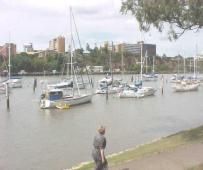
The next day was Tuesday and, after sleeping for over 12 hoursand after a full breakfast at the Park Royal Hotel, wewalked through the botanical gardens and along the river walk. These beautifulandwell maintained gardens are just across the street from the hotel.
We had planned to go on the CityCat, a cruise boat that plies the Brisbane Riverand is a popular tourist attraction, but it rained off and on all afternoon, sowe stayed in the hotel and watched a movie on the tube. At breakfast we met fourof the people who would be flying the safari with us. Most of the others on thisadventure were from the Washington state, although one was from Pennsylvania andanother was from New Jersey, plus a couple from Alaska and another couple from Indiana.
Indeed, our party consisted of quite a diverse group. We ranged in age from the early30s to the mid-70s. Seven of the 15 of us were non-pilots. Onewas a professional pilot — me — one had flown for the government in Alaska, oneowns a TBM and regularly flies it from his home in Pennsylvania to Florida, andthe rest are relatively low-time private pilots. One is a doctor (acardiologist), one a landscaper, one a rancher, a couple of retirees, and anautomobile dealer. Tim was the youngest and least experienced and I was theoldest and most experienced of the pilots.
|
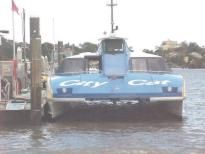
The following day, Wednesday, we walked from the hotel past a roundabout (alsoknown as a traffic circle) anddown the river walk to Riverside Centre, where we boarded one of the manycatamarans and paid Aus $7.00 for a ticket which would be good all day on anypublic transportation in Brisbane — bus, ferry, City Cat, etc. We rode the CityCat, a large catamaran "bus" that goes downriver to the university, makingfrequent stops along the way. It then goes upriver through the downtown area,criss-crossing the river to stop on both sides to load and off-load passengers.On the downriver leg, while standing in the bow of the boat, the wind blew mycap off into the river, exposing my bald pate to the hot sun. I sure hated tolose that cap.
After leaving the City Cat, we walked back (upside-down on the bottom side of theworld — across the equator and the International Date Line from the good oleU.S. of A.) to the Park Royal to rest, stopping along the way for lunch at one of thenumerous outdoor cafes. It was then break-time, so after a dip in the pool and asession in the spa, we napped. (This travel journalism sure is tough! — Ed.) The next day the big adventure really gotunderway.
The Adventure Begins
|

The following morning at 0800 we were all picked up, along with our baggage,and taken to Redcliffe Aerodrome, some 40 or so kilometers away. We weregiven a thorough briefing on flying in Australia, regulations, survival in theoutback, etc., and we were issued a kit containing charts, radio procedures,data on the itinerary, etc. Some of our stops would be at airports within MBZs (pronounced M BeeZed), or Mandatory Broadcast Zones. These exist at remote airports wherecommuter traffic comes and goes, and when within 15 miles of such an airport,one is required to monitor the frequency and broadcast his intentions in theblind. At other airports one is not required to have a radio in the airplane,but if there is one it must be used! One of the more interesting points broughtout during the briefing was the fact that almost all the aircraft movement onthe ground must be accomplished with a towbar and manpower because most ramps inthe Australian outback are gravel surfaced, made up of extremely fine stone andsand, and they are death on propellers. The paved runways are coated withbitumen, but many of the runways are unimproved, whichmeans they are surfaced with fine gravel. In fact, dressing the props with afile would soon wearthem down to thin strips of metal, so the replacement of propellers isaccomplishedfairly often.
Preparing To Depart
After a nice lunch in the GOANA hangar we met our airplanes and each of thepilots was checked out in the airplane he or she would be flying. It reallywasn’t a check flight, but rather an indoctrination flight to give the pilot anopportunity to learn where all the knobs and dials are located in his or herparticular machine. All the airplanes are equipped with GPS and each isprogrammed with the waypoints for the daily route, en route and destination. We werethen taken to a nice motel in Redcliffe, where we rested until suppertime, atwhich time we were again picked up and taken to a restaurant for a very nicedinner.
It REALLY Begins!
|
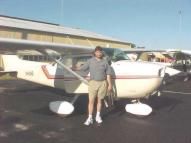
At 6:45 the next morning, Friday, we were again picked up with all ourbaggage and taken back to the GOANA Hangar at Redcliffe Aerodrome, where we hadbreakfast prior to starting out. After breakfast we finally got started. Ourcharts had been cut into 17 x 11-inch segments, laminated, folded into 8-1/2 x11-inch sheets and inserted into cellophane pockets in a spiral binder. They weremarked with the straight-line routes between waypoints with the heading andmileage noted for each route segment. It would be hard to get lost!
The first three segments took us clear of Brisbane’s Class C airspace. They were 256 degrees/34nm, 225/33,and 222/19 respectively. The next segment (224/84) brought us to Goondiwindi, anunattended paved strip where we all topped off our tanks. It is extremelyimportant to top off the fuel tanks at every opportunity, because theavailability of fuel is somewhat limited, in terms of distances between placeswhere fuel can be obtained. And it would be a disaster to experience anoff-airport landing in the outback because of fuel exhaustion.
From Goondiwindi, a straight line flight of 256 nm brought us toHaddon Rig station (ranch to us). Haddon Rig is a large sheep station. It has atwo-strip, unimproved airport at which we all landed. And when I say large, Imean large! It encompasses 58,000 acres — that’s right58,000 acres of land! — and that’s a small station! In addition to raising andbreeding championship breeding rams, Haddon Rig maintains a guest lodge, wherewe spent the night.
Fuel Critical
|

When we left Haddon Rig the next morning, there was a low, broken cloud deck,and we flew along under this deck for a few miles, expecting it to break up, butinstead it just hung there, becoming thicker and dropping lower than the 600-or-so-feet where it was when we started. When occasional clouds wouldreach the ground, we decided it was time to climb up on top, so we did justthat, breaking out at about 1,700 feet agl into blueskies and sunshine. However, the friendly broken deck below us soon closed upand became solid. It was at this time that we really came to appreciate what wehad been told about fuel at our briefing back at Redcliffe.
The distances between aerodromes where fuel is available in Australia are sogreat that everyone tops off their fuel tanks at everyopportunity. We had a scheduled fuel stop at Burke, 132 nm fromHaddon Rig (remember we had traveled 210 nm from Goondiwindi wherewe had last fueled up before arriving at Haddon Rig), so there was no questionof reaching our destination of Charleville even with the long-range fuel tankswith which all the airplanes are equipped. We would have to be able to get downat Burke, or return to Haddon Rig, and there’s no fuel available at Haddon Rig.As it turned out, some 40 nm prior to reaching Burke, the undercast beganto break up so we could get down and we all made it in for our scheduled fuelstop at Burke.
The next waypoint, Cunnamulla, was a distance of 122 nm, at whichpoint we made the final turn for the 103 nm run to Charleville. Since it was abit late in the day it was decided to let the fueling wait until the next morning, and headfor town and lunch. After a local tour and a presentation on local history, wevisited a research center run by the Queensland Parks and Wildlife Service wherethey have a breeding program underway to save the Bilby, a small marsupial whichis in grave danger of extinction, primarily at the hands on feral cats andfoxes. We got the full lecture on "save the Bilby" and then we sawsome of those cute little buggers in their large breeding pen.
Longreach
|
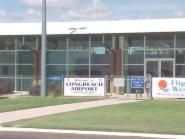
The shortest day of flying occurred the next day. After fueling up atCharleville, we made the turn at Blackall, our only waypoint on the way toLongreach, a total of only 210 nm from Carleville. On the airport atLongreach we visited the Qantas Museum. The acronym QANTAS stands forQueensland and Northern Territories Air Service, and the airline now known as QantasAirways grew up at Longreach.
|
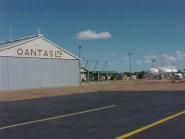
The museum traced the history of Qantas Airways from its inception right up tothe present day. After visiting this interesting facility, we boarded a bus forthe Stockman’s Hall of Fame, where we had lunch. The Stockman’s Hall of Fame atLongreach is another interesting museum.
After lunch at the Stockman’s Hall of Fame, where we gained a lot of backgroundon the outback, we checked into another nice motel where we were to spend thenight. First, however, after checking in, we proceeded by bus some 30 or sokilometers to the Wellshot Hotel at Ilfracombe where we had an excellent dinner.After we ate we had an incredible demonstration of working sheep dogs — short-haired Border Collies. These remarkable dogs workedducks and sheep, bothindividually and in teams of up to four dogs. The Australian cowboy who gavethis demonstration then demonstrated with his working horse, which had Americanquarterhorse ancestry. The bus then returned us to the motel at Longreach.
On To Mt. Isa
|

Next morning we took off for Mt. Isa, a distance of 328 nm from Longreach withthree waypoints along the route. On arrival at Mt. Isa we were taken to anotherfirst-class hotel where we relaxed for a couple of hours (a dip in the swimmingpool, rest in the room, etc.) after which we walked one kilometer to visit aremarkable museum, the Riverleigh Fossils Centre, which offers an impressivedisplay of fossils, chronicling the archeological history of our planet, and allthe fauna and flora that have inhabited our world since the beginning of time.
After returning to the motel we again rested until suppertime when we walkedacross the street to the Carpenteria Buffalo Club for dinner. We all signed inand became members of this fine private club — three-month members, but membersnonetheless. By the time we finished with our dinner it was time to walk back tothe motel and retire.
Our next scheduled stop was to be Alice Springs, but the weather forecast wasnot good, and we had to spend another day at Mt. Isa. Even the Air Carriers arenot getting in or out of Alice Springs. The following morning the weather at Alice Springs was still iffy, so instead ofvisiting the Flying Doctor office in Alice Springs as originally planned, we sawthe one at Mt. Isa, delaying the decision to depart for Alice Springs until afterlunch.
|

At the flying doctor base we saw a film and heard a fascinating lecture onthe history and activity of the RFDS (Royal Flying Doctor Service). Theoperation is supported by the government (80 percent) and donations (20percent). Teams ofdoctors and nurses flying Beech King Airs serve the remote areas of Australia and itis said that a person can be seen by a physician more quickly than waiting in adoctor’s office or a hospital in the city. As the image to the left shows, theRFDS didn’t always have it so good to be flying King Airs — earlier equipmentincluded the deHavilland Dove piston twin.
After the visit to the RFDS base we returned to the Buffalo Club for lunch atwhich time we learned that we would not be proceeding to Alice Springs that dayafter all.Even so, there was still much to see and do in Mt. Isa. After a rest and a dipin the pool at the motel we walked over to the Aboriginal Culture Centre, wherewe acquired a smattering of knowledge of Aboriginal life. Some of our group alsotook a tour of a mine (Mt. Isa is very big mining country.)
Boulia, Outback In Queensland
Having spent an unplanned extra day in Mt. Isa, we moved on. However, our next scheduleddestination, Alice Springs, was still socked in, so we changed direction and wentsouth to Boulia, the shortest distance we had flown in a single day — only 139nm. The disappointment of not making Alice Springs was soon dissipated when wehad checked in to the motel at Boulia. We had lunch at the Min Min Encounter,and thereafter attended the show at the Min Min Encounter Theatre.
This program is extremely impressive. It tells all about the mysterious Min MinLight, which I believe inspired the movie Close Encounters of the Third Kind! This unusuallight is rarely seen and has never been satisfactorily explained. Some say it isnatural (perhaps some sort of radiation glow), while others believe it to besupernatural. Some say it follows you, while others believe that it leads you onto your doom. Whatever it is, it can’t be searched out and found. It shows upwhen and where it pleases and allows only those it chooses to observe it. TheMin Min Light probably originated as an Aboriginal myth. Boulia is also the site ofthe big camel race held in July each year.
Longest Day Flying
From Boulia to Coober Pedy (hey, I didn’t make up these names, honest…) was the longest day of flying on the entire trip.We were in the air for over five hours altogether. Lunch had been packed back atBoulia, and when we stopped for fuel at Birdsville, we walked across the streetfrom the airport to the pub where we relaxed for a bit and had our lunch. Thenoff to complete the day’s journey to Coober Pedy, a distance of well over 300 nmmore. Along the way camels, cattle, donkeys, kangaroos, andwild horses were spotted.
Also, we had the rare opportunity to fly over lakeEyre, the largest salt water lake in the world. What made our experience so rareis the fact that this lake only has water in it about twice per century, therest of the time it is a huge dry salt bed. This year Lake Eyre is indeed a hugebody of saltwater. Because everything has been so wet this year the desertlooked more like a swamp than a traditional desert. The water comes from therivers which all flow inland and evaporate or seep into the ground when theyreach the desert, but the area qualifies as a desert because of the very limitedannual rainfall. However, by this time we were all joking about how the term"limited annual rainfall" is a myth!
|
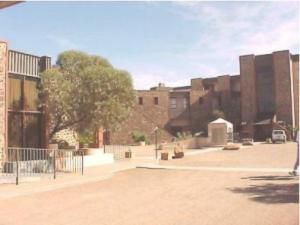
The hotel in which we stayed here is by far the most luxurious of any we haveexperienced on the trip so far. It is unique in that it is cut right in the sideof a rock hill, and the rooms are underground with rock walls. They are notreally underground — in effect they are a series of caves cut into the side ofthe rock hill. This means, of course, that there are no windows in the rooms. We also had the best dinner of the trip here at Coober Pedy, at aGreek restaurant, of all things.
Coober Pedy is the center of the world’s opal mining industry. Over 90 percent of theopals mined in the entire world come from this area and most of the localpopulation are engaged in either mining or cutting of the stones, turning theproduct of the mines into fine jewelry. Our original itinerary puts us in CooberPedy tomorrow for an overnight stay, but because of the diversions we have made,we’ll be here for two nights, after which we will be back on schedule. When wearrived at the community of Coober Pedy the population and merchants were busilypreparing for the Opal Festival, an annual event that atracts thousands ofvisitors from all over the world.
|
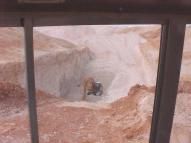
The next morning after breakfast we visited an opal shop where we had theopportunity to observe a cutter at work and the beautiful handiwork he turnedout. We then boarded a bus for a tour of the area. This tour included severalstops, from the local cemetery, to an underground church, an undergroundresidence, and a tour of an underground mine, as well as surface miningoperations. These underground facilities are very practical in that they arerelatively maintenance free and they require neither heat not cooling. TheCoober Pedy golf course is the strangest in the world. No part of it is made ofgreen grass! The golfers are permitted to carry a bit of sod or a piece ofcarpet on which they place the ball for their shots.
Another Long Leg
|
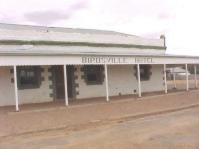
Leaving Coober Pedy we had a bit over four hours of flying to Birdsvillewhere we overnighted at the Birdsville Hotel after visiting a workingmuseum which contains collections of all kinds of historic artifacts. This longday of flying saw us cross over portions of three of Australia’s huge states —South Australia, Northern Territories, and Queensland. Please don’t take theexpression "huge states" lightly. Just think, with a land massapproximately the size of the contiguous 48 United States, mainlandAustralia has only five states — Victoria, New South Wales, Queensland,Northern Territories, and South Australia. Birdsville is quite a small town, butit attracts a large number of people for the races that are held there.Virtually all the activity in this quiet little town centers around the pubwhich is part of the hotel, and at night the place really comes alive. While a guitar player strummed and sang, several others playedpool. The public bar was quite crowded and very noisy. The hotel rooms were themost primitive we’ve seen on the trip. The accommodations at the station guesthouse at Haddon Rig were much finer. However the breakfast at the BirdsvilleHotel the next morning was very good.
Birdsville To Blackall
|

Our next scheduled stop was to be Avington (after a fuel stop at Windorah),but since the rain had soaked the sod runway at Avington, we amended ourdestination to Blackall where we landed for an overnight stay, after making thefuel stop at Windorah. On these two legs, a total distance of 280 nm, we sawmore wildlife than we had seen so far, including camels, kangeroos, emus,dingoes, wild hogs, and, of course, lots of cattle and sheep. We got in toBlackall under a very low ceiling (300 feet) and visibility of perhaps one-half mile. In other words, we made it by scud running over flat country with zeroobstacles. For most of this day’s flying we were 500 or fewer feet above theground.
The next morning the weather still required that we stand down so the decisionwas made to spend another night in Blackall. Although a very nice little town,there is very little to see or do in Blackall so we just rested and took iteasy. A stroll through the town included a visit to a shearing shed where wehad the opportunity to observe an old style shearing machine in operation, andit was all over as far as activity is concerned. The motel, however, is reallyfirst class, and if you have to be stuck someplace, this is as good as any. Ourschedule called for us to spend two days at Avington (the previous night, thisnight and the next day), and the next two days at Great Keppel Island, then backto Redcliffe, our starting point and the end of the great adventure. Of course,anyone who flies is completely at the mercy of the weather. This is simply afact of life.
Great Keppel Island
The next morning was flyable, so we departed Blackall for Emerald, a gemstonecenter, where we topped off the tanks. As soon as we finished fueling theairplanes, we took off again for Great Keppel Island. The Keppel Islands were named by CaptainCook during his famous voyage in 1770. Cook named the area after AdmiralAugustus Keppel (1725-1786) who had joined the Royal Navy at the age of 10(that’s right — he was 10 years old when he joined up) and had risen to becomeFirst Lord of the British Admiralty. Altogether we traveledjust under 300 nm, again under a low overcast all the way.
Landing atGreat Keppel, we were met right out at the airstrip by a small bus and a tractorpulling a trailer for our luggage. We then checked in to the Great Kepple IslandResort hotel, and quite a resort it is — very similar to those at Miami orHonolulu. We assembled on the restaurant balcony at 5:00 pm for a welcomingcomplimentary champagne cocktail reception. Then, at 6:30 we met for supper atthe Admiral Keppel Restaurant. The schedule called for an excursion on a largecatamaran the next morning at 10:30, a schedule which gave us all an opportunityto sleep in for a change. Again, it rained intermittently all night, sometimesquite hard. The weather in Australia certainly had not been anything like whatmost, if not all, of us had expected, but the Australians never expected thatkind of weather either.
|
Another washout — not only did it rain all night on Grand Keppel Island, butthe following morning it was still raining, so our boat ride in the big catamaranwas cancelled as well. We could walk around the island, rest, partakein one or another of the many activities available there, or simply do nothinguntil dinnertime. Grand Keppel Island is indeed a tropical paradise with smalland medium sized marsupials scampering about and gorgeous tropical birdsflitting from tree to tree and uttering various raucous noises. The birds foughtus for the food on our plates, and the possums begged at the table (Australianpossums differ from those I’m used to in that they have furry tails rather than therat tails of the North American opossums). Huge bats called flying foxes abound on the island. They spend the dayhanging upside down in the trees and at night fly out for food.
This was really our final day of the tour’s flying portion. The following day we were scheduledto fly to Redcliffe and then back to Brisbane by bus. In spite of the fact thatwe had missed several of the things we were scheduled to see, the trip was asuccess, for we experienced many equally interesting things that weren’t on theschedule. In other words whatever was missed was replaced with something ofequal or greater interest. This, of course, was a result of the work of ourwonderful tour director. Keith is not only and accomplished pilot and engineer,but is an extremely knowledgeable historian and naturalist. Throughout theentire trip we had all been in communication with one another on the GOANA chatfrequency, and Keith explained facts about the flora and fauna of Australia aswe flew by the habitat of each.
Another Day Of Scud Running
Although scheduled to start at 8:00 a.m., we delayed the start of our final day offlying until 9:00 because of the weather. Then when we departed Great Keppel Islandwe stayed low under a 400-foot overcast. We followed the shoreline toGladstone, a distance of approximately 60 nm, where we topped off our tanks.Again the weather held us on the ground for over two hours, and when we took offfor Redcliffe we were again forced to fly low through light, moderate, and heavyrainshowers as we followed the coastline down. Flying low over the coastline(just out over the water where we were sure of ground clearance at our lowaltitude), we passed by some very interesting countryside — volcanic hills andsuperb farmland. The rich volcanic soil provides excellent growing land forseveral tropical products. We also flew over the world’s largest sand island.
|

On arriving at Redcliffe, we were met and greeted by Mal and Marjorie Shiffer,who had been manning the GOANA booth at Sun ‘n Fun when we departed two weekspreviously. They had a nice light lunch laid outand souvenirs (pins andpolo shirts) for each of us. After much group picture taking and joking around,we loaded up in the GOANA vans and were taken back to the Park Royal Hotel inBrisbane. Thus the odyssey ended. We had flown over 42 hours and coveredwell over 3,000 nm. Such a trip would have taken over three monthsif done by car or bus.
Tim and I had another full day and a night in Brisbane to do a bit ofsightseeing and wandering around the city.
Final Day Downunder
Although our experience flying ’round the land down under was over, GOANAprovided us with another night’s stay at the Park Royal Hotel in Brisbane, so the nextday we availed ourselves of the opportunity to visit the Lone Pine KoalaSanctuary, which turned out to be one of the highlights of the entireexpedition. This wonderful place — which is dedicated to saving the koala — is hometo over 130 of the furry, cuddly creatures. It also houses kangaroos, wallabies,emus, crocodiles, bats (flying foxes), dingoes, and several other forms ofAustralian wildlife, as well as numerous varieties of birds.
|
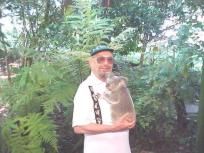
Although many of the creatures are housed in large pens, the kangaroos, emus,wallabies, and wild turkeys are free to wander about the grounds, and thevisitors are free to feed them. Since koalas are very particular regarding whichspecific kind of eucalyptus leaves they will eat, the sanctuary has planted40,000 gum trees and plans to put in another 30,000 to provide food for thekoalas, who manage to consume about 230 tons of leaves annually. Koala is anAboriginal word meaning "doesn’t drink water." Since eucalyptus leavesare about 50% water, koalas rarely, if ever, drink water.
This ended our adventure in Australia. Tim and I had a wonderful time seeing thesights and traveling throughout Australia. I’m already planning to go back next yearfor another one of the GOANA trips. Maybe I’ll see you then?
For more information on these excursions, contact: GOANA AUSTRALIAN Air Safaris — or — P.O. Box 72 Kippa Ring Email: [email protected] tel: +61 7 3204 2211 |
