
















Castle Airport, in California’s Central Valley, is the home of a superbaviation museum and a few other attractionswhich make it worthy of a day-trip by general aviation pilots, and especially those withan interest in military aviation history. The airport is located next to the town ofAtwater, north of Merced, making it an easy afternoon trip for Bay Area pilots, and aslightly longer flight for those from Southern California.
Castle is an ex-military airport, in the midst of transformation. When the StrategicAir Command moved out a few years ago, local authorities determined to utilize theexisting facilities as profitably as possible, while maintaining the unique airport’sability to thrive, and planning for revenue from development of aircraft maintenance,freight operations or other aviation facilities.
Today only half the vision has been realized. Pac Bell arrived in force, turning manyof the administrative buildings into "customer disservice" centers. The basehospital is now a civilian medical center. The auditorium, bowling alley and officer’sclub have been converted to civilian use. A variety of other businesses ranging from lightmanufacturing to telesales operations are occupying many of the other structures. Theaviation museum gets a steady stream of visitors. But the aviation side of the field isstill looking for a major tenant or two to keep the huge ramp and 11,802’x300′ runwaybusy.
Long Landing Approved
|
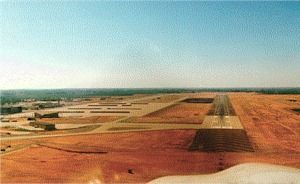
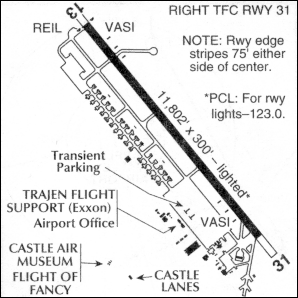
In the meantime, this huge expanse of concrete is available to any small plane pilotwho cares to use it. To general aviation pilots who are used to searching for hard-to-findairports, the approach to Castle is truly a unique experience. The runway is visible from20 miles away and fills the windshield on final approach. I found Castle to be an idealplace for landing practice, as my club prohibits touch-and-goes in high-performanceaircraft but this runway’s length allows for easy stop-and-go operations. In fact therunway is so big that it makes sense to think ahead and perhaps not touch down too soon.If you touch down on the numbers, you’ll have to taxi about 3000 feet just to get to thefirst turnoff! For instrument pilots, runway 31 also offers an ILS approach.
I probably could have parked in a spot formerly occupied by a B-52, but that’s not agood idea. The old bomber pads are a long walk from anywhere interesting and don’t offertiedowns or fuel. A much more practical option is to park near the main terminal building,now occupied by Trajen FlightServices.
|
Facilities, Fuel, Food
Trajen has a fairly nice setup, as they took over several military conference rooms,lounges etc. If you buy avgas from them, they’ll throw in a free ride to the Museum andtwo complementary entrance tickets. I didn’t need the gas, so decided to walk over, takingtime to note the gradual conversion of the airbase facilities to civilian commerce. Atpresent time, Trajen is open 7am-6pm every day.
For the arriving aviator there are two places to eat, in the bowling alley or in themuseum. I had no desire to go to the bowling alley, so decided to eat at the museum when Igot there. A cafe in the terminal building didn’t survive on the minimal local traffic,but there is talk of a "real" restaurant at the museum sometime soon. Pilotsmight also want to consider combining the trip to Castle with a lunch or dinner atHarris Ranch (3O8) which is just 40 miles south,and serves up some of the best steaks west of Chicago.
The Main Attraction: Castle Air Museum
The museum is a ten minute walk from transient parking at Trajen. Walk straight outtowards the base main gate, pass the memorial parade grounds, turn right next to the oldbase chapel (now a science learning center), and look for a small gate in the fence to themuseum’s parking lot. You can’t miss the SR-71 standing out front!
The SR-71 is prominently featured in the front parking lot, and is logically the firstaircraft visited. The plaque notes that it is "on loan from the U.S. Air ForceMuseum." The same notice is repeated on most of the aircraft plaques. The museum wasstarted with the support of the Air Force and handed over to a non-profit civil committeewhen the base was closed, but the USAF has retained official "ownership" of manyof the aircraft.
The museum is a seven acre outdoor complex, with walkways between the planes. Manymajor types used during and since World War Two are on display, but in keeping withCastle’s history, much of the emphasis is on bombers.
You enter the musuem through a building housing the gift shop and Flight of FancyGrill, where a decent burger and other basics can be found for a reasonable price. $5 getsyou entry to the museum and a look at the entire collection, which is still growing. Oneof the volunteers told me that they have the largest collection west of the Mississippi,"unless you count all the wrecks in the desert which Pima claims as airplanes in itscollection." The museum is staffed by such volunteers, some of whom flew the types ofaircraft on display or had been affiliated with the air base in one way or another.
|
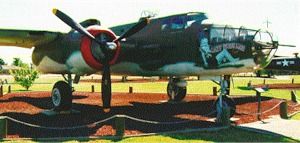
The first two planes you encounter inside are a B-17 Flying Fortress and a B-24Liberator. Nearby, you’ll find many others of the same era, including a B-25, B-18, B-29,and A-26. This B-24 is notable for service in Europe, and also for being the last of thetype ever produced. Castle’s B-29 was re-assembled from parts of 3 hulks recovered atChina Lake and is rumored to be inhabited by ghosts. However, it’s nose section stillfeatures original battle markings and nose-art from one of the salvaged aircraft. Nearby,a B-25 is one of many aircraft in good condition which features restored nose-art.
Further into the complex, more modern bombers can be found, including a B-47 Stratojet(the last ever to fly) and a B-52, which is displayed with a large jet-propelled dronebelow the left wing. This unusual craft is a Hound Dog missile, an early version oftoday’s cruise missiles that carried a thermonuclear warhead and featured aninertial/stellar navigation system. The B-52 could carry two Hound Dogs and their enginescould be started before takeoff in order to provide extra power and convert the Buff intoa ten-engined airplane!
|
Next is a KC-135 tanker originally based at Castle. This is one of the few aircraft atthe museum that you can enter and it contains a small exhibit about the aircraft, thebase, and the difficulty in moving this aircraft from the runway to the museum complexwhen it was retired.
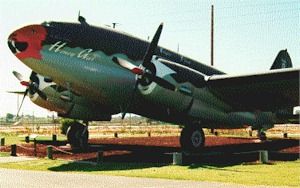
Across from the heavy jet bombers and tankers is a row of early jet fighters from theU.S. and elsewhere. Also nearby is a selection of cargo and utility aircraft from theWorld War 2 years and later. A recently-restored C-47 (DC-3) features interesting"modern" nose art which was added in 1985, but is not typical of a WWII cargoplane. Adjacent to it is a more authentically painted C-46D, which survived 45 trips"over the hump," crossing the Himalayas between Burma and China during WWII.
|
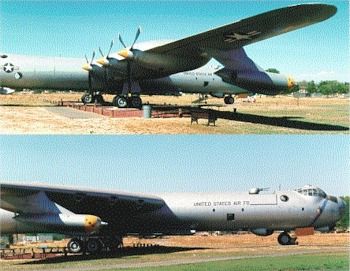
One of the last aircraft in the line is an RB-36H Peacemaker. This aircraft is uniquein the world, being one of only four remaining B-36s, and the only existing "RB"variant. This type was the largest bomber ever produced, and designed to carry a single25-foot, 21-ton Mark 17 nuclear bomb. The B-36 was also the last major piston-poweredbomber, powered primarily by six 28-cylinder R-4360 engines mounted on the back of thewing in a pusher configuration and assisted by two pairs of J47-GE-19 turbojets in podsunderneath the wings. When equipped for full bombing and reconnaissance work, the RB-36carried a crew of 22 and could remain in the air for as long as 50 hours!
Out beyond the RB-36 is a large undeveloped area, with several aircraft awaitingrestoration and space for many more. Among the aircraft waiting here are a C-54, C-119 andSA-16. The aircraft in this section were just barely rescued from the scrap heap andsuffer from years of wear and tear.
Towards the end of the afternoon, I was alone at this end of the complex when a gust ofwind blew up and one of the props on the unrestored C-54 started to turn slowly in thebreeze. Then another puff started the second prop turning, almost as if the aircraft weretrying to fly just one more time. A minute or two later the wind died down and everythingstopped almost without a sound. I was the only one there to see it. It almost made mebelieve there ARE ghosts here. I beat a hasty retreat.
In the end I left somewhat depressed, despite the stellar job the museum is doing inpreserving aviation history. Its a shame that these aircraft — most of which arrived hereunder their own power — are parked just half a mile from an unused and inviting runway,yet are unlikely to ever fly again.
Flight Planning Information
Museum Hours:
Memorial Day through October 1st: 9am to 5pm daily
October 1st through Memorial Day: 10am to 4pm daily
Closed Thanksgiving, Christmas and New Year’s Day
Contact Telephone Numbers:
Castle Air Museum: (209) 723-2178
Gift Shop/Ticket Counter: (209) 723-2182
Flight of Fancy Grill: (209) 723-2177
Trajen Flight Support: (209) 725-1455
Airport Office: (209) 384-7325
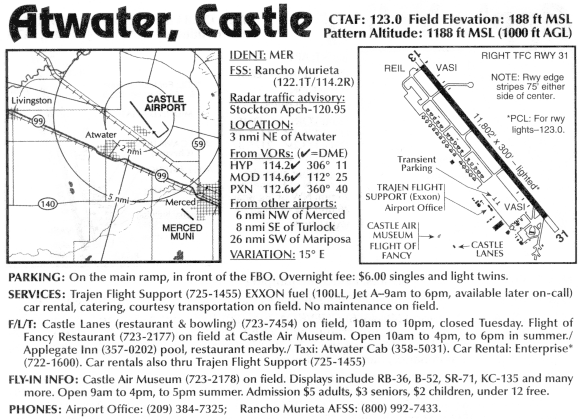
Airport information courtesy of Pilots Guide toCalifornia Airports.
Full Listing of the Museum’s Aircraft
| Designation | Nickname | Notes |
|---|---|---|
| A-26 | Invader | |
| B-17 | Flying Fortress | |
| B-18 | Bolo | |
| B-23 | Dragon | |
| B-24 | Liberator | |
| B-25 | Mitchell | |
| B-29 | Superfortress | |
| RB-36 | Peacemaker | The only one of this model still in existence |
| B-45A | Tornado | |
| B-47 | Stratojet | |
| WB-50 | Stratofortress | |
| B-52D | ||
| EB-57 | Canberra | |
| B-2 | Vulcan MkII | RAF Colors |
| F-80C | Shooting Star | |
| T-33 | Shooting Star | trainer |
| F-84F | Thunderstreak | |
| F-86H | Sabre | |
| F-89J | Scorpion | |
| F-101 | Voodoo | |
| F-104B | Starfighter | |
| F-105 | Thunderchief | Thud |
| FB-111 | Aardvark | |
| F-4E | Phantom | originally a Thunderbirds aircraft, painted in T-bird colors |
| CF-100 Mk V | Cannuk | Candian colors |
| C-45 | Expediter | military version of Beech 18 |
| C-46D | Commando | |
| C-47 | Skytrain | |
| C-54 | Skymaster | new addition, still work in progress |
| C-60 | Lodestar | RAF/South African colors |
| C-119 | Flying Boxcar | recent addition, from the Forest Service, in progress |
| C-123 | Provider | |
| KC-97 | StratoFreighter | |
| KC-135 | StratoTanker | this airplane is open for "walk through" |
| AT-6 | Texan | |
| BT-13 | Voodoo | |
| T-34 | Mentor | |
| SR-71 | Blackbird | |
| SA-16 | Albatross | new addition, still in progress |
| HH-43B | Huskie | |
| L-20 | Beaver | aka deHaviland Beaver |
| O-2A | Super Skymaster | military version of a C-337 (unrelated to the C-54) |
| U-3A | military version of the "tuna tank" C-310 | |
| KAQ-1 | Drone | |
