

















 Bruce Bohannon was born June 21, 1958, in Alvin, Texas. He grew up next to a duster strip, began working there to pay for flying lessons, and by age 18 he was flying Ag Cats. He began flying aerobatics, then teaching aerobatics, then flew competitive aerobatics. When Bruce found the judging too subjective, he switched to racing, where everybody knows who won. When he met Jim Miller he decided to build a JM-2 pusher and called it Pushy Galore. For ten years Bruce raced Formula One with Pushy, winning Silver and Bronze at Reno and finishing second to Nemesis in the Gold. Bruce and Pushy set two Speed Dash records and six time-to-climb records. He also went undefeated for three years at the “any challenger” drags at Sun n’ Fun. Pushy was fast, but was a handful to fly, and after Bruce built an RV-4 he decided his next airplane would be modeled on the RV series. Pushy Galore now hangs in the EAA Museum in Oshkosh.
In 1997 Exxon approached Bruce with a sponsorship offer and the Flyin’ Tiger was born. It’s a modified RV-8, powered by a Mattituck IO-540 and Kelly Aerospace Turbos, and is a work-in-progress for Bruce and his Crew Chief Gary Hunter. When last summer’s time-to-climb attempt at Oshkosh came up short, Bruce and Gary went to work fabricating new pressure lines for the engine accessories. That work paid off last month when Bruce set a time-to-climb record to 12,000 meters and an absolute altitude record of 41,300 feet. And he’s not done — he’s convinced the airplane will go a lot higher.
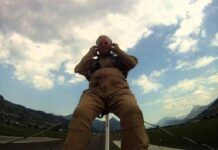
Bruce is into just about anything that flies. In addition to dusters and sport airplanes he has flown a Hughes 500 helicopter and had a corporate job flying a Hawker 125-600. He also builds and flies RC airplanes. Like all aerobatic pilots, Bruce has been wearing parachutes for a long time, and recently he decided to find out what it was like to use one. He started with a tandem jump close to home and is now a veteran skydiver with over 150 jumps. During one jump in April 2001 he pulled out a piece of paper and showed it to his fellow jumper. She read “Donah, will you marry me?” said yes, and they married at Reno last fall. Donah (who took most of the pictures in this Profile) and Bruce live outside of Houston with Bruce’s two sons.
How did you get interested in flying?
I was born with the desire to fly. My uncle built model airplanes, my dad always had plastic models around, and that was my very first exposure. The town I grew up in is a rural community with a lot of crop dusting going on, and I was pretty infatuated with watching the dusters fly around low and slow — low enough that you could see the pilot sitting in the airplane. My grandfather used to take me out to the local airport that I eventually hangared at for 20 years. He’d sit and drink a cup of coffee and I would get up on top of the building and watch the airplanes.
I got my first ride when I was about 12 years old. We moved right next to a duster strip with a small sport aviation community — Cubs, Champs and Luscombes — and lots of aerobatic airplanes — Stardusters, Pitts Specials, things like that. Of course, I immediately started trying to bum a ride in anything I could get in, and my first ride was in a Piper J3 with Gene Robertson. I would clean the oil off the belly of people’s airplanes, and when they’d show up I’d say, “Hey, come look what I did,” just to get a ride. “Shoot first, ask questions later” kind of thing. I started working on the ground crew for that duster right after we moved there in 1972. I worked on the ground crew for seven years, and the nice thing about working on the ground crew for a duster is you don’t have time to go spend your money. We were working 15, 16 hours a day, seven days a week all summer long. I was able to save up enough money to keep myself in motorcycles, and just about paid my own way from the time I was 12 or 13 on. I put myself through flight school, got my license when I was 17, had my commercial at 18, and was flying dusters by the end of that year.
Dusting is a great job when you’re young. I don’t know how the old guys keep doing it. When I was on the ground crew I thought you couldn’t get harder work than throwing 120-pound rice sacks all day long, but sitting in the seat of the airplane, it’s the mental fatigue that gets you. You’re flying three feet off the ground at 105, 110 miles an hour all day long and you’re exposed to all kinds of problems — poisoning, power lines, engine failures — and you just have no place to go.

Were your parents supportive of this?
My parents were always supportive of whatever I wanted to do as long as I could afford it. There were seven kids and there wasn’t much money, but my mom said it best when I was very young, that anything you earn the money for you can buy it and nobody can ever take it away from you. That got tested pretty severely when I bought a Kawasaki 250 street motorcycle when I was 13 years old. She didn’t really agree with that until I threw her words back at her and said, “Well, you said this, so …” That’s kind of the way it’s always been — whatever I wanted I went after it and didn’t stop till I got it.
Probably the largest turning point in my life was flying a corporate jet for a year. It wasn’t that flying a jet was a neat deal because it really wasn’t to me. A Hawker HS 125-600 was an awfully intimidating airplane after a 100 mph Ag Cat. I had done a favor for a guy years before, and he was a very wealthy guy and he decided he was going to pay me back by giving me the opportunity to leave the rice fields. He knew what a dirty, dangerous job it was, and so he said, “You know, I’m going to get you an instrument rating and put you in this jet, and I’ll fly you for one year and then I’m going to fire you.” Well, the first time I sat in that jet and looked around at the instrument panel, I told him “Jim, I can’t do this. We’ve made a big mistake.” He says, “You can’t do what?” I said, “I can’t fly this thing?” He said, “Why not?” I said, “Because I don’t understand any of it. There’s so much — it’s so complicated. I’m used to an airplane with three gauges, and two of them don’t work,” and that was the way it was in dusters most of the time. It perplexed him a little bit that somebody would just stonewall him so quickly, and that was my problem for many years up to that point, was that if I looked at something and it was too complicated, I would choose not to do it.
From the time I was in school I had that same problem, from grade school on up, because I felt stupid because other people would get something that I couldn’t. What Jim taught me that has been so valuable to me over the years was that it’s not that you can’t do it, it’s that you choose not to. That sounds so simple, but when you, when you’re in that position for so long it’s a self-perpetuating problem, and the longer it goes the worse it gets. He told me, “I want you to understand nobody looks at this instrument panel the first time and gets it. You just break it into parts and learn what each part of the panel does, and pretty soon you’ll know it all.” Well, I was still resisting, and I resisted this guy for a long time. I just fought back so hard to keep from learning. He and I mixed like matches and gasoline while all this was going on.
I was an aerobatic instructor at that time and I was teaching him aerobatics while he was teaching me to fly the jet, and we got into a big knock-down, drag-out in a hotel bar in San Francisco after making a flight out there. I’m a very coaching-type instructor, very calm and very laid-back, and he was a “pick up the stick and beat me with it,” type instructor. Basically I told him he was a rotten instructor, and that I was really a superior instructor. Then he said, “I’m going to ask you a few questions, and I want yes or no answers, and I don’t want you to put any commentary to it, just answer.” He asked, “Who showed up first at the airport this morning and got the airplane out?” I said “Well, I did.” He asked, “Who put the fuel on it?” “I did.” “How did you know how much to put on?” “Well, I figured it out.” “Who filed a flight plan?” “I did.” “Who ordered the catering?” “I did.” “Who flew the airplane to Albuquerque and landed for fuel?” “I did.” “Who picked it up from there and flew it on into here?” “I did.” “You know how to start the APU. You knew when to start it … dah, dah, dah.” I said “Yeah, yeah, yeah, and your point is what?” He said “My point is that two months ago you sat down in the right seat of this airplane and looked at the instrument panel and told me, ‘I can’t do this.’ In two months you have gone from knowing absolutely nothing about this to being able to do not only fly that airplane and fly it well, but you know that the entire peripheral things about having the cars waiting for the passengers in San Francisco. You knew where to call them. You knew how to check the weather. You knew that you couldn’t make it non-stop. You know all of it, in two months, and you’re telling me I’m a bad instructor?” Even then I was angry about that for quite awhile because I hate losing an argument.
That was the awakening that I’m not stupid and I could do anything I want to. I’m not saying I’m a smart guy either — most of my learning is from trial and error, whereas a smart guy would pick up a book and read it and be light years ahead of me in many cases. On the other hand, quite often we have done things with little airplanes to set some of these records that people told us “You just can’t do that,” because they went to school and they were taught that they couldn’t do that and even to take a look at it was stupid to them. I owe a tremendous amount to that Jim Robinson for getting me past that mental block.
How did you get involved in racing?
I built and flew Pitts Specials in competition and air shows. I never went on the national scale but I flew all the local shows. In the post-Leo Laudenslager generation they just kept making the sequences harder and harder — to try to punish the monoplanes — and they really didn’t punish the monoplanes at all, but they just pushed the Pitts right into dinosaurdom. I kept complaining that “I’m destroying my airplane, trying to fly it in Unlimited,” and they said, “Well, that’s what the other, lower categories are for.” My point was that some day all you’re going to be measuring is who is the best aerobatic pilot in the country that can afford a quarter-million dollar airplane, and, that’s absolutely what they’re measuring now, and the pool is fairly, fairly thin.
So the judging in competitive aerobatics is what prompted me to start air racing. One judge would give you a ten on a maneuver and the other one give you a five. I’d drag those two guys together and say, “What did both of y’all see? How can this be? How can I all but zero the maneuver in your eyes and you — the other guy — think I did it perfect?” I realized that there was just a whole lot of politics in how well you score. It depended on how much they liked you. After I watched the first air race I said, “You know, when that guy crossed the finish line everybody knows who won.”
Hoot Gibson and I shared a hangar, and he had a little Cassutt Racer which he was awfully proud of — I didn’t think much of it — and I had a Pitts Special. One year he says, “Hey, let’s go out to the Reno Air Races.” The dusting season had slowed down so I went out to the races with him and some friends of ours. I didn’t spend much time at the races, to tell you the truth. Hoot came home just seriously infected with air racing, so we started racing the Pitts against the Cassutt. I’d always take off first and lead and then he’d try to catch and pass me before the end of it. We fooled around with that for awhile and the next year I went back to Reno and I came home a little more serious about it. I bought a Midget Mustang with a Lycoming 0-320 so it wasn’t a Formula One legal. One day Hoot and I got invited to a race and I met Jim Miller, who I had seen at Reno with his Miller Special “Pushy Cat.” Being as I had an 0-320, I thought it’d be kind of unfair to go out there and beat up on these 0-200 powered airplanes, and Miller kind of sensed that I was pretty confident, and he says, “Let me ask you something: How many laps do you think you can outrun me before I pass you?” Well, I didn’t think he was going ever pass me, but I always try to take any hedge I can get, so I said, “Uh, two,” and he laughed, and he says, “No, I’m serious. How many do you think?” I looked at him like he was nuts. I said, “Listen, old man. You know, this is an 0-320?” He says, “I don’t care what you got in there. It’s not going to take me two laps to pass you.” I thought, “Okay.” I probably even mentioned something about a pink slip.
There were six airplanes in the race — I was in the front row and Jim was in the back — so I felt really confident that I could hold him off the entire race, much less two laps. The runway was one edge of the race course, and the first turn was at the end of the runway, and as I laid the airplane over and started around the first pylon it looked like somebody threw a dart through my shadow. I wheeled around and looked up at the top wings, and there’s Miller grinning at me as he goes by with about 40 miles an hour on me — maybe 50. I have never seen such a trouncing in my life, and this was in the first one-quarter of a lap — an 0-200 powered airplane against an 0-320. Well, I learned a lot about air racing that day. I had already started building a Formula One Cassutt project and that day it went up for sale. I sat down with Jim that evening and we discussed what the possibilities of me getting another pusher like his and we sat down and worked out a contract on a napkin. It said six months later I would have an airplane, and doggoned if it was six months and three days later I flew Pushy Galore.
Bruce and Crew Chief Gary Hunter squeeze out a few more knots


Didn’t Hoot design the canard for Pushy?
He did. I quit smoking one year and picked up about 15 pounds almost immediately. In Pushy you sat way out ahead of the wings and the extra weight didn’t agree with the airplane at all. I was having to hold back stick all the time — even at top speed, straight and level — if I let go of the stick the airplane would just dive. Flying dusters taught me to always have the airplane trimmed up just a little bit, so if something distracts you it’s going to be more likely to climb than it is to run into the ground. One day I was in the hanger fed up with this problem, so I was in the hangar with a hack saw on the horizontal stabilizer as Hoot walks up. He says, “Do you realize what’s going to happen when you move that?” I said, “Yeah, it’s going to hold the nose up,” and he said, “That’s right, but at the expense of the carrying a tremendous amount of weight.” And I said, “I’m not changing the weight of the airplane.” He says, “No, but right now to fly straight and level you’re holding the stick back. When you’re doing that you’re pushing down with the tail. The airplane is carrying that much more weight than what it actually weighs.” I said “Okay, well how do I go about not doing that.” He said, “You lift at the nose instead of pushing down at the tail, and if you’ll notice that the nose is way further from the center lift than the tail is,” so I would have to push down with probably 60 pounds of force to hold the nose up, and I could lift with 15 pounds of force and end up with the same balance. I didn’t want to have this can opener looking device up there on the front of my airplane, but it was a no-brainer ’cause to fly the airplane 60 or 70 pounds heavier would be stupid if you could actually reduce the total weight of the airplane by 15 pounds and get the same cure that you were after in the first place. Hoot designed the canard and gave Gary Hunter — my crew chief, who’s an absolute magician with carbon fiber and fiberglass — the specs. Hoot gave us all the specs — set it at two degrees and it’ll hold up 15 pounds. So we built a three-quarter scale model of it and put it on the airplane. We could change the angle of attack on the ground, and when we got to about 4 or 5 degrees, it would hold the nose up. It didn’t try to flip the plane over backwards or do anything strange, so we built a full-scale model. We set it at one degree and flew it and it almost held the nose. At two degrees and it held the nose perfectly straight level. Hoot nailed the design. That’s certainly the least of his accomplishments, but I was very impressed.
Pushy looked like a lot of fun to fly. Was it?
It was an exciting airplane to fly, but it wasn’t fun. I was always on the edge of my chair flying that airplane. It had a lot of things about it that scared me, and, over the years of flying it just pretty much took the fun out of flying to me. Two of the four of that design had broken up in flight and killed the pilot — you’d have a hard time getting in a 172 if exactly half the fleet had been fatal in flight failures. That alone made it very difficult to enjoy the airplane. The construction was just an eggshell that as long as it was in its original shape it was very strong, but if you compromised any part of it, it had no strength at all. I was always worried about a bird strike breaking a hole in the leading edge and a wing coming off, because there were no ribs in the wing. It was just a main spar, a rear spar, and an end rib at each end, and that was it. There were no boxes along the way to prevent propagation of cracks or anything like that. If you broke any part of that leading edge, the whole thing was going to come apart, and that’s pretty nerve-wracking. It touched down at 110 miles an hour, and a few other little things like that. There were all kinds of things to be scared of on that airplane, and I’d kind of gotten to where flying just wasn’t any fun anymore.
Then I built an RV4 and started flying it, and it just truly brought the fun back into flying. It’s such a wonderful flying airplane. It had more than enough control, and I decided right then and there that if I was going to build another hot rod — for going after records — I was going to start with something that was a good airplane instead of forcing a bad one into places that it shouldn’t be. That’s how the Flyin’ Tiger began.
I started by saying “Okay, here’s what I want the airplane to look like.” One, I knew that if I sat in the back seat of the airplane I could put a whole variety of things where the front seat used to be without ever affecting the center of gravity. Two, it looks a lot better to have a single-place canopy way back on the plane. We’re in the marketing business so I had to have something that would make people just really stand up and take notice when we showed up with it. With a million of these little square-wing airplanes around it was going to be difficult to set ourselves apart from all that, and flying it from the back seat really helped that because it made the nose look 20 feet long on it and it just gave it a very distinctive look.
I knew it was a good choice, but as time has gone on it has proven out to be the smartest thing I ever did. I wish I could take credit for any of this, but it’s all to Dick Van Grunsven’s credit. He’s designed a magic wing here, in my opinion. Down low you can throw it around like a fighter and at 40,000 feet it flies as good as it does at sea level. You couldn’t put as many Gs on it up there, but it has no yaw instability, no roll inertia, there’s plenty of pressure to the elevator — it’s just a rock-solid airplane.

Is the Flyin’Tiger nose the same as a Harmon Rocket nose?
We took the front end off the Harmon Rocket and applied that to an RV4 fuselage, but you wouldn’t call it a Rocket fuselage because we left the short turtledeck. I don’t care for the tall turtledeck of the Rocket, and I wanted the P-51 look of a bubble canopy. Performance was secondary to begin with, but our prime objective to begin with was to have a very good-looking airplane, and that was pretty easy to achieve.
Now there’s a big scoop on top of the airplane between the cockpit and the nose. That scoop is the inlet for the intercooler. The scoop, the intercooler mount, and the plenum under the inner cooler are all one piece of carbon fiber. It weighs three pounds and it supports a 26 pound intercooler, and it supports it at 6 Gs. I know that because I stood on top of it and jumped up and down on it, and I weigh 180 pounds. That was our G-load test. That intercooler had started out as two separate, smaller intercoolers, half that big, and we were going to mount one on each side of the engine, and we just flat couldn’t come up with the room to do it, and the plumbing became a nightmare. I decided to weld the three parts together. It took me 20 minutes to describe to it to Gary and three days later that part is sitting there.
So over time, we’ve been sacrificing that original look. Now that we’ve got the airplane more established we’re letting a little bit of the look go for performance. We’ve built the best-looking cowling we can and still have a huge turbocharger and intercooler that’s adequate to take us to 40,000 feet and higher.
(photo by Bruce’s brother Darrell)

Congratulations on last month’s record to 12,000 meters. Why did you pick Palm Springs?
Desert Resort Regional airport — which was known as Thermal for years — is 113 feet below sea level. When we attempted this at Oshkosh last summer we knew we were really hurting ourselves. When you’re doing a time to climb, every single second counts — even though in this case we weren’t trying to break an existing record — because whatever time we put up there is going to set the bar for the next guy. You want to set it hard enough to dissuade people for taking your records away from you. They measure these from ground level. You have to climb X amount of meters above that — 3, 6, 9, 12, whatever record you’re after, so at Oshkosh you’re taking 800 feet away from your best rate of climb and you stick it on up at the very top of the flight, which is your worst rate of climb. If you start at 113 feet below sea level, instead of taking 800 foot off of our best and putting it on our worst, we’re taking 113 feet off the worst and putting it down where it’ll only take me two seconds to cover that much altitude, so the difference between doing it at Oshkosh and doing it at Thermal will be probably seven or eight minutes difference. When you can do things to shave a few seconds — and it’s amazing how much money and time I’ll spend to save a few seconds, much less several minutes, on a time to climb — that’s what possessed us to do it there. We were going out for the AOPA Convention anyway, so we decided to do it just prior to that.
How do you practice for something like this?
Well, you really don’t, per se. You should. At Oshkosh we got caught with our pants down because there was something that said a single test flight would have shown up and would have saved me a whole lot of embarrassment. The engine-driven fuel pump, the fuel-injector nozzles, and the magnetos have to pressurized with air to make them function correctly up there at those altitudes and, typical of me, I didn’t go get an expert to show me how to pressurize them, so I had all three of those accessories pressurized from a line that was too small and was being taken from a lower pressure area in the system than it should have been. There just wasn’t enough air around those nozzles to mix air with the fuel coming into the cylinders, and so you pretty much ended up running raw fuel up there without atomizing it. As soon as we got home we moved where we took the pressure from the high pressure side of the turbo, got three new bosses, and we ran one 1/4″ line to the fuel pump, one to the fuel injector nozzles, and one to the mags. On the very next test flight the airplane just performed spectacularly.
What physiological stuff goes on during a time to climb?
Basically it’s just like you get in the 172 and you set up a climb flying the numbers. Your ears will go through some popping because we’re climbing about 2,000, 2,500 feet a minute down low, and we can maintain 2,000 feet a minute right through about 30,000.
And you’re not pressurized so you’re breathing oxygen?
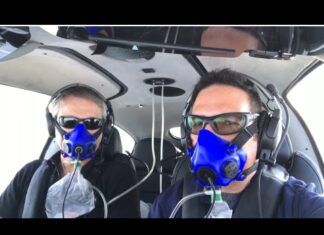
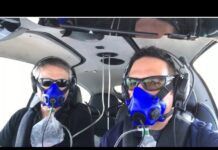
That’s correct. We’ve got a pressure-demand system that we built out of military system parts, and at 25,000 feet you switch it over from where you have to draw a breath. It goes to a pressure system where when you stop pushing the air out of your lungs it pumps you back up. You have to forcibly exhale, and the most comical part of that is — I don’t know whether it’s the oxygen level or whether it’s just you’ve been pressure-breathing and it has strained your vocal cords or whatever — but I’ve got into the habit of now whenever center calls me and I have to respond, I practice talking before I push the button because otherwise the first thing you say after you’ve been silent for awhile up at those altitudes sounds like a frog — you just go “Aaaah.” Words don’t come out. I’ve even had them ask me if I was hypoxic, and I said, “No, I just, I’m, you know, it’s hard to talk with pressure breathing going on.”
The other physiological problem would be the bends — nitrogen bubbles. If you don’t pre-breathe 100% oxygen for at least an hour before you take off you will experience problems with the bends, and I’ve experienced them myself a couple times when I didn’t pre-breathe at all or I didn’t do it enough. At the bare minimum they just hurt like crazy — if you get them in a joint it feels like somebody trying to pry that joint apart — and at the very worst they could get into your blood stream and send a fatal shot of nitrogen to your brain. You’ve got to keep the mask on the entire time — you can’t even take it off for one breath. If you do, it just re-infests your system with nitrogen.
In Palm Springs we set two records — one for time to climb to 12,000 meters [39,370 feet] and one for absolute altitude record of 41,300 feet — and that’s the highest we will fly this airplane without a pressure suit. We are in the process now of trying to acquire a pressure suit, which will eliminate a lot of these problems, or at least minimize the danger of being up there. Hopefully, it’ll also help some of the cold problems, ’cause it was 70 degrees below zero at 40,000 at Palm Springs.
Did you change airplanes when you changed sponsors?
In 1997 we still had a year left on our contract with the Yellow Oil Company [Shell], and Exxon approached me wanting to know what it would take to hire me and Pushy Galore to come over to their side and help sell a new product. I was a little bit wary because sponsorships are so hard to get. I’d never had anybody approach me, much less somebody wanting to be a major sponsor, so, first of all, I figured he was a Shell guy testing me out — it turns out he was with Exxon. We had already started formulating the idea and acquiring some parts for what became the Flyin’ Tiger. I told the Exxon guys “You don’t want Pushy Galore. It’s all but used up. This new airplane’s going to be spectacular and it’s going to be able to out-do everything we ever did with the other one.”
I’d been with Shell for years and wasn’t going to just jump up and leave at the first time somebody snapped their fingers. I made a proposal to both companies and Shell beat me up over and over and over about the details and what I would make and how much I would do for it, and Exxon accepted it hands-down the way it was written. It didn’t take me very long to get over Shell — everybody’s got to eat — and I’ve never been happier. Not that I had a bad relationship with Shell, but at Exxon they treat us like kings. We demonstrate the quality and reliability of their products and services, and there has been a lot of technology that Exxon and Mattituck have developed through these engines that we operate. If I don’t tear it up, they pretty well figure they’ve got a system that’s pretty strong because I’m well-known for being hard on equipment. That’s how we’ve achieved a lot of things we’ve done, just by abusing the stuff.

What’s next?
We’re still after time to climb and altitude records. At 12,000 meters the airplane is still flying extremely well, and the rate of climb up there is surprising. I don’t want to say anything specific yet, because I want it to be a surprise, but when you see how easily we got to 40,000 feet, you can see how easily we could go right on through that.
I want to do an L.A.-to-Mattituck, Long Island non-stop flight in the airplane. I have a feeling that if I take a good look at what time of the year is right for the jet steam to be making the great circle route that I would want to follow — and I’ve got buddies in the airline industry that have weather departments that have said they will help me — I could actually average close to 400 miles an hour from coast to coast in an RV4.
Would that be a speed record or a distance record?
Probably both if I do it right. I’ve got 32 gallons on board. I’ve tried every way in the world to move this airplane from one place to the other, trying to figure out what’s the most efficient, and it turns out it’s just like a jet — you leave it at full power, climb it straight to your maximum altitude, level off, and cruise up there at a low-power setting. I’m burning 32, 33 gallons on take-off, but I’m only doing it for one-tenth of an hour or maybe two-tenths at the worst, and then I get it back to about 11 gallons an hour, and I’m trueing about 185 to 190 knots, so it’s a pretty efficient airplane. One of our projects this winter is to build new leading edges and we’re going to put fuel tanks in the leading edges of the wings from tip to tip. That should give us about 100 gallons of fuel and we’ll have to offset that weight by putting a tank behind the seat as well, which we’re hoping will give us transcontinental range.
Every time we’ve set a record we didn’t learn a thing — all we did was demonstrate what we already knew. Every test flight or every record attempt that we failed at, we always learned something. We learned what we didn’t know, or we learned that we didn’t know enough. There was always something valuable to learn.
If you or someone you know has an interesting aviation story to tell, please send an Email to Joe Godfrey.
 Joe Godfrey mixes his love of flying with a love of music. He is an instrument-rated private pilot who flies a 1974 Bellanca Viking based at Palomar airport just north of San Diego, Calif. He composes music for commercials, films, broadcast and corporate media and has composed and produced thousands of music tracks for America’s largest advertisers. He’ll be playing bass with Eugene Levy and Catherine O’Hara in “A Mighty Wind” — Chris Guest’s spoof of folk music due out in the spring of ’03. Find out more at Joe’s website. In addition to writing for AVweb, Joe has written for AOPA Pilot, The Aviation Consumer, Twin and Turbine and IFR magazines. He is a pilot and ex-director of Angel Flight West, a nonprofit organization that uses private airplanes to fly indigent medical patients. He is married and lives in Leucadia, Calif. So far, Joe is the only AVweb staff member who has logged time with Ella Fitzgerald and conducted the London Symphony.