

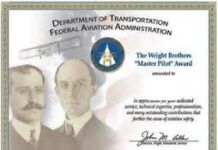
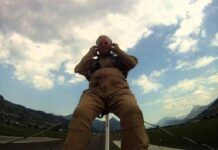

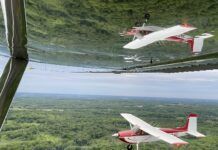

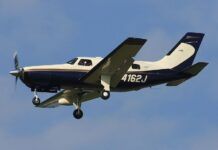





Myron Collier was born June 8,1930, on a farm near Butler, Ohio. He built model airplanes and, though hedidn’t know any pilots, knew he wanted to be one. An hour’s worth of instructionwas too expensive, so he paid for 15 minutes at a time. What he lacked infinances he made up for in determination, and by age 23 he had accumulatedprivate, instrument, commercial, multiengine, instructor and ATR ratings. Hefinanced his college education by teaching flying, and entered the job market just as airline pilots were being laid off. He taught science to junior highstudents and rewarded their achievement with airplane rides. He continued toteach flying and in 1956 became a designated flight examiner.
In 1959 a late-spring Michigan snowstorm changed the travel plans ofexecutives of the Empire-Reeves division of Cyclops Corporation. Instead ofinstructing that afternoon, Myron flew to Detroit and brought the executiveshome. That trip earned him a job offer from the president of the division, andhe spent the next 34 years as Chief Pilot of Cyclops. As the company prosperedhe transitioned from Apache to Aero Commander to King Air to Citation. He becamean early proponent of RNAV, wrote an RNAV handbook for air traffic controllers,and served as chairman of NBAA’s RNAV committee. He also completely rewrote thenavigation chapter in the 5th edition of General Van Sickle’s ModernAirmanship. On his 66th birthday — 50 years to the day after he soloed –he flew to Dallas and flew the same Luscombe in which he had first soloed. In1998 Myron was named Flight Instructor of the Year by the Allegheny FSDO. Healso served eight years as a board member of NBAA and was recipient of NBAA’sJack Doswell award in 2001 for “lifelong individual achievement onbehalf and in support of the aims, goals and objectives of businessaviation.”
How did you decide you wanted to be a pilot?
I grew up on a farm in North Central Ohio during the Depression. I didn’t know any pilots and have no idea how I got hooked on airplanes, but it happened, and there was never a question in my mind that I was going to be a pilot.
Was there aviation around you?
None. The closest airport was Mansfield, which was 20 miles away, and the only airplanes I saw were those that flew overhead. I read every aviation publication I could get my hands on, and by reading books and magazines I taught myself how to move the controls before I took my first lesson.
When was your first lesson?
18-year-old Ace I was about 14, and I hitchhiked to the Mansfield airport and asked for a ride. The war was still on and no pleasure flights were allowed, but flight instruction was allowed, so instead of a ride they gave me a lesson. Dual was $11 an hour, and all I could afford was $2.75 for 15 minutes. The school could see I was interested and they would stretch out the lesson to a half-hour or more and only charge me for 15 minutes. I did that at every opportunity and soloed on my 16th birthday. After I soloed I would circle over the farmhouse of a girl that I was sweet on. I didn’t impress her, but her dad took an interest in flying, bought a brand new J-3 Cub and put a 700-foot landing strip on his farm. He didn’t have a lot of confidence, but he would fly if I went with him. So I got to use the airplane just about anytime I wanted, and all it cost me was fuel that we bought in 55-gallon drums for 13 cents a gallon. So I could fly that Cub for 50 or 60 cents an hour. One day a buddy and I hopped in that Cub and flew it 11 hours. We flew to Chicago, back to Toledo, up to Detroit, and back to Butler, just trying to build hours.
I kept flying and got my private certificate on my 17th birthday. Shortly after my 18th birthday I got my commercial rating, and shortly after my 20th birthday I got my flight instructor’s rating.

You moved through these ratings in a hurry. Did you have a mentor and wereyour parents supportive of your flight training?
I didn’t have a mentor. My dad was 100% behind me, and my mom thought I ought to grow up and be a farmer. My mom was not fond of airplanes, and one Sunday I landed the J-3 in a hayfield on our farm. I took my dad for a ride, then asked my mom and — to my surprise — she said she’d go. We circled around for a while, and when we landed she called all the neighbors to tell them that was her in the airplane. From then on she didn’t object to my flying.
I had a friend named Mike who lived up the road from me. He was two years older than me, so he had a drivers license. We drove to the Mount Vernon airport on Sundays and found a guy who was selling a 40-horsepower Porterfield for $200. It was priced so cheap because it needed new fabric, and he didn’t have the money to do it. We told him we’d buy it on two conditions — that he took us for a ride so we knew it would fly, and that he delivered it to a field on our farm near Butler. After he delivered it Mike and I taxied it around in the field, then we got bored with that so we took the wings off — they needed to be recovered anyway — and taxied the fuselage on a long, straight stretch of State Route 95 near the farm. There wasn’t a lot of traffic, but occasionally we would see a car coming the other way and they’d pull over as we whizzed past. The Porterfield had no brakes, so we’d just let it roll out.
That went on for a week or two then my dad found out about it and that was the end of that. We decided to sell it, and a local fellow bought it and restored it. I heard that it got blown over in a windstorm, and that’s when I lost track of it until many years later when I started wondering what had happened to it. From the photos I had I couldn’t read the NC number, so I called EAA. They sent me the name of the president of the Porterfield club. I wrote to him with a description of the airplane and what history I knew, and he was the last owner of that very airplane. He donated it to a museum in Blakesburg, Iowa and that’s where it is today.
 | |
| Myron reunites with his first flame. |
What other ratings did you get?
I got my instrument rating while I was instructing part-time in Mansfield, Ohio, and taught a lot of ex-military pilots to get their instrument ratings. I became a designated flight examiner in 1956. In those days anything you could give an exam in anything you were rated in. It’s not quite like that now.
How many flight exams did you give last year?
Around 80.
And how does that break out for private, instrument, commercial and theother ratings?
There are a lot of privates, a lot of instruments, quite a few multiengine — it’s a pretty good variety.
Somebody somewhere is getting ready to take a private checkride. What’sthe most common bad habit you see on the private ride?
Today’s pilot — compared with the average pilot of the ’50s and ’60s — just lacks good basic stick-and-rudder skills, and most of that is inappropriate rudder technique.
Is there one particular phase of flight where you see that? Climbs?Descents? Turns?
All phases of flight. In a climb I see them using right yoke input instead of right rudder to counter torque. I can tell whether a pilot learned to fly in a tricycle gear airplane or a tailwheel airplane shortly after we’re in the air, just by how the pilot uses the rudder.
That covers private rides. What about the other ratings?
I see bad rudder technique on commercial rides and pretty much across the board. They understand the concept of using rudder to correct for yaw, but they don’t fly that way. When I got my private, the flight test guides — as they were called in those days — specifically stated that if the applicant attempted to use aileron to pick up a wing in a stall recovery he failed the flight test. Over the years the airplane manufacturers used differential aileron travel — so the down aileron doesn’t go down as far as the up aileron goes up — to minimize yaw, so coordinated controls became the standard, but the primary control is still rudder.
How did you get from teaching school to the job at Cyclops?
I taught general science to junior high students for six years. I had the same students in my homeroom for 7th, 8th and 9th grades, and we became a little family. Normally I’d have 17 or 18 students make the honor roll, so I threw them a challenge. I told my class of 32 students that if 30 of them made the honor roll I’d take them all for an airplane ride. When the honor roll came out 28 of them made it, and I decided that was close enough, so I took them all for a ride. That group of kids just had their 40th high school reunion and I threw a little luncheon for them. I hadn’t seen some of them for 43 years, and some of them went on to be military pilots and airline pilots.
In 1958 Cyclops bought a brand-new Piper Apache and the FBO in Mansfield — Richland Aviation — provided pilots for them. One day the executives at Cyclops had flown to western Michigan, it started snowing and the Richland pilot couldn’t get them back to Mansfield. They took North Central Airlines as far as Detroit. I was teaching school and giving flight instruction in the evenings and in the summer. That day I got to the airport around 4 p.m. and the manager of the FBO asked me to take one of the Apaches to Willow Run in Detroit and fly these guys home. I flew there, picked them up — by then it was snowing in Detroit, too — filed an instrument flight plan and about Toledo we broke into the clear.
When we landed at Mansfield I gave the president of the company a ride to his apartment, and he asked me if I could fly him to another meeting in the morning. He was sizing me up, and about a week later I got an offer for a job. That was in late spring and I wanted to finish the school year, so on June 15, 1959, I became the chief pilot of the Empire-Reeves Steel division of Cyclops Corporation, and I stayed there until January 31, 1992.
Myron is named Professional Pilot Magazine’s “Pilot of the Year.” For many years, Empire-Reeves was the only division of the company that had an airplane. Even corporate headquarters in Pittsburgh didn’t have one. I flew the Apache, then an Aero Commander 500-B, then a King Air B90 for 12 years, and in 1981 a decision was made to get a jet and make it available to all the divisions. The company bought a Citation, and I moved to Pittsburgh to fly it. Our customers were east of the Mississippi — because shipping steel out west didn’t pencil out economically — so we wanted airplanes that would get our executives out in the morning and back home at night.

Somewhere somebody is getting ready to transition from props to jets. Whatadvice can you offer?
I had never even sat in a Citation, but after the two-week course at FlightSafety I was very comfortable with the airplane. In fact I took my flight check in the simulator, then shot three takeoffs and landings in the airplane. That was my first time in the airplane. People think jets are supposed to be harder to fly, but I found the Citation much easier to fly than the King Air.
What type of personality makes the best corporate pilot?
I was very lucky. I had as close to an eight-to-five, five-days-a-week job that I could imagine. That doesn’t mean I never had to fly on a weekend, but as a rule we flew out, took care of business and flew home. Today’s corporate pilot has to be flexible, because you don’t have regular hours, and your family needs to understand that. You also have to wonder how long the company will keep the airplane. Lots of corporate flight departments are closing down, because the company has fallen on hard times, and fractional ownership may give them a more cost-effective option.
If I were running a company, I wouldn’t look twice at fractional ownership. I would want to know my pilots and my aircraft.
How did the steel business change in your time there?
Cyclops specialized in stainless steel. Obviously the auto industry was a big customer, but they also sold to appliance manufacturers like Whirlpool. It took years for the problems to grow, and for years business was so good that the company gave in to the unions. Eventually the steel industry couldn’t keep overhead down — for instance, a union steel worker got an extra 13 weeks vacation after five years on the job — then imported steel became available at or below cost, and companies couldn’t compete. Many of the foreign steel companies are nationalized — owned by the government — so they sell steel cheap just to keep people working.
This problem isn’t going away. The president just imposed more tariffs onsteel.
That’s a Band-Aid as far as I’m concerned. The industry has to get costs under control, and it’s up to the unions to try and work with management to keep the business alive. The same thing is happening with the pilots at at U.S. Airways. They’re on the verge of bankruptcy and they want more regional jets, but the pilots don’t want to take pay cuts to fly something smaller.
If you gave 80 checkrides last year, the Pittsburgh economy can’t be toobad. What’s taking the place of the steel industry?
Carnegie-Mellon university is here, so the computer industry and other high-tech businesses have moved here.
Tell us about the Reading [Pa.] airshow.
In its day Reading was the premiere business aviation airshow — like NBAA is now — on a much smaller scale. The manufacturers parked the new models of airplanes on the ramp, exhibitors set up booths and there were prizes for different categories of corporate airplanes. I entered our King Air five times and won three first prizes and two second prizes. The airplane was pretty but it wasn’t just appearance — each time I prepared a little booklet showing our typical flights and how the airplane fit into the company strategy.
Reading also had an airshow, with the Thunderbirds and the Blue Angels and Bob Hoover, flying that old yellow P-51. There are a lot of hills around Reading, and Bob used to like to disappear behind the one set of hills and pop up somewhere else. When he landed, my wife noticed something dragging behind the airplane. He had hit a power cable and blacked out a portion of the city of Reading.
When did you begin writing?
Leighton Collins really promoted instrument flight, so I wrote an article called “Instrument Flight Test” for his Air Facts magazine. I got $75 for the article and spent it on a suit, which my wife and I always called my “Air Facts” suit. When we got RNAV in the King Air, I could see the potential so I wrote an article about it for Professional Pilot. I wrote some airplane reviews, and over about 20 years I had 40 articles published.
When did you get on the board of NBAA?
 | |
| Myron celebrates his 66th birthday by flying the Luscombe he soloed in 50 years earlier. |
When RNAV was relatively new they formed a air navigation subcommittee under the airspace committee, which Bill Horn asked me to chair. A few years later I was asked to serve on the board.
Did you get as enthusiastic about GPS as you did for RNAV?
I retired when Cyclops got bought out in 1993, so I saw GPS coming, but I’m not as familiar with it technically as I am with RNAV. GPS is wonderful, and it solves a couple of the shortcomings of RNAV.
For instance?
With RNAV, ATC might clear you to a waypoint 300 miles away, then you’d have to plot a course line to get there. GPS gives you that course line, but we didn’t have that with early RNAV. It takes too long to use a chart, so we had two small computers to do it. One ran on a Texas Instruments TI59 and the other ran on a Psion, and [AVweb Editor in Chief] Mike Busch had the best program for that. It was a wonderful program, it just came along a little too late.
NBAA gave you the Doswell Award in 2001. Tell us about Jack Doswell.
He was a military pilot who retired and became chief pilot for American Standard. He was very active in NBAA until he acquired a rare disease that took his life. Based on all that he had done for corporate aviation, NBAA decided to give an annual award for “lifelong contribution to business aviation.”
Can you offer advice about how to handle emergencies?
I had an engine blow up in a Navion, but I was close enough to a grass field and glided in and landed. I had a rough engine in the Aero Commander, but I shut it down and landed at the next airport. And I had an engine go bad after takeoff in the Citation, and I came back and landed. I haven’t really had any spectacular emergencies, and I always tried to plan so things didn’t happen.
Tell us about your 66th birthday.
I soloed in a Luscombe, and got my private in the very same Luscombe. One day I realized that the 50-year anniversary of my solo was approaching, and I wondered what had happened to that Luscombe. I used the internet and found the current owner in Burleson, Texas, close to Dallas. I called him and he offered to let me fly the airplane again. He’s a retired banker with a private strip on his ranch, so I flew to Dallas, drove out to his ranch and flew that airplane 50 years to the day after I soloed in it.
Lazy-Rudder Syndrome
by Myron Collier
From time to time there is talk among those in the flight training arenaabout the merits of reinstating the requirement for spin training at all levelsof pilot training and certification, as it existed several decades ago. Theissue asks a simple question — “Would spin training for private andcommercial pilot applicants have any tangible benefit in terms of improvingoverall safety?”
Earning my private pilot certificate in 1947, commercial pilot certificate in1948 and as a young flight instructor in the early 1950s, I have experienced myshare of spins. Has this experience in itself made me a more capable or saferpilot — probably not?
Accidental spins usually occur at low altitudes when doing such things asmaking the turn from base to final or buzzing someone’s house. Under these orsimilar conditions a recovery is highly unlikely, even if one had previouslyundergone spin training. Pilots who have had spin training know how to recoverfrom them, but at low altitudes they don’t have the room needed to apply whatthey have learned.
Prevention is the key to avoiding these situations. Almost without exception,improper use of the rudder is the primary contributor to an accidental spin.What can be done to decrease the chance of an accidental spin? Perhaps returningto the “basics” would be appropriate. This falls directly in the lapof the flight instructor. Before the flight instructor can be an effectiveteacher to address this issue, he must fully understand the role the rudderplays in the scenario.
During the 46 years this writer has served as a designated pilot examiner (DPE),it has become apparent that many (if not most) contemporary pilots suffer, atleast to some extent, from what I call “Lazy-Rudder Syndrome.” Inother words, they simply don’t use appropriate rudder response when required.Rather, they attempt to “drive” the airplane with inputs from the yokewith little, if any, rudder input.
Tricycle gear vs. tailwheel, yoke vs. stick…
Why is this? In my view the root cause lies primarily with the tricycle landing gear and yoke control. Many years ago training-type aircraft had what was then called a “conventional” landing gear. In other words, the aircraft had a tailwheel. Initially, just learning to taxi one of these “tail-draggers” was a challenge in itself.
With time the student soon got the hang of it and the required rudder inputs to make the airplane go where he or she wanted it to go. This resulted in a conditioning of the student’s reflexes. This conditioning became so well-ingrained that at the first hint of any directional deviation, on the ground or in the air, immediate and appropriate rudder response was initiated without conscious effort. This development simply doesn’t happen to the same degree when learning to fly in a tricycle-geared aircraft.
The inherent tendency for contemporary pilots to suffer from lazy-rudder syndrome is reflected in Federal Aviation Regulation 61.31(i) (1), which reads in part:
“No person may act as pilot in command of a tailwheel airplane unless that person has received and logged flight training from an authorized instructor who found the person proficient in the operation of a tailwheel airplane.”
Although this requirement is grandfathered for a person who has logged pilot-in-command time in a tailwheel airplane before April 15, 1991, the inference is clear for all pilots.
It has been reported by some flight instructors in both tailwheel and tricycle-geared aircraft that, even though rudder response was adequate when operating a tailwheel aircraft, any conditioning derived thereof was soon forgotten when flying the more traditional and forgiving tricycle landing gear aircraft. In these cases it would appear the conditioning process had not been sufficiently developed to come into play, regardless of the type of aircraft being flown.
In addition to a tailwheel, aircraft used for flight training during earlier years had a “stick,” as opposed to a yoke or wheel. When driving an automobile one subconsciously turns the wheel in the opposite direction when the vehicle starts to drift to one side of the road or the other. This also is a conditioned reflex. Unfortunately, this conditioning carries over to airplanes equipped with a yoke control. A stick, unlike a yoke, provided little similarity to an automobile’s steering wheel and a pilot trained in a stick-airplane was less likely to attempt to “drive” the airplane.
Aircraft designs of the 1930s, ’40s, and early ’50s were generally not as aerodynamically “forgiving” as current designs, and using the ailerons during a stall recovery was a no-no. With these aircraft, attempting to pick up a wing or maintain directional control during a stall recovery with ailerons was cause for failure of a flight test. The flight-training manuals and Flight Test Guides of that time emphasized, “Only the rudder is to be used to maintain directional control during stall recoveries.”
Quoting from Civil Aeronautics Administration Bulletin No. 32, June 1943, “Fundamentals of Elementary Flight Maneuvers” (Yes, I still have those old manuals), it was emphasized: “The wings are to be held level without the use of ailerons.”
These mandates should be recognized and given heed by contemporary pilots restoring and flying these grand old vintage birds.
Why did this bulletin and other training manuals stress using the rudder to keep the wings level? To spin, an airplane must first be in a stalled configuration and, while in that configuration, “allowed” to rotate. If the airplane is prevented from rotating it cannot spin. It is the rudder that is the key to preventing rotation.
Aircraft that initially came onto the market following World War II were primarily designs that existed before the conflict. Eventually some of these aircraft, along with entirely new aircraft designs, were given various aerodynamic enhancements that came into play when approaching and during a stall. Of particular note were differential aileron travel and wing-washout.
…and forgiving aerodynamics
As any CFI knows, differential aileron travel provides that the down-aileron deflects into the slipstream to a lesser degree than the up-aileron, thereby, minimizing adverse yaw. Adverse yaw can have a villainous impact on various aspects of controlled flight.
Differential aileron travel is not restricted to only training aircraft. For example, the Citation II provides for differential aileron travel by the up-aileron extending 19 degrees, while the down-aileron extends only 15 degrees. This may not seem like much, but it results in a decrease in adverse yaw that has a direct impact on required rudder response.
Frise-type ailerons can also address adverse yaw. Although perhaps not common on typical training-type aircraft, the Frise-type aileron provides for the structure’s leading edge to project into the airflow, thereby, increasing drag. Unlike a conventional aileron design, the increased drag contributes to a decrease in adverse yaw. In addition, the “slot” afforded by this design makes the aileron more effective at high angles of attack by disciplining the airflow over the structure’s surface. However, despite this feature some rudder is still needed whenever ailerons are applied.
Wing-washout provides for a decreased angle of incidence from wing root to wing tip. Thus, at the onset of a stall, the stall occurs at the wing root and progressively moves outwardly toward the wing tip. This results in increased aileron effectiveness during slow flight and, to some degree, during a stall.
With embellishments of this nature applied to a wing’s platform it has now become acceptable practice, according to FAA’s current Flight Training Handbook, to use aileron inputs during a stall recovery. However, it gives this caution:
It is important that the rudder be used properly during both the entry and recovery from a stall to counteract any tendency of the airplane to slip or yaw, the latter being a prelude to a spin.
Talking about the proper use of ailerons and rudder means little if pilots do not acknowledge their interaction in flight. Having conducted pilot certification flight tests for over four decades as a DPE, it has become abundantly clear that many contemporary pilots don’t fully comply fully with FAA’s intent in the use of ailerons during a stall recovery. In many cases, the rudder pedals appear to serve only as foot rests. Or simply put, the pilot suffers from lazy-rudder syndrome.
How can flight instructors address lazy-rudder syndrome when training pilots, including those who may have learned to fly in a tail-dragger but have since fallen victim to lazy-rudder syndrome? Recognizing that the condition exists is a good place to begin. Lest it be thought this applies only to the student or private pilots, rest assured it applies to all levels of pilot certification and experience, including the flight instructor.
Improving stick-and-rudder skills
What then can be done to address lazy-rudder syndrome? There are several excellent training exercises that can contribute to strengthen one’s basic stick-and-rudder skills.
When taxing the aircraft, keep one’s hands off the yoke, unless wind and surface conditions suggest otherwise. This reinforces the pilot’s subconscious that the rudder is the major contributor to the airplane’s “direction” (yaw), not the yoke. It is not uncommon to see an applicant for a pilot certificate turn the yoke in the desired direction when taxing the aircraft. Almost assuredly, this tendency will be demonstrated in flight as well.
From time to time the instructor should have their students completely remove their hands from the yoke during a climb, as well as in straight and level flight, using only soft applications of the rudder to maintain directional control. If a wing drops slightly, as it will likely do at some point, smoothly applying opposite rudder pressure in a timely manner (human yaw damper) will return the wings to level flight. It can be expected the student will initially display difficulty when in flight to completely remove his/her hands from the yoke. This is not unusual and is a subtle reminder of the presence of lazy-rudder syndrome.
It is also important that the aircraft be in proper trim, particularly in its roll axis. Because many training-type aircraft do not have in-flight capability to adjust roll-trim, trial and error adjustments of the aileron’s manual trim-tab (if provided) may be required to achieve the desired results.
These exercises cannot only have a positive impact on developing one’s rudder reflexes, they can also have a more subtle value as well. When conducting an Instrument or ATP flight test, I have observed that when the applicant attempts to change a radio frequency, review a chart, etc., the aircraft will pitch up/down or drop a wing due to unintended control inputs. If a pilot simply removes one’s hands from the yoke, and with a little timely assistance from the rudder to maintain directional control while attending to these needs, the aircraft will remain in straight and level flight remarkably well. When I offer this suggestion to an applicant during a flight examination, the reaction is often one of, “If removing one’s hands from the yoke an immediate loss of control will occur.” Needless to say, it will not.
Another skill that seems to have lost some importance over the years is one of coordination. Proper coordination of the flight controls is often viewed as a mark of a proficient pilot. As a young lad determined to fly airplanes for a living when I grew up, proper coordination became one of my top priorities. The rudder certainly plays an important roll in coordinating flight controls
An excellent training exercise for the development of coordination skills is a maneuver called “turning about a point.” In straight-and-level flight, a point is picked on the horizon. The aircraft is then rolled into a turn, and after turning perhaps 15 degrees or so, the turn is reversed. This is carried to the same degree on the other side of the point, and so on. This is an excellent maneuver to develop coordination skills and can be extended into a climb where the torque affect must be recognized and dealt with to achieve coordinated flight.
Takeoffs and landings
Of the repertory of aerial maneuvers, evidence that a pilot suffers from lazy-rudder syndrome is perhaps greatest during the initial lift-off and during the approach and landing exercise, particularly when dealing with gusty crosswind conditions. On rotation, to correct for yaw generated by torque (P-factor if you prefer), the pilot is likely to react solely with an input from the yoke. During approach and landing as turbulence-induced yaw rocks the aircraft from side to side, invariably the applicant will attempt to counter these motions with yoke inputs, with nary a budge of the rudder. This not only doesn’t’t get the job done, it exacerbates the very thing the pilot is attempting to counter.
I recall when conducting a Private Pilot test on final approach the applicant was experiencing some difficulty by attempting to deal with yawing motions induced by light turbulence solely with inputs with the yoke. Noting he was tiring, I asked if he minded if I “take it around once.” On final approach, I dealt with the same yawing motions the applicant had experience, but with appropriate rudder response. The comment by the applicant is one I shall never forget, “The wind died down for you.” In other words, he was inflicting much of the so-called turbulence upon himself with inappropriate responses from the yoke.
One may get away with poor coordination and improper rudder response during routine flight operations, but when dealing with a gusty crosswind landing such indifference is often a prelude to an incident, if not an accident. For example, when negotiating a crosswind landing and the longitudinal axis of the aircraft is suddenly yawed askew, responding with only an input from the yoke not only increases the yawing motion momentarily, it raises the wing and there goes any required crosswind correction. Simply stated, the rudder is used to maintain the longitudinal axis of the aircraft aligned with the runway centerline, and the ailerons are used to lower the wing sufficiently into the wind to affect a side-slip and, thereby, offset wind drift. Sounds simple enough, doesn’t it? If the rudder and ailerons are used properly, it is.
The contribution the runway’s white centerline can provide is often overlooked. One should strive, both on takeoff and landing, to straddle the centerline if one is available. When landing, the centerline provides an immediate point of reference to show if proper drift correction is applied, as well as an aid for longitudinal alignment of the aircraft. Similarly, it is an excellent aid to maintain directional control when taking off.
As a fledging aviator I recall a crusty old CAA inspector (Civil Aeronautics Administration in those days) telling a story of giving an aspiring airline pilot a flight check. According to the inspector, the pilot would touch down on one side of the runway and the next time on the other side when landing. The inspector, displaying a degree of wit, addressed the situation by simply saying, “Son, you can land anywhere on this runway you wish. But remember, the centerline is reserved for captains and potential captains.” That is a good thought to keep in mind, whether captain of a light single engine or captain of a large multiengine aircraft.
When faced with these conditions, pilots must discipline themselves to adhere to the fundamental principals that apply: “Use the rudder to maintain alignment of the aircraft’s longitudinal axis with the runway centerline while concurrently maintaining any required wing-low adjustment to counter for wind-drift.” Unlike non-turbulent air conditions where coordinated control inputs are the norm, in crosswind conditions the feet and the hands may appear to operate independently, if not counter to each other. This is as it should be.
This becomes particularly critical during the flare and initial contact with the runway. If directional alignment and drift corrections are not maintained, the aircraft will touch down in a crabbed attitude, not unlike that of an automobile sliding sideways on icy pavement onto dry pavement. When this occurs, a landing incident, or perhaps even worse, an accident, is highly probable.
Self-evaluation
Admitting to one’s self that one’s stick-and-rudder skills have deteriorated, or perhaps have not been fully developed, may not be easy to accept. This can be particularly difficult for the flight instructor with whom the responsibility lies for the training of proficient and safe pilots. However, recognizing the need for improvement of one’s stick-and-rudder skills can be the first step to becoming a more proficient pilot, as well a safer pilot. Performing and teaching properly executed maneuvers on the part of the flight instructor are indicative of not only professionalism, it becomes the mold that determines the quality of the product the instructor produces.
Do you suffer from lazy-rudder syndrome?
